
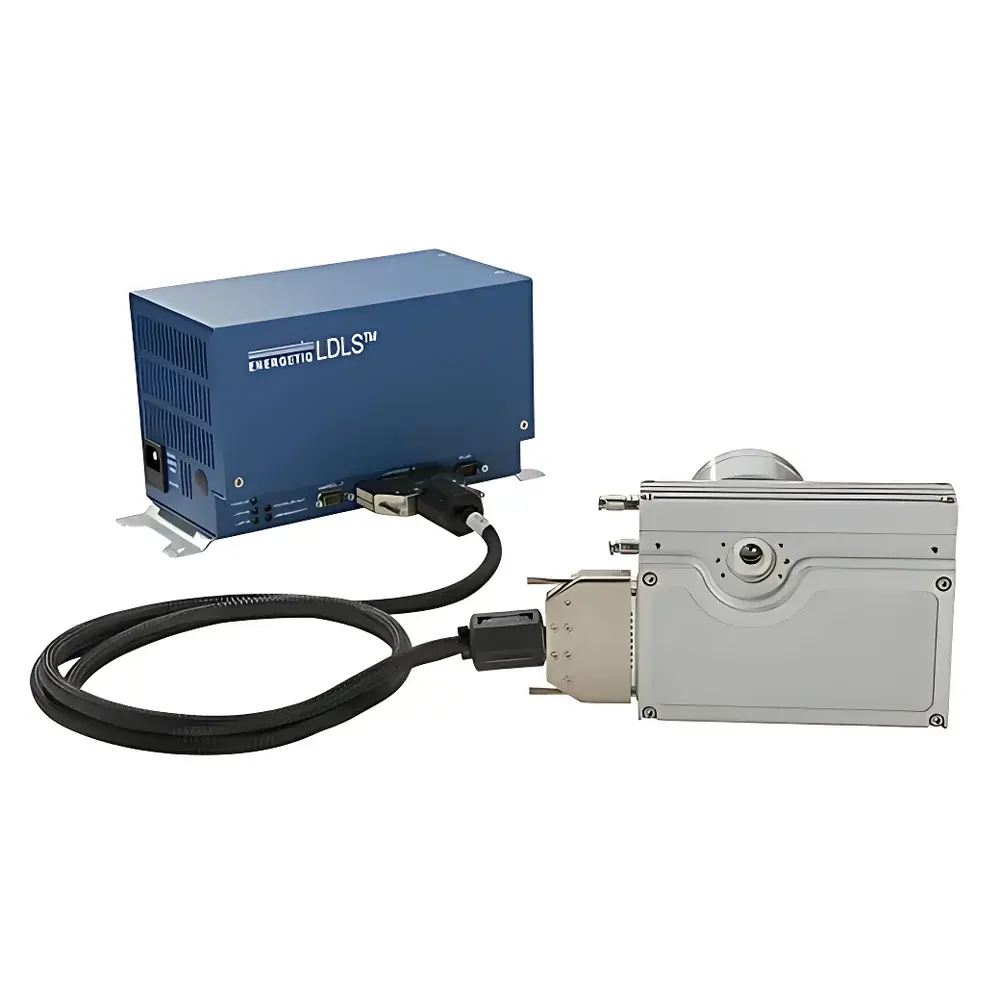
Energetiq EQ-77 Laser-Driven Light Source
| Brand | Energetiq |
|---|---|
| Origin | USA |
| Manufacturer Type | Authorized Distributor |
| Product Origin | Imported |
| Model | EQ-77 |
| Light Source Type | Laser-Driven Plasma Light Source |
| Illumination Mode | External Illumination |
| Spectral Range | 170–2100 nm |
| Numerical Aperture (NA) | up to 0.5 |
| Typical Lamp Lifetime | >9,000 hours |
| Lamp Dimensions | 135.6 × 144.9 × 56 mm |
| Lamp Weight | 2.7 kg |
| Power Supply Dimensions | 132.6 × 482.6 × 583.6 mm |
| Power Supply Weight | 18.8 kg |
| Output Configuration | Single- or Dual-Beam Optional |
Overview
The Energetiq EQ-77 Laser-Driven Light Source is a high-brightness, electrode-free broadband continuum source engineered for demanding optical metrology and spectroscopic applications. Unlike conventional arc lamps (e.g., xenon or mercury), the EQ-77 utilizes a high-repetition-rate pulsed laser to sustain a stable, high-temperature plasma in a flowing hydrogen or deuterium gas environment—enabling continuous-wave-equivalent spectral output without electrode erosion, spectral drift, or catastrophic failure modes associated with thermal cathode degradation. This laser-driven plasma architecture delivers exceptional radiance (>40 mW/mm²·sr·nm, wavelength-dependent) across an ultra-broad spectral range from deep ultraviolet (170 nm) through visible to near-infrared (2100 nm), making it suitable for applications requiring both high photon flux and long-term photometric stability. Its design eliminates the need for lamp alignment, warm-up stabilization, or periodic electrode replacement—significantly reducing operational overhead in automated or 24/7 analytical systems.
Key Features
- Laser-driven plasma technology ensures electrode-free operation, eliminating spectral instability caused by electrode sputtering and thermal drift.
- Ultra-broad spectral coverage (170–2100 nm) with high spatial and temporal stability—critical for calibration-grade reference sources and multi-spectral imaging.
- High radiance output (>40 mW/mm²·sr·nm at peak wavelengths) enables rapid data acquisition in low-light or high-resolution detection systems.
- Low intensity noise (<0.2% RMS, 10 Hz–10 MHz bandwidth) and sub-microradian pointing stability support precision photometry and interferometric measurements.
- Flexible beam delivery: configurable single-beam or dual-beam output ports with integrated collimation optics and SMA905 or FC/PC fiber coupling options.
- Compact, water-cooled lamp head (135.6 × 144.9 × 56 mm; 2.7 kg) with hermetically sealed plasma chamber—designed for integration into vacuum-compatible or cleanroom environments.
- Intelligent power supply with digital feedback control enables precise modulation of plasma intensity (0–100% via analog voltage or RS-232/USB command), supporting shutterless intensity normalization protocols.
Sample Compatibility & Compliance
The EQ-77 is compatible with standard optical breadboards, monochromator input slits, spectrometer entrance optics, and vacuum-compatible sample chambers (with optional UHV feedthroughs). Its UV output (down to 170 nm) requires fused silica or MgF₂-transmissive optics and appropriate ozone management in ambient air configurations. The system meets CE marking requirements for electromagnetic compatibility (EMC Directive 2014/30/EU) and low-voltage safety (LVD Directive 2014/35/EU). While not intrinsically certified for hazardous locations, its sealed plasma chamber and absence of mercury or xenon gas storage align with RoHS 2011/65/EU and WEEE 2012/19/EU directives. For regulated laboratories, the digital control interface supports time-stamped intensity logging, enabling traceability under GLP and ISO/IEC 17025 quality frameworks.
Software & Data Management
The EQ-77 integrates with third-party control environments via ASCII-based serial (RS-232) or USB virtual COM port protocols. Energetiq provides a Windows-compatible configuration utility for setting operating parameters—including plasma ignition delay, current ramp profiles, and interlock monitoring thresholds. All intensity commands and status responses are timestamped with millisecond resolution, facilitating synchronization with external detectors or motion controllers. Raw spectral irradiance data (NIST-traceable calibration files) are delivered in CSV format and compatible with common spectroscopic analysis platforms (e.g., MATLAB, Python SciPy, LabVIEW, and Ocean Insight OceanView). Audit trails—including power-on cycles, fault logs, and intensity history—are retained in non-volatile memory for compliance review.
Applications
- Semiconductor wafer inspection and mask metrology, where stable UV-VIS illumination enables high-SNR defect contrast at sub-200 nm wavelengths.
- UV-Vis-NIR absorbance, reflectance, and transmittance spectroscopy—particularly in applications requiring extended spectral baselines without lamp swaps.
- Monochromator and spectrograph calibration light sources, leveraging the EQ-77’s smooth continuum and absence of discrete emission lines.
- Photoemission Electron Microscopy (PEEM) illumination, benefiting from high brightness and low wavefront distortion in the 170–350 nm range.
- Film thickness measurement via spectral ellipsometry, where consistent broadband irradiance improves fitting convergence and reduces measurement uncertainty.
- Optical component testing—including lens transmission, filter edge characterization, and detector quantum efficiency mapping—across multiple spectral bands simultaneously.
- Time-resolved fluorescence and pump-probe setups requiring fast-intensity modulation and minimal thermal load on samples.
FAQ
What distinguishes laser-driven plasma sources from traditional xenon or deuterium lamps?
Laser-driven plasma sources eliminate electrodes entirely, removing primary failure mechanisms such as cathode sputtering, seal degradation, and spectral aging. They offer superior radiance uniformity, longer lifetime (>9,000 h), and no warm-up period.
Is the EQ-77 compatible with vacuum systems?
Yes—the lamp head can be mounted with CF-35 or KF-40 flanges using optional vacuum feedthrough kits. Plasma gas flow is fully contained; no external gas lines are required during operation.
Does the EQ-77 require routine maintenance beyond cooling system checks?
No consumables or periodic replacements are needed. Routine verification includes coolant flow rate, inlet temperature (<25 °C), and interlock continuity—typically performed during scheduled facility maintenance.
Can output intensity be modulated at high frequency?
Yes—intensity can be analog-modulated up to 10 kHz (small-signal AC mode) or digitally gated with <10 µs rise/fall times, supporting lock-in detection and synchronized illumination schemes.
How is spectral calibration provided, and is it NIST-traceable?
Each unit ships with a factory-measured spectral irradiance curve (±2% uncertainty, 200–1100 nm), calibrated against NIST SRM 2030 and 2032 standards. Certificate of Calibration includes measurement date, instrument ID, and environmental conditions.





