
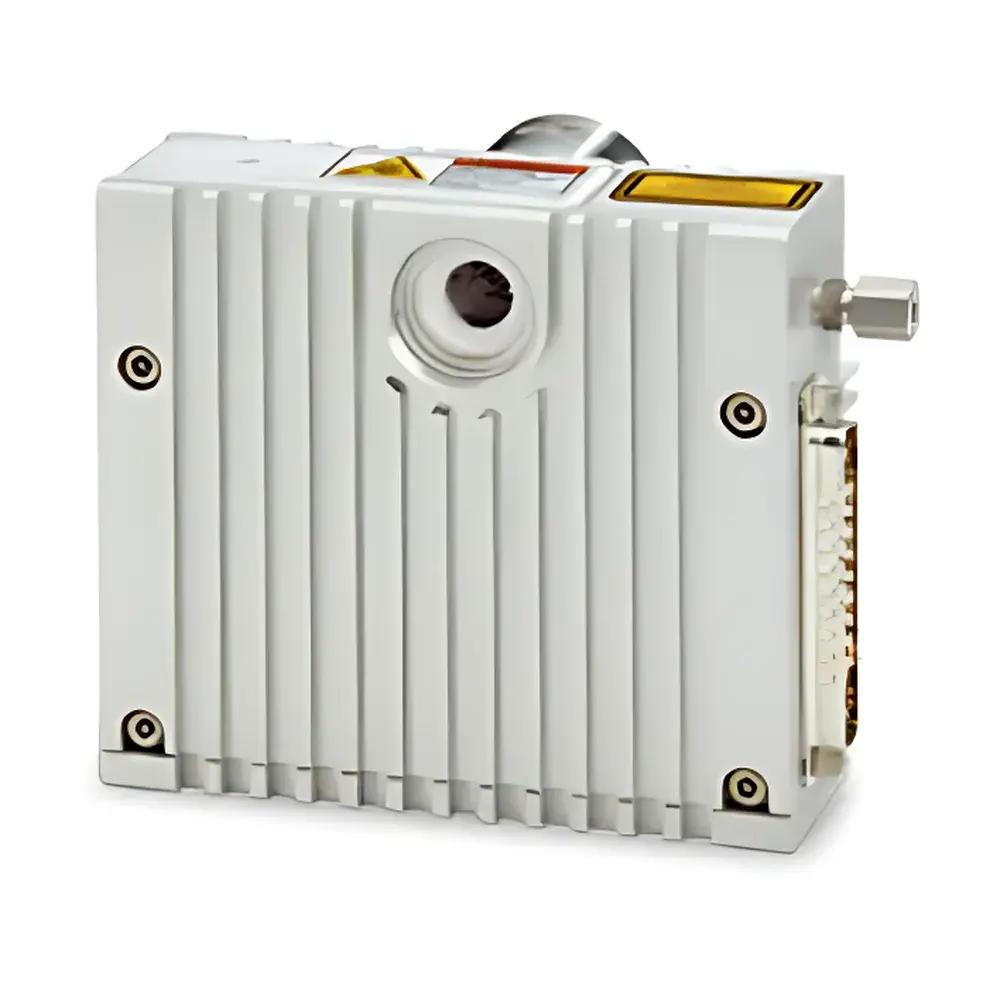
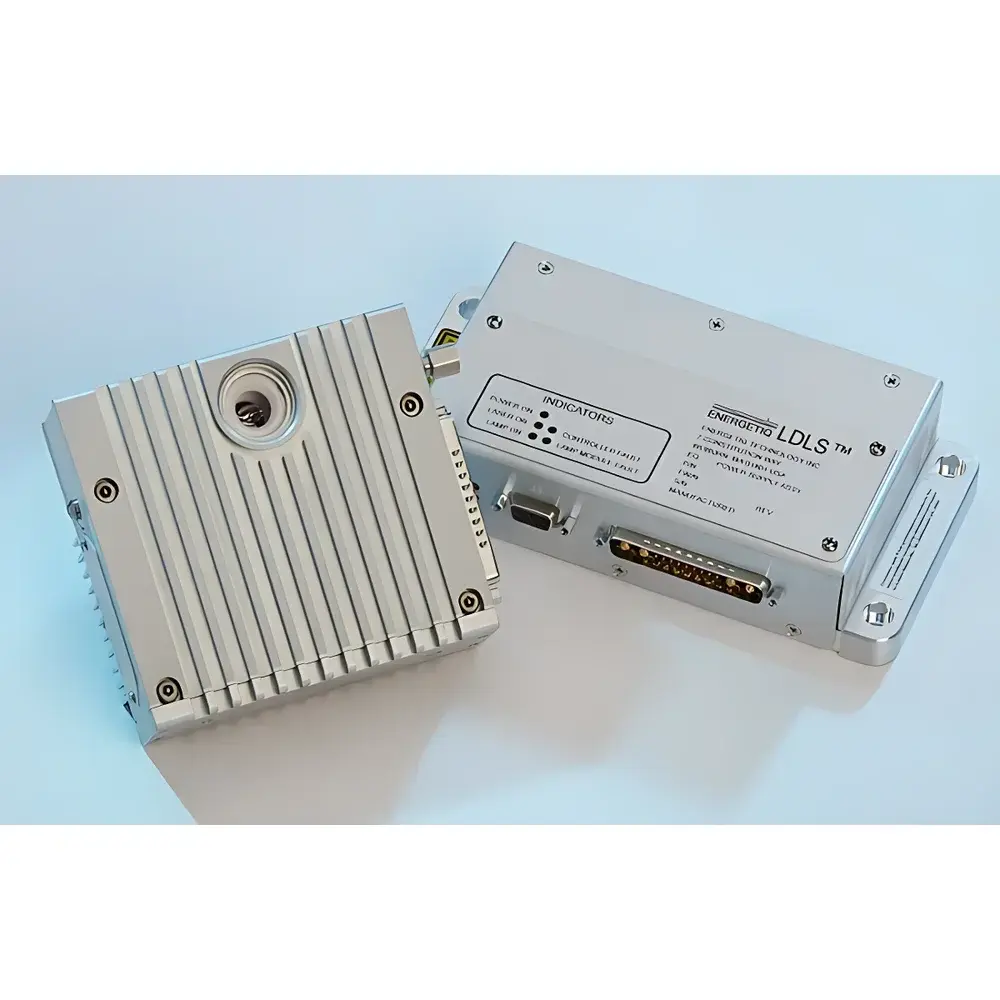
Energetiq EQ-9 Laser-Driven Light Source (LDLS™)
| Brand | Energetiq |
|---|---|
| Origin | USA |
| Model | EQ-9 |
| Light Source Type | Xenon-based Laser-Driven Plasma Source |
| Illumination Mode | Internal Illumination |
| Spectral Range | 170–2100 nm |
| Spectral Radiance | ~10 mW/mm²·sr·nm (lamp exit) |
| Output Options | Dual-beam or rear-reflector single-beam |
| Numerical Aperture | 0.56 NA |
| Lifetime | >9,000 hours (to 10% radiance degradation) |
| Lamp Housing Dimensions | 109 × 120 × 43 mm |
| Controller Dimensions | 38 × 197 × 93 mm |
| Lamp Housing Weight | 0.91 kg |
| Controller Weight | 0.68 kg |
| Total Output Power | ~0.5 W |
Overview
The Energetiq EQ-9 Laser-Driven Light Source (LDLS™) is a compact, high-brightness broadband continuum source engineered for demanding optical metrology, spectroscopic imaging, and precision photonic instrumentation. Unlike conventional electrode-based arc lamps—such as deuterium, xenon, or tungsten-halogen sources—the EQ-9 employs a patented laser-driven plasma technology in which a high-power continuous-wave laser focuses into a flowing xenon gas stream, generating a stable, sub-millimeter-scale plasma emitting intense, spatially coherent broadband radiation. This fundamental departure from thermal or discharge-based excitation eliminates electrode erosion, enabling exceptional long-term radiometric stability and spectral continuity across the deep ultraviolet (170 nm) to near-infrared (2100 nm) range. The EQ-9 delivers a typical spectral radiance of ~10 mW/mm²·sr·nm at the lamp exit port, with output configurable as either dual-beam (each beam ~7 mW/mm²·sr·nm) or single-beam with rear reflector (~1.3 mW/mm²·sr·nm), supporting flexible integration into monochromators, microscopes, ellipsometers, and synchrotron beamline pre-aligners.
Key Features
- Laser-driven xenon plasma architecture eliminates electrodes, removing primary failure mechanisms associated with cathode sputtering and seal degradation.
- Extended operational lifetime exceeding 9,000 hours to 10% radiance decay—more than 5× longer than standard xenon arc lamps—reducing maintenance frequency and total cost of ownership.
- Compact form factor: lamp housing measures only 109 × 120 × 43 mm; controller is half the volume of the EQ-99X, facilitating OEM integration into space-constrained optical platforms.
- High spatial stability (<0.5% RMS centroid drift over 8 hours) and low temporal noise (<0.2% RMS intensity fluctuation, 10 Hz–10 kHz bandwidth), critical for quantitative hyperspectral imaging and lock-in detection.
- Optically symmetric dual-output configuration enables simultaneous illumination of reference and sample paths in ratio-metric systems, while the rear-reflector option supports high-throughput single-beam applications such as PEEM or reflectance calibration.
- Integrated thermal management and active plasma position stabilization ensure consistent output under varying ambient conditions and extended duty cycles.
Sample Compatibility & Compliance
The EQ-9 is compatible with standard SM1- and SM2-threaded optical mounts and accepts Ø1″ and Ø2″ collimation optics without adapter modification. Its UV-enhanced fused silica output window transmits down to 170 nm, supporting applications requiring deep-UV spectral fidelity—including semiconductor wafer inspection, photoemission electron microscopy (PEEM), and UV-Raman spectroscopy. The system complies with IEC 61000-6-3 (EMC emission standards) and IEC 61000-6-2 (immunity), and its sealed xenon gas handling meets ISO 8573-1 Class 2 purity requirements. While not inherently GLP/GMP-certified, the EQ-9’s deterministic lifetime, minimal recalibration interval (<1/year under typical use), and traceable radiometric output support compliance with ASTM E275, ISO/IEC 17025, and FDA 21 CFR Part 11 when deployed within validated instrument workflows.
Software & Data Management
The EQ-9 operates via a USB 2.0–connected controller running embedded firmware (v3.2+), supporting ASCII command protocol (SCPI-compliant) for integration into LabVIEW, Python (PyVISA), MATLAB, or custom C++ control environments. Real-time monitoring includes plasma ignition status, laser diode current, chamber temperature, and cumulative operating hours. All parameters are logged with timestamped metadata to internal non-volatile memory (16 MB buffer), exportable as CSV for audit trails. Optional firmware upgrade enables analog voltage output (0–5 V) proportional to radiance stability index—a feature used for closed-loop feedback in automated calibration stations. No proprietary runtime or cloud dependency is required; full local control and data sovereignty are maintained.
Applications
- High-resolution monochromator and spectrograph illumination, especially where UV throughput and long-term repeatability are limiting factors.
- Semiconductor process control: thin-film thickness measurement (spectroscopic ellipsometry), mask inspection, and CD-SEM light-source replacement.
- Materials characterization: diffuse reflectance spectroscopy (DRS), photoluminescence excitation (PLE), and time-resolved absorption studies requiring broad spectral coverage.
- Advanced microscopy: confocal Raman, multi-photon fluorescence lifetime imaging (FLIM), and UV-induced autofluorescence mapping.
- Calibration reference source for radiometric transfer standards, NIST-traceable irradiance monitors, and satellite sensor ground validation.
- Photoemission Electron Microscopy (PEEM) illumination, where high brightness and vacuum-compatible operation are essential.
FAQ
What distinguishes LDLS technology from traditional xenon arc lamps?
LDLS replaces thermionic electrodes with a focused laser to sustain xenon plasma, eliminating electrode wear, spectral line instability, and catastrophic failure modes inherent in arc lamps.
Can the EQ-9 be operated in vacuum environments?
The lamp housing is not vacuum-rated; however, it may be coupled to UHV systems via differential pumping stages and appropriate viewport interfaces (e.g., MgF₂ windows for <190 nm transmission).
Is spectral calibration data provided with the unit?
Yes—each EQ-9 ships with a factory-measured, NIST-traceable spectral radiance curve (170–2100 nm, 1 nm resolution), delivered digitally and certified per ISO/IEC 17025.
How often does the EQ-9 require radiometric recalibration?
Under normal laboratory conditions (stable temperature, clean environment), annual verification is sufficient; users report <0.3% spectral shape drift over 5,000 hours.
Does the dual-beam configuration compromise radiance per channel?
No—each output port maintains ~7 mW/mm²·sr·nm radiance, derived from optimized beam splitting optics that preserve etendue and minimize polarization asymmetry.




