
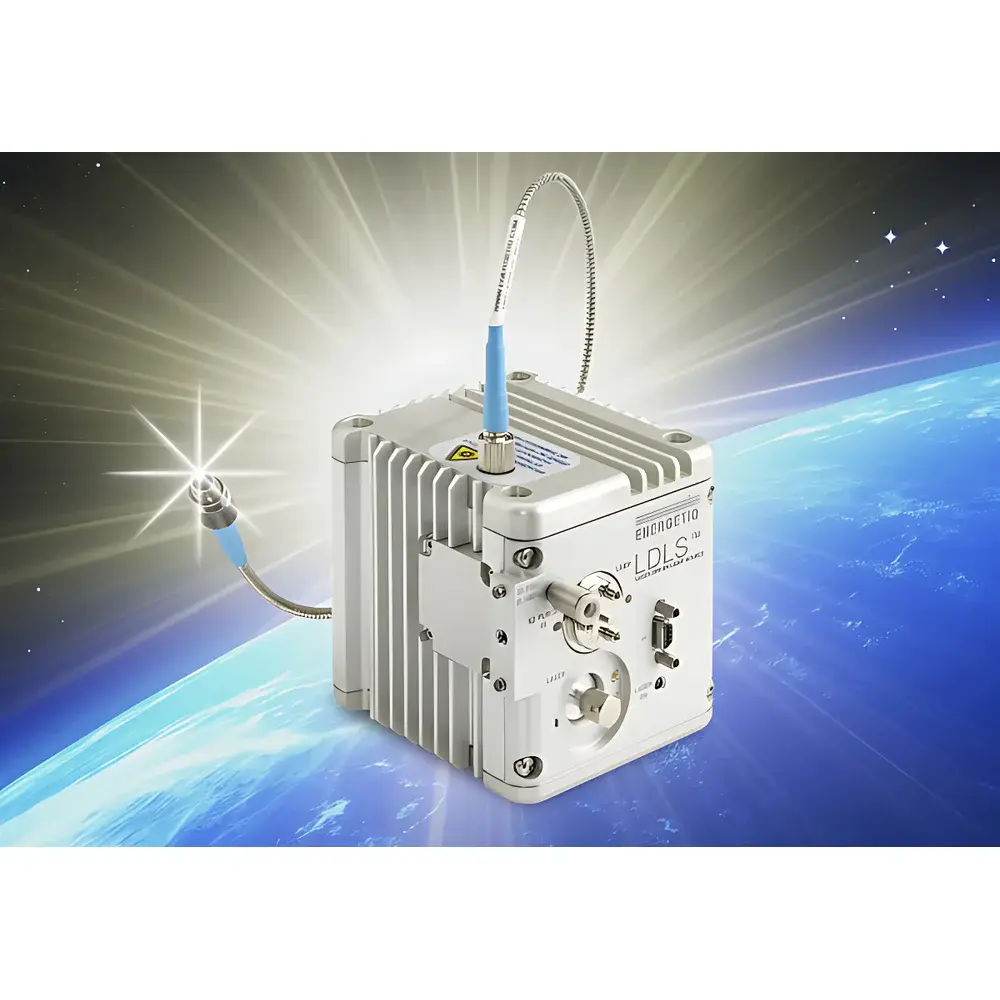
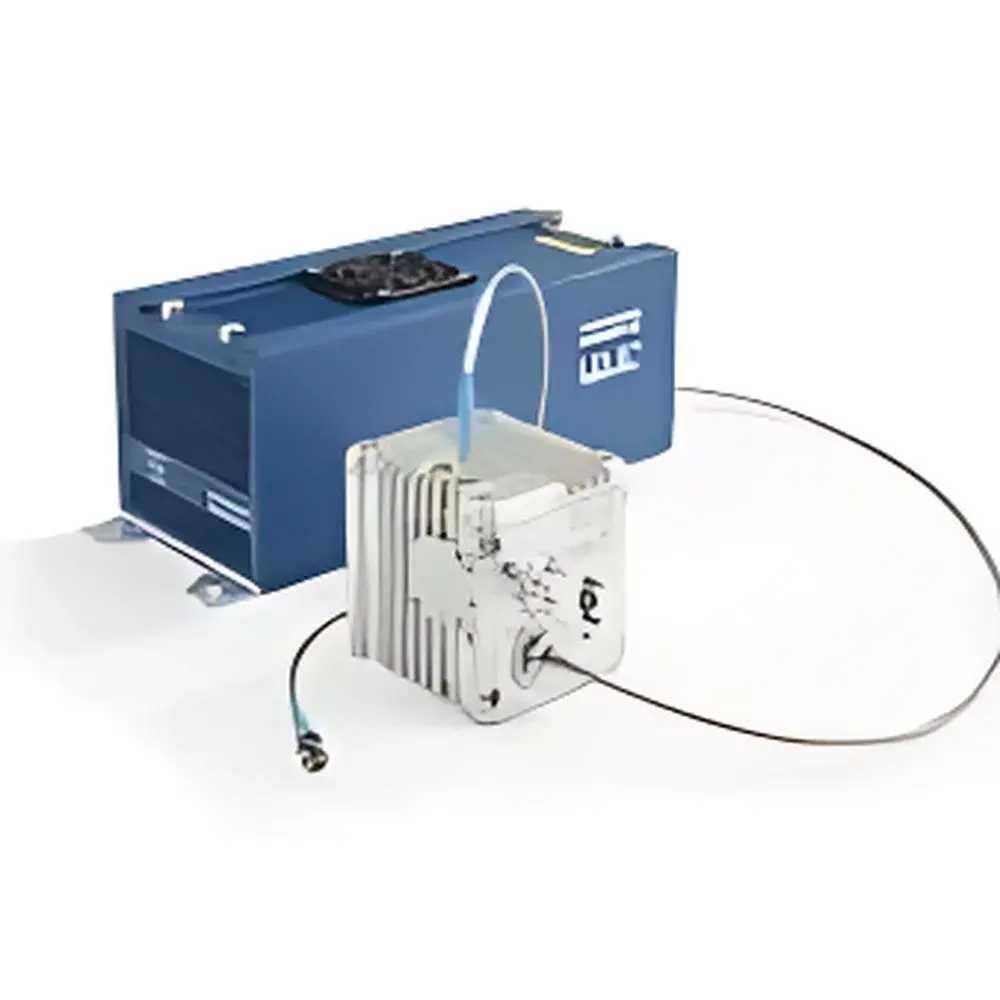
Energetiq EQ-99XFC Laser-Driven Light Source (LDLS™)
| Brand | Energetiq |
|---|---|
| Origin | USA |
| Model | EQ-99XFC |
| Light Source Type | Xenon-based Laser-Driven Plasma Source |
| Illumination Mode | Internal Illumination |
| Spectral Range | 190–2100 nm |
| Output Power | ~80 mW |
| Spectral Radiance | ~60 µW/nm |
| Numerical Aperture | 0.22 NA |
| Lifetime | >9000 hrs (to 10% output degradation) |
| Output Interface | FC-terminated fiber |
| Fiber Core Diameters Available | 100, 115, 200, 230, 400, 600 µm |
| Fiber Length Options | 1 m or 2 m |
| Lamp Chamber Dimensions | 82 × 86 × 76 mm |
| Controller Dimensions | 113 × 111 × 299 mm |
| Lamp Chamber Weight | 0.7 kg |
| Controller Weight | 1.4 kg |
Overview
The Energetiq EQ-99XFC is a compact, high-brightness, laser-driven light source (LDLS™) engineered for demanding optical applications requiring broadband spectral coverage, exceptional spatial and power stability, and long-term operational reliability. Unlike conventional electrode-based arc lamps—such as deuterium, xenon, or tungsten-halogen sources—the EQ-99XFC employs a patented laser-driven plasma technology: a high-power CW laser focuses onto a flowing xenon gas target within a sealed quartz chamber, generating a stable, sub-100 µm plasma point source. This fundamental departure from resistive or arc discharge eliminates electrode erosion, thermal drift, and catastrophic failure modes common in traditional lamps. The resulting plasma operates at temperatures exceeding 10,000 K, enabling continuous spectral emission from the deep ultraviolet (190 nm) through visible to near-infrared (2100 nm), with high radiance and minimal temporal fluctuation. Designed specifically for fiber-coupled instrumentation, the EQ-99XFC integrates an optimized ellipsoidal collector and proprietary fiber-protection optics to maximize coupling efficiency into low-NA, small-core fibers—making it ideal for integration into spectrometers, microscopes, HPLC detectors, and process monitoring systems where reproducibility, uptime, and spectral fidelity are mission-critical.
Key Features
- Laser-driven xenon plasma source with no electrodes—eliminates filament burnout, cathode sputtering, and spectral drift associated with arc lamp aging
- Ultra-stable 100 µm effective emission point size, ensuring excellent spatial coherence and repeatability across measurement cycles
- Integrated ellipsoidal collection optics delivering >70% coupling efficiency into 0.22 NA fiber, maintaining high brightness across 190–2100 nm
- Patented deep-UV-enhancing fiber interface with anti-reflection and UV-transmissive coatings, preserving spectral integrity below 220 nm
- Compact dual-module architecture: lamp head (82 × 86 × 76 mm, 0.7 kg) and dedicated controller (113 × 111 × 299 mm, 1.4 kg) for flexible system integration
- Rated lifetime exceeding 9,000 hours to 10% radiant flux degradation—reducing maintenance frequency and total cost of ownership versus conventional lamp systems
- Short- and long-term power stability < ±0.2% (rms, 1 hr) and < ±0.5% (24 hr), validated under constant-current operation and ambient temperature fluctuations
Sample Compatibility & Compliance
The EQ-99XFC is compatible with standard silica-based optical fibers (core diameters 100–600 µm, NA 0.22) terminated with FC/PC or SMA connectors. Its deep-UV transmission capability supports compliance with ASTM E275, ISO 17025 traceable UV-Vis calibration protocols, and USP requirements for spectrophotometric system suitability when used with NIST-traceable reference standards. The absence of mercury or hazardous electrode materials renders it compliant with RoHS Directive 2011/65/EU and WEEE recycling guidelines. For regulated environments—including GLP/GMP laboratories—the system supports external TTL triggering and analog intensity modulation, enabling synchronization with data acquisition hardware that maintains full audit trail functionality per FDA 21 CFR Part 11 when integrated into validated workflows.
Software & Data Management
While the EQ-99XFC operates as a standalone analog-controlled source, its controller provides RS-232 and USB-C interfaces for remote status interrogation (lamp-on/off, temperature, operating hours, fault codes) and intensity setpoint adjustment. Energetiq’s LDLS Control Suite (v3.2+) enables logging of real-time radiometric output trends, lifetime usage metrics, and thermal diagnostics—exportable as CSV for integration into LIMS or ELN platforms. All firmware updates are digitally signed and version-locked to ensure integrity in regulated deployments. No proprietary drivers are required; communication follows ASCII command protocol documented in IEC 62471-compliant technical annexes.
Applications
- High-resolution UV-Vis-NIR spectroscopy (e.g., absorption, reflectance, fluorescence excitation)
- Fiber-optic sensor characterization and calibration, including distributed acoustic sensing (DAS) and FBG interrogation
- Confocal and widefield microscope illumination—particularly for multi-channel fluorescence imaging requiring stable broadband excitation
- In-line process analytical technology (PAT) for pharmaceutical manufacturing, including real-time dissolution and blend uniformity monitoring
- Environmental monitoring systems for water quality analysis (e.g., COD, TOC, nitrate detection via UV absorption)
- Materials science applications: thin-film thickness mapping, photoluminescence quantum yield measurement, and solar cell spectral response testing
- HPLC-UV/Vis detector illumination where lamp-to-lamp variability must be eliminated across instrument fleets
FAQ
What distinguishes LDLS technology from conventional xenon arc lamps?
LDLS replaces thermionic electrodes with a focused CW laser to sustain xenon plasma, eliminating electrode wear, spectral instability, and short lifetimes typical of arc lamps. It delivers superior radiance, broader spectral continuity, and >9,000-hour lifetime.
Can the EQ-99XFC be used with UV-grade fused silica fibers below 200 nm?
Yes—when paired with optional UV-optimized fiber (e.g., Solarization-Resistant FS with OH⁻ suppression) and the integrated fiber protection optics, measurable output is sustained down to 190 nm with <15% transmission loss over 1,000 hours.
Is intensity modulation supported for lock-in or pulsed measurements?
The unit supports analog 0–5 V DC intensity control (10 Hz bandwidth) and TTL-triggered on/off switching (rise time <100 µs), enabling synchronization with gated detectors and chopper wheels.
How is spectral calibration performed for quantitative applications?
Energetiq provides NIST-traceable spectral irradiance calibration certificates (per CIE S 026/E:2019) for each shipped unit, covering 190–2100 nm at specified fiber output conditions. Users may perform in-situ recalibration using calibrated spectroradiometers compliant with ISO/IEC 17025.
Does the system require water cooling or forced airflow?
No—thermal management is passive via aluminum heatsinking and convection. Ambient operating range is 15–35 °C at ≤80% non-condensing humidity; no external chillers or compressors are needed.





