
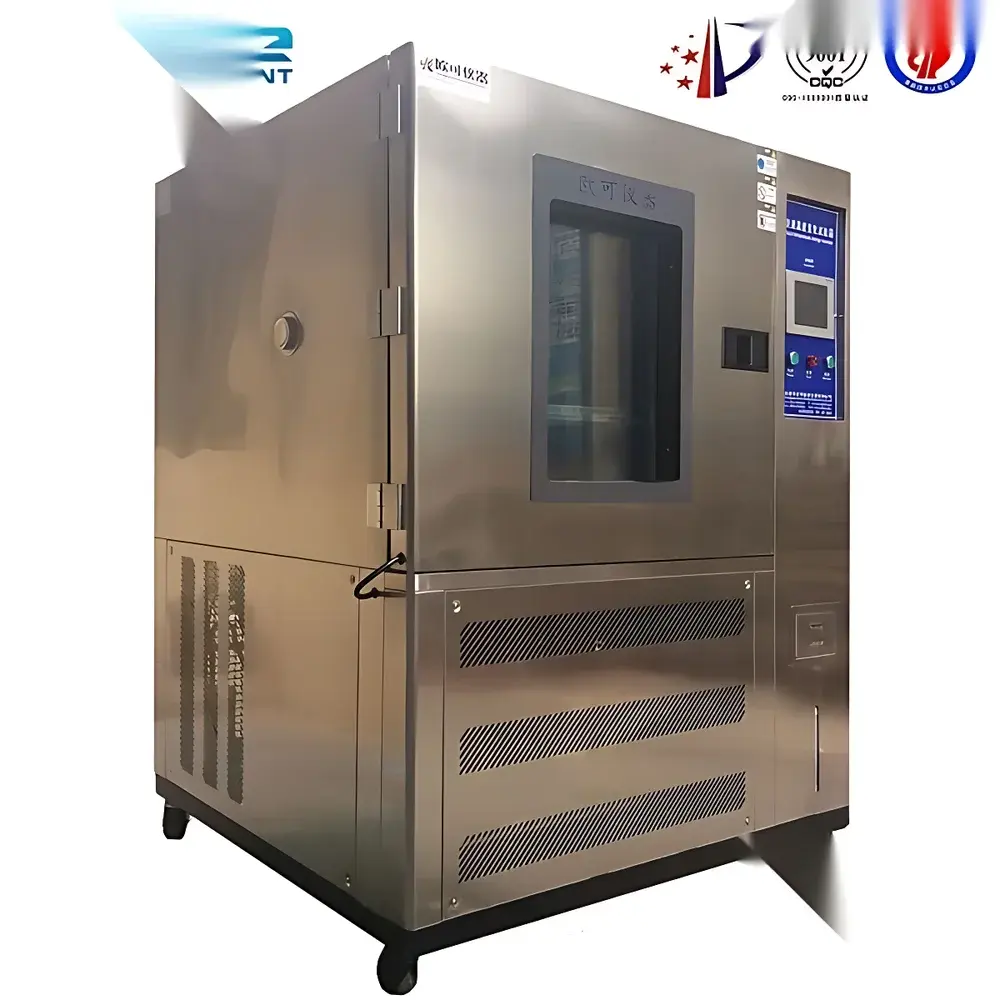
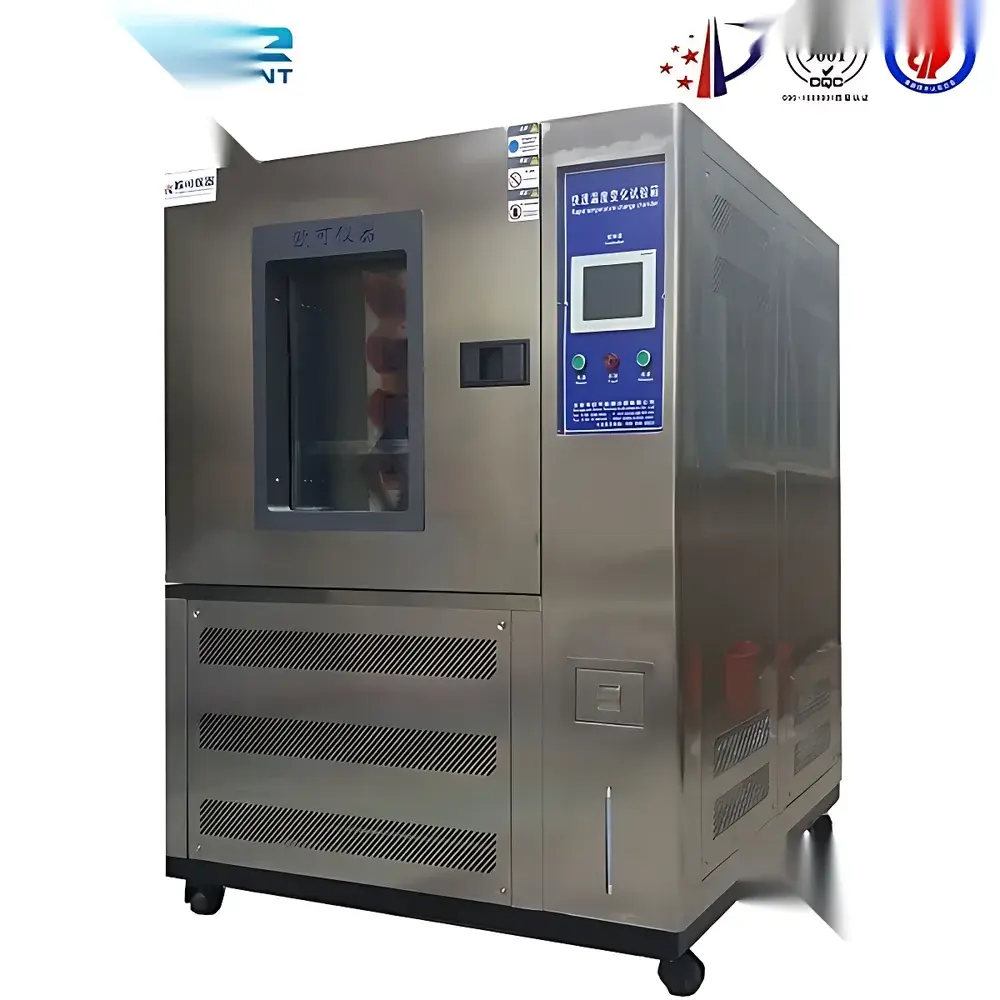
English Product Name
| Brand | KS |
|---|---|
| Model Range | KS-TH-225 / KS-TH-408 / KS-TH-800 / KS-TH-1000 |
| Internal Dimensions (H×W×D) | 75×50×60 cm / 85×60×80 cm / 100×80×80 cm / 100×100×100 cm |
| Volume | 225 L / 408 L / 800 L / 1000 L |
| Temperature Range (Standard) | −20 °C to +150 °C |
| Extended Ranges | −40 °C to +150 °C |
| Programmable Ramp Rates | Linear: 5 / 10 / 15 °C/min |
| Non-linear | 5 / 10 / 15 / 20 °C/min |
| Temperature Uniformity | ≤2 °C (at steady state) |
| Temperature Stability | ±0.5 °C (at steady state) |
| Control Method | Balanced Temperature Control (BTC) |
| Construction | SUS304 Stainless Steel Exterior & Interior |
| Insulation | Rigid Polyurethane Foam (≥120 mm thickness) |
| Refrigeration | Dual-Stage Cascade Compression System |
| Compressor Type | Hermetic or Semi-Hermetic Low-Temperature Compressor |
| Cooling Mode | Air-Cooled or Water-Cooled (configurable) |
| Power Supply | Three-Phase AC, Voltage & KVA rating dependent on selected ramp rate and model size |
Overview
The KS-TH Series Rapid Temperature Change (RTC) Chambers are engineered for high-fidelity thermal stress testing of electronic components, automotive modules, aerospace hardware, and advanced materials under dynamically controlled environmental conditions. Operating on the principle of balanced temperature control (BTC), these chambers utilize dual-stage cascade refrigeration combined with precision PID-controlled heating and forced-air circulation to achieve rapid, repeatable, and highly stable transitions across wide thermal spans. Unlike conventional thermal cycling systems, the KS-TH series supports both linear and non-linear ramp profiles—enabling compliance with industry-standard test protocols such as MIL-STD-810H Method 503.7 (Temperature Shock), IEC 60068-2-14 (Change of Temperature), and JEDEC JESD22-A104F. The system’s architecture is optimized for long-term operational reliability in QA/QC laboratories, R&D centers, and production-line validation environments where traceability, repeatability, and thermal fidelity are mission-critical.
Key Features
- Modular chamber configurations: Four standard internal volumes (225 L to 1000 L) accommodate diverse sample footprints—from PCB assemblies to full ECUs or battery packs.
- Wide operational temperature range: Standard −20 °C to +150 °C; extended variants support −40 °C and −65 °C low-end limits for cryogenic-grade qualification.
- Precisely programmable thermal ramp rates: Linear modes (5/10/15 °C/min) and non-linear modes (up to 20 °C/min) allow granular alignment with test specifications and material-specific thermal inertia requirements.
- SUS304 stainless steel construction throughout: Seamless interior welds, corrosion-resistant exterior cladding, and ≥120 mm rigid polyurethane insulation ensure thermal integrity and long-term structural stability.
- Dual-stage cascade refrigeration: Independently controlled high- and low-temperature circuits deliver consistent cooling performance across the full operating envelope without reliance on liquid nitrogen or external chillers.
- Configurable cooling interface: Air-cooled models suit standard lab infrastructure; water-cooled variants enable deployment in high-ambient or space-constrained facilities with stable chilled water supply.
Sample Compatibility & Compliance
The KS-TH chambers accommodate samples ranging from single-component DUTs to multi-layer enclosures and instrumented test fixtures. Internal airflow design ensures uniform thermal distribution per ISO 16750-4 Annex A and ASTM E1545–19 requirements. All models meet CE marking criteria for electromagnetic compatibility (EMC) and low-voltage directive (LVD). Optional validation packages support IQ/OQ documentation aligned with GLP and GMP frameworks. When equipped with calibrated Class I RTDs and integrated audit-trail logging, the system satisfies FDA 21 CFR Part 11 data integrity requirements for regulated industries.
Software & Data Management
Control is managed via an embedded industrial touchscreen HMI running real-time Linux OS, supporting intuitive profile programming, multi-segment ramp/soak sequences, and event-triggered actions (e.g., door interlock, power failure recovery). Optional PC-based software provides remote monitoring, CSV export of time-stamped temperature logs, statistical process control (SPC) charting, and automated report generation compliant with ISO/IEC 17025 laboratory accreditation standards. All data—including setpoints, actual values, alarms, and operator actions—is timestamped and stored with immutable audit trails.
Applications
- Accelerated life testing of solder joints, conformal coatings, and encapsulated semiconductors.
- Thermal shock validation of EV battery modules per UN ECE R100 and GB/T 31467.3.
- Environmental stress screening (ESS) of avionics units under DO-160 Section 4 conditions.
- Material coefficient-of-thermal-expansion (CTE) characterization and delamination onset detection.
- Pre-compliance screening for automotive electronics per ISO 16750-4 and AEC-Q200 stress categories.
FAQ
What is the difference between linear and non-linear ramp modes?
Linear mode maintains a constant temperature change rate throughout the segment. Non-linear mode allows variable rate scheduling—e.g., faster ramps in mid-range and slower rates near extremes—to reduce thermal overshoot and improve sample survivability.
Can the chamber be validated for ISO/IEC 17025 accredited testing?
Yes—optional factory-installed NIST-traceable sensors, calibration certificates, and IQ/OQ documentation kits are available to support laboratory accreditation processes.
Is water cooling mandatory for the −65 °C configuration?
Water cooling is strongly recommended for sustained operation at −65 °C to maintain compressor efficiency and thermal stability; air-cooled variants are rated for intermittent use only at this extreme low end.
How is temperature uniformity verified during operation?
Uniformity is assessed using a 9-point sensor array per IEC 60068-3-5, with results logged automatically and available in exported reports for quality audits.



