
English Product Name
| Brand | Other Brands |
|---|---|
| Origin | Imported |
| Manufacturer Type | General Distributor |
| Price | USD 2,650 (approx.) |
| Internal Dimensions (W×H×D) | 500×600×500 mm to 1000×1000×1000 mm |
| Temperature Range | −70 °C to +150 °C |
| Humidity Range (optional) | 20–98% RH |
| Rapid Temperature Transition Range | −45 °C to +85 °C |
| Transition Rate Options | 5–30 °C/min (linear or non-linear, selectable) |
| Temperature Uniformity | ±2.0 °C |
| Humidity Uniformity | ±3.0% RH |
| Temperature Control Accuracy | ±0.5 °C |
| Humidity Control Accuracy | ±2.5% RH |
| Temperature Resolution | 0.1 °C |
| Humidity Resolution | 0.1% RH |
| Cooling System | Water-Cooled |
| Compressor | Tecumseh (France) or Bitzer (Germany) |
| Power Supply | AC 380 V, 3-phase 5-wire, 50/60 Hz |
| Weight | 950–2300 kg |
Overview
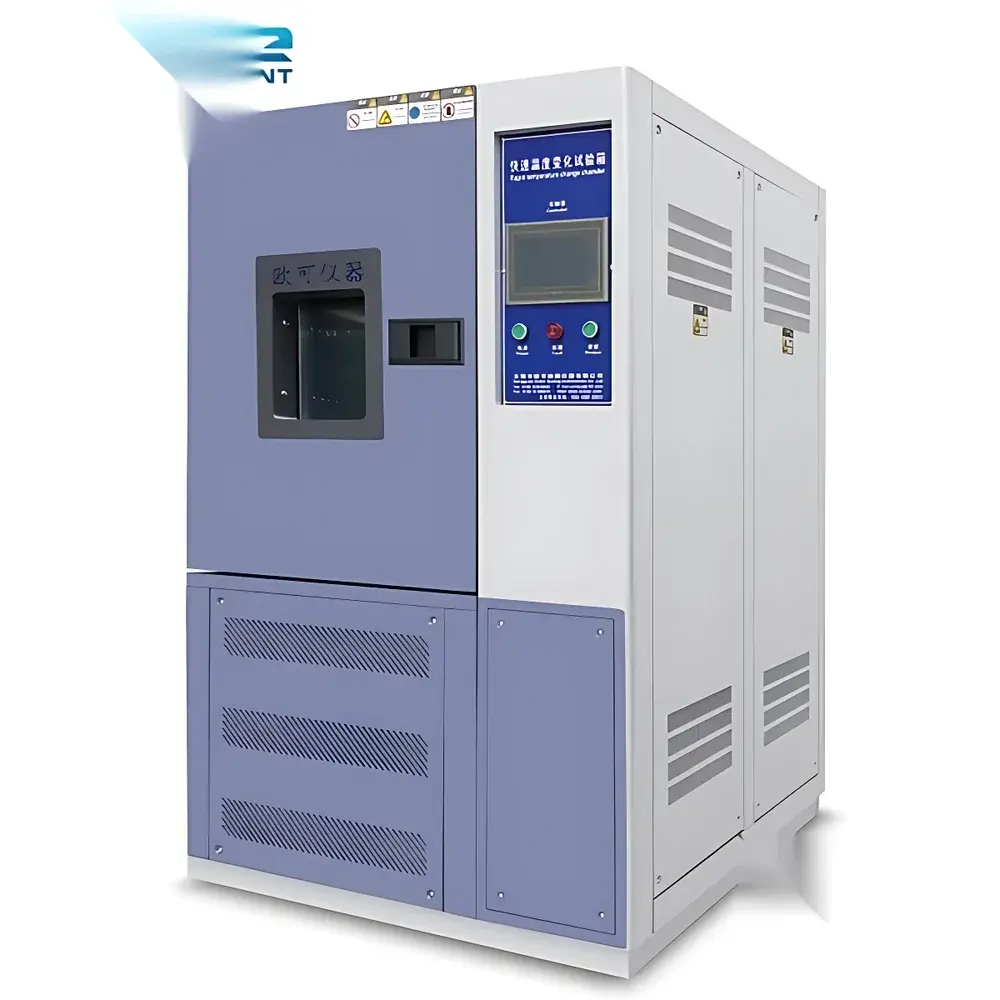
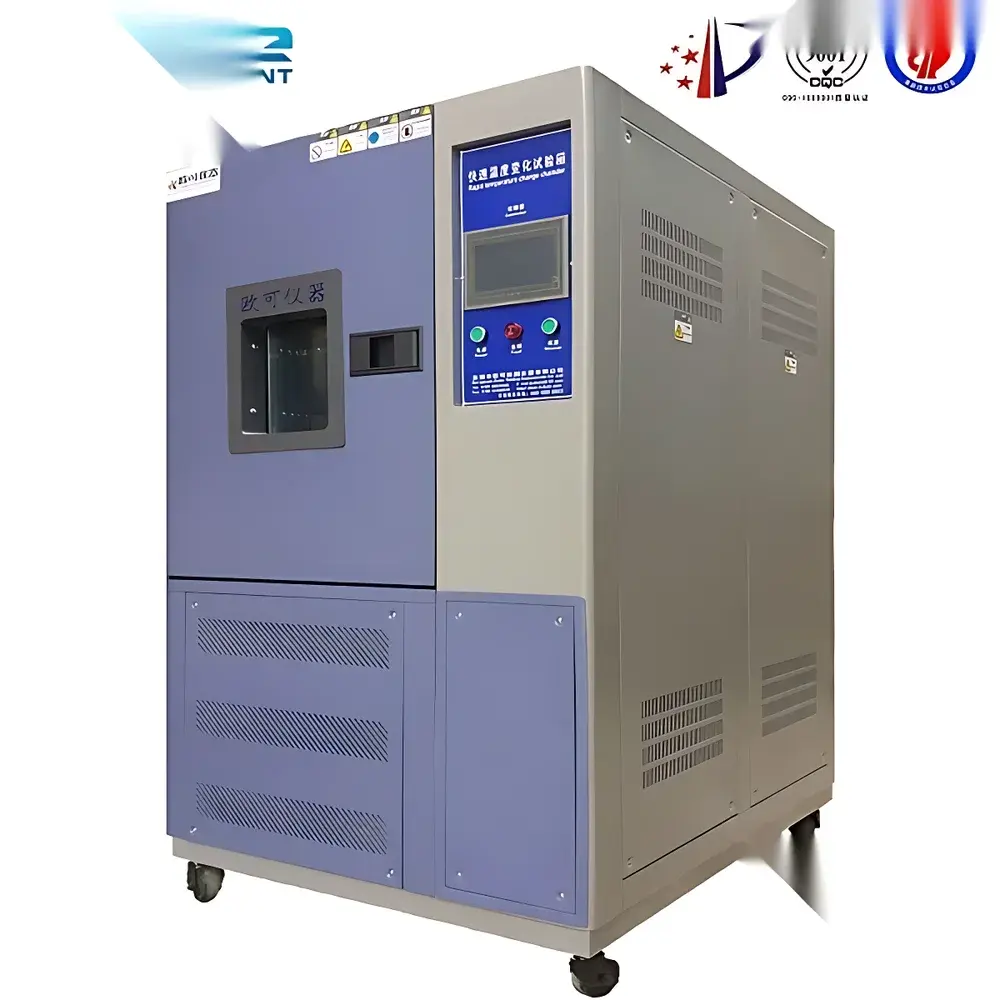
The Quick Environmental Temperature Transition Chamber is a high-performance climatic test system engineered for accelerated thermal stress evaluation of electronic components, automotive modules, aerospace assemblies, and packaging materials under dynamically varying temperature conditions. It operates on the principle of active refrigerant-based thermal modulation—leveraging dual-stage compression, optimized evaporator/condenser geometry, and precision cold-end output control—to achieve rapid, repeatable, and programmable temperature transitions without relying on conventional hot-cold air mixing. Unlike static thermal chambers, this system supports both linear and non-linear ramp profiles across a broad operational envelope (−70 °C to +150 °C), with optional humidity control (20–98% RH) for combined environmental stress screening. Designed for laboratory and industrial reliability testing environments, it complies with fundamental structural and safety requirements outlined in IEC 60068-2-1 (cold), IEC 60068-2-2 (dry heat), and MIL-STD-810G Method 502.6 (temperature shock), serving as a foundational platform for qualification per AEC-Q200, JEDEC JESD22-A104, and IPC-9701 standards.
Key Features
- Structural integrity ensured by CNC-machined stainless steel frame; inner chamber fabricated from mirror-finish SUS304 stainless steel, outer enclosure from brushed-finish SUS304 or SECC cold-rolled steel with electrostatic powder coating.
- High-efficiency thermal insulation comprising dual-layer composite: high-density polyurethane (PU) foam core + glass fiber blanket, minimizing thermal leakage and stabilizing chamber wall temperatures during rapid transients.
- Robust air circulation system featuring extended-shaft, high-torque motors and multi-blade stainless steel impellers rated for continuous operation at −70 °C to +150 °C—enabling uniform vertical airflow distribution and reducing thermal stratification.
- Multi-layer heated conductive-glass observation window with anti-fog functionality, providing real-time visual access without condensation interference during low-temperature cycles.
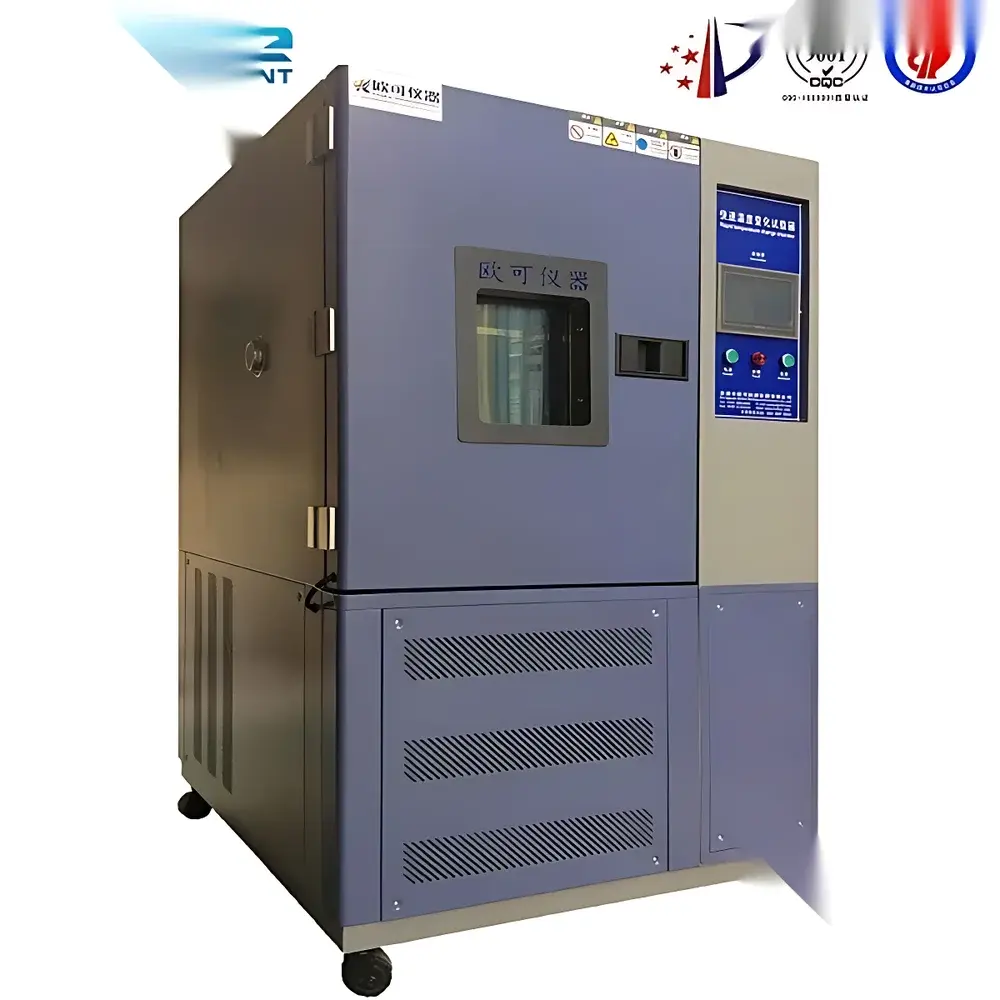
- Standard Ø50 mm cable/port access on left side wall, sealed with silicone gasket for pressure and humidity retention; configurable with optional feedthroughs for thermocouple wiring or signal conditioning.
- Integrated leveling feet and lockable PU casters for stable positioning and safe relocation within controlled laboratory spaces.
Sample Compatibility & Compliance
The chamber accommodates test specimens up to 1000 × 1000 × 1000 mm (internal volume: 1 m³), supporting standard test fixtures, DUT carriers, and environmental monitoring probes. Its thermal performance meets repeatability requirements for GLP-compliant validation protocols when operated with calibrated reference sensors traceable to NIST or PTB standards. While not inherently certified for FDA 21 CFR Part 11, the system’s data logging architecture—including timestamped setpoint history, actual chamber readings, and alarm event logs—can be configured to support audit-ready documentation under ISO/IEC 17025 and ICH Q5C frameworks. Optional accessories such as external data recorders, dehumidifiers, and purified water generators extend its applicability to regulated pharmaceutical stability studies (ICH Q1A–Q1E).
Software & Data Management
Equipped with a 7-inch true-color touchscreen HMI running embedded Linux, the chamber features an intuitive bilingual (English/Chinese) interface with drag-and-drop profile programming, real-time trend visualization, and up to 100 user-defined test sequences. The controller supports Ethernet (10/100 Mbps) connectivity and includes native OPC UA and Modbus TCP drivers for integration into centralized MES or LIMS platforms. Included PC software enables remote monitoring, batch export of CSV-formatted time-series data (temperature/humidity/alarms), and automated report generation compliant with internal QA templates. All operational parameters—including ramp rate selection, dwell duration, and transition mode—are stored with full versioning and user-access logging, facilitating traceability during internal audits or third-party certification reviews.
Applications
This chamber is routinely deployed in: accelerated life testing of PCBAs and solder joints; thermal cycling validation of EV battery modules per UN ECE R100 and GB/T 31467.3; environmental stress screening (ESS) of military-grade connectors; qualification of medical device enclosures under ISO 11607-1; and accelerated aging of polymer-based packaging per ASTM F1980. Its rapid transition capability (up to 30 °C/min) significantly reduces test cycle time compared to conventional chambers—making it suitable for high-throughput production line verification, design failure mode analysis (DFMEA), and pre-compliance screening prior to formal certification testing at accredited labs.
FAQ
What is the maximum allowable load mass for thermal transition testing?
Thermal performance specifications assume empty-chamber operation. For loaded configurations, derating is required per IEC 60068-3-5; consult the Load Derating Guide included in the technical manual for mass- and thermal-mass–dependent rate reductions.
Is humidity control available as a factory-installed option or field retrofit?
Humidity functionality must be specified at time of order; it cannot be retrofitted due to integrated steam generator, condensate management, and sensor calibration dependencies.
Does the system support automated compliance reporting per MIL-STD-810 or JEDEC standards?
While the chamber executes defined test profiles, generation of formal compliance reports requires external validation software and third-party instrument calibration; the built-in logger provides raw data necessary for such reporting.
What maintenance intervals are recommended for the refrigeration system?
Compressor oil and filter replacement every 12 months or 2000 operating hours (whichever occurs first); annual leak check and refrigerant charge verification using certified manifold gauges.
Can the controller be validated for GxP-regulated environments?
Yes—the firmware supports IQ/OQ documentation packages, and the system can be qualified per Annex 15 (EU GMP) and ASTM E2500 when paired with documented calibration procedures and change control records.



