
English Product Name
| Brand | Other Brands |
|---|---|
| Origin | Imported |
| Manufacturer Type | General Distributor |
| Temperature Range | -40 °C to +100 °C |
| Humidity Range | 20–98% RH |
| Temperature Uniformity | ±1 °C |
| Humidity Uniformity | ±5% RH |
| Sensor Placement | Directly in Test Zone (Not in Air Duct) |
| Cooling System | Air-Cooled, Single-Stage Compressor (for –20 °C base), Dual-Stage Compressor (for –40 °C to –70 °C) |
| Insulation Material | High-Density Polyisocyanurate Foam with High-Temperature Resistance |
| Safety Protections | Fuseless Circuit Breaker, Compressor Overload Protection, Refrigerant High/Low Pressure Switches, Over-Temperature Cut-Off, Integrated Fault Alert System |
Overview
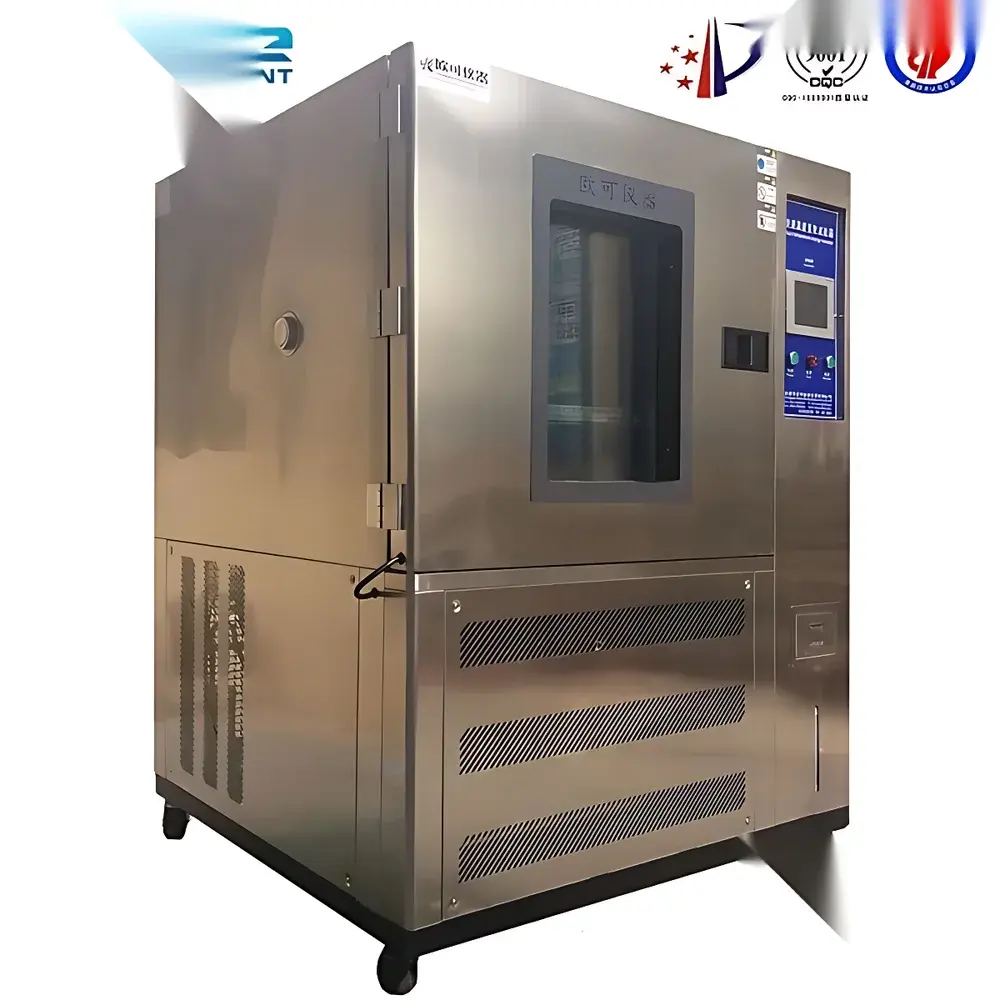
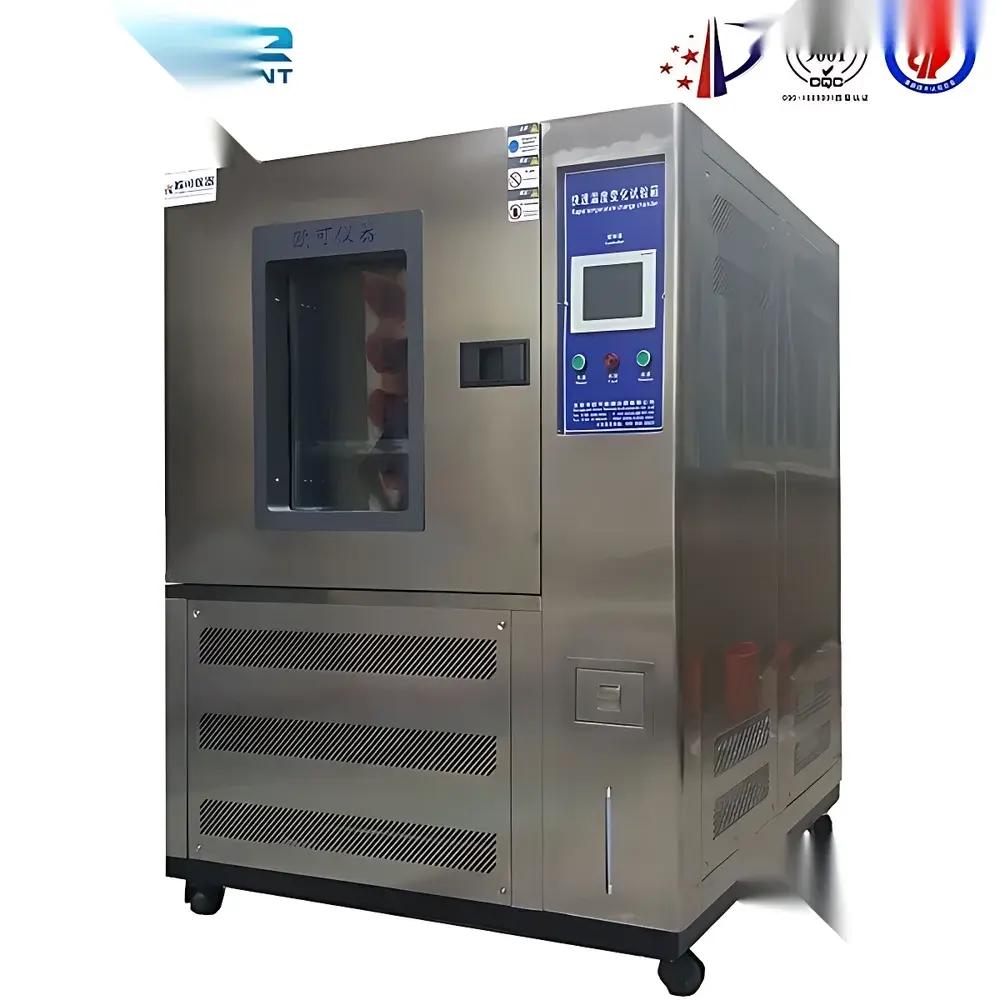
The Rapid Temperature Transition Environmental Chamber is an engineered test platform designed for high-fidelity thermal stress evaluation under dynamically controlled ambient conditions. It operates on a dual-chamber or single-chamber forced-air convection architecture—depending on configuration—to achieve rapid temperature transitions between extreme setpoints, with verified ramp rates exceeding industry-standard requirements for JEDEC JESD22-A104, MIL-STD-810H Method 503.5, and IEC 60068-2-14. Unlike conventional thermal chambers relying solely on passive dwell cycles, this system integrates real-time thermal load compensation algorithms and precision air distribution tuning to maintain spatial uniformity (±1 °C) and temporal stability (<0.5 °C/min drift during dwell) across the entire working volume—even during aggressive transitions from –40 °C to +100 °C within ≤15 minutes. Its design prioritizes metrological integrity: temperature and humidity sensors are embedded directly within the test zone—not in supply ducts—ensuring measurement fidelity aligned with ISO/IEC 17025 traceability principles for accredited laboratory use.
Key Features
- Aluminum-based thermal load validation protocol—eliminates plastic or low-mass dummy loads that misrepresent actual device-under-test (DUT) thermal inertia.
- Dual-access door configuration (front and rear) enables seamless integration into inline reliability testing workflows, especially for large-area flat-panel displays.
- LCD-adjustable mounting fixture allows precise angular positioning of TFT-LCD panels, OLED modules, and LTPS substrates—critical for simulating real-world thermal gradient exposure during operation.
- Configurable dwell time extension at surface temperature thresholds—enabling accelerated qualification per IPC-9701A and JEDEC J-STD-020 for lead-free solder joint reliability (e.g., tin whisker growth assessment).
- Energy-optimized low-temperature shock mode: capable of executing 0 °C thermal shocks without full cryogenic compressor engagement, reducing power consumption by up to 32% versus standard –40 °C cycling protocols.
- Humidity control remains compliant with ASTM E145 Class A specifications throughout rapid transition phases—validated via NIST-traceable hygrometers placed at three orthogonal positions within the test volume.
Sample Compatibility & Compliance
The chamber accommodates flat-panel display assemblies up to 650 mm × 500 mm × 120 mm (W×D×H), including TFT-LCD panels, LED backlight units, flexible OLED modules, and LTPS driver IC substrates. All internal surfaces are non-outgassing and electrostatically dissipative (10⁶–10⁹ Ω/sq), preventing contamination or charge accumulation during extended thermal cycling. The system complies with safety standards IEC 61000-6-2 (immunity) and IEC 61000-6-4 (emissions), and supports GLP/GMP-aligned audit trails when paired with optional data logging firmware. Humidity performance meets ISO 16750-4 Annex C for automotive electronics environmental simulation, while thermal transition repeatability conforms to ASME PTC 19.3TW uncertainty guidelines for temperature measurement systems.
Software & Data Management
Equipped with a Windows-based control interface supporting RS-485, Ethernet TCP/IP, and optional Modbus RTU communication, the chamber enables remote scheduling, real-time parameter logging (≥10 Hz sampling), and automated report generation in PDF/CSV formats. Audit trail functionality records operator ID, setpoint changes, alarm events, and calibration history—fully compliant with FDA 21 CFR Part 11 requirements when configured with electronic signature modules. Data export supports direct import into MATLAB, JMP, and Minitab for Weibull analysis of failure distributions during accelerated life testing.
Applications
This chamber is deployed in R&D labs and QC facilities for thermal shock qualification of optoelectronic components, including: cold-to-hot cycling of OLED encapsulation layers; moisture-assisted thermal fatigue testing of COG (Chip-on-Glass) interconnects; tin whisker acceleration per NASA-HDBK-8739.23; reflow profile validation for lead-free PCBAs; and thermal boundary condition mapping for active matrix backplane reliability. It is widely adopted by Tier-1 display manufacturers and third-party test houses accredited to ISO/IEC 17025 for environmental testing services.
FAQ
What is the minimum dwell time achievable at extreme temperature setpoints?
Standard configuration supports 5-minute dwell at –40 °C and +100 °C; optional high-stability mode extends dwell stability to 30 minutes with <±0.3 °C deviation.
Can the chamber perform combined temperature/humidity shock testing?
Yes—humidity transitions from 20% to 98% RH are synchronized with thermal ramps, maintaining compliance with IEC 60068-2-30 test Db.
Is external calibration support available?
Certified field calibration services—including sensor mapping and uncertainty budgeting—are offered globally through authorized service partners with ISO/IEC 17025 accreditation.
What maintenance intervals are recommended for the dual-stage refrigeration system?
Compressor oil analysis and refrigerant purity verification every 1,500 operating hours; full system leak check and filter-drier replacement every 3 years.
Does the system support custom test profiles via script-based programming?
Yes—via embedded Python interpreter (v3.9) accessible through the API interface, enabling conditional logic, external sensor input triggering, and adaptive ramp rate modulation.
Related Products



