
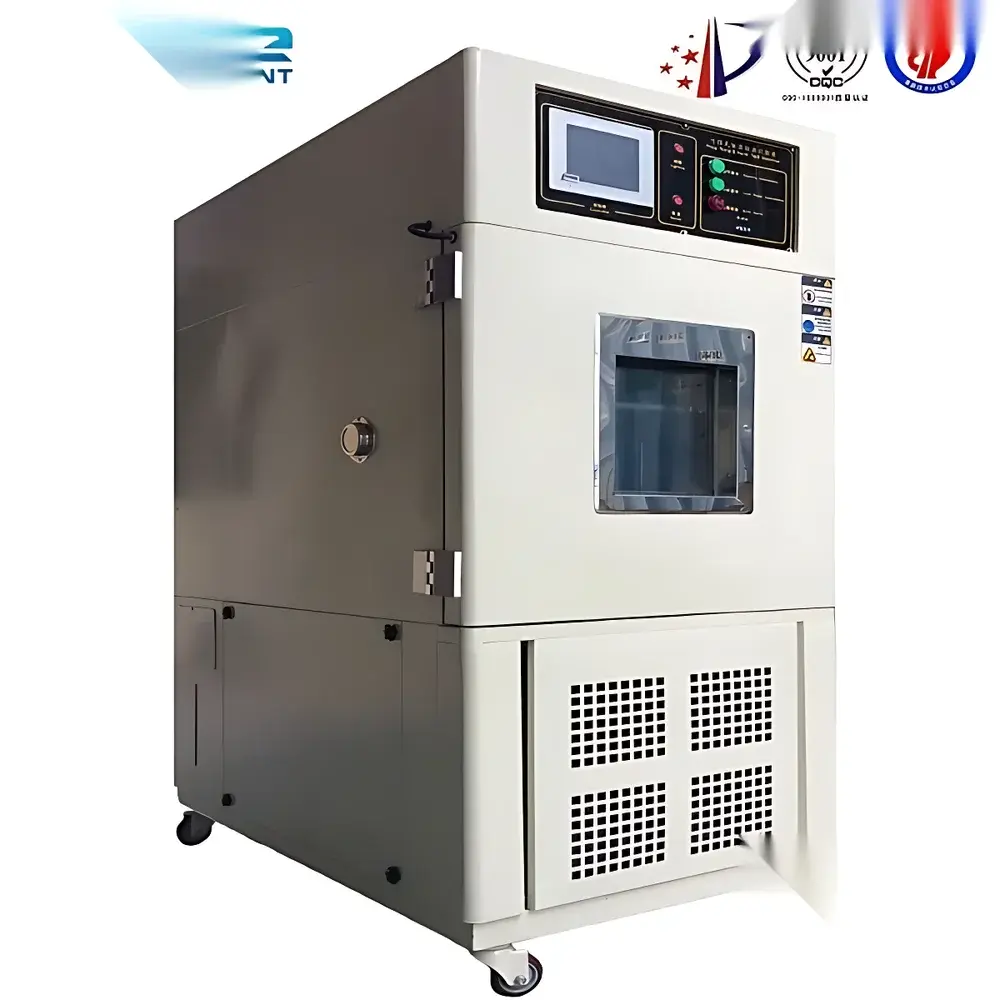
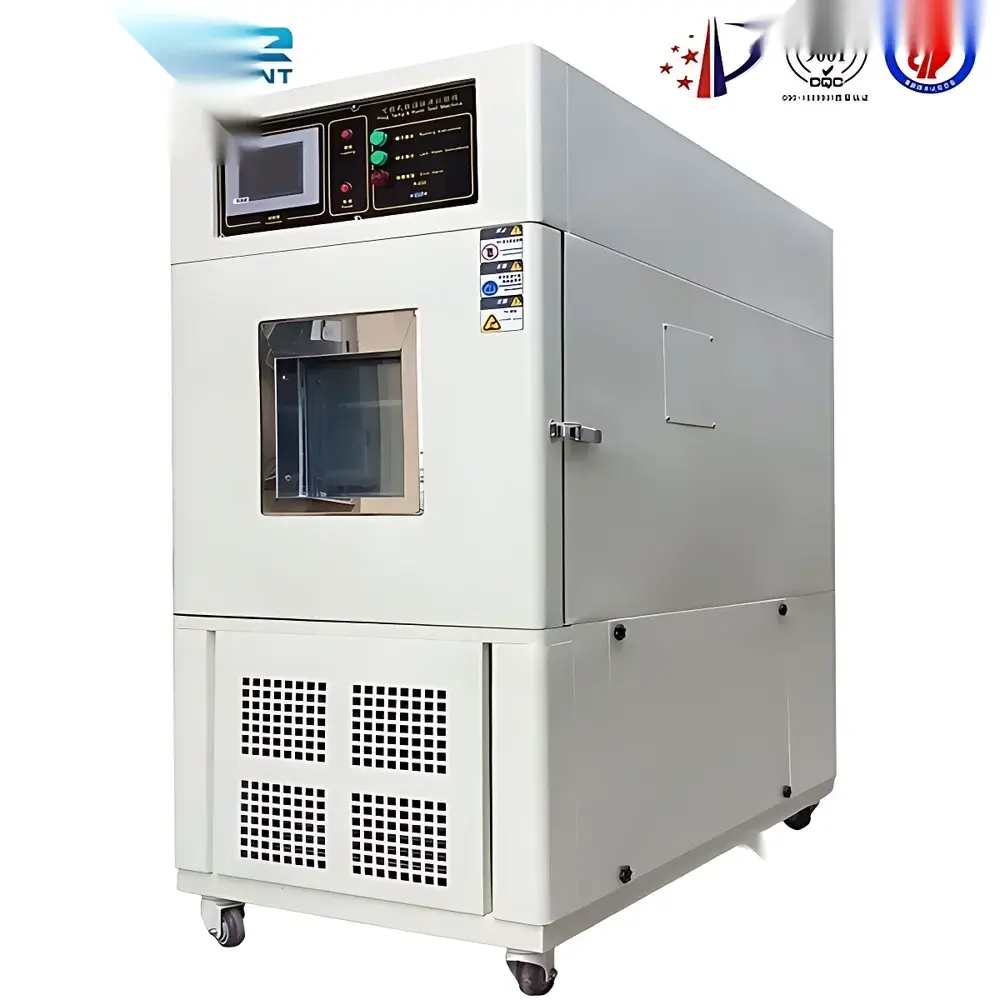
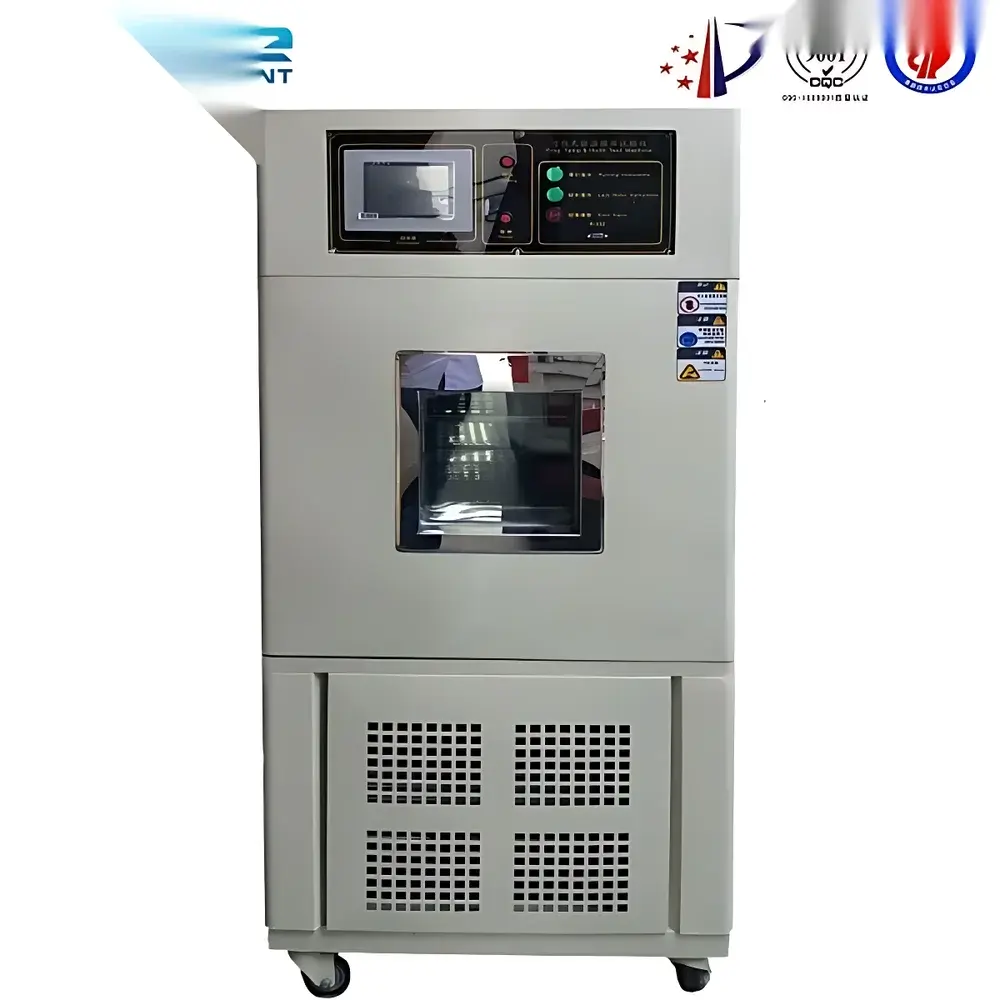
English Product Name
| Brand | OEM / Custom Brand |
|---|---|
| Origin | Imported |
| Manufacturer Type | Authorized Distributor |
| Pricing Reference | USD 2,650 (excl. tax & freight) |
| Temperature Range | -70°C to +180°C (standard) |
| Humidity Range | 20%–98% RH |
| Cooling Water Requirement | 10–28°C, 0.1–0.3 MPa |
| Control Method | Balanced Temperature & Humidity Control (BTHC) via PID + SSR |
| Compressor | Hermetic Twin-Screw Type (R404A refrigerant) |
| Noise Level | <60 dB(A) |
| Compliance | GB/T 2423.1, GB/T 2423.2, IEC 60068-2-1, MIL-STD-2164A, GJB 1032 |
Overview
The Environmental Test Chamber for Temperature and Humidity Cycling is an engineered precision system designed to replicate dynamic atmospheric conditions for reliability validation, environmental stress screening (ESS), and accelerated life testing of electronic components, automotive modules, aerospace subsystems, and industrial materials. It operates on the principle of balanced temperature and humidity control (BTHC), where proportional-integral-derivative (PID) algorithms regulate solid-state relays (SSRs) to dynamically match heating/humidification output with thermal and moisture losses—enabling stable, long-duration operation without thermal overshoot or condensation instability. Unlike single-loop controllers, this architecture maintains traceable equilibrium across wide operational envelopes, supporting both steady-state conditioning and programmable ramp-soak profiles per MIL-STD-2164A and GJB 1032 protocols.
Key Features
- Hermetically sealed twin-screw compressor using R404A refrigerant—CFC-free, compliant with Montreal Protocol Annex A Group II requirements.
- Full-capillary automatic capacity modulation system—superior to thermostatic expansion valves in transient response and low-load stability.
- Integrated distilled water recovery loop for humidification—reduces consumable usage by up to 40% versus conventional steam generators.
- Self-cleaning municipal water filtration and auto-fill system—eliminates dependency on deionized or distilled water sources.
- Touchscreen controller with multi-language UI (English, German, Japanese, Chinese), audit-trail-enabled event logging, and USB data export.
- Acoustic enclosure design achieving <60 dB(A) at 1 m distance—meets ISO 7779 noise emission standards for laboratory environments.
- Structural integrity validated per IEC 60068-2-6 (vibration) and IEC 60068-2-27 (shock) for transport and installation safety.
Sample Compatibility & Compliance
The chamber accommodates test specimens up to 1,200 mm (W) × 1,000 mm (D) × 1,500 mm (H), with optional custom cavity dimensions available upon engineering review. Internal stainless-steel shelves (2 standard tiers, load-rated to 30 kg each) support uniform airflow distribution per ASTM E145 Class II requirements. All control firmware and calibration procedures adhere to ISO/IEC 17025:2017 metrological traceability standards. Third-party NIST-traceable calibration certificates (including temperature uniformity ±0.5°C, humidity accuracy ±2.5% RH) are supplied with each unit. The system satisfies regulatory prerequisites for GLP-compliant environmental qualification under FDA 21 CFR Part 11 (electronic records/e-signatures), including user-level access control, versioned parameter logs, and non-erasable audit trails.
Software & Data Management
Embedded controller firmware supports up to 99 programmable test cycles, each with 99 segments (ramp/soak/humidity modulation). Real-time data—including chamber setpoints, sensor readings, alarm status, and compressor duty cycle—is timestamped and stored locally (≥30 days) with optional Ethernet/IP or RS-485 Modbus TCP integration for SCADA or LIMS synchronization. Export formats include CSV and PDF reports compliant with ISO 17025 clause 7.8.2. Remote monitoring via secure HTTPS interface enables role-based access (administrator/operator/viewer) with TLS 1.2 encryption. Firmware updates follow a dual-signature verification process to prevent unauthorized modification.
Applications
This chamber is routinely deployed in:
- Automotive Tier-1 suppliers conducting ISO 16750-4 environmental stress screening on ECUs, sensors, and infotainment units.
- Aerospace contractors performing MIL-STD-810H Method 502.7 low-temperature storage and Method 507.6 humidity exposure tests.
- Medical device manufacturers validating sterilization packaging integrity per ISO 11607-1 under cyclic thermo-hygrometric loads.
- Electronics labs executing JEDEC JESD22-A104D thermal cycling and JESD22-A105A high-humidity operating life tests.
- Materials science research groups studying hygrothermal aging effects on polymer composites and conformal coatings.
FAQ
What is the minimum achievable humidity at -40°C?
At sub-zero temperatures, humidity specification shifts from %RH to dew point; the system achieves a verified dew point of -70°C at -40°C chamber temperature, corresponding to <5% RH equivalent.
Can the chamber operate continuously at 180°C with 98% RH?
No—maximum humidity is pressure- and temperature-dependent; above 100°C, saturated vapor pressure exceeds chamber structural limits. Humidity capability is capped at 85% RH above 120°C per ASME B31.3 design constraints.
Is third-party calibration included in delivery?
Yes—a full NIST-traceable calibration certificate covering temperature uniformity, humidity accuracy, and ramp rate linearity is provided prior to shipment.
Does the controller support automated report generation per ISO/IEC 17025?
Yes—PDF reports include instrument ID, calibration dates, uncertainty budgets, technician signatures, and digital timestamps—all embedded in encrypted metadata.
What cooling water quality is required for sustained operation?
Deionized water is not required; municipal supply filtered to ≤5 µm particulate and ≤10 ppm total dissolved solids (TDS) meets operational specifications per ASTM D1193 Type IV.



