
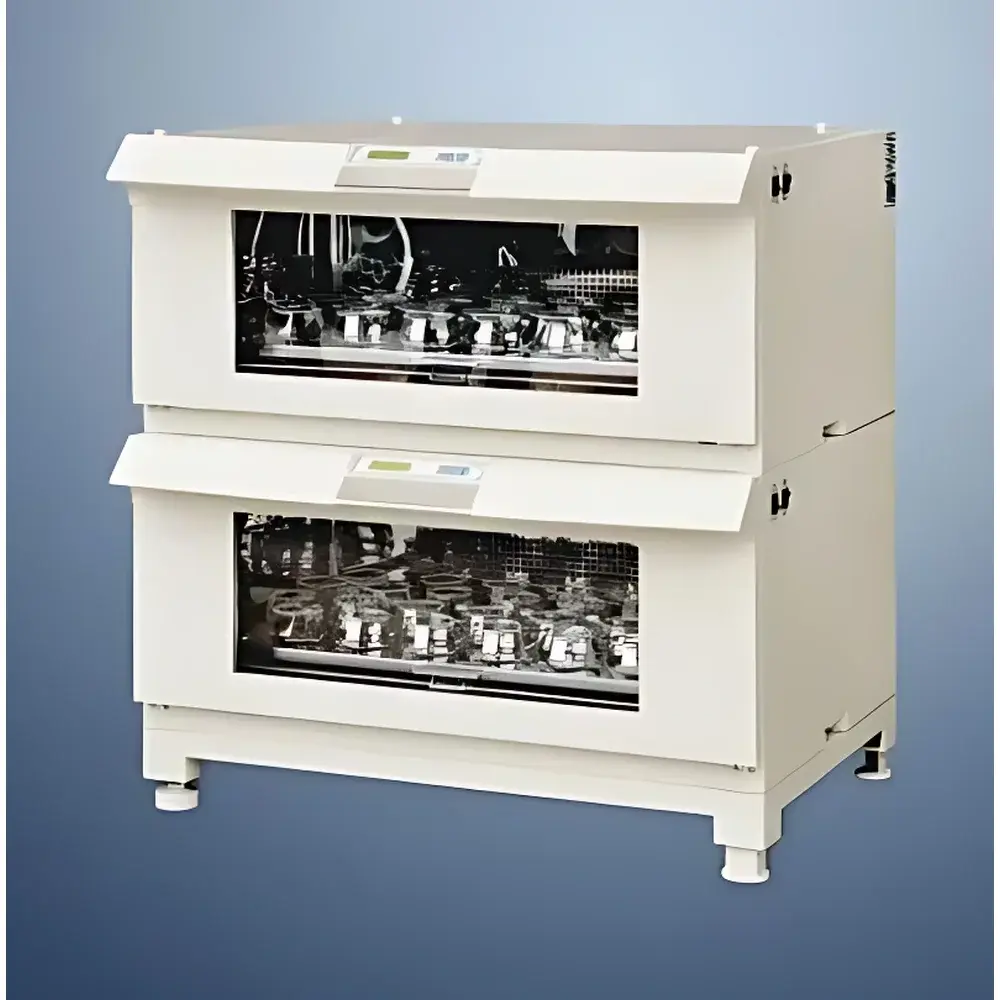
English Product Name
| Origin | Shanghai, China |
|---|---|
| Manufacturer Type | Authorized Distributor |
| Country of Origin | China |
| Model | ZWYD-4402 |
| Pricing | Available Upon Request |
| Temperature Range | Ambient +5°C to 60°C (refrigerated mode: 4°C to 60°C) |
| Temperature Resolution | 0.1°C |
| Temperature Uniformity | ±1.0°C at 37°C |
| Temperature Stability | ±0.1°C at 37°C |
| Orbital Speed Range | 0–300 rpm |
| Speed Accuracy | ±1 rpm |
| Orbit Diameter | Φ0–50 mm (infinitely adjustable) |
| Chamber Capacity per Layer | 182 L |
| Internal Dimensions per Layer (W×D×H) | 920 × 532 × 373 mm |
| Shelf Dimensions | 800 × 430 mm |
| Number of Independent Chambers | 2 |
| Total External Dimensions (W×D×H) | 1100 × 910 × 1210 mm |
| Net Weight | 370 kg |
| Power Supply | AC 220 V, 50/60 Hz |
| Rated Power | 2200 W |
| Refrigerant | R134a |
| Cooling Method | Bottom-mounted forced-air refrigeration with frost-free operation |
| Control System | PID-controlled microprocessor with environmental scanning chip |
| Programming Capability | 9 segments / 18 steps (multi-stage ramp-hold profiles) |
| Timer Range | 0.1–99.9 hours |
| Display | Backlit LCD with real-time parameter monitoring |
| Communication Interface | RS-232 |
| Data Output | Embedded thermal microprinter |
| Safety Certifications | Compliant with IEC 61010-1 for laboratory equipment safety |
Overview
The Zhongwei ZWYD-4402 Intelligent Stackable Combination Incubator Shaker is a dual-chamber, programmable orbital shaker engineered for precision-controlled cell culture, microbial fermentation, enzyme kinetics, and hybridization studies requiring simultaneous regulation of temperature, humidity, CO₂ (in D-series configurations), and oscillatory motion. Its core operational principle integrates PID-regulated thermal control with digitally synchronized orbital agitation—ensuring stable, reproducible environmental conditions across both chambers. Unlike conventional single-mode shakers, the ZWYD-4402 employs a dual independent chamber architecture with bottom-mounted refrigeration and top-heating zones, enabling asymmetric thermal setpoints (e.g., 4°C in lower chamber, 37°C in upper) without cross-contamination or thermal interference. This configuration supports parallel experimental workflows—such as comparative thermotolerance assays or multi-condition bioreactor pre-cultivation—within a single footprint. The system adheres to fundamental requirements of GLP-compliant laboratories, including traceable parameter logging, hardware-enforced safety interlocks, and deterministic startup/recovery behavior after power interruption.
Key Features
- Dual independent incubation chambers (2 × 182 L volume), each with fully programmable temperature, speed, and timing parameters
- PID-controlled microprocessor with environmental scanning chip for adaptive thermal compensation and dynamic load response
- Orbital shaking mechanism with infinitely adjustable amplitude (Φ0–50 mm) and speed range (0–300 rpm, ±1 rpm accuracy)
- Multi-stage curve programming: up to 9 segments and 18 steps per chamber, supporting ramp-hold, step-change, and cyclic protocols
- Frost-free refrigeration system using R134a with bottom-mounted air-cooled compressor and intelligent defrost logic
- Integrated water-level sensing with automatic refill function and audible/visual low-water alerts
- Triple-layer safety architecture: personnel protection (leakage current cutoff, overcurrent trip), sample integrity (dual independent overtemperature cutoffs, speed limit enforcement), and equipment longevity (compressor overload protection, motor thermal shutdown)
- Soft-start acceleration profile ensuring gentle initiation of orbital motion to prevent splashing or shear-induced cell damage
- Corrosion-resistant interior: electropolished stainless steel chamber walls, reinforced glass viewing window, and powder-coated steel frame
- RS-232 serial interface for external data acquisition and remote parameter synchronization with LIMS or ELN systems
Sample Compatibility & Compliance
The ZWYD-4402 accommodates standard laboratory vessels—including Erlenmeyer flasks (up to 5 L), culture bottles, deep-well plates, and custom bioreactor cartridges—via interchangeable stainless steel platforms with spring-loaded clamps and universal adapter kits. Its chamber geometry (920 × 532 × 373 mm internal per layer) permits vertical stacking of multiple trays while maintaining unobstructed airflow. From a regulatory standpoint, the instrument conforms to IEC 61010-1:2010 for electrical safety in laboratory environments and incorporates design elements aligned with FDA 21 CFR Part 11 requirements—namely, audit-trail-capable parameter logging (via embedded printer and RS-232 output), user-access controls (parameter encryption), and deterministic recovery behavior following power loss. It supports ISO 13485-aligned quality systems through repeatable thermal uniformity (±1.0°C at 37°C) and documented calibration traceability for temperature and speed sensors.
Software & Data Management
While the ZWYD-4402 operates autonomously via its front-panel LCD interface, its RS-232 port enables bidirectional communication with third-party software platforms for centralized protocol deployment and long-term trend analysis. All programmed parameters—including segment duration, target temperature, speed setpoint, and alarm thresholds—are stored in non-volatile memory and retained during power cycles. The embedded thermal microprinter provides hard-copy verification of runtime logs, including timestamps, actual vs. setpoint deviations, and triggered safety events (e.g., “THERMAL OVERLOAD – CHAMBER B – 2024-06-12 14:22:07”). For GxP environments, users may configure periodic printouts as part of SOP-defined checkpoint procedures. No proprietary software installation is required; ASCII-formatted data streams are compatible with common spreadsheet and statistical analysis tools.
Applications
This shaker serves critical roles in upstream bioprocessing, academic life science research, and pharmaceutical QC labs. Typical use cases include aerobic bacterial cultivation (E. coli, Bacillus spp.) under controlled O₂ transfer rates; mammalian suspension cell expansion with shear-sensitive lineages (e.g., CHO, HEK293); enzymatic reaction optimization across thermal gradients; DNA hybridization kinetics under variable stringency conditions; and stability testing of protein formulations under accelerated agitation stress. Its dual-chamber capability further enables side-by-side comparison studies—for instance, evaluating antibiotic efficacy at sub-MIC concentrations across two temperature regimes, or assessing yeast ethanol tolerance under simultaneous thermal and osmotic stress. The platform is routinely deployed in facilities conducting ASTM E2500-13–guided equipment qualification and ISO/IEC 17025 method validation.
FAQ
Can the two chambers operate at different temperatures simultaneously?
Yes—the ZWYD-4402 features fully independent thermal control circuits for each chamber, allowing asynchronous setpoints within the specified range (4–60°C).
Is CO₂ control available on this model?
No—CO₂ regulation is exclusive to the ZWYD-4402-D variant. The base ZWYD-4402 model (described here) supports temperature and orbital agitation only.
What is the maximum flask size supported per shelf?
Each 800 × 430 mm platform accommodates one 5 L Erlenmeyer flask or up to four 2 L flasks using optional multi-position clamps.
Does the unit comply with electromagnetic compatibility (EMC) standards?
Yes—it meets EN 61326-1:2013 for laboratory equipment immunity and emissions, verified during factory acceptance testing.
How is temperature calibration performed?
Users may perform offset correction via the front panel menu (“Temp Calibration”), entering deviation values measured against NIST-traceable reference probes.
Is remote monitoring possible without physical RS-232 connection?
Not natively—the unit lacks Ethernet or Wi-Fi interfaces. Integration with networked systems requires an external RS-232-to-Ethernet converter configured as a virtual COM port.
Related Products




