
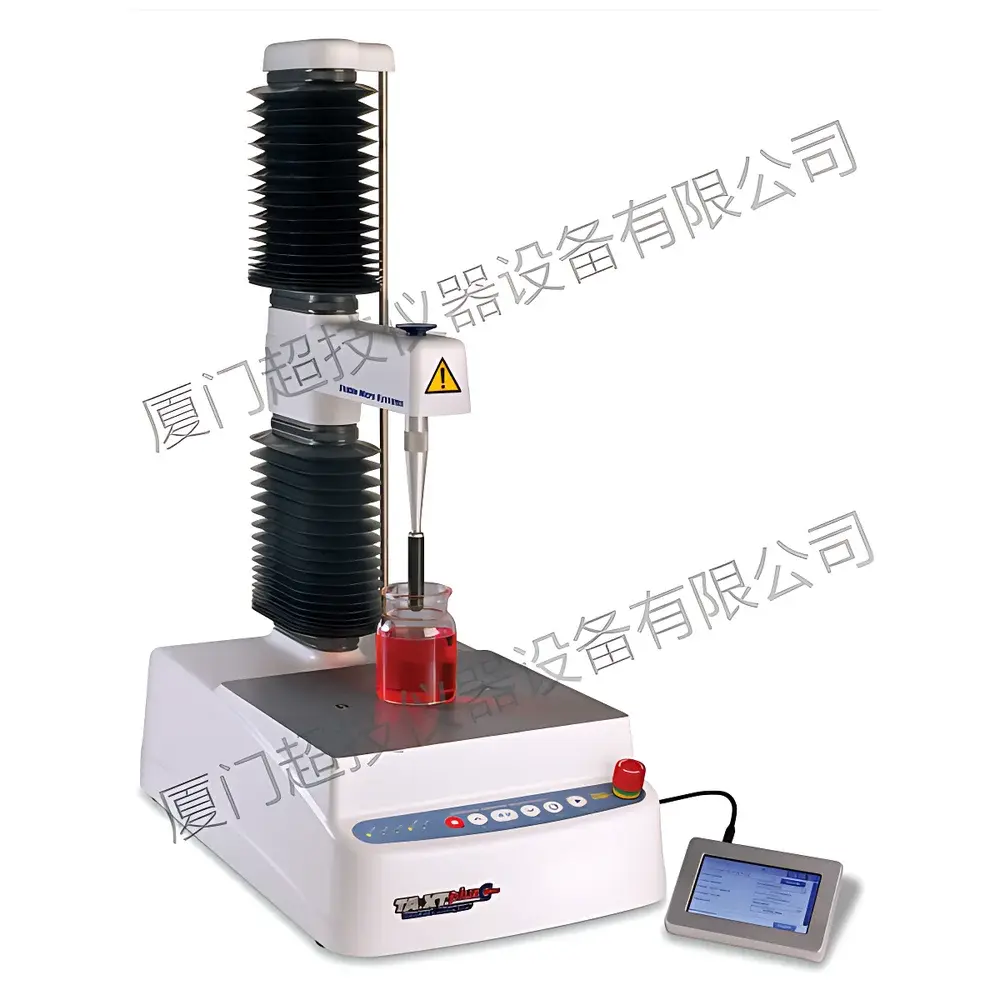
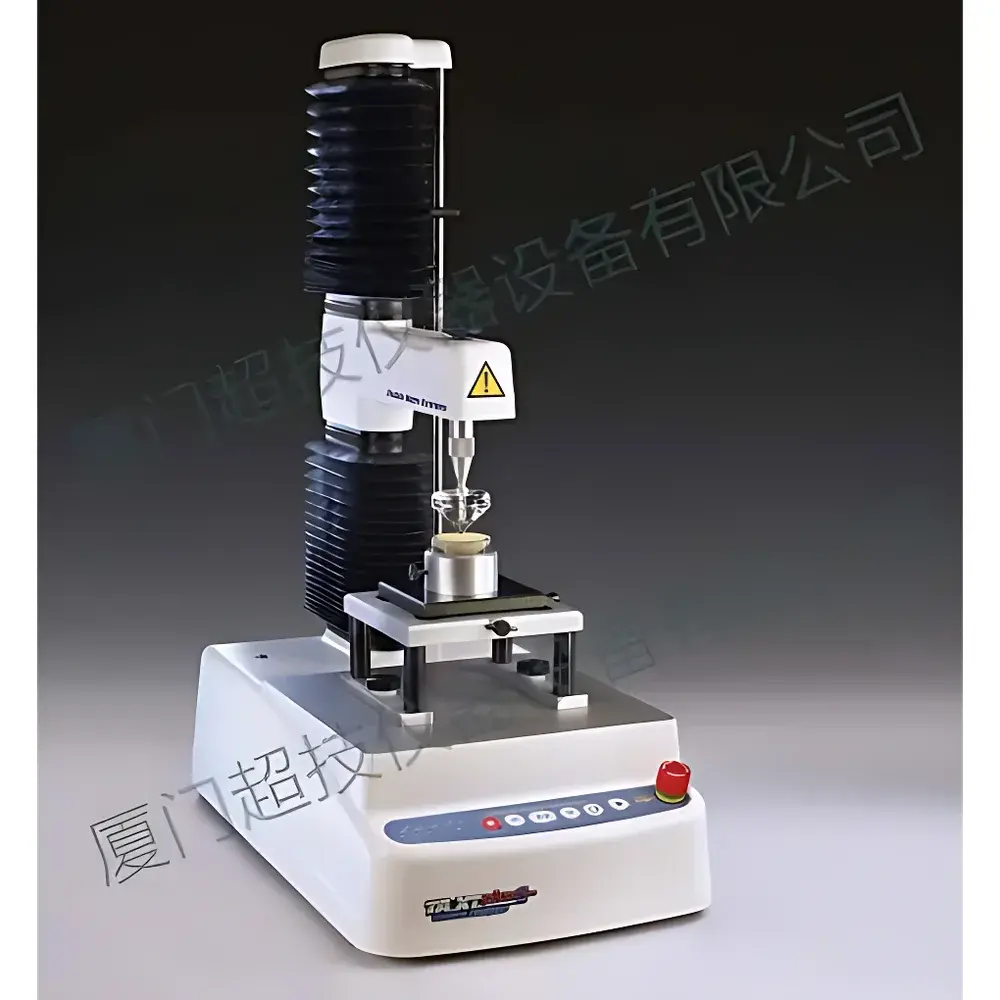
English Product Name
| Brand | Stable Micro Systems |
|---|---|
| Origin | United Kingdom |
| Model | TA.XT Plus C |
| Force Range | ±5 kg / ±30 kg / ±50 kg |
| Speed Range | 0.01–40 mm/s |
| Distance Resolution | 0.001 mm |
| Force Accuracy | 0.0002% of full scale |
| Test Distance Range | 0.001–295 mm |
| Operating Temperature | 0–40 °C |
| Dimensions (H×W×D) | 665 × 280 × 440 mm |
| Weight | 16.2 kg |
| Power Supply | 220 V, 50 Hz |
| Interface | RS232 or USB |
| Software | Multilingual (including English and Chinese), ASTM/ISO/AOAC-compliant method library |
| Probe Options | 300+ application-specific probes |
Overview
The Stable Micro Systems TA.XT Plus C Texture Analyzer is a high-precision, computer-controlled universal testing instrument engineered for quantitative mechanical property characterization of pharmaceutical and biomedical materials. Based on the fundamental principles of uniaxial compression, tension, penetration, extrusion, and shear deformation, the system applies controlled force and displacement to samples while recording real-time force–distance–time profiles. Its modular architecture enables rigorous quantification of textural parameters—including hardness, adhesiveness, cohesiveness, springiness, chewiness, gumminess, fracturability, and bioadhesion—critical for formulation development, quality control, and regulatory documentation in pharmaceutical manufacturing. Designed and manufactured in the UK, the TA.XT Plus C conforms to Good Manufacturing Practice (GMP) and Good Laboratory Practice (GLP) frameworks, supporting audit-ready data integrity in regulated environments compliant with FDA 21 CFR Part 11 and EU Annex 11 requirements.
Key Features
- Triple-range load cell options (±5 kg, ±30 kg, ±50 kg) enable precise measurement across low-force tablet coating evaluation and high-force bone substitute testing.
- Ultra-fine motion control with speed resolution of 0.01 mm/s and positional accuracy of 0.001 mm ensures reproducible simulation of physiological handling conditions (e.g., capsule disintegration, transdermal patch peel).
- Automated calibration routine using NIST-traceable external weights validates force accuracy per ISO/IEC 17025 requirements; software-guided self-checks confirm system readiness before each test sequence.
- Integrated environmental monitoring inputs accept optional temperature and humidity sensors, allowing correlation of mechanical behavior with ambient conditions during stability studies.
- Modular probe ecosystem includes over 300 application-specific fixtures—such as Bloom gel strength probes, tablet fracture rigs, syringe plunger testers, and mucosal bioadhesion plates—designed to ASTM D882, USP <1160>, ISO 11357, and Ph. Eur. 2.9.36 compliant geometries.
Sample Compatibility & Compliance
The TA.XT Plus C accommodates solid, semi-solid, and viscoelastic pharmaceutical dosage forms including immediate- and extended-release tablets, soft gelatin capsules, hydrogels, mucoadhesive films, lyophilized wafers, nasal sprays (via spray deposition analysis), transdermal patches, wound dressings, and excipient powders. It supports compliance with pharmacopoeial monographs (USP <1042>, <1160>, <1217>), international standards (ASTM D638, D882, D3330; ISO 11357-3; AEN/ISO 11357-4), and industry consortium protocols (GMIA, FINAT, PSTC). All test methods are documented in accordance with ALCOA+ principles—attributable, legible, contemporaneous, original, accurate, complete, consistent, enduring, and available—for regulatory submissions and internal audit trails.
Software & Data Management
Exponent Connect software provides a validated, 21 CFR Part 11–compliant platform featuring role-based user access, electronic signatures, automated audit logs, and secure data export (CSV, PDF, XML). Over 100 pre-programmed test templates—including capsule rupture, tablet hardness, ointment spreadability, suppository melt-through, and powder flow index—are directly downloadable and editable. Real-time graphical overlays display stress–strain curves, relaxation modulus decay, creep compliance, and time-dependent deformation kinetics. Built-in statistical tools calculate mean, SD, CV%, and confidence intervals across replicate runs; batch reporting modules generate GMP-compliant summary reports with embedded metadata (operator ID, timestamp, instrument serial number, calibration status).
Applications
- Tablet and capsule mechanical integrity assessment: crushing strength, friability, coating adhesion, and disintegration kinetics.
- Topical and transdermal product evaluation: gel firmness (Bloom value), ointment extrudability, patch peel/adhesion strength, and film tensile properties.
- Biomaterial characterization: hydrogel swelling pressure, scaffold compressive modulus, bone cement setting behavior, and tissue-engineered construct viscoelasticity.
- Excipient functionality testing: lactose flowability, microcrystalline cellulose compaction profile, polymer film plasticization, and surfactant-induced powder cohesion.
- Medical device interaction studies: catheter kink resistance, suture tensile break load, absorbent pad wicking rate, and adhesive tape removability under hydrated conditions.
FAQ
Is the TA.XT Plus C suitable for GLP/GMP-regulated laboratories?
Yes—the system supports full 21 CFR Part 11 compliance through Exponent Connect software, including electronic signatures, audit trail generation, and data integrity safeguards.
Can test methods be validated per ICH Q2(R2) guidelines?
Yes—method validation parameters (accuracy, precision, specificity, linearity, range, robustness) can be systematically evaluated using built-in calibration routines and reference standard materials.
Does the instrument support third-party probe integration?
Yes—standardized mechanical and electrical interfaces allow integration of custom or OEM probes meeting ISO 80000-4 dimensional and signal output specifications.
How is force accuracy verified between scheduled calibrations?
Users perform routine verification using certified external weights; the software guides step-by-step execution and records pass/fail outcomes with timestamps and operator IDs.
Are raw data files compatible with LIMS or statistical analysis platforms?
All exported datasets include metadata headers and adhere to ASTM E1482-20 and ISO/IEC 17025 traceability formats for seamless import into JMP, Minitab, or enterprise LIMS systems.



