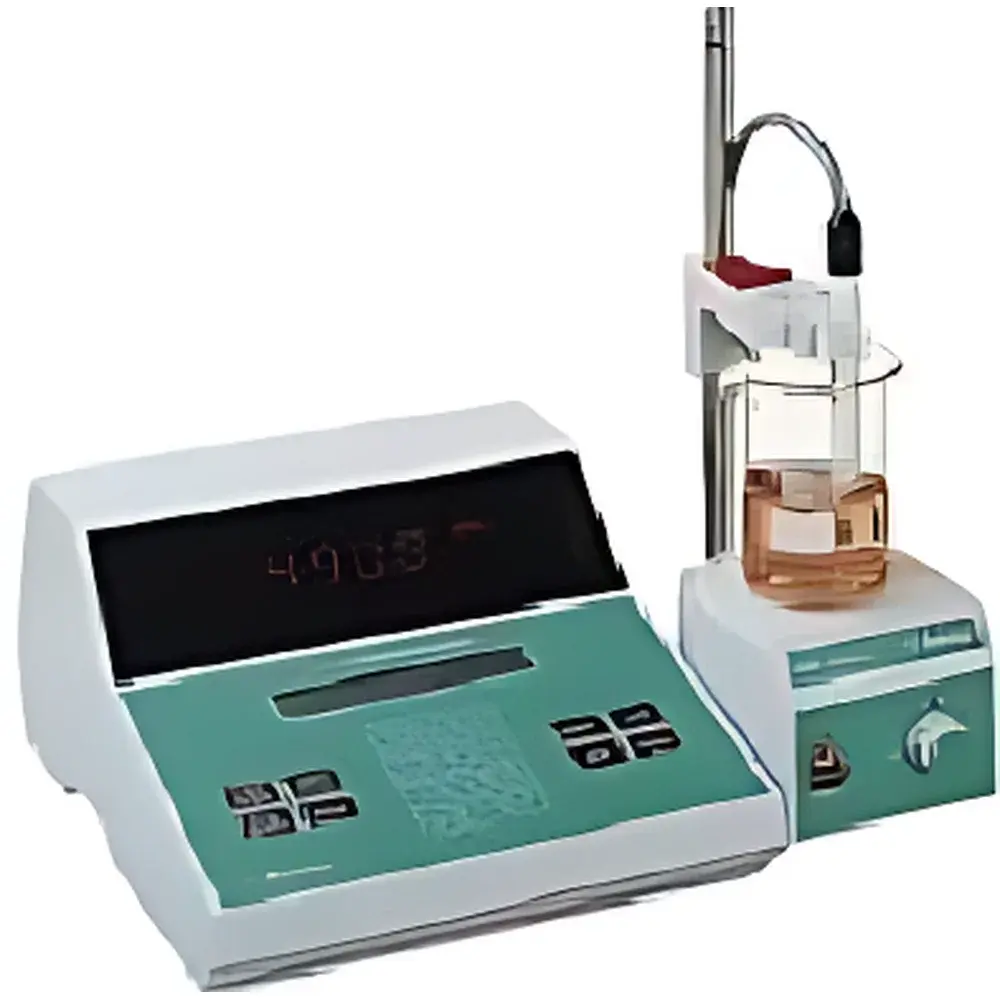
English Product Name
| Origin | Switzerland |
|---|---|
| Type | Imported Instrument |
| Model | 712 |
| Compliance | USP, GLP, ISO 9000 |
| Conductivity Range | 0.001 µS/cm to 20 S/cm |
| Temperature Range (Pt100/Pt1000) | −170 °C to +500 °C |
| TDS Range (as NaCl) | 0.5 mg/L to 300 g/L |
| Measurement Frequencies | 300 Hz / 2.4 kHz (auto-selectable) |
| Auto-Zero Function | Yes |
| Reference Temperature | User-Selectable |
| Cell Constant & Temp. Coefficient | Auto-Determined |
| Analog Output | Programmable |
| Digital Interface | RS-232C (bidirectional) |
| Platinization Current | 20 mA |
| Real-Time Plotting | Conductivity & Temperature vs. Time |
| I/O Lines | Min/Max Limit Outputs, Sample Changer Control |
Overview
The Metrohm 712 Online Conductivity Analyzer is a high-precision, laboratory-grade conductometer engineered for continuous or intermittent monitoring of aqueous and non-aqueous electrolyte solutions in industrial process control, pharmaceutical water systems, power plant chemistry, and environmental compliance applications. It operates on the principle of two-electrode or four-electrode AC conductivity measurement—applying a sinusoidal voltage across the cell and measuring the resulting current to determine solution conductance, corrected for geometric cell constant and temperature-dependent ion mobility. Its wide dynamic range (0.001 µS/cm to 20 S/cm) accommodates ultra-pure water validation (e.g., WFI, PW per USP ) as well as highly concentrated brines and chemical process streams. Built-in automatic range switching eliminates manual gain adjustments, ensuring uninterrupted data continuity during rapid concentration shifts. The instrument simultaneously acquires conductivity, temperature (via Pt100 or Pt1000 sensor), and derived TDS values—calculated using standardized NaCl equivalence algorithms traceable to NIST-certified reference materials. All measurements adhere to the fundamental relationship σT = σref × [1 + α(T − Tref)], where α is the sample-specific temperature coefficient automatically determined during calibration.
Key Features
- Automatic frequency selection (“Frequency Auto”) dynamically switches between 300 Hz and 2.4 kHz based on sample conductivity—minimizing polarization errors in low-conductivity ultrapure water and reducing capacitive interference in high-conductivity media.
- “Auto-Zero” function establishes a real-time baseline offset, enabling high-resolution tracking of small conductivity drifts—critical for leak detection, rinse validation, and endpoint identification in conductometric titrations.
- User-definable reference temperature (e.g., 20 °C, 25 °C, or custom) ensures alignment with pharmacopeial standards (USP , EP 2.2.38), ASTM D1125, or internal SOPs without post-processing correction.
- Integrated platinization current output (Iplat = 20 mA) enables in-situ electrochemical conditioning of stainless-steel or platinum conductivity cells—extending electrode service life and maintaining measurement stability in aggressive or fouling-prone streams.
- Dual-line alphanumeric display (16 characters × 2 lines) supports sample ID entry, real-time parameter viewing, and status flags—including last calibration date, cell constant, and temperature coefficient verification—fulfilling core GLP documentation requirements.
- Configurable relay outputs (min/max, hysteresis-adjustable) support direct integration into PLC-based control loops—eliminating the need for external controllers in dosing, blowdown, or alarm-triggered shutdown scenarios.
Sample Compatibility & Compliance
The 712 analyzer interfaces seamlessly with a broad spectrum of industrial and regulatory environments. It supports two-electrode cells for clean, low-viscosity fluids (e.g., purified water, boiler feedwater) and four-electrode cells for high-conductivity, high-fouling, or variable-viscosity samples (e.g., caustic soda, seawater desalination brine, fermentation broths). Temperature compensation follows either linear (α) or non-linear (β) models, selectable per application. The system meets the data integrity and audit-trail expectations of FDA 21 CFR Part 11 when paired with compliant LIMS or SCADA software—retaining full calibration history, operator IDs, timestamped events, and electronic signatures. It is validated for use in GMP manufacturing environments per ICH Q7 and supports IQ/OQ/PQ protocols through documented test scripts and factory calibration certificates (traceable to METAS or UKAS-accredited labs). All printed reports include instrument designation, serial number, date/time stamp, and measurement conditions—ensuring full traceability per ISO/IEC 17025 and ISO 9001 requirements.
Software & Data Management
Data acquisition and reporting are managed via bidirectional RS-232C interface, supporting both ASCII command protocols and proprietary Metrohm data formats. The analyzer transmits raw and compensated values—including conductivity, temperature, TDS, cell constant, α-coefficient, and status codes—to PCs, printers, or distributed control systems (DCS). Real-time plotting of conductivity and temperature versus time is directly supported on connected thermal or dot-matrix printers—enabling continuous trend logging without third-party software. Analog outputs (4–20 mA or 0–10 V) are fully programmable for any measured parameter or derived value (e.g., % saturation, deviation from setpoint), facilitating integration into legacy analog control infrastructure. Internal memory retains up to 1,000 measurement records with timestamps; external storage via serial dump allows long-term archiving compliant with 21 CFR Part 11 electronic record retention guidelines.
Applications
- Pharmaceutical water systems: Continuous monitoring of Purified Water (PW), Water for Injection (WFI), and Clean Steam condensate per USP and EU Annex 1.
- Power generation: Condensate polishing, steam cycle chemistry control, and demineralizer effluent verification.
- Chemical processing: Reaction endpoint detection in acid-base or redox titrations; concentration control in caustic/chlorine dosing loops.
- Food & beverage: Brine strength verification, CIP rinse water quality, and sugar solution concentration.
- Environmental monitoring: Effluent discharge compliance (e.g., EPA Method 120.1), groundwater salinity profiling, and desalination plant performance auditing.
FAQ
Does the 712 support four-electrode conductivity cells for high-conductivity applications?
Yes—it natively supports both two-electrode and four-electrode configurations, with automatic recognition and configuration of cell geometry and constant.
Can the instrument store calibration history and operator entries for GLP audits?
Yes—each calibration event is timestamped and logged with cell ID, reference standard used, α-coefficient, and operator identifier; all accessible via printout or serial export.
Is temperature measurement limited to Pt100 sensors?
No—both Pt100 and Pt1000 RTD inputs are supported, with configurable excitation current and lead-wire compensation for 2-, 3-, or 4-wire connections.
How does the “Auto-Zero” function improve resolution in low-conductivity measurements?
By subtracting the baseline offset in real time, it effectively increases the usable digitization range of the ADC—enabling detection of sub-0.001 µS/cm changes in ultrapure water systems.
Are analog outputs isolated and scalable?
Yes—fully galvanically isolated 4–20 mA outputs with user-defined zero/span mapping for any primary or derived parameter, including TDS deviation or temperature-compensated conductivity.
Related Products