
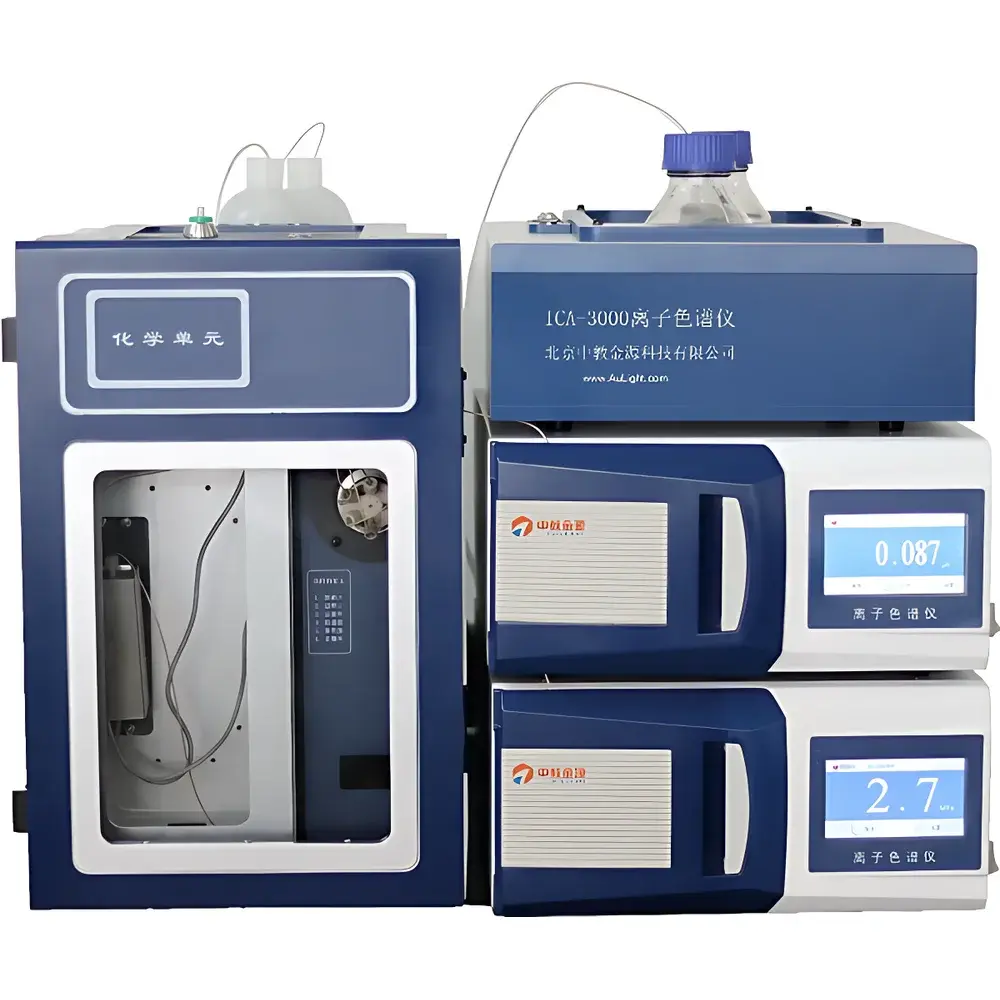
English Product Name
| Brand | Zhongjiaojinyuan |
|---|---|
| Origin | Beijing, China |
| Manufacturer Type | Direct Manufacturer |
| Country of Origin | China |
| Model | ICA-3000 |
| Pricing | Upon Request |
Overview
The Zhongjiaojinyuan ICA-3000 is a high-performance, suppressed-mode ion chromatograph engineered for precise, reproducible quantification of inorganic anions and cations in complex matrices. Based on the fundamental principle of ion exchange chromatography, the system separates ionic species according to their charge density and hydration radius on chemically functionalized stationary phases, followed by sensitive conductivity detection. Suppression—achieved via an integrated electrochemical micro-membrane suppressor—reduces background conductivity of eluents (e.g., KOH, methanesulfonic acid), thereby enhancing analyte signal-to-noise ratio without chemical reagent addition or manual regeneration. Designed for compliance with ISO 10304-1 (water quality — determination of dissolved anions by liquid chromatography), ASTM D4327 (standard test method for anions in water by suppressed ion chromatography), and USP (conductivity of water for pharmaceutical use), the ICA-3000 supports GLP/GMP-aligned workflows through audit-trail-capable software and hardware-level traceability.
Key Features
- Modular architecture enabling standalone anion, cation, or simultaneous dual-channel analysis—ideal for multi-ion environmental screening or process control validation.
- Integrated dual-piston high-pressure pump system (max. 36 MPa) with intelligent flow control algorithm; delivers stable flow rates from 0.0001 to 5.000 mL/min across pH 0–14 eluent chemistries, including carbonate, hydroxide, and sulfonic acid gradients.
- Self-regenerating electrochemical suppressor with zero dead volume design; operates continuously without external acid or base, achieving thermal and chemical stability within <12 minutes after startup.
- Temperature-controlled conductometric detector featuring dual-pulse excitation, digital thermostatic regulation (range: ambient +5°C to 59°C, stability ≤±0.05°C), and 1 µL cell volume—optimized for low-noise baseline (<0.05% FS) and high-resolution detection (≤0.020 nS).
- 6-port high-pressure injection valve with automated signal triggering and sub-1.0 µL precision metering; enables uninterrupted flow during injection cycles for unattended operation.
- Column oven with independent PID control ensures isothermal conditions across separation column, suppressor, and detector—critical for retention time reproducibility and peak shape fidelity.
- Touchscreen LCD interface supporting full instrument parameter configuration and real-time status monitoring without PC dependency.
- Wireless Bluetooth and USB 2.0 connectivity options allow remote operation from any workstation running dedicated IC software—supporting multi-user lab environments and distributed QC networks.
Sample Compatibility & Compliance
The ICA-3000 demonstrates robust performance across diverse sample types requiring regulatory-grade ion quantification: aqueous environmental samples (rainwater, surface water, wastewater, atmospheric particulate extracts), semiconductor-grade ultrapure water, food extract matrices (e.g., dairy, beverages), pharmaceutical excipient solutions, and catalytic reaction effluents (e.g., photocatalytic NOx degradation, CO2 reduction products). Its PEEK fluidic path resists corrosion from strong acids, bases, and organic modifiers—enabling compatibility with EPA Method 300.1 (anions), ASTM D6919 (cations), and ISO 14911 (cation exchange). All hardware components meet CE/EMC Directive 2014/30/EU requirements; software architecture supports 21 CFR Part 11-compliant electronic signatures and audit trails when deployed with validated configurations.
Software & Data Management
The proprietary IC workstation provides 24-bit analog-to-digital conversion with real-time baseline correction, automatic negative peak recognition, and adaptive integration algorithms. It supports method transfer between instruments, retention time locking, and customizable report templates compliant with ISO/IEC 17025 documentation standards. Instrument control is bidirectional: users configure pump gradients, detector settings, and injection sequences directly from the software interface, while the system autonomously logs operational parameters, error codes, and maintenance events. Data export formats include CSV, PDF, and CDF (NetCDF)—facilitating integration with LIMS platforms and statistical process control (SPC) dashboards. Firmware updates are delivered via secure HTTPS channels with cryptographic signature verification.
Applications
Primary application domains include environmental monitoring (Cl−, NO3−, SO42−, F−, NH4+, Ca2+ in drinking water per WHO guidelines), industrial hygiene (trace metal cations in electroplating baths), food safety (nitrite/nitrate in cured meats per EU Regulation No. 1169/2011), and advanced materials research (in situ ion release profiling from photocatalysts under UV irradiation). The system’s low detection limits (e.g., Cl− ≤ 0.005 µg/mL; BrO3− ≤ 0.01 µg/mL; Li+ ≤ 0.008 µg/mL) make it suitable for ultra-trace analysis in cleanroom water systems and battery electrolyte characterization.
FAQ
Does the ICA-3000 support gradient elution for complex sample matrices?
Yes—the dual-pump architecture allows independent programming of eluent concentration and pH gradients, enabling optimized resolution of co-eluting ions such as phosphate and sulfate in wastewater.
Can the suppressor be used with both acidic and basic eluents?
Yes—the electrochemical membrane suppressor operates across pH 0–14 and is compatible with methanesulfonic acid (MSA), potassium hydroxide (KOH), and carbonate-based eluents without performance degradation.
Is the software validated for regulated pharmaceutical laboratories?
The workstation supports 21 CFR Part 11 implementation when configured with user access controls, electronic signatures, and audit trail logging—subject to site-specific IQ/OQ/PQ validation protocols.
What maintenance intervals are recommended for routine operation?
The suppressor requires no consumables or manual regeneration; annual calibration of detector sensitivity and pump flow accuracy is recommended per ISO/IEC 17025 maintenance schedules.
How does the system handle particulate-laden samples?
A 0.22 µm inline filter is standard upstream of the injector; for high-solids samples (e.g., digested sludge), offline centrifugation or syringe filtration is advised prior to injection.






