
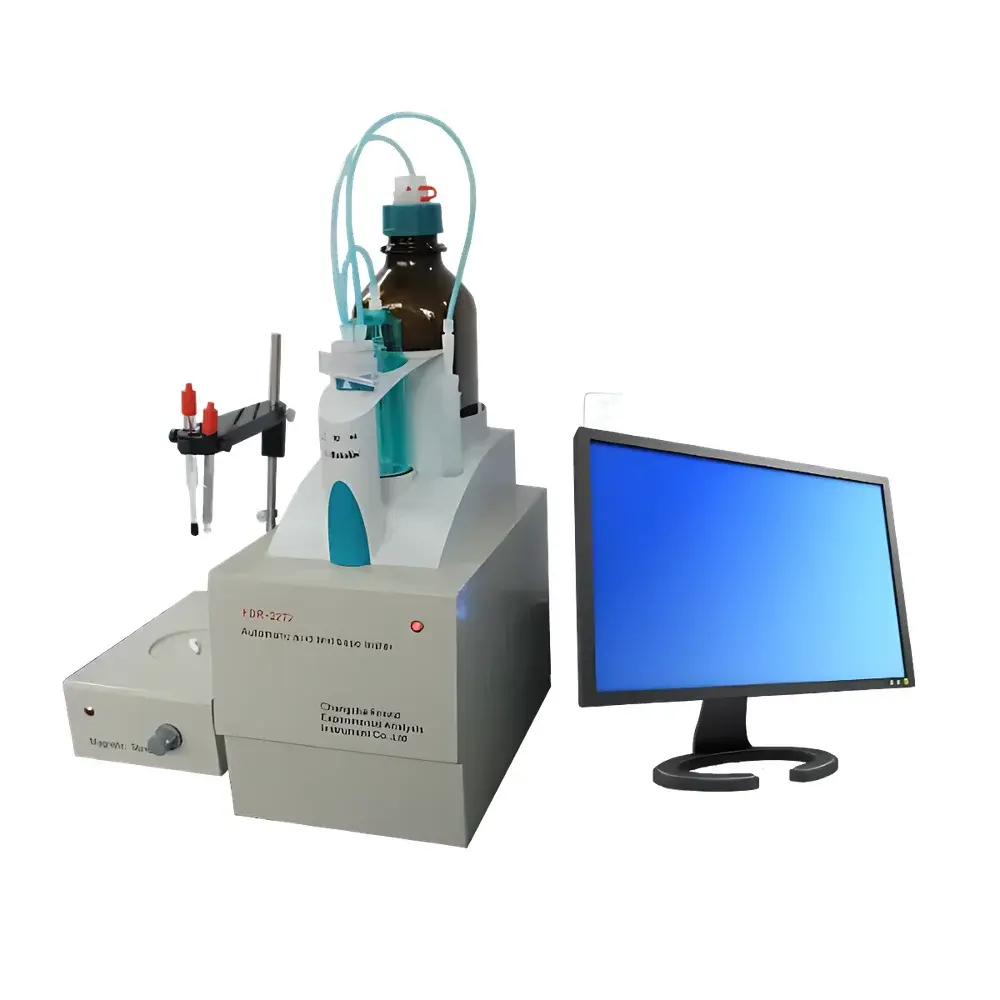
English Product Name
| Brand | Furand (csfriend) |
|---|---|
| Model | FDR-2271 |
| Instrument Class | 0.05 |
| pH Range | 0.00–14.00 pH |
| mV Range | −1800.0 to +1800.0 mV |
| Temperature Range | −5.0 to 105.0 °C |
| pH Resolution | 0.01 pH |
| mV Resolution | 0.1 mV |
| Temperature Resolution | 0.1 °C |
| pH Accuracy | ±0.01 pH ±1 digit |
| mV Accuracy | ±0.03% FS |
| Temperature Accuracy | ±0.3 °C ±1 digit |
| Burette Capacity Tolerance | ±0.025 mL (10 mL), ±0.035 mL (20 mL) |
| Burette Resolution | 1/10000 (10 mL), 2/10000 (20 mL) |
| Burette Fill/Dispense Time | 50 ±10 s (full scale) |
| Repeatability | 0.2% RSD |
| Endpoint Detection Sensitivity | ±2 mV |
| Drift Stability | ±0.3 mV ±1 digit / 3 h |
| Power Supply | AC 220 V ±10%, 50 Hz ±1 Hz |
| Dimensions (W×D×H) | 340 × 400 × 400 mm |
| Weight | 10 kg |
Overview
The Furand FDR-2271 Automated Acid-Base Titration Analyzer is a dedicated potentiometric titration system engineered for precise determination of acid number (AN) and base number (BN) in petroleum products—including lubricating oils, transformer oils, diesel fuels, and crude fractions—according to standardized test methods such as ASTM D664, ASTM D974, ISO 3675, ISO 6618, and GB/T 1884. The instrument implements a robust two-electrode potentiometric endpoint detection principle, where the inflection point of the potential–volume (E–V) curve is identified via first-derivative analysis (dE/dV). This method eliminates subjective visual endpoint interpretation, ensuring high reproducibility across operators and laboratories. Designed for routine QC/QA environments in refineries, lubricant blending facilities, and third-party testing labs, the FDR-2271 integrates a microprocessor-controlled burette drive, temperature-compensated reference electrode interface, and real-time electrochemical signal acquisition at 10 Hz sampling rate. Its architecture supports both aqueous and non-aqueous titrations, with compatibility for glass combination electrodes, redox electrodes, and ion-selective sensors—enabling full method flexibility beyond acid-base determinations.
Key Features
- Windows-based control software with bilingual (English/Chinese) GUI, supporting mouse and keyboard operation without external PC dependency—embedded industrial computer included.
- Real-time simultaneous display of E–V titration curves, dE/dV derivative plots, measured electrode potential (mV), delivered titrant volume (mL), and final calculated acid/base number (mg KOH/g).
- Automated endpoint recognition using dynamic slope thresholding and inflection point interpolation—configurable sensitivity (±2 mV default) and delay filtering to suppress noise-induced false triggers.
- Preloaded titration modes: pre-titration, preset-endpoint, blank correction, manual override, and user-defined method templates—each storing electrode calibration history, titrant concentration, solvent parameters, and calculation coefficients.
- Chemically resistant fluid path constructed from PTFE, borosilicate glass, and ceramic components; compatible with perchloric acid in glacial acetic acid, alcoholic KOH, and other aggressive titrants used in non-aqueous BN analysis.
- Fully automated peripheral functions: electrode rinsing (programmable rinse cycles with adjustable duration), reagent reservoir replenishment, and fixed-volume dosing for standardization or blank steps.
Sample Compatibility & Compliance
The FDR-2271 accommodates liquid petroleum samples ranging from low-viscosity naphthas to high-viscosity residual fuels (up to 500 cSt at 40 °C), provided they are homogenized and free of particulate contamination. Sample volumes range from 10 to 50 mL depending on expected AN/BN magnitude and selected titrant normality (0.01 N to 0.1 N). The system meets the instrumental performance criteria specified in ASTM D664 Annex A1 (potentiometric apparatus requirements) and ISO 8293 for acid number determination. All calibration, validation, and operational records—including electrode slope, asymmetry potential, titrant titer verification logs, and raw titration curves—are timestamped and stored locally with audit-trail capability. While not inherently 21 CFR Part 11 compliant out-of-the-box, the firmware supports optional digital signature modules and user access levels (admin/operator/analyst) to facilitate GLP/GMP-aligned deployment when integrated into validated laboratory informatics environments.
Software & Data Management
The embedded Windows OS runs Furand’s proprietary TitraSoft v3.x application, which provides full method lifecycle management: creation, versioning, locking, and electronic signature-enabled approval. Raw data files (.tdf) retain unprocessed mV/time series, interpolated dE/dV maxima, and intermediate calculations per IUPAC-recommended traceability standards. Export formats include CSV (for LIMS ingestion), PDF analytical reports (with lab header, analyst ID, instrument ID, and QC flagging), and XML for enterprise ELN integration. Data backup is automated to internal SSD and configurable network shares (SMB/CIFS). Software validation documentation (IQ/OQ protocols) and electronic record retention policies (≥10 years) are available upon request for regulated users.
Applications
- Determination of Total Acid Number (TAN) in in-service turbine oils per ASTM D664—critical for monitoring oxidation degradation and predicting remaining useful life.
- Base Number (BN) quantification in marine cylinder oils (ASTM D974) to assess detergent reserve and neutralization capacity against acidic combustion byproducts.
- Quality control of new lubricants and additive packages during manufacturing, including synthetic ester-based formulations requiring non-aqueous titration conditions.
- Crude oil assay support: rapid screening of naphthenic acid content prior to desalting and corrosion risk assessment.
- Research applications involving titration thermodynamics, electrode kinetics, and method development for novel petroleum-derived biofuels.
FAQ
What electrode types are recommended for ASTM D664 acid number analysis?
A combination glass pH electrode with double-junction reference (e.g., Ag/AgCl/KNO₃ outer fill) is standard. For high-chloride or sulfided samples, a sleeve-type junction electrode minimizes clogging. Electrodes must be calibrated daily using certified pH 4.01 and 7.00 buffers.
Can the FDR-2271 perform back-titrations or multi-step titrations?
Yes—the software supports sequential titrant addition with conditional logic (e.g., “add 5 mL HCl, wait 60 s, then titrate with NaOH to pH 7.0”), enabling Karl Fischer water determination add-ons or complex redox sequences.
Is temperature control of the sample vessel available?
The unit includes a built-in Pt100 temperature sensor in the titration beaker holder but does not integrate a Peltier or water-jacketed thermostat. External heating mantles or chillers may be used with manual temperature input compensation.
How is system suitability verified before sample analysis?
Daily verification requires titration of certified reference material (CRM) such as NIST SRM 2722 (acid number) or SRM 2723 (base number), with acceptance criteria: recovery 95–105% and repeatability ≤0.15 mg KOH/g (for AN) or ≤0.20 mg KOH/g (for BN).
Does the instrument support remote diagnostics or firmware updates?
Yes—via Ethernet port using secure HTTPS-based update portal; remote desktop assistance is enabled under authenticated admin credentials with configurable session timeout and activity logging.




