
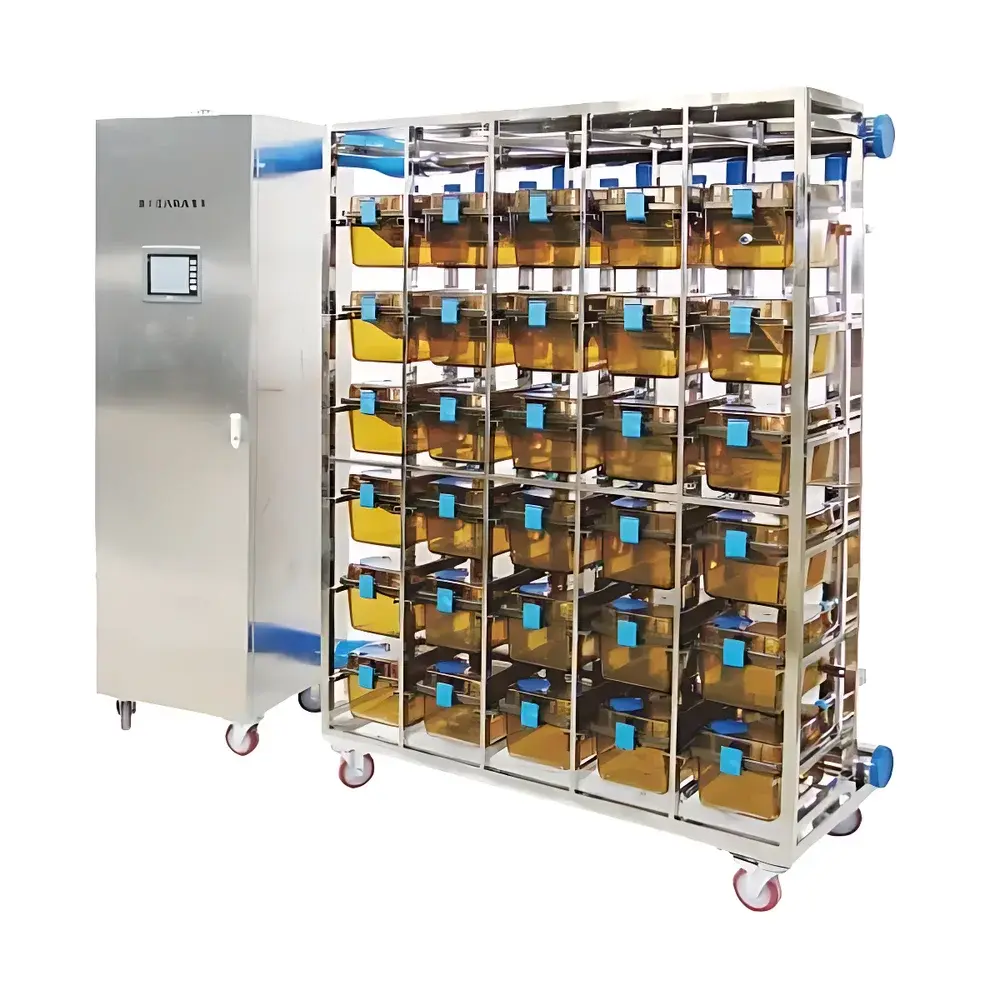
English Product Name
| Origin | Beijing, China |
|---|---|
| Manufacturer Type | Authorized Distributor |
| Origin Category | Domestic (China) |
| Model | GA56 Cage |
| Pricing | Upon Request |
| Air Changes per Hour | 10–50 (adjustable) |
| Air Velocity | ≤0.18 m/s |
| Pressure Gradient | 20–50 Pa (adjustable) |
| Air Cleanliness Class | < ISO Class 5 (≤100 particles ≥0.5 µm/m³) |
| Settle Plate Microbial Count | <1 CFU/4 h |
| Noise Level | <55 dB(A) |
| Dimensions (W×D×H) | 1890 × 530 × 1750 mm |
| Rack Configuration | 7 tiers × 8 cages per tier |
| Cage Material | Medical-Grade PSU (Polyphenylsulfone), Autoclavable at 150°C, 15 psi for 30 min |
Overview
The LabIVC GA56 Mouse IVC Caging System is an engineered solution for barrier-level rodent housing in preclinical research, GLP-compliant toxicology studies, and immunocompromised animal models. Designed around the principle of independent ventilation with static-pressure air distribution, the system delivers HEPA-filtered air to each cage via a dedicated ducted pathway—eliminating cross-contamination between cages while maintaining precise environmental control. Unlike conventional rack-based systems relying on shared plenums, the GA56 employs a micro-differential pressure architecture where each cage functions as an isolated microenvironment. Air enters through a laminarized static-pressure chamber integrated into the cage lid, diffusing uniformly through precision-drilled orifices at low velocity (≤0.18 m/s) to avoid stress-induced physiological artifacts in mice. This design complies with internationally recognized standards for ventilated caging, including NIH Guide for the Care and Use of Laboratory Animals, AAALAC International requirements, and EU Directive 2010/63/EU Annex III specifications for airflow and containment.
Key Features
- Color TFT touchscreen interface displaying real-time cage-level parameters: temperature, relative humidity, inter-cage pressure gradient, cumulative runtime, and supply/exhaust airflow status.
- Static-pressure air distribution system with integrated lid-mounted diffusion chamber and aerodynamically optimized baffle plate—ensuring uniform, laminar, low-velocity airflow across the entire living zone.
- Variable-frequency drive (VFD) controlled supply and exhaust fans enabling precise, independent regulation of air changes per hour (10–50 ACH) and pressure differential (20–50 Pa) per cage row.
- Imported German-engineered centrifugal blower assembly with redundant thermal protection and continuous duty-cycle rating for 24/7 operational reliability.
- Intelligent alarm matrix: triggers visual and audible alerts for out-of-range temperature/humidity, loss of pressure differential, power interruption, or HEPA filter saturation (tracked via cumulative runtime counter).
- Self-sealing inlet/outlet valves automatically close upon cage removal—preventing unfiltered air ingress and maintaining rack-level containment integrity.
- Medical-grade silicone gaskets ensure leak-tight sealing at all cage-to-rack interfaces, validated per ISO 14644-3 containment testing protocols.
- Dual-redundant safety pathways: passive ventilation channel remains open during power failure to sustain minimum O₂ exchange for ≥24 hours; manual “life window” access enables emergency intervention without compromising adjacent cages.
- Cage bodies fabricated from PSU (polyphenylsulfone), certified USP Class VI biocompatible polymer—resistant to autoclaving (150°C, 15 psi, 30 min), repeated chemical disinfection (e.g., 2% peracetic acid, 70% ethanol), and long-term UV exposure.
Sample Compatibility & Compliance
The GA56 system accommodates standard IVC-compatible mouse cages (up to 56 units per rack) and supports optional retrofitting for rat-sized cages (e.g., GA30/GA36 configurations). All structural components meet ISO 7218:2018 microbiological safety requirements for animal housing infrastructure. The system’s airflow performance has been verified against ASTM E2952-14 (Standard Practice for Performance Testing of Ventilated Animal Caging Systems) and aligns with FDA expectations for environmental controls in nonclinical laboratory studies (FDA Guidance for Industry: Nonclinical Laboratory Studies, 2022). Full audit trails—including parameter logs, alarm history, and maintenance timestamps—are exportable in CSV format to support 21 CFR Part 11-compliant data governance workflows.
Software & Data Management
The embedded control firmware records timestamped environmental data at 1-minute intervals, storing up to 12 months locally. Data export is supported via USB 2.0 or Ethernet (Modbus TCP/IP) for integration into centralized LIMS or facility monitoring platforms. Alarm events are tagged with severity level (warning, critical, fault), duration, and root-cause code—enabling root-cause analysis during GLP audits. Optional cloud-based remote monitoring (via TLS 1.2–secured API) permits off-site oversight of multiple GA56 racks across distributed vivarium sites, with configurable email/SMS notifications for predefined threshold breaches.
Applications
The GA56 system is deployed in academic transgenic core facilities, contract research organizations (CROs) conducting oncology and immunology studies, and pharmaceutical R&D labs requiring reproducible phenotyping of genetically engineered mouse models (GEMMs). Its high-fidelity environmental control minimizes confounding variables in behavioral assays, metabolic phenotyping, and longitudinal infection challenge models. The modular rack architecture allows seamless scalability—from single-rack installations in satellite labs to multi-rack arrays integrated with automated cage-washing and bedding-dispensing infrastructure.
FAQ
What is the maximum autoclave cycle tolerance for the PSU cages?
Cages are validated for repeated autoclaving at 150°C, 15 psi (103 kPa) for 30 minutes without dimensional distortion or loss of optical clarity.
Does the system support integration with third-party building management systems (BMS)?
Yes—via Modbus TCP/IP or optional BACnet MS/TP gateway, enabling real-time telemetry of pressure differentials, fan status, and alarm states into enterprise-wide HVAC monitoring platforms.
How is cage-level air change rate calibrated and verified?
Each cage includes a factory-calibrated thermal anemometer port; users may perform on-site verification using traceable NIST-certified airflow meters per ASTM E2952-14 Annex A2.
Is the touchscreen interface compliant with IEC 62304 for medical device software?
While not classified as a medical device, the firmware follows IEC 62304 Software Lifecycle processes for Class B software, with full version-controlled source code archives available under NDA for regulatory submissions.
Can the GA56 rack be operated in negative-pressure containment rooms?
Yes—the exhaust manifold is designed for connection to dedicated room-level exhaust ducting with variable-air-volume (VAV) balancing, maintaining stable rack-level pressure gradients even under dynamic room pressure conditions.





