
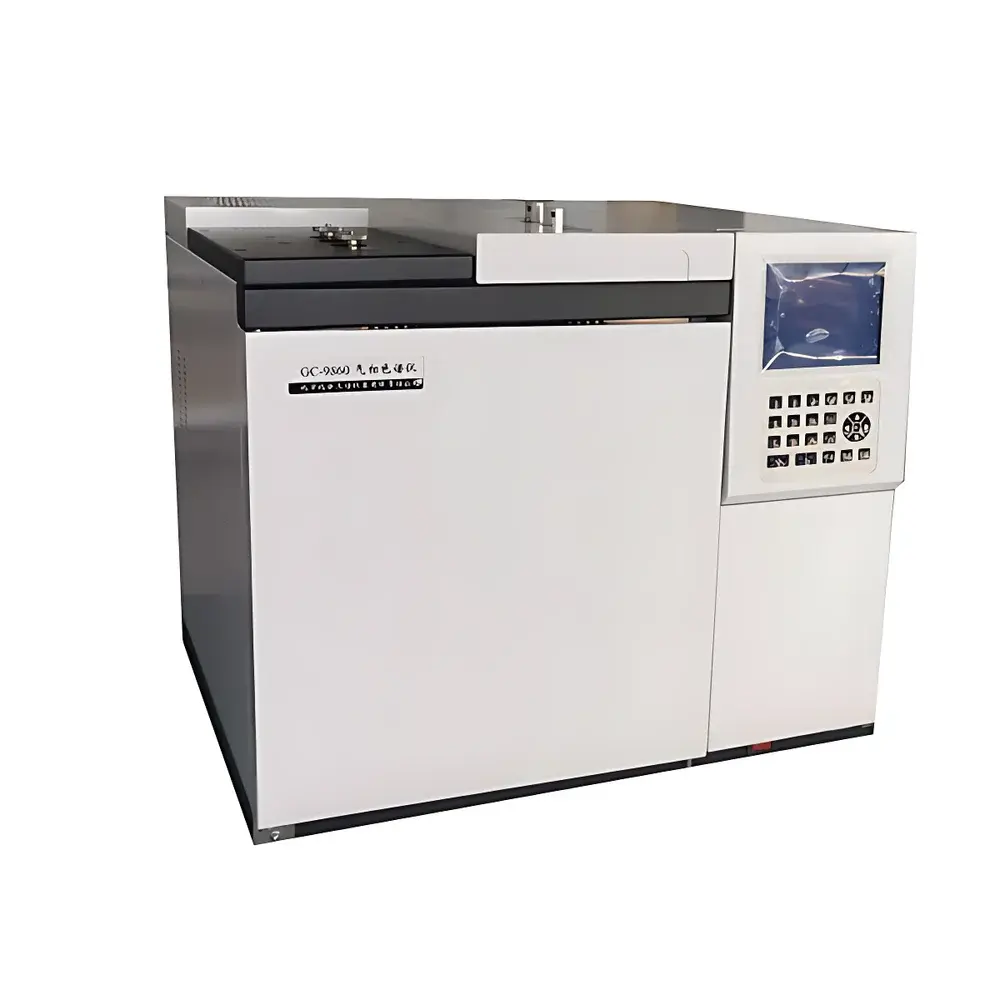
English Product Name
| Brand | Beifen Sanpu |
|---|---|
| Origin | Beijing, China |
| Manufacturer Type | Direct Manufacturer |
| Instrument Type | Laboratory Gas Chromatograph |
| Model | GC-9860III |
| Temperature Control Range | Ambient to 400 °C |
| Maximum Ramp Rate | 40 °C/min |
| Cooling Rate | 40 °C/min |
| Carrier Gas Flow Range | 0–1200 mL/min |
| Carrier Gas Pressure Range | 0–970 kPa |
| Injector Maximum Temperature | 450 °C |
| Injector Pressure Setting Range | 0–970 kPa |
| Injector Total Flow Setting Range | 0–1200 mL/min |
Overview
The Beifen Sanpu GC-9860III Dedicated Gas Chromatograph is a purpose-engineered analytical system designed specifically for the quantitative determination of volatile impurities in food-grade ethyl alcohol (ethanol), in full compliance with Chinese national standards GB/T 10345–2008 (Methods for Analysis of Alcoholic Beverages) and GB 10343–2008 (Hydrous Ethanol for Industrial Use). It employs capillary gas chromatography with flame ionization detection (FID) and polyethylene glycol (PEG-20M) stationary phase columns to resolve and quantify critical contaminants—including methanol, acetaldehyde, ethyl acetate, fusel oils (higher alcohols such as propanol, isobutanol, and amyl alcohols), and other trace volatiles—using internal standard calibration. The instrument operates on classical gas chromatographic principles: sample vaporization in a temperature-controlled inlet, separation within a thermally stable capillary column under precisely regulated carrier gas flow and pressure, and selective detection via FID with linear response over six orders of magnitude. Its architecture supports routine QC/QA workflows in ethanol production facilities, regulatory testing laboratories, and third-party certification bodies requiring trace-level accuracy and method reproducibility.
Key Features
- Industrial-grade thermal management system with eight-stage linear programmable temperature ramping and intelligent dual rear-door cooling, enabling precise near-ambient column oven control (±0.1 °C stability) across wide operating ranges.
- Dual independent gas control modules: high-precision electronic pressure control (EPC) and mass flow control (MFC) for carrier (N₂), fuel (H₂), and makeup (air) gases—ensuring long-term retention time reproducibility and peak symmetry.
- High-capacity split/splitless injector with active vaporization chamber design, supporting both manual and automated injection modes; maximum injector temperature up to 450 °C with real-time pressure and total flow regulation.
- Modular detector configuration: accommodates simultaneous installation of up to four detectors (e.g., dual FID, dual TCD, or mixed combinations); each detector operates independently with dedicated gas supply and signal processing channels.
- Integrated self-diagnostic firmware with real-time fault logging and Chinese/English bilingual display interface (5.7″ LCD, 320 × 240 resolution); stores up to 20 complete method configurations and chromatographic data sets internally via non-volatile FLASH memory—no battery backup required.
- Comprehensive safety architecture including automatic carrier gas shutoff upon flow interruption, platinum RTD-based overtemperature protection, open/short circuit detection for temperature sensors, and FID auto-ignition with flame-out monitoring.
Sample Compatibility & Compliance
The GC-9860III is validated for direct analysis of undiluted or diluted aqueous ethanol solutions (≥95% v/v), fortified with internal standards (e.g., n-propanol or isopropanol) per GB 10343–2008 protocols. It accepts liquid samples via syringe injection or optional accessories including headspace autosamplers, thermal desorption units, and pyrolysis interfaces. All hardware and software components comply with general laboratory safety requirements per IEC 61010-1. While not pre-certified for FDA 21 CFR Part 11, the system supports audit-trail-ready operation when paired with BF-2002白酒专用工作站 (Baijiu Analysis Workstation), which logs user actions, method changes, and raw data modifications—facilitating GLP/GMP-aligned documentation practices. Method transfer and validation align with ISO/IEC 17025 and ASTM D4806–22 (Standard Specification for Denatured Fuel Ethanol).
Software & Data Management
The BF-2002 Baijiu Analysis Workstation is a Windows-based chromatography data system (CDS) optimized for alcoholic beverage testing. It provides automated peak integration using retention time locking (RTL) algorithms, internal standard ratio calculations, and pass/fail reporting against predefined specification limits per GB 10343–2008. Raw data files (.cdf or .txt) are stored with embedded metadata (operator ID, date/time stamp, instrument parameters, calibration history). The software supports LIMS export via CSV or XML and includes built-in tools for system suitability testing (SST), including resolution (Rs), tailing factor (Tf), and %RSD of replicate injections. All data handling conforms to ALCOA+ principles (Attributable, Legible, Contemporaneous, Original, Accurate, Complete, Consistent, Enduring, Available) for regulatory review.
Applications
- Quantitative analysis of methanol and higher alcohols in potable ethanol and neutral spirits per national food safety regulations.
- Batch release testing in ethanol manufacturing plants to verify conformance with GB 10343–2008 purity grade specifications (Super Grade, First Grade, Ordinary Grade).
- Raw material verification of fermentation-derived ethanol feedstocks prior to distillation or dehydration steps.
- Contamination screening in pharmaceutical-grade ethanol used as solvent or excipient (aligned with USP Chromatography guidelines).
- Research applications in fermentation optimization, yeast strain evaluation, and process troubleshooting through volatile metabolite profiling.
FAQ
Does the GC-9860III support method validation according to international pharmacopoeial standards?
Yes—the instrument’s thermal stability, retention time repeatability (<0.05% RSD), and detector linearity meet baseline requirements for USP , EP 2.2.46, and JP 6.05 method validation protocols when operated with appropriate column selection and calibration procedures.
Can the system be integrated into an automated production QC line?
With optional accessories such as the HS-12A automatic headspace sampler or PAL RTC robotic autosampler, the GC-9860III supports unattended overnight analysis and scheduled reporting via Ethernet-connected CDS.
Is remote diagnostics and firmware update capability available?
Remote access is supported via secure VNC or TeamViewer connections under customer IT policy; firmware updates are delivered as signed binary packages with version-controlled changelogs and rollback functionality.
What maintenance intervals are recommended for routine operation?
FID nozzle cleaning every 200 injections; column trimming every 6 months or after 500 injections; EPC sensor recalibration annually or after major gas system servicing.
Does the instrument include factory-installed IQ/OQ documentation?
IQ/OQ templates compliant with ISO/IEC 17025 Annex A.2 are provided upon request; full qualification support—including on-site execution by certified field application engineers—is available as a value-added service.
Related Products





