
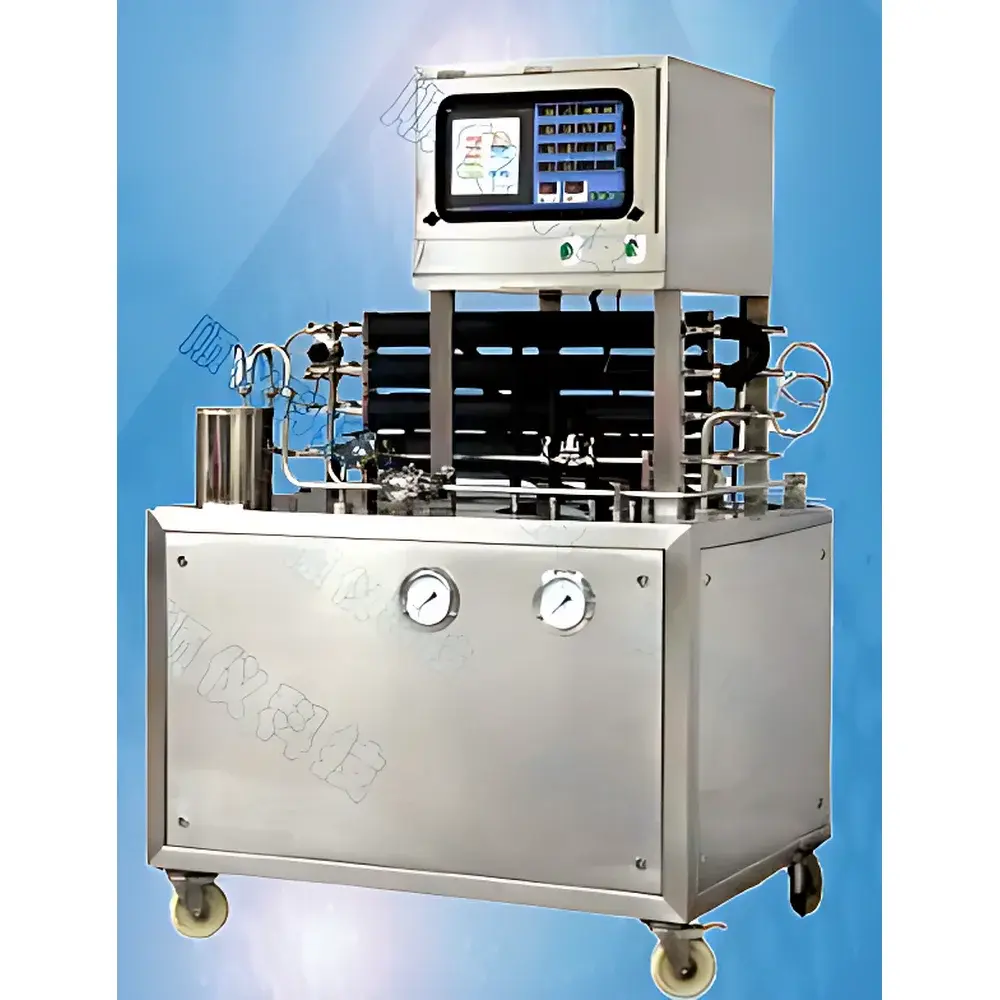
English Product Name
| Origin | Shanghai, China |
|---|---|
| Manufacturer Type | Authorized Distributor |
| Origin Category | Domestic (China) |
| Model | ST-20 |
| Pricing | Upon Request |
| Standard Throughput | 20 L/h (adjustable 5–40 L/h) |
| Minimum Batch Volume | 3–5 L |
| Max Sterilization Temperature | 150 °C |
| Holding Time Options | 5 s, 15 s, 30 s (at 20 L/h) |
| Fill Temperature Range | 20–90 °C |
| SIP Capability | Yes |
| CIP Flow Rate | 400 L/h |
| Max System Pressure | 10 bar |
| Power Supply | 3-phase, 380 V, 10 kW |
| Dimensions (UHT Unit) | 1600 H × 1200 L × 950 W mm |
| Aseptic Filling Module (CT-20) | HEPA Filtration Efficiency ≥99.999% @ 0.3 µm |
| Cleanroom Class | ISO Class 5 (Fed. Std. 209E Class 100) |
| CT-20 Dimensions | 2100 H × 850 L × 660 W mm |
| CT-20 Power | Single-phase, 220–240 V, 50 Hz, 0.25 kW |
Overview
The ST-20 Laboratory-Scale Ultra-High Temperature (UHT) Sterilization System is an engineered platform for precise thermal process development and validation of fluid-based food, dairy, beverage, and functional nutrition products. Based on the principle of direct or indirect UHT processing—typically involving rapid heating to ≥135 °C for controlled residence times (e.g., 2–30 seconds) followed by immediate cooling—the system replicates industrial-scale sterilization kinetics in a benchtop footprint. Unlike conventional pasteurization units, the ST-20 supports true UHT conditions (up to 150 °C), enabling microbiological validation studies compliant with ISO 11133, AOAC 977.27, and FDA guidance for low-acid canned foods. Its integrated design bridges formulation R&D and pilot-scale trials, delivering scalable data for regulatory submissions, shelf-life modeling (per ISO 21869 and ASTM F1980), and process hazard analysis (HACCP). The system operates under full hydraulic and thermal mass balance, ensuring fidelity between lab results and commercial retort or continuous UHT line performance.
Key Features
- Compact footprint (2–3 m²), mobile on industrial casters with leveling feet for stable operation on standard laboratory flooring
- Full PID-controlled thermal management with ±0.5 °C accuracy across heater, hold tube, and cooling zones
- Modular architecture supporting optional add-ons: inline homogenization (pre- or post-sterilization), chilled water integration, and steam-jacketed holding tubes
- Real-time parameter monitoring via touchscreen HMI or Ethernet-connected PC interface; all variables logged at 1 Hz resolution with timestamping
- Onboard SIP (Steam-in-Place) and CIP (Clean-in-Place) sequences compliant with 3-A Sanitary Standards 10–08 and EHEDG Doc. 8
- Self-contained hot water generator eliminates dependency on external boiler systems
- Pressure-rated construction (10 bar MAWP) with sanitary tri-clamp connections (DIN 11851 / SMS 1144) throughout fluid path
Sample Compatibility & Compliance
The ST-20 accommodates Newtonian and non-Newtonian liquids—including milk, plant-based beverages, fruit nectars, protein emulsions, and viscous nutritional suspensions—with viscosities up to 10,000 mPa·s. All wetted parts are constructed from AISI 316L stainless steel (electropolished Ra ≤ 0.4 µm), certified to EN 10204 3.1 material traceability. The system meets key regulatory expectations for GMP-aligned R&D environments: audit-ready electronic records (21 CFR Part 11 compliant when paired with validated software), automated calibration logs, and configurable user access levels. The CT-20 aseptic filling module satisfies ISO 14644-1 Class 5 environmental control requirements, with real-time particle counters (0.3/0.5/5.0 µm) and microbial air sampling ports. It supports sterile filling into glass bottles, PET containers, pouches, and vials—validated per USP and EC Guide to Good Manufacturing Practice Annex 1.
Software & Data Management
The embedded control system runs on a deterministic RTOS with dual redundant storage (SSD + SD card). Process recipes—including temperature ramps, flow profiles, hold times, and CIP/SIP cycles—are stored with digital signatures and version control. Data export formats include CSV, PDF reports, and XML for LIMS integration. Optional software modules provide statistical process monitoring (SPC), deviation reporting (OOS/OOT alerts), and automated generation of thermal integrals (Fo values) per USDA/FSIS guidelines. All electronic records support ALCOA+ principles (Attributable, Legible, Contemporaneous, Original, Accurate, Complete, Consistent, Enduring, Available) for GLP/GMP audits.
Applications
- Formulation optimization: screening stabilizers, emulsifiers, and pH modifiers under realistic thermal stress
- Shelf-life prediction: accelerated stability testing (AST) with microbiological challenge studies (e.g., Geobacillus stearothermophilus spore inactivation)
- Process validation: D-value and z-value determination for target pathogens (e.g., Clostridium botulinum, Bacillus sporothermodurans)
- Pilot batch production: generating >5 L sterile samples for sensory evaluation, packaging compatibility, and regulatory submission dossiers
- Technology transfer support: generating scale-up coefficients (e.g., Reynolds number, Peclet number) for seamless transition to 1,000–10,000 L/h production lines
FAQ
Can the ST-20 be used for low-acid food sterilization validation?
Yes—the system achieves Fo ≥ 3.0 at 121.1 °C and Fo ≥ 12.0 at 135 °C, meeting FDA 21 CFR 113 requirements for thermal process filing when operated with calibrated thermocouples and validated hold tubes.
Is third-party IQ/OQ/PQ documentation available?
Yes—comprehensive qualification protocols aligned with ASTM E2500 and ISPE Baseline Guide Vol. 5 are provided upon request, including sensor calibration certificates traceable to NIST standards.
Does the CT-20 module support ISO 5 environmental monitoring compliance?
Yes—it includes integrated HEPA filtration (99.999% @ 0.3 µm), laminar airflow verification (≥0.45 m/s), and pre-installed ports for viable/non-viable particle counters per ISO 14644-2.
What maintenance intervals are recommended for the homogenizer option?
For the optional 50 MPa inline homogenizer, valve seat inspection is recommended every 200 operational hours; full rebuild kit replacement every 1,000 hours, per manufacturer’s service bulletin HT-2023-07.
Can the system operate with variable frequency drive (VFD) control on feed pumps?
Yes—standard configuration includes VFD-controlled peristaltic or positive displacement feed pumps with flow feedback loop integration for closed-loop throughput regulation.



