
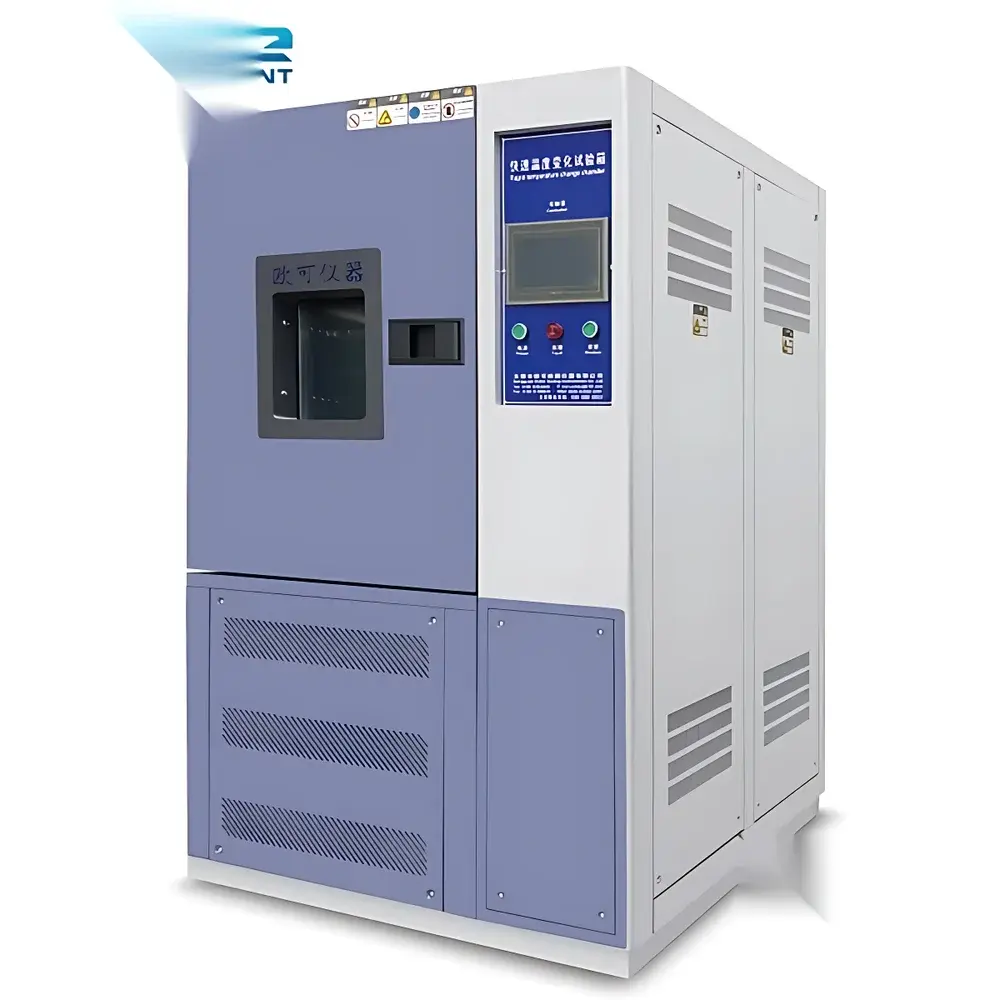
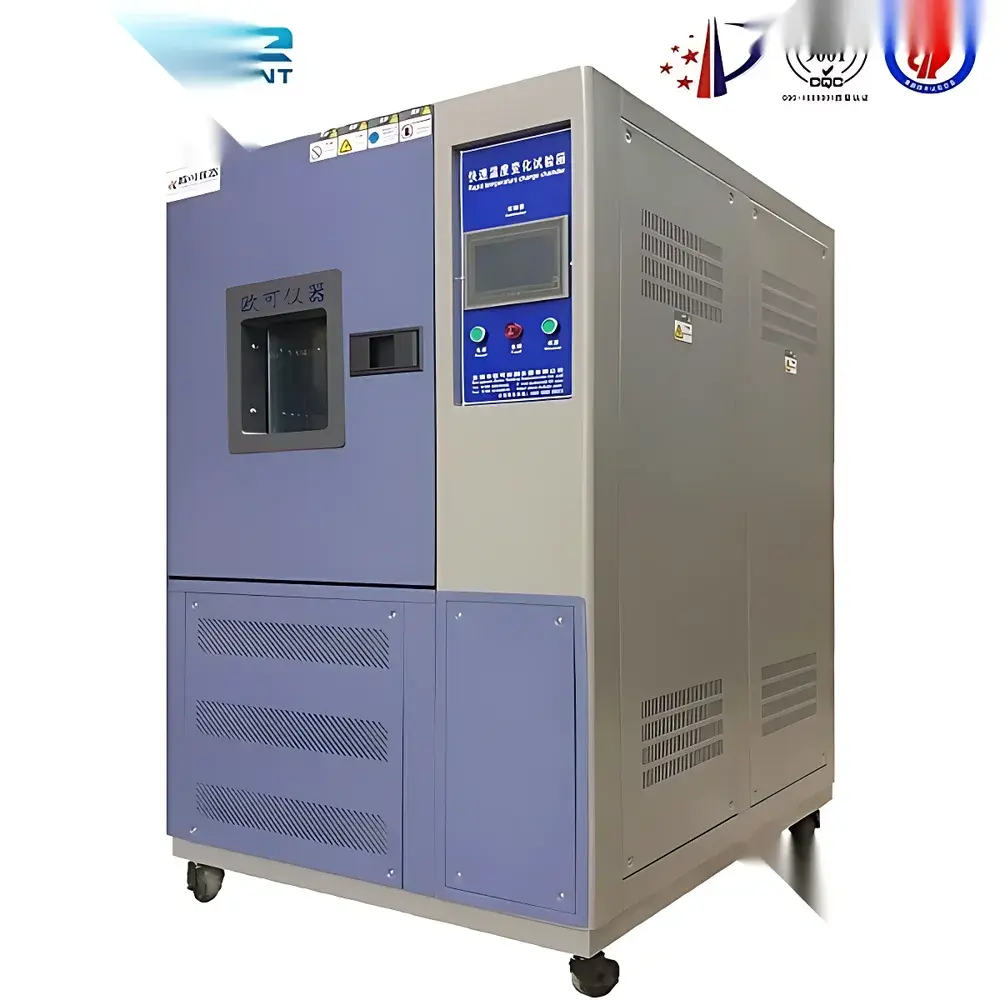
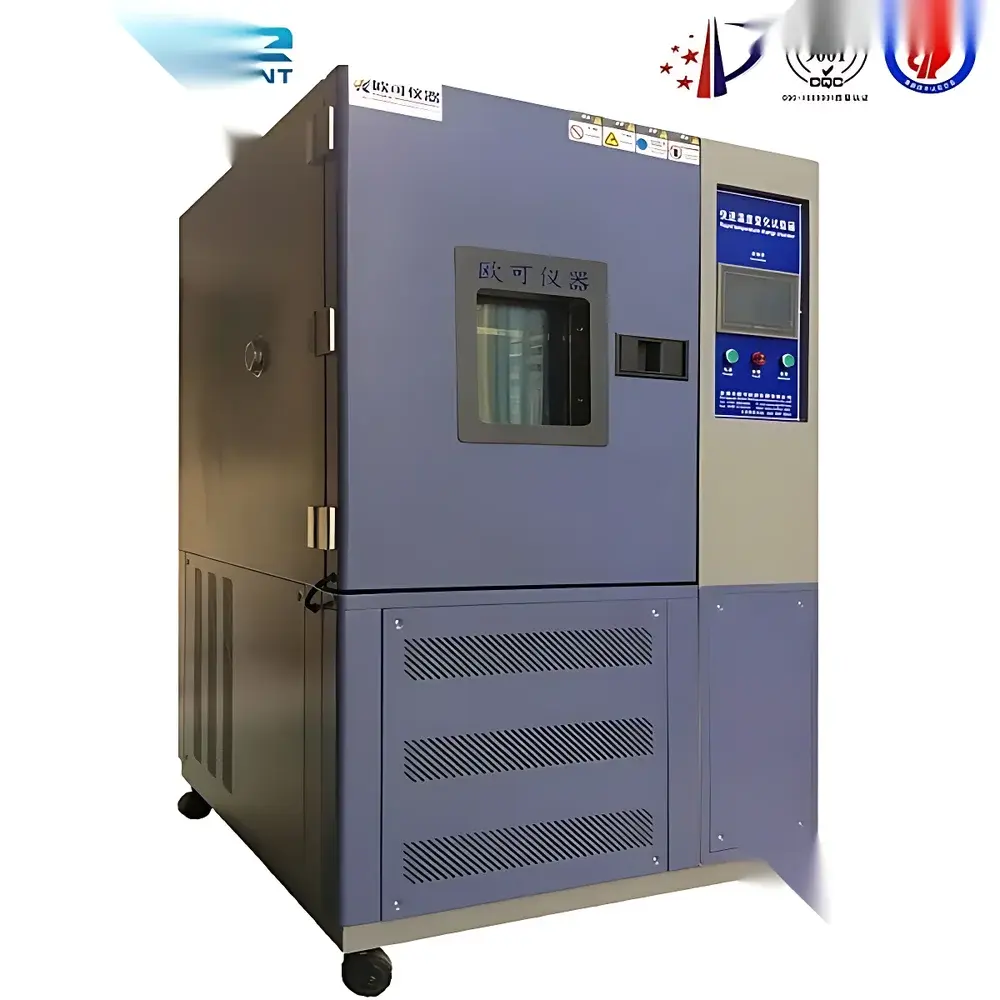
English Product Name
| Brand | Other Brands |
|---|---|
| Origin | Imported |
| Manufacturer Type | Authorized Distributor |
| Price | USD 5,200 (approx.) |
| Internal Chamber Dimensions | 46×46×46 cm / 56×66×56 cm / 68×68×65 cm / 80×80×76 cm |
| High-Temperature Zone Range | Ambient to +150°C |
| Low-Temperature Zone Range | Ambient to −60°C |
| Average Ramp Rate | 1.5°C/min |
| Temperature Uniformity | ±0.5°C |
| Temperature Deviation | ±2.0°C |
| Transfer Time (Between Zones) | <10 s |
| Temperature Recovery Time (in Test Zone) | <5 min |
| Actuation Method | Pneumatic Cylinder |
| Construction | SUS#304 Stainless Steel (Exterior & Interior) |
| Refrigeration System | Dual-Stage Compound Compression (Air-Cooled or Water-Cooled), Imported Tecumseh/Tecumseh-type Compressor, Eco-Friendly Refrigerant (R404A/R507) |
| Control System | Japanese-Made Programmable LCD Controller (320×240 Dots), Bilingual (English/Chinese) Interface |
| Memory Capacity | 100 Programs, Up to 9999 Cycles, Max Segment Duration: 999 h 59 min |
| Communication | RS-232C Port for PC Integration, Two Dynamic Time-Signal Relays |
| Compliance | GB/T 2423.22, GJB 150.5A, IEC 60068-2-14, MIL-STD-810G Method 503.5 |
| Power Supply | AC 380 V / 50 Hz, 3-Phase 4-Wire |
| Rated Power | 7.5 kW / 12 kW / 15 kW / 26 kW |
| Standard Features | Observation Window, Cable Port, Interior LED Lighting |
Overview
The Thermal Shock Test Chamber is an engineered environmental simulation system designed to evaluate material and component resilience under extreme, rapid thermal transitions. Based on the principle of two- or three-zone compartmentalization—comprising independent high-temperature, low-temperature, and test zones—the chamber utilizes pneumatic actuation to physically transfer the test specimen between thermally isolated environments within ≤10 seconds. This architecture eliminates mechanical movement of the sample during exposure, ensuring positional stability and measurement repeatability. The system conforms to standardized thermal shock protocols defined in IEC 60068-2-14, MIL-STD-810G Method 503.5, and GB/T 2423.22, enabling quantitative assessment of thermally induced failures such as interfacial delamination, solder joint fracture, coating cracking, or dimensional instability in electronic assemblies, automotive ECUs, aerospace composites, and polymer-based enclosures.
Key Features
- Modular dual- or triple-zone configuration with fully segregated thermal chambers, minimizing cross-contamination and enabling precise boundary condition control.
- Pneumatic cylinder–driven transfer mechanism ensures sub-10-second zone transition and repeatable positioning accuracy without vibration-induced artifacts.
- Dual-stage compound refrigeration system incorporating imported compressors (Tecumseh or equivalent) and eco-compliant refrigerants (R404A/R507) for stable operation down to −60°C and up to +150°C.
- SUS#304 stainless steel construction (both exterior and interior) provides corrosion resistance, non-outgassing performance, and long-term dimensional stability under cyclic thermal stress.
- Programmable microprocessor controller with 320×240-dot LCD display supports bilingual (English/Chinese) interface, 100 programmable profiles, and up to 9999 cycles per program—suitable for HALT/HASS pre-screening and qualification testing.
- Integrated safety architecture includes PLC-monitored over-temperature/over-pressure cutouts, mains voltage fluctuation detection, emergency stop circuitry, and automatic fault-locking diagnostics.
- Uniform airflow distribution via axial fans and optimized duct geometry maintains temperature homogeneity of ±0.5°C across the working volume, validated per IEC 60068-3-5.
Sample Compatibility & Compliance
This chamber accommodates static mounting of samples ranging from PCBs and IC packages to structural brackets and molded housings. Its rigid, non-vibrating test zone design prevents unintended mechanical loading during thermal transients—critical for evaluating brittle materials (e.g., ceramics, glass substrates) and miniaturized SMT components. The system satisfies mandatory compliance requirements for military, automotive, and medical device validation, including GJB 150.5A (China’s MIL-STD equivalent), ISO 16750-4 (road vehicles), and AEC-Q200 stress testing guidelines. All configurations meet electromagnetic compatibility (EMC) Class B limits per EN 55032 and are suitable for GLP/GMP-aligned laboratories requiring audit-ready operational records.
Software & Data Management
The embedded controller supports RS-232C serial communication for real-time parameter monitoring, remote program editing, and time-stamped data logging—including chamber setpoints, actual zone temperatures, cycle counters, and alarm event timestamps. Optional PC software enables graphical trend analysis, export to CSV/Excel, and automated report generation compliant with FDA 21 CFR Part 11 requirements (when paired with user-defined electronic signatures and audit trail configuration). Dynamic relay outputs facilitate synchronization with external instrumentation—such as high-speed thermal imagers or strain gauge amplifiers—for correlated multi-parameter failure analysis.
Applications
- Qualification testing of avionics modules per DO-160 Section 4 (Temperature Variation).
- Reliability screening of power semiconductor packages (IGBTs, SiC MOSFETs) subjected to JEDEC JESD22-A106B.
- Validation of conformal coatings and potting compounds under repeated thermal cycling per IPC-CC-830B.
- Material science studies on coefficient-of-thermal-expansion (CTE) mismatch effects in heterogeneous laminates.
- Pre-compliance verification for automotive electronics targeting ISO 16750-4 Level 4 (−40°C to +105°C, 1000 cycles).
- Accelerated life testing of battery management systems (BMS) and EV traction inverters.
FAQ
What is the difference between a 2-zone and a 3-zone thermal shock configuration?
A 2-zone system alternates the test specimen between hot and cold chambers only; a 3-zone variant adds a dedicated ambient-temperature soak zone, enabling more complex profiles (e.g., hot → ambient → cold → ambient) required by certain MIL-STD and IEC test methods.
Can this chamber perform humidity-controlled thermal shock tests?
No—this model is strictly a dry thermal shock system. For combined temperature/humidity stress, a separate thermal-hygrothermal chamber (e.g., complying with IEC 60068-2-30) is required.
Is the controller firmware upgradeable in the field?
Yes—firmware updates are delivered via USB memory stick and retain all user programs and calibration settings post-installation.
Does the system include validation documentation for IQ/OQ protocols?
Standard delivery includes a Factory Acceptance Test (FAT) report and calibration certificate traceable to NIST or CNAS-accredited standards; full IQ/OQ documentation packages are available as optional add-ons.
What maintenance intervals are recommended for the refrigeration system?
Compressor oil and filter dryer replacement is advised every 24 months under continuous operation; annual inspection of refrigerant charge integrity and heat exchanger cleanliness is required for sustained performance.



