
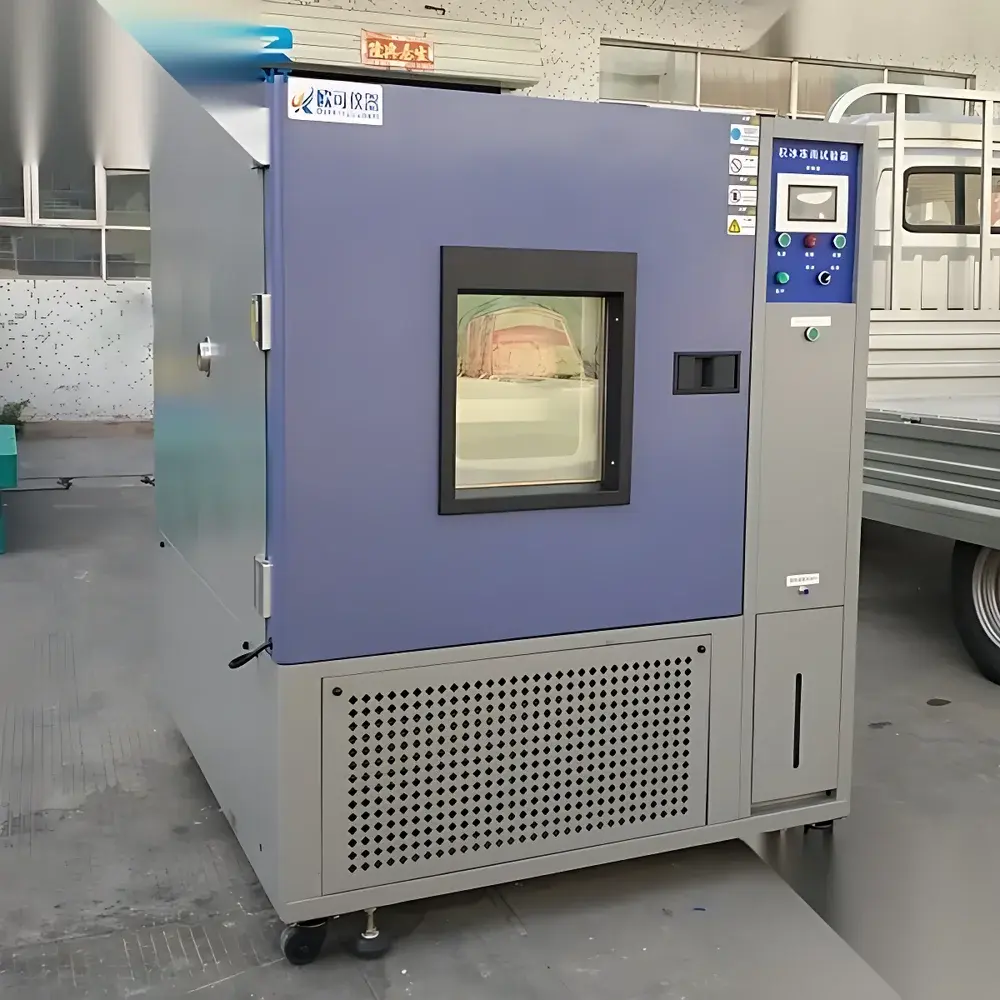
English Product Name
| Brand | OK Instruments |
|---|---|
| Origin | Imported |
| Manufacturer Type | Authorized Distributor |
| Temperature Range | -20 °C to 80 °C (customizable) |
| Temperature Uniformity | ±2.0 °C |
| Temperature Fluctuation | ±0.5 °C |
| Rainfall Intensity | 25 mm/h |
| Nozzle Orifice Diameter | φ0.4 mm |
| Simulated Droplet Diameter | 1.0–1.5 mm |
| Ice Accumulation Thickness Options | 6 mm, 13 mm, 37 mm, 75 mm |
| Ice Density Range | 0.2–0.9 g/cm³ |
| Water Temperature Control | 0–5 °C |
| Internal Chamber Material | SUS#304 Stainless Steel |
| External Cabinet | Galvanized Steel with Powder Coating or Optional SUS304 |
| Refrigeration System | Hermetic Compressor (France/Tecumseh) |
| Controller | 5.7″ TFT Color LCD Touchscreen (Bilingual English/Chinese) |
| Power Supply | AC 220 V ±5%, 50 Hz ±0.5 Hz, Single-Phase Three-Wire |
Overview
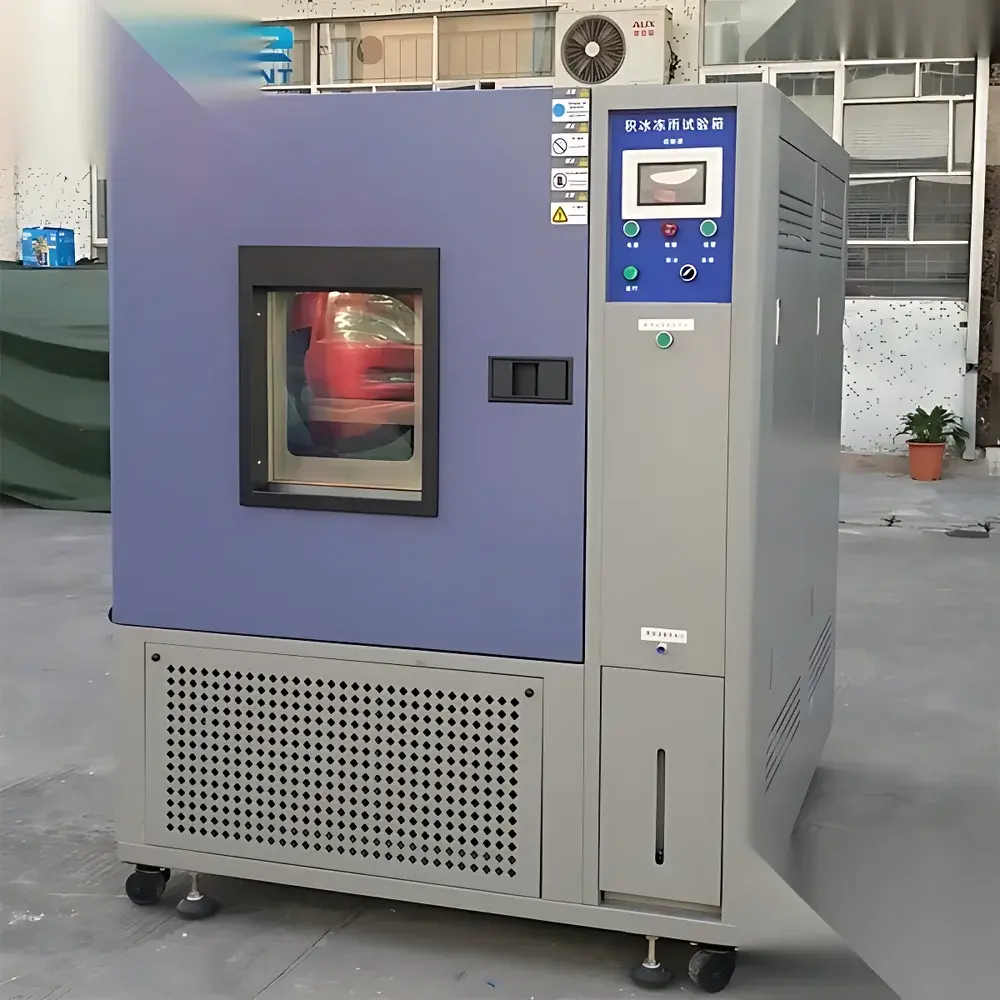
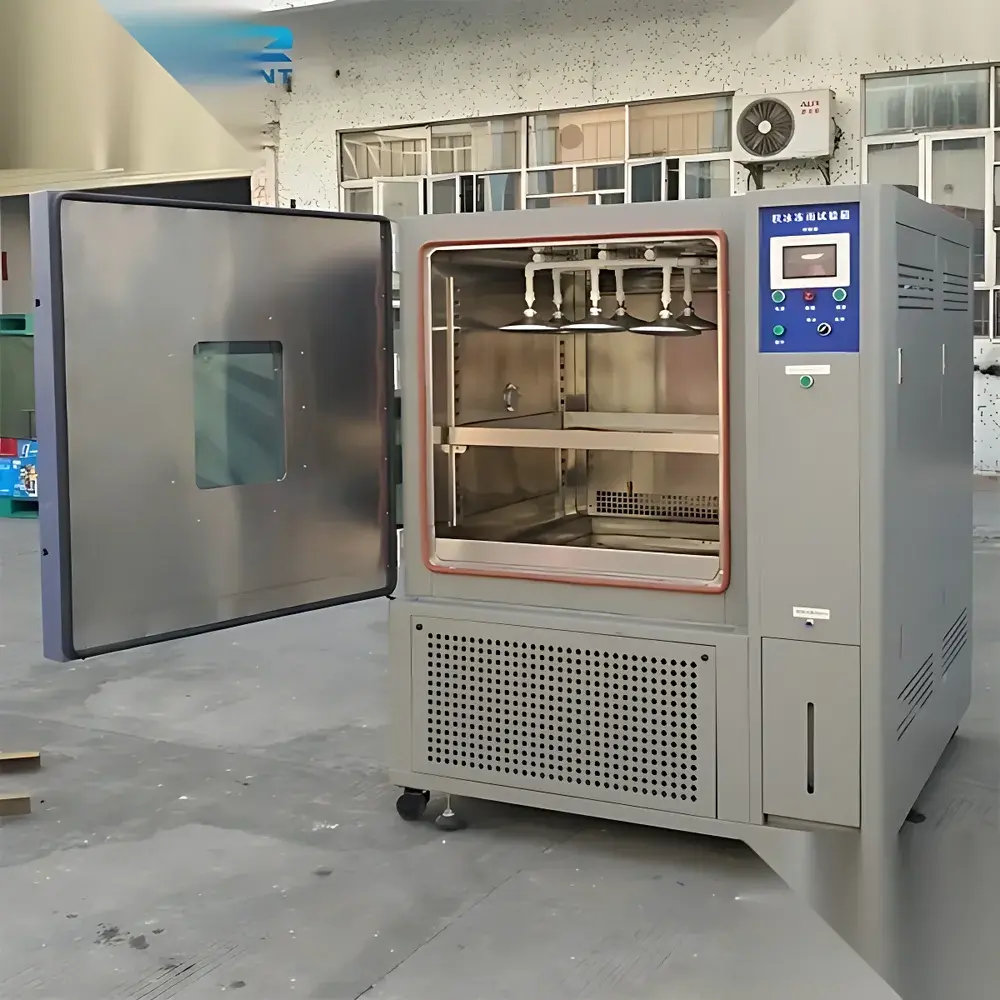
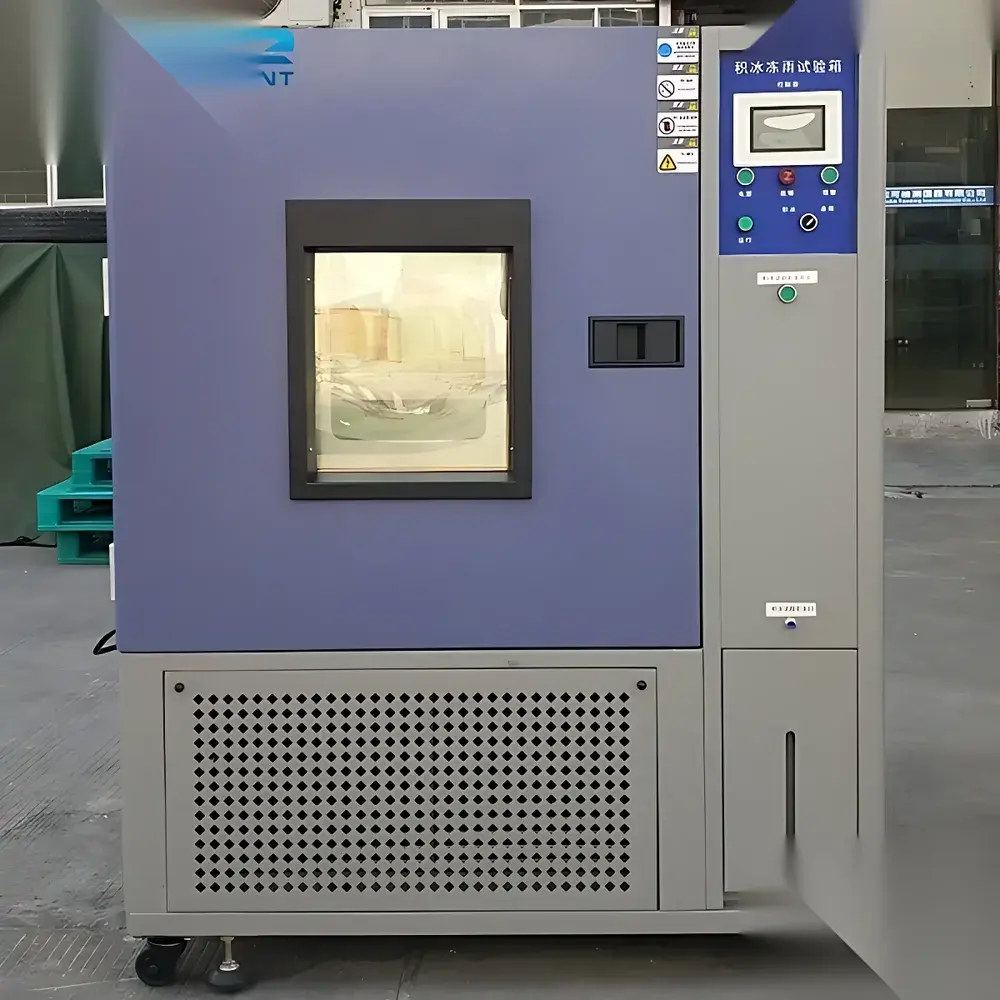
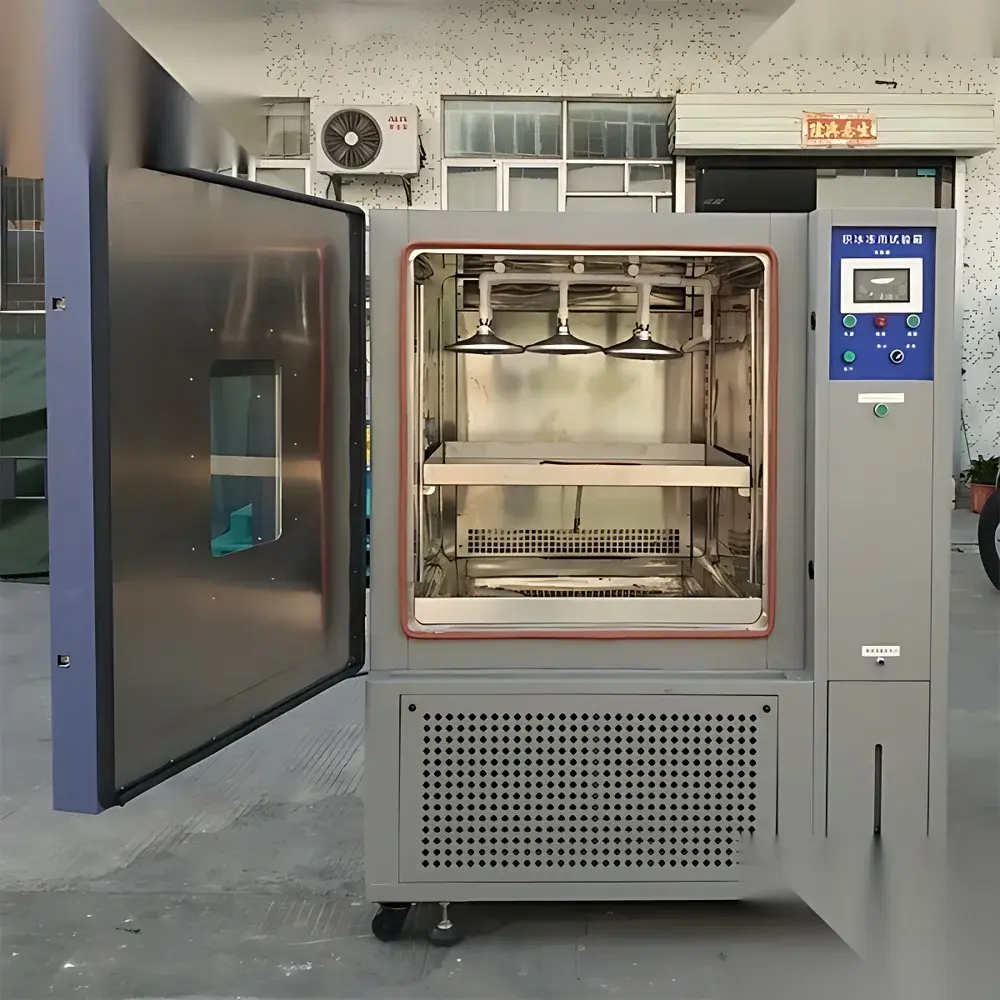
The OK-JBDY Series Icing and Freezing Rain Test Chamber is a purpose-built environmental simulation system engineered for rigorous laboratory evaluation of equipment performance under atmospheric icing and freezing rain conditions. It operates on the principle of controlled nucleation and accretion: supercooled water droplets—generated at precisely regulated temperature and flow dynamics—are directed onto test specimens in a thermally stabilized chamber, enabling reproducible formation of glaze ice, rime ice, or mixed-phase ice deposits. This physical simulation directly replicates the thermodynamic and kinetic conditions defined in MIL-STD-810H Method 522, DO-160 Section 23, and GJB 150.22A–2009, supporting qualification testing for aerospace, defense, wind energy, power transmission, and transportation systems exposed to cold-humid environments. The chamber’s architecture integrates dual-stage refrigeration, high-fidelity droplet generation, and real-time thermal mapping to ensure compliance with stringent repeatability requirements across multiple ice thickness and density configurations.
Key Features
- Modular chamber design available in four standard internal volumes (150 L to 1000 L), with fully customizable dimensions to accommodate large-scale subsystems such as aircraft wing sections, radar housings, or photovoltaic arrays.
- Precision-controlled supercooled water delivery: independent regulation of water temperature (0–5 °C), droplet size distribution (1.0–1.5 mm median diameter), and impact flux (25 mm/h nominal intensity) via calibrated stainless-steel nozzles (φ0.4 mm orifice).
- Wide operational temperature range (–20 °C to +80 °C) with ±0.5 °C stability and ±2.0 °C uniformity across the working volume, verified per IEC 60068-3-5 using NIST-traceable PT100 sensors.
- Ice accumulation profiling capability: selectable target thicknesses (6, 13, 37, or 75 mm) achieved through programmable exposure duration and dynamic thermal feedback control; ice density adjustable between 0.2–0.9 g/cm³ via water subcooling and airflow modulation.
- Robust mechanical construction: interior chamber fabricated from electropolished SUS#304 stainless steel; external enclosure options include powder-coated galvanized steel or full SUS304 for corrosion resistance in marine or coastal test environments.
- Integrated safety and monitoring: overtemperature/overpressure cut-off, refrigerant leak detection, emergency stop circuitry, and real-time logging of chamber ambient parameters (T, RH, water temp, pressure drop across nozzles).
Sample Compatibility & Compliance
The OK-JBDY chamber accommodates both static and dynamically operated test articles—including rotating components (e.g., turbine blades, propellers), electrically powered avionics, and sealed optical sensors—via standardized 50 mm cable/port penetrations and load-rated internal mounting rails. All models comply with the test condition definitions and procedural requirements of GJB 150.22A–2009, and are compatible with supplementary standards including ASTM D3232 (ice adhesion strength measurement), ISO 14617-11 (graphical symbols for icing), and RTCA DO-160G Section 23 (Environmental Conditions and Test Procedures for Airborne Equipment). For regulatory submissions, the system supports GLP-compliant audit trails when paired with optional data acquisition modules meeting FDA 21 CFR Part 11 requirements for electronic records and signatures.
Software & Data Management
The embedded 5.7″ TFT touchscreen controller provides intuitive bilingual (English/Chinese) operation with preloaded test profiles aligned to GJB 150.22A–2009 Annex B and DO-160G Table 23-1. Real-time parameter visualization includes chamber air temperature, water supply temperature, nozzle differential pressure, and elapsed exposure time. Data export is supported via USB 2.0 to CSV format, with timestamped entries traceable to internal RTC (real-time clock). Optional PC-based software enables remote supervision, multi-chamber synchronization, automated report generation (PDF/Excel), and integration with enterprise LIMS platforms via Modbus TCP or OPC UA protocols.
Applications
- Aerospace: Certification testing of de-icing boots, pitot-static systems, and UAV airframes under simulated in-flight icing conditions.
- Renewable Energy: Validation of anti-icing coatings and active heating strategies for wind turbine blades operating in alpine or offshore climates.
- Power Infrastructure: Functional verification of insulators, disconnect switches, and SCADA enclosures subjected to freezing fog and wet snow accumulation.
- Automotive & Rail: Evaluation of sensor obscuration (LiDAR, cameras), brake actuator reliability, and HVAC intake ice bridging in cold-weather vehicle validation programs.
- Research Institutions: Controlled studies of ice nucleation kinetics, interfacial heat transfer coefficients, and electrothermal de-icing efficiency metrics.
FAQ
What standards does the OK-JBDY chamber explicitly support?
It is configured to meet the environmental condition specifications and test execution methodology outlined in GJB 150.22A–2009, MIL-STD-810H Method 522, and RTCA DO-160G Section 23. Custom profiles can be developed for ISO 14617-11 or national grid icing standards upon request.
Can the chamber simulate mixed-phase icing (e.g., freezing drizzle + cloud droplets)?
Yes—by adjusting water subcooling depth, airflow velocity, and nozzle array configuration, users can replicate combinations of glaze, rime, and mixed icing morphologies consistent with ICAO Annex 6 and FAA AC 20-117 guidance.
Is third-party calibration and validation documentation provided?
Each unit ships with a factory calibration certificate traceable to NIM (China National Institute of Metrology); optional UKAS-accredited calibration and IQ/OQ documentation packages are available for GMP or defense prime contractor deployments.
What maintenance intervals are recommended for the refrigeration and water delivery systems?
Compressor oil and filter replacement every 12 months; nozzle inspection and ultrasonic cleaning every 200 operational hours; full chamber sanitization and gasket integrity check quarterly per preventive maintenance schedule included in the operator manual.
Related Products



