
English Product Name
| Brand | OEKO |
|---|---|
| Temperature Range | -70 °C to +150 °C |
| Rapid Transition Range | -45 °C to +85 °C |
| Max Linear Ramp Rate | 15 °C/min |
| Humidity Range (Optional) | 5–98% RH |
| Temperature Resolution/Accuracy | 0.1 °C / ±0.5 °C |
| Humidity Resolution/Accuracy | 0.1% RH / ±2.5% RH |
| Internal Construction | SUS304 Stainless Steel, Matte Finish |
| Insulation | High-Density Polyurethane Foam with Ethyl Chloroformate Base |
| Cooling System | Air-Cooled or Water-Cooled |
| Compressor | Tecumseh (France) |
| Refrigerant | R-404A / R-23 (DuPont Certified) |
| Controller | Imported LCD Touchscreen, Multi-Step Programmable (Quick & Slope Modes) |
| Power Supply | AC 220 V, 1-Phase or AC 380 V, 3-Phase |
Overview
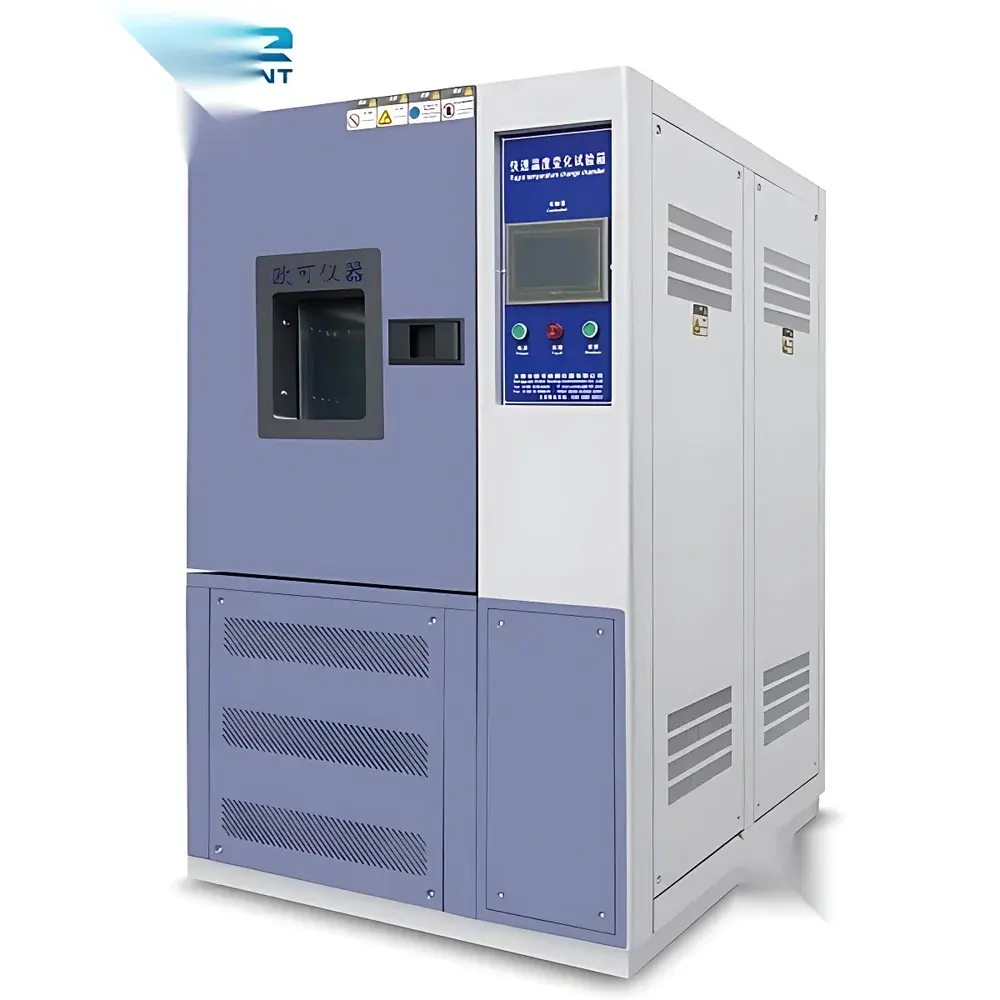
The OEKO KS-TH Series Rapid Temperature Change Test Chamber is an engineered environmental stress screening (ESS) system designed for accelerated reliability testing of electronic components, automotive modules, aerospace subsystems, and medical devices under dynamically controlled thermal conditions. It operates on the principle of forced-air convection combined with dual-stage refrigeration and precision PID-controlled heating, enabling precise, repeatable, and traceable thermal transitions across extreme temperature ranges. Unlike standard thermal chambers, the KS-TH series integrates proprietary ramp-rate modulation technology—allowing fully linear or non-linear temperature profiles with continuous adjustment from 3 °C/min up to 15 °C/min (linear) or 20 °C/min (non-linear). This capability supports MIL-STD-810H Method 503.5, IEC 60068-2-14, and JEDEC JESD22-A104D test protocols, making it suitable for qualification-level thermal shock and rapid thermal cycling validation in R&D labs and production QA environments.
Key Features
- Robust stainless steel construction: Full SUS304 body with matte-finish surface treatment and seamless welded interior chamber for corrosion resistance and long-term dimensional stability.
- Optimized thermal insulation: High-density polyurethane foam with ethyl chloroformate-based formulation ensures low thermal conductivity (<0.022 W/m·K) and zero CFC/HCFC content, compliant with EU F-Gas Regulation (EU) No 517/2014.
- Advanced refrigeration architecture: Twin-circuit Tecumseh compressors paired with DuPont-certified R-404A/R-23 mixed refrigerants; integrated oil separation system prevents lubricant accumulation in capillary tubes and evaporators.
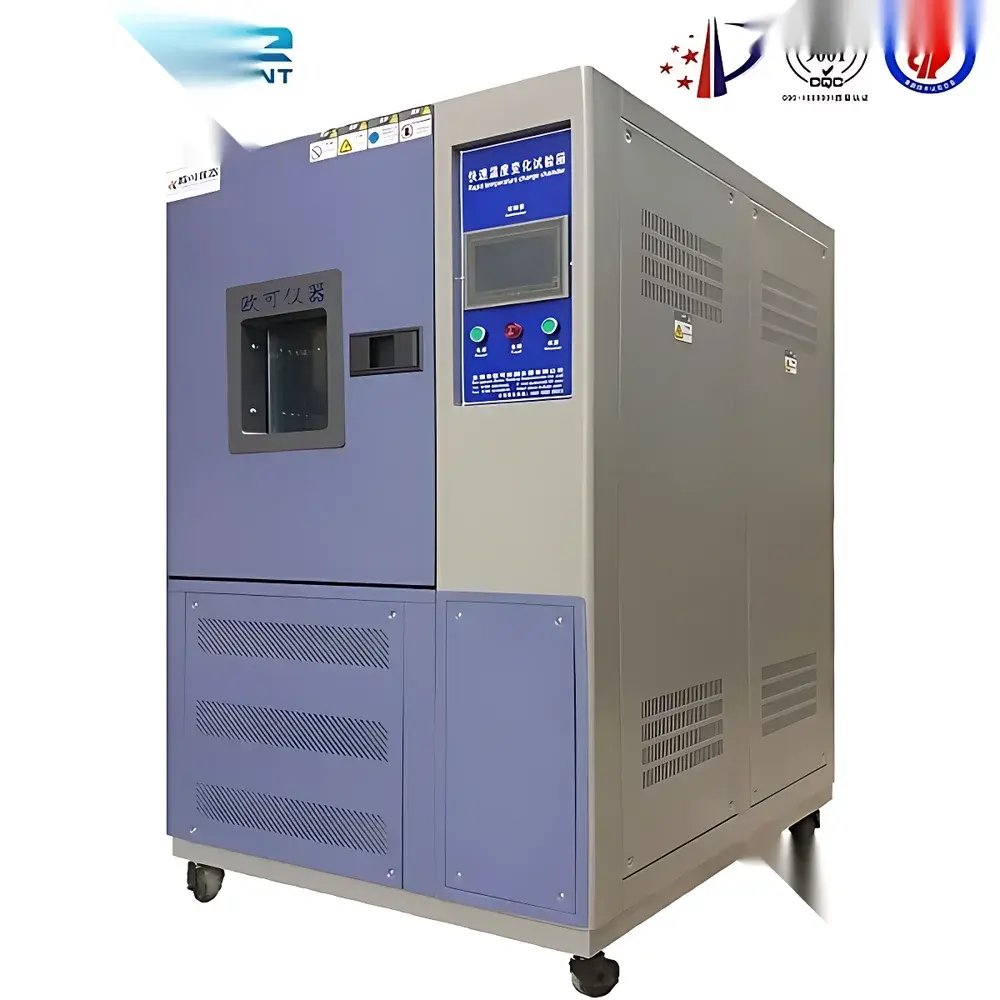
- Intelligent controller interface: 7-inch color LCD touchscreen with real-time display of setpoint, actual value, elapsed time, and active program segment; supports up to 999 segments per profile with slope and step modes.
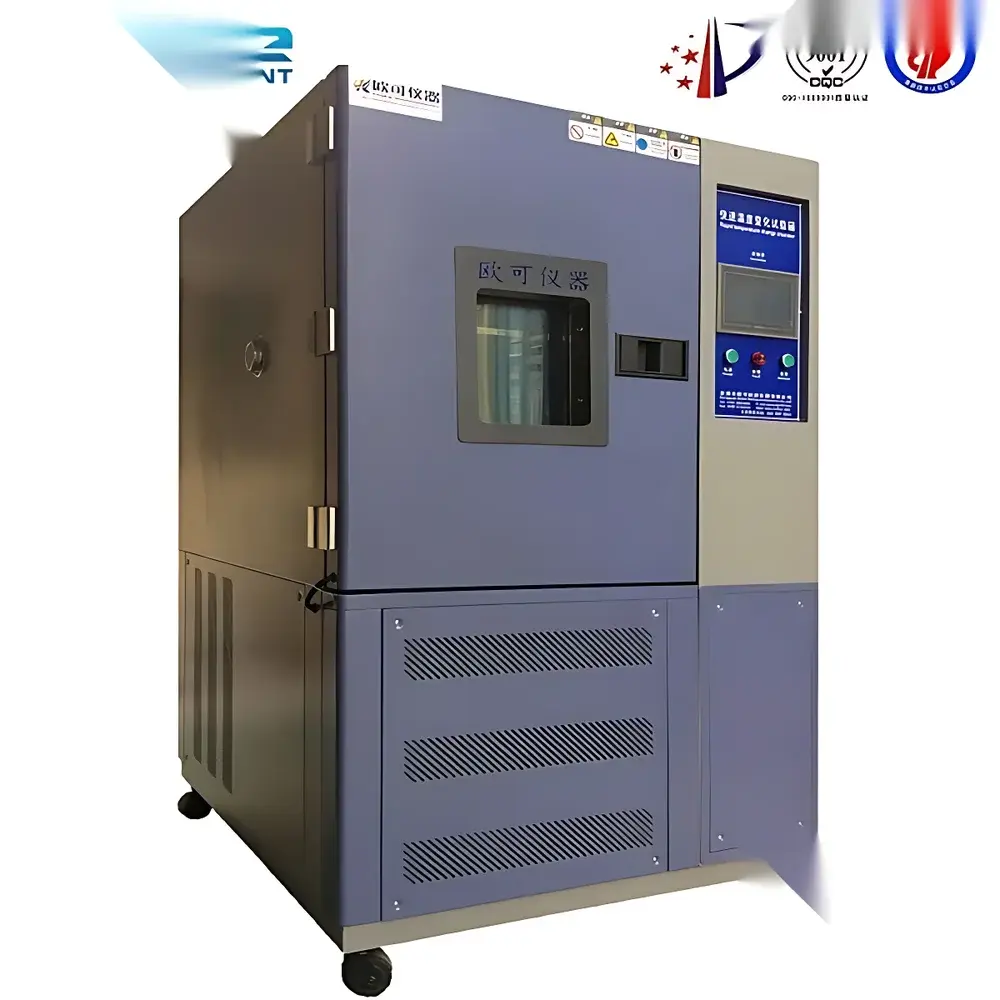
- Human-centered ergonomics: Dual-layer insulated observation window with anti-fogging heater and high-luminance PL fluorescent lighting; flat, non-slip door handle; adjustable stainless steel shelves and 50 mm diameter test port with silicone gasket.
- Mobility & installation flexibility: Integrated heavy-duty casters with locking mechanism and leveling feet; optional water-cooled configuration for high-ambient installations (≥35 °C).
Sample Compatibility & Compliance
The KS-TH chamber accommodates a broad range of sample geometries—from PCB assemblies and battery packs to sealed enclosures and optical sensors—via configurable internal dimensions (80 L to 1000 L). Its uniformity performance (±2.0 °C spatial deviation at steady state) and stability (±0.5 °C over 2 hours) meet ISO 17025 calibration requirements when operated within defined load conditions (≤30% volume occupancy, non-exothermic samples). Optional humidity control (5–98% RH) extends applicability to combined temperature-humidity stress tests aligned with IPC-9701A and Telcordia GR-468-CORE. All electrical safety features—including overtemperature cutoff, refrigerant pressure monitoring, phase failure detection, and dry-run protection—are certified to IEC 61000-6-2/6-4 and UL 61010-1 standards.
Software & Data Management
The embedded controller logs timestamped temperature and humidity data at user-selectable intervals (1 s to 60 min), storing up to 3 months of continuous records internally. Export is supported via USB 2.0 to CSV or Excel-compatible formats. For enterprise integration, optional Ethernet-enabled firmware enables remote monitoring through Modbus TCP or OPC UA interfaces. Audit trail functionality—including operator ID, parameter changes, alarm events, and calibration history—is compliant with FDA 21 CFR Part 11 requirements when paired with validated user access controls and electronic signature modules. Raw data files are structured for direct import into MATLAB, JMP, or Minitab for statistical process control (SPC) analysis.
Applications
- Thermal shock qualification per MIL-STD-810H Method 503.5 and GJB 150.5A.
- High-acceleration life testing (HALT) of power electronics and EV battery management systems (BMS).
- Material coefficient of thermal expansion (CTE) characterization for polymer composites and solder joint reliability assessment.
- Pre-conditioning of sensors prior to functional testing in automotive ADAS validation workflows.
- Stress screening of avionics hardware under DO-160 Section 4 (Temperature Variation) and Section 5 (Temperature Shock).
- Validation of packaging integrity for sterile medical devices under ISO 11607-1 accelerated aging conditions.
FAQ
What is the difference between linear and non-linear ramp rate control?
Linear mode maintains constant temperature change per unit time (e.g., 10 °C/min) throughout the entire transition. Non-linear mode allows variable ramp rates—such as faster initial cooling followed by slower stabilization—programmable per segment to replicate real-world thermal transients.
Can the chamber operate continuously at -70 °C?
Yes, the KS-TH series is rated for indefinite operation at -70 °C when configured with water-cooled condensers and ambient temperatures ≤25 °C. Air-cooled models require derating above 30 °C ambient.
Is third-party calibration support available?
OEKO provides NIST-traceable calibration certificates (per ISO/IEC 17025) and supports on-site verification by accredited metrology providers. Calibration intervals are recommended every 12 months or after major maintenance.
How is data integrity ensured during power interruption?
The controller retains all active programs and logged data in non-volatile flash memory. Upon recovery, it resumes operation from the last saved state without data loss.
Are custom test ports or internal fixtures available?
Yes—OEKO offers OEM engineering services for application-specific modifications including multi-port feedthroughs, vibration-isolated mounting plates, and EMI-shielded signal conduits.



