
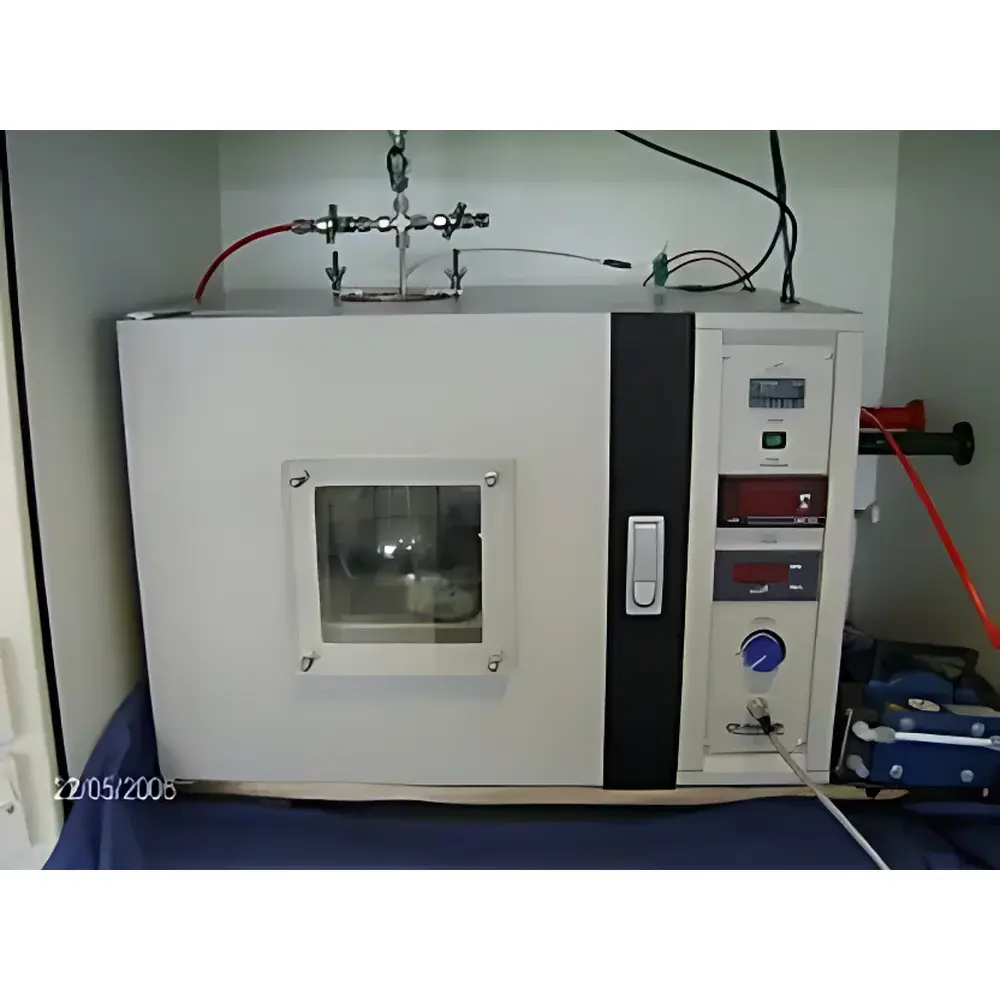
English Product Name
| Origin | United Kingdom |
|---|---|
| Manufacturer Type | Authorized Distributor |
| Origin Category | Imported |
| Model | ADE Series |
| Standard Compliance | ASTM E681, EN 45014, GB/T 12474-2008 |
| Operating Pressure Range | 0 to 101 kPa (gauge), adjustable down to –100 kPa (gauge) |
| Maximum Test Temperature | 150 °C |
| Oven Max Temperature | 300 °C |
| Ignition Source | 15 kV, 30 mA pulsed arc, 0.5 s duration |
| Electrode Gap | 3–4 mm |
| Reaction Tube Dimensions | 1400 ± 50 mm length, 60 ± 5 mm ID, ≥2 mm wall thickness (borosilicate glass) |
| Vent Valve Diameter | ≥25 mm |
| Stirring | Magnetic stirrer at tube base |
| Safety Interlock | Dual-door mechanical/electrical interlock with remote activation |
| Flame Detection | Visual + optional thermocouple-assisted detection for non-luminous flames (e.g., H₂) |
Overview
The ADE Series Explosion Limit Tester is a precision-engineered laboratory instrument designed for the experimental determination of flammability limits—specifically the Lower Explosive Limit (LEL) and Upper Explosive Limit (UEL)—of combustible gases and vapors in air. It operates on the principle of controlled spark ignition within a standardized vertical reaction tube under precisely regulated pressure, temperature, and stoichiometric mixing conditions. The system implements the fundamental test methodology defined in ASTM E681 (“Standard Test Method for Determining the Limits of Flammability of Chemicals at Elevated Temperature and Pressure”), supplemented by alignment with EN 45014 (for conformity assessment of explosion testing equipment) and China’s national standard GB/T 12474-2008. This apparatus enables reproducible, traceable measurement of the minimum and maximum fuel-air concentrations at which self-sustaining flame propagation occurs—critical data for process safety design, hazard classification (e.g., NFPA 497, IEC 60079-20-1), and regulatory compliance in chemical, petrochemical, pharmaceutical, and battery manufacturing environments.
Key Features
- Regulated Ignition System: High-energy pulsed arc (15 kV, 30 mA, 0.5 s duration) delivered via tungsten electrodes positioned centrally in the reaction tube cross-section, ≥100 mm above the base, with adjustable gap (3–4 mm) to ensure consistent energy deposition across test concentrations.
- Thermally Controlled Environment: Integrated convection oven maintains uniform axial temperature profiles up to 150 °C during testing; oven housing reaches 300 °C for cleaning or conditioning. Dual-layer observation doors (tempered glass + polycarbonate) provide visual monitoring while meeting impact resistance requirements per EN 16228.
- Reaction Tube Assembly: Borosilicate glass tube (1400 ± 50 mm × 60 ± 5 mm ID, ≥2 mm wall thickness) fitted with a certified rupture disk and ≥25 mm diameter pressure-relief valve compliant with ISO 4126-1 for safe overpressure venting.
- Gas Handling & Mixing: Precision mass flow controllers (MFCs) or calibrated syringe injection systems enable accurate volumetric blending of fuel vapor and air; vacuum pump and digital pressure transducer support initial evacuation and final pressure stabilization (±0.5 kPa resolution).
- Operational Safety Architecture: Electromechanical door interlock prevents arc initiation unless both oven doors are fully closed and sealed; remote electronic start controller ensures operator distance (>2 m) during ignition sequence—fully aligned with IEC 61511 SIL 1 functional safety principles.
- Magnetic Stirring & Thermal Homogeneity: Bottom-mounted magnetic stirrer eliminates stratification of gas mixtures and promotes uniform pre-ignition thermal equilibrium—essential for minimizing concentration gradients that compromise LEL/UEL repeatability.
Sample Compatibility & Compliance
The ADE Series accommodates gaseous fuels (e.g., methane, hydrogen, propane, ethylene) and volatile organic compounds (VOCs) with boiling points below 150 °C, including solvents such as acetone, ethanol, toluene, and methyl tert-butyl ether (MTBE). Testing must be conducted above the sample’s dew point to prevent condensation-induced concentration errors. All operational procedures—including purging intervals (dry air <30% RH), electrode cleaning frequency, and minimum 10-cycle preconditioning prior to formal testing—are explicitly prescribed in ASTM E681 and GB/T 12474-2008. The system supports full audit trails required under GLP (Good Laboratory Practice) frameworks and is compatible with 21 CFR Part 11-compliant data acquisition modules when integrated with validated software platforms.
Software & Data Management
While the base ADE hardware operates via manual control panels, optional PC-based acquisition modules enable synchronized logging of pressure transients, thermocouple readings, ignition timing, and chamber temperature. Data export formats include CSV and XML, supporting integration into LIMS (Laboratory Information Management Systems) and enterprise risk databases. Calibration records, user access logs, and test sequence metadata are stored with timestamped digital signatures—ensuring traceability for internal audits and third-party verification against ISO/IEC 17025 accreditation criteria. All firmware updates undergo version-controlled release validation per IEC 62304 Class B medical device software standards (applied analogously for safety-critical instrumentation).
Applications
- Determination of LEL/UEL values for SDS (Safety Data Sheet) Section 9 completion and GHS classification.
- Process hazard analysis (PHA) inputs for HAZOP and Layer of Protection Analysis (LOPA) studies.
- Validation of inerting strategies (e.g., N₂ blanketing) in reactor design and storage tank specification.
- Supporting UN Transport Classification (UN Manual of Tests and Criteria, Part I, Section 10.3) for flammable gas packaging groups.
- Research into flame inhibition mechanisms and additive efficacy (e.g., halon replacements, metal oxide suppressants).
- Verification of explosion-proof equipment certification boundaries (e.g., Ex d, Ex e enclosure testing margins).
FAQ
What standards does the ADE Series Explosion Limit Tester comply with?
ASTM E681 (2022 edition), EN 45014:1999, and GB/T 12474-2008—covering test methodology, apparatus construction, and reporting requirements.
Is the system suitable for testing liquid-phase fuels directly?
No. Liquids must first be vaporized using calibrated evaporators or saturation chambers; the tester evaluates only gaseous-phase mixtures in air.
How is explosion confirmed when flame is invisible (e.g., hydrogen)?
By integrating a fast-response K-type thermocouple near the electrode zone; a ≥150 °C transient rise within 100 ms post-ignition constitutes positive detection.
What is the recommended purge protocol between tests?
Minimum 3-minute flush with dry compressed air (<30% RH) at 5× chamber volume flow rate, verified by dew point sensor before next charge.
Can the instrument be used for oxygen-enriched atmospheres?
Not without modification and revalidation; standard configuration is certified only for air (20.9% O₂); alternative oxidizer testing requires custom engineering review and updated hazard analysis.



