
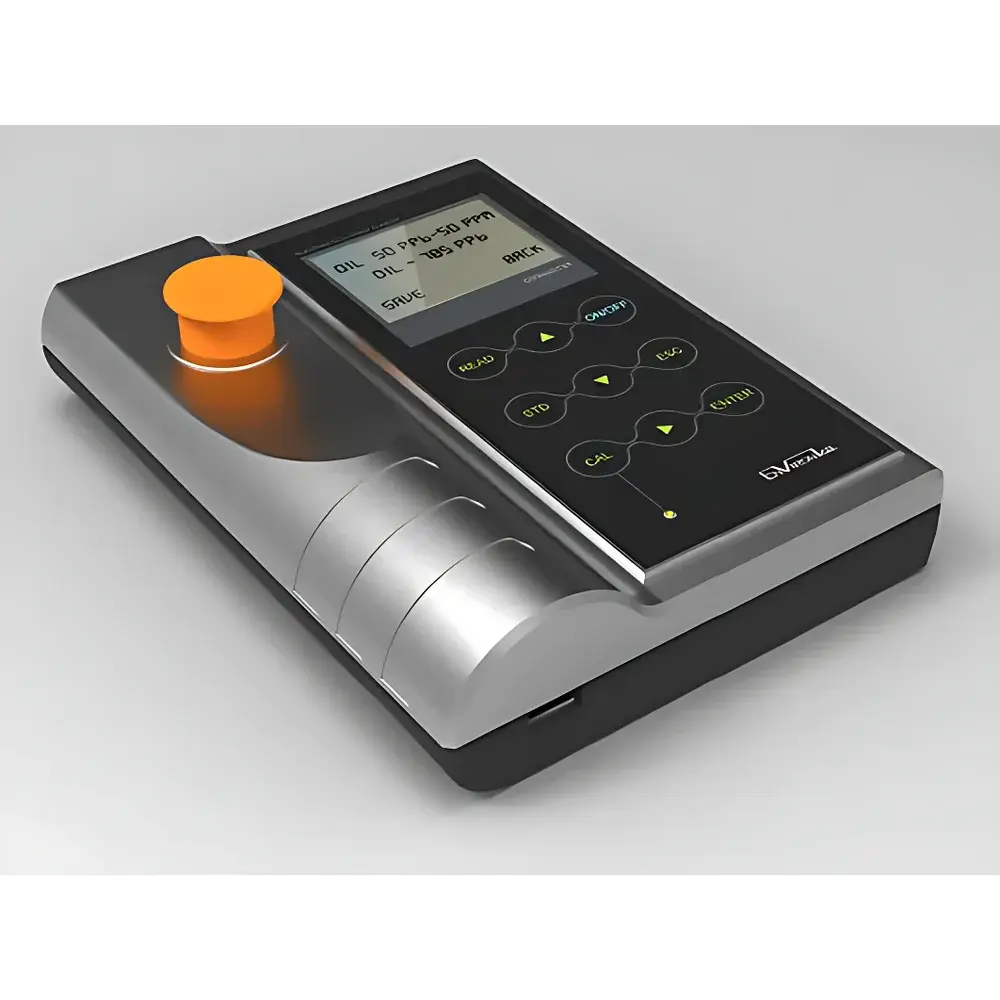
Environ Lab OilTech121 Portable Oil-in-Water Analyzer
| Brand | Environ Lab |
|---|---|
| Origin | USA |
| Model | OilTech121 |
| Instrument Type | Portable |
| Measurement Principle | UV-Induced Fluorescence Spectrophotometry |
| Measurement Range | 0–1000 ppm and 50 ppb–50 ppm (dual-range) |
| Detection Limit | <5 ppb |
| Accuracy | ±5% of reading |
| Resolution | 1 ppb |
| Measurement Frequency | 60 tests/hour |
| Measurement Time | ≤5 seconds per test |
| Display | Backlit LCD |
| Operating Temperature | 5–40 °C |
| Auto Power-Off | After 3 minutes of inactivity |
| Dimensions | 195 × 100 × 70 mm |
| Weight | 500 g (including batteries) |
| Power Supply | 4 × AAA alkaline batteries (>1000 tests per set) |
| Enclosure Rating | IP67 |
| Compliance | EPA Method 1664A-compatible solvent usage (e.g., n-hexane), ASTM D7678 referenced |
| Sample Vessel | Disposable quartz-cuvette-style microcell (1.5 mL volume) |
Overview
The Environ Lab OilTech121 Portable Oil-in-Water Analyzer is a field-deployable, fluorescence-based instrument engineered for rapid, on-site quantification of petroleum hydrocarbons in aqueous matrices. Unlike conventional infrared or gravimetric methods, the OilTech121 employs UV-induced fluorescence spectrophotometry—exciting aromatic and polycyclic hydrocarbon components at 254 nm and detecting emitted fluorescence in the 320–420 nm range. This principle delivers high selectivity for crude oil, diesel, gasoline, and lubricants while minimizing interferences from humic substances or chlorophyll commonly encountered in environmental water samples. Its compact form factor and battery-powered operation enable real-time analysis at remote sampling points—including offshore platforms, wastewater outfalls, stormwater retention ponds, and spill response zones—without reliance on laboratory infrastructure.
Key Features
- UV-fluorescence detection with dual-range capability (0–1000 ppm and 50 ppb–50 ppm), enabling both regulatory compliance screening and low-level leak detection;
- Integrated dual-beam optical path architecture: one sample channel and one reference channel operate simultaneously to compensate for solvent background drift and lamp intensity fluctuation, ensuring measurement stability across variable field conditions;
- Disposable, optically matched microcells (1.5 mL capacity) eliminate cross-contamination and cleaning artifacts—critical for high-throughput field campaigns and GLP-aligned workflows;
- Compatible with EPA-recommended extraction solvents including n-hexane (Method 1664A), avoiding hazardous CCl₄ use while maintaining method comparability;
- Ruggedized housing rated IP67 for dust and immersion resistance; operational within 5–40 °C ambient range;
- Onboard QuickAdjust calibration module supports rapid two-point verification using certified standard solutions prior to critical measurements;
- Automated data logging with timestamp and operator ID tagging (via optional Bluetooth-enabled mobile app); supports CSV export for LIMS integration.
Sample Compatibility & Compliance
The OilTech121 is validated for use with surface water, groundwater, seawater, produced water, and treated effluent. It meets performance criteria outlined in ASTM D7678 (Standard Test Method for Determination of Oil and Grease in Water by Solvent Extraction and Infrared Spectrometry) when used with n-hexane extraction and calibrated against NIST-traceable oil standards. Correlation studies demonstrate strong linear agreement (R² > 0.995) with EPA 1664B gravimetric results and ISO 9377-2 infrared measurements across diverse hydrocarbon profiles. The system supports audit-ready documentation: all calibrations, blanks, replicates, and field blanks are stored with metadata compliant with 21 CFR Part 11 requirements when paired with the optional secure software suite.
Software & Data Management
The OilTech121 operates standalone via its embedded firmware but interfaces seamlessly with Environ Lab’s OilData Connect™ desktop application (Windows/macOS). This platform provides full traceability: automatic generation of calibration curves, QC flagging (e.g., blank drift >10% FS), statistical summaries (mean, SD, CV%), and PDF report templates aligned with ISO/IEC 17025 reporting guidelines. Raw spectral data (excitation/emission intensity vs. wavelength) is retained for retrospective reprocessing. Cloud synchronization (optional subscription) enables centralized monitoring of fleet-wide instrument performance and inter-laboratory comparison studies.
Applications
- Regulatory compliance monitoring at NPDES discharge points and SPCC-regulated facilities;
- Rapid assessment during oil spill response—detection of sheen-level contamination (<10 ppb) within minutes of sample collection;
- Process control in refinery wastewater treatment units and produced water reinjection systems;
- Maritime port state control inspections for bilge water compliance (MARPOL Annex I limits);
- Long-term trend analysis in watershed management programs tracking urban runoff hydrocarbon loading;
- Educational field labs requiring robust, low-maintenance instrumentation for undergraduate environmental chemistry courses.
FAQ
What extraction solvents are compatible with the OilTech121?
n-Hexane is recommended per EPA Method 1664A; other non-polar solvents such as cyclohexane or petroleum ether may be used if validated for fluorescence yield and spectral interference.
Can the OilTech121 differentiate between crude oil and refined products?
It quantifies total petroleum hydrocarbons (TPH) as a class; speciation requires GC-FID or GC-MS. However, built-in correction factors allow user-defined calibration offsets based on known source profiles.
Is method validation documentation available?
Yes—full validation reports per ISO/IEC 17025, including LOD/LOQ determination, linearity (5–1000 ppm), precision (intra-day RSD <3.2%), and matrix spike recovery (85–112%) across 12 water types, are provided with each unit.
How is calibration traceability maintained?
All factory calibrations are performed against NIST SRM 2781 (petroleum hydrocarbon standard in isooctane) and verified annually using Environ Lab’s Certificate of Calibration Traceability (CCT).
Does the instrument support multi-user access control?
When connected to OilData Connect™ with network license, role-based permissions (operator, supervisor, QA reviewer) enforce procedural controls consistent with GxP environments.
Related Products







