
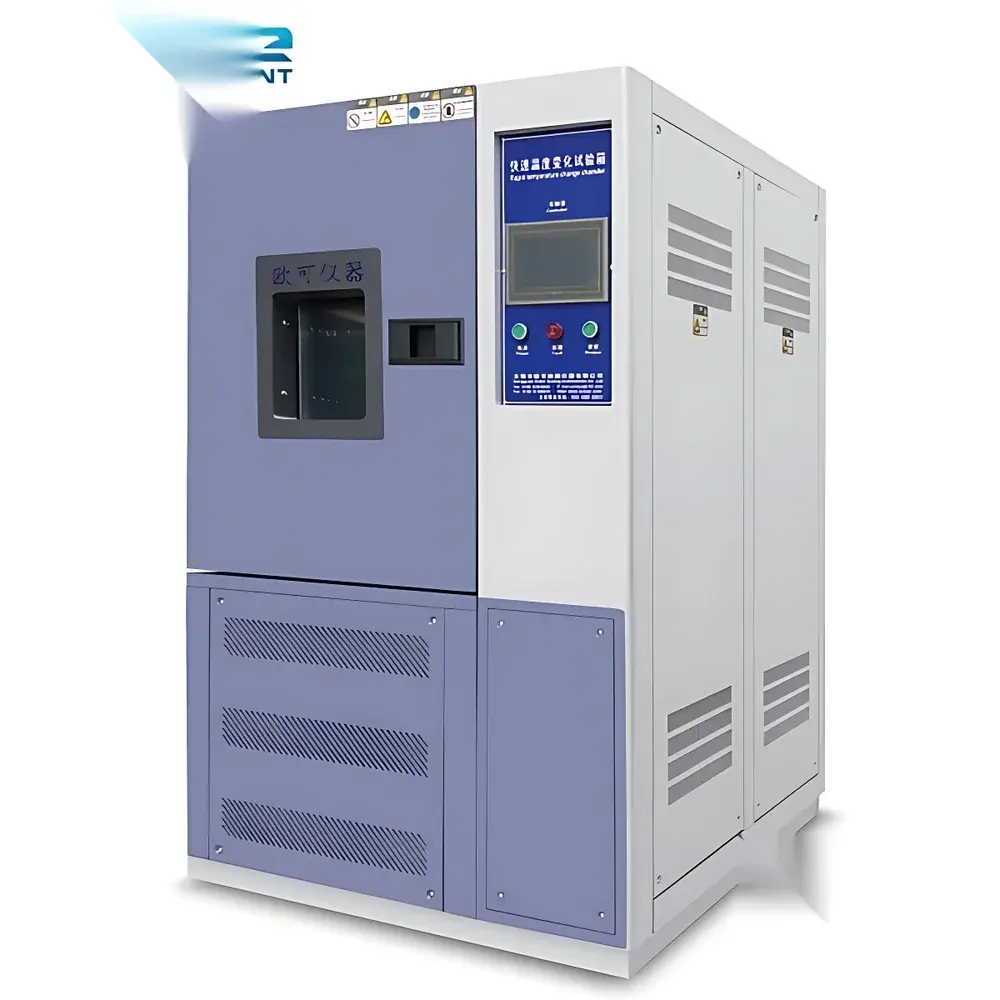
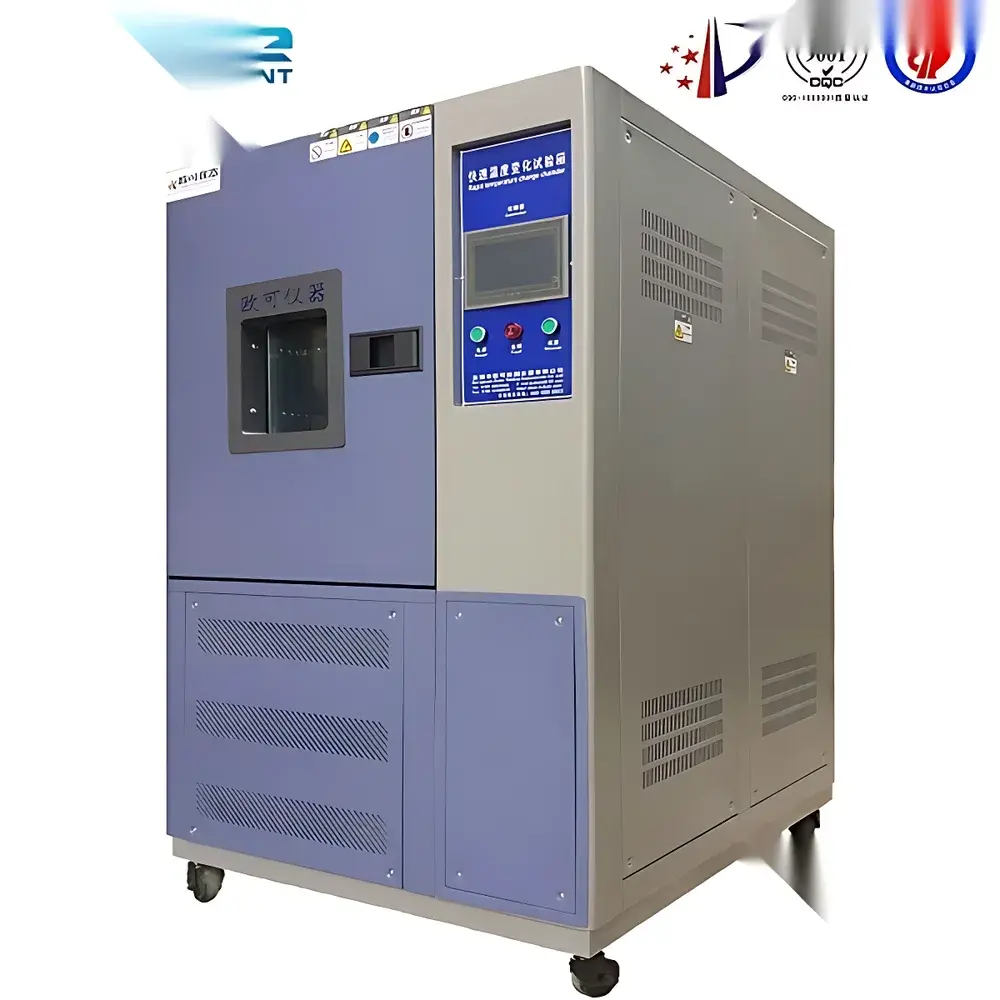
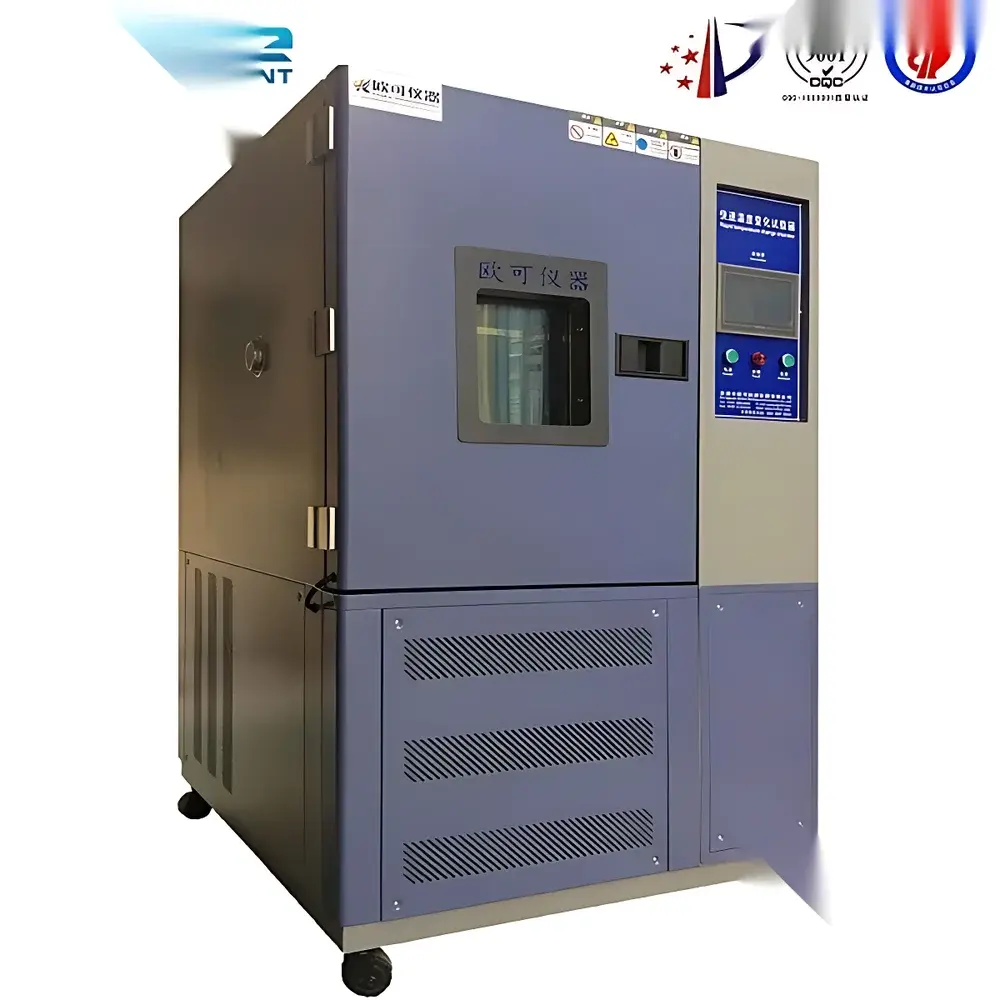
Environmental Stress Screening Chamber – Rapid Temperature & Humidity Cycling System
| Brand | Generic OEM |
|---|---|
| Origin | Imported |
| Manufacturer Type | Authorized Distributor |
| Price | USD 14,200 (FOB) |
Overview
The Environmental Stress Screening Chamber – Rapid Temperature & Humidity Cycling System is a precision-engineered climatic test chamber designed for accelerated environmental stress screening (ESS) and temperature-humidity profile validation in accordance with MIL-STD-810, IEC 60068-2, and GJB 150 series standards. It employs dual-refrigeration cascade cooling, high-efficiency steam humidification, and independent PID-controlled heating/cooling/humidification subsystems to achieve rapid thermal transitions—typically ≤15°C/min ramp rates across the full operating range. The chamber utilizes a forced-air convection system with adjustable airflow velocity and uniformity-compensated duct design to ensure spatial temperature deviation ≤±0.5°C and humidity uniformity ≤±2% RH (at 25–85% RH, 25–60°C) per IEC 60068-3-5. Its primary function is to induce thermomechanical fatigue, interfacial delamination, solder joint failure, and hygroscopic swelling in electronic assemblies, automotive ECUs, aerospace avionics modules, and polymer-based structural components—enabling early detection of latent defects prior to field deployment.
Key Features
- Touchscreen HMI controller with 7-inch color LCD, supporting multi-language UI (English, German, Japanese), real-time trend graphing, and password-protected parameter locking
- PID auto-tuning algorithm with adaptive gain scheduling for stable control under dynamic load conditions
- Triple-wall insulated chamber construction: outer SUS304 brushed stainless steel, inner mirror-finish SUS304, and high-density polyurethane foam insulation (≥120 mm thickness)
- Programmable cycling modes: two-zone (hot/cold) or three-zone (hot/cold/humidity soak) profiles with user-defined dwell times, ramp rates, and transition logic
- Intelligent energy management system that dynamically modulates compressor capacity and heater duty cycle based on thermal load feedback—reducing average power consumption by up to 28% versus fixed-output systems
- Comprehensive safety architecture including overtemperature cutoff (mechanical backup thermostat), high-humidity shutoff, refrigerant pressure monitoring, door interlock, and emergency power-off circuit
- Auto-defrost functionality with programmable frequency and duration; frost accumulation detection via evaporator coil temperature gradient analysis
Sample Compatibility & Compliance
This chamber accommodates test specimens up to 600 × 600 × 600 mm (W×D×H) with maximum payload mass of 50 kg. It supports standardized mounting fixtures compliant with IEC 60068-2-14 (change of temperature) and MIL-STD-202 Method 107 (thermal shock). All control firmware and data logging routines comply with FDA 21 CFR Part 11 requirements for electronic records and signatures—including audit trail generation, user role-based access control, and immutable event logs. Test reports are exportable in PDF/CSV formats with embedded digital signatures and timestamped metadata traceable to NIST-traceable calibration certificates (calibration interval: 12 months).
Software & Data Management
Built-in embedded Linux OS hosts the proprietary TestMaster™ control suite, enabling local operation without external PC dependency. Optional Ethernet/Wi-Fi connectivity allows remote monitoring via web browser or dedicated SCADA integration (Modbus TCP, OPC UA). All test sequences—including multi-step profiles with conditional branching—are stored in non-volatile memory with version control and change history. Raw sensor data (temperature, relative humidity, chamber pressure, compressor current) is sampled at 1 Hz and archived with millisecond-resolution timestamps. Data integrity is ensured through cyclic redundancy check (CRC-32) and automatic backup to internal SD card plus optional NAS sync. Exported datasets include ISO/IEC 17025-compliant uncertainty budgets derived from sensor calibration certificates.
Applications
- Qualification testing of automotive ADAS sensors under combined thermal cycling and condensation exposure (ISO 16750-4)
- Reliability assessment of PCBAs subjected to JEDEC JESD22-A104D thermal cycling profiles
- Material compatibility evaluation for conformal coatings exposed to 85°C/85% RH + rapid cooldown to −40°C
- GJB 150.9A-compliant humidity resistance verification of military-grade connectors and cable harnesses
- Process validation of reflow soldering parameters using simulated thermal inertia loads
- Accelerated aging studies of lithium-ion battery enclosures under thermo-hygric stress (UN 38.3 Section 40.3)
FAQ
What is the maximum achievable temperature ramp rate between −70°C and +180°C?
The standard configuration achieves ≥10°C/min average ramp rate across −40°C to +150°C; optional high-performance refrigeration package extends this to ≥15°C/min over the same range.
Does the system support automated compliance reporting per IEC 60068-2-14?
Yes—preconfigured test templates include full IEC 60068-2-14 Annex A reporting logic with pass/fail thresholds, deviation mapping, and statistical summary (mean, std dev, min/max) per test segment.
Can the chamber operate unattended for extended qualification runs?
Absolutely—the system includes watchdog timers, redundant sensor validation, and email/SMS alerting via SMTP/HTTP API upon anomaly detection or cycle completion.
Is third-party calibration certification included with delivery?
Each unit ships with a factory-issued calibration certificate traceable to NIST standards, covering all critical sensors (PT100 RTDs, capacitive RH probes, pressure transducers); on-site UKAS-accredited calibration is available as an add-on service.
What maintenance intervals are recommended for long-term reliability?
Compressor oil replacement every 6,000 operating hours; refrigerant filter-drier replacement every 24 months; full preventive maintenance (including airflow calibration and PID retuning) recommended annually or after 1,000 thermal cycles—whichever occurs first.



