
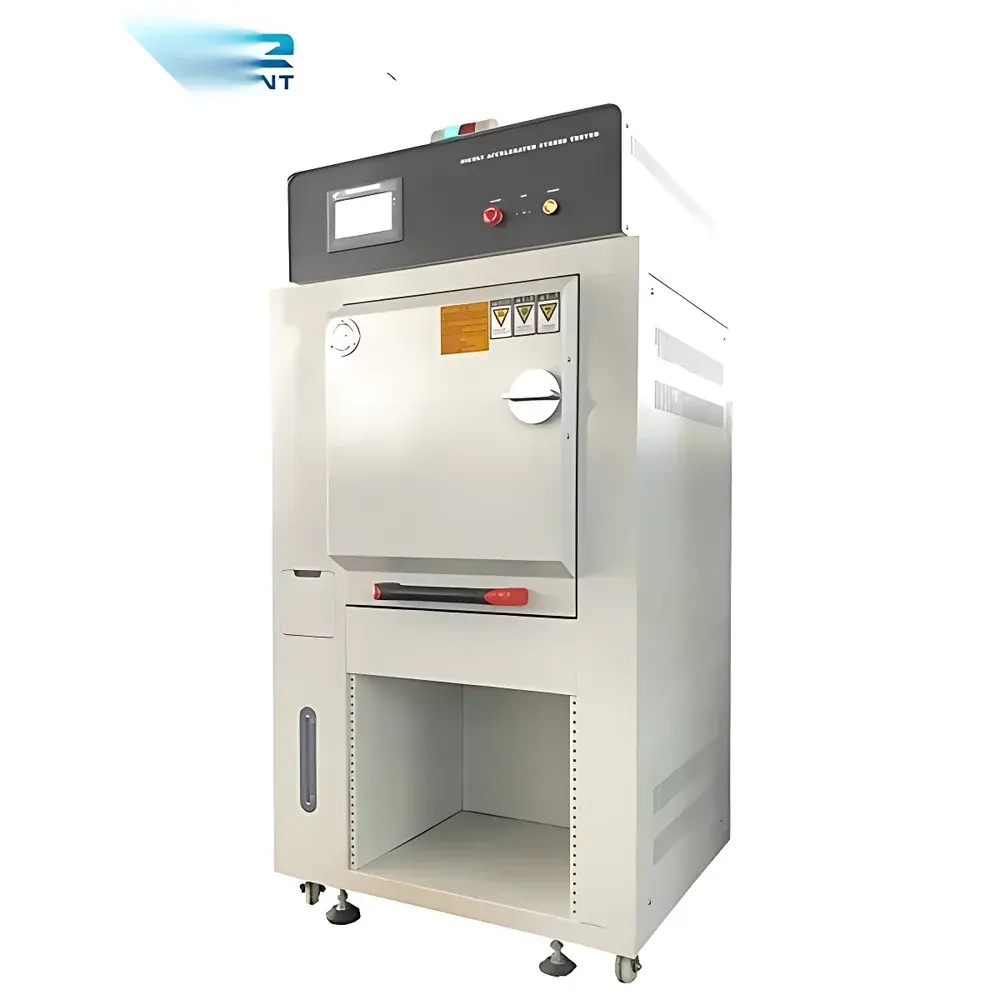
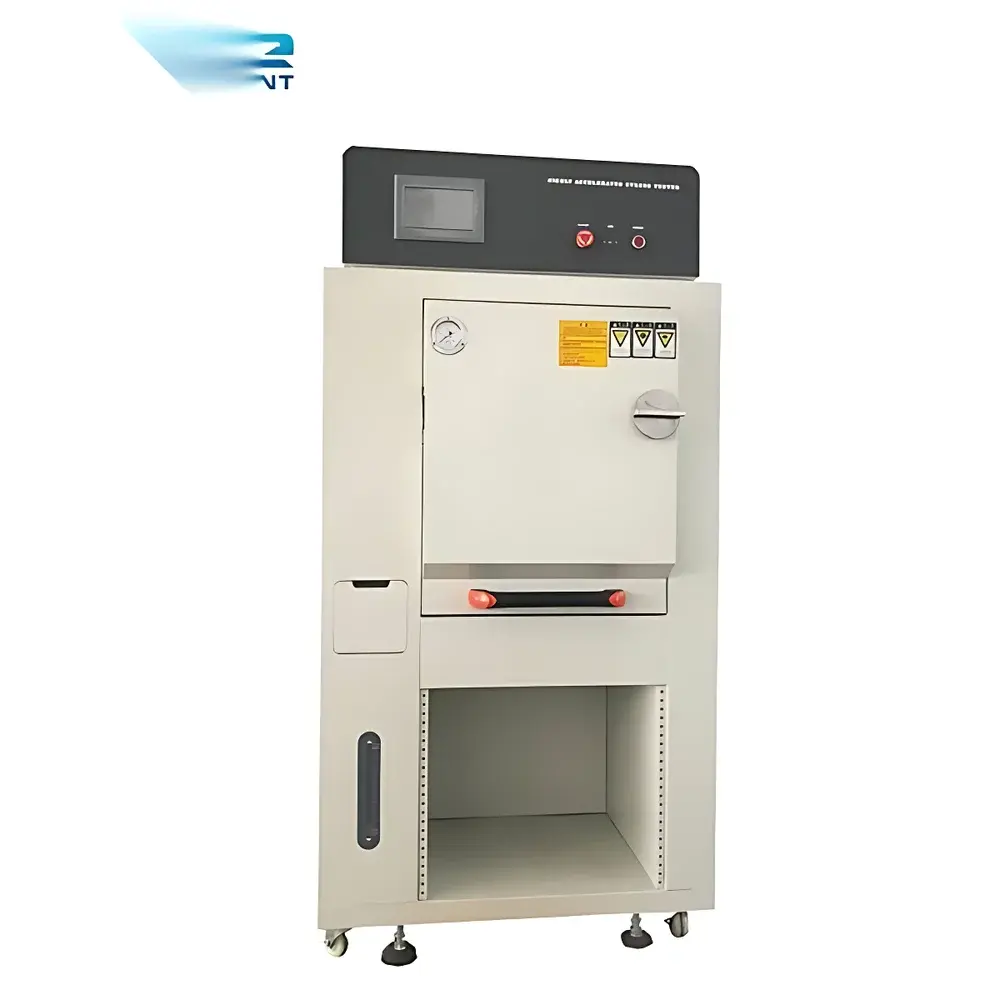
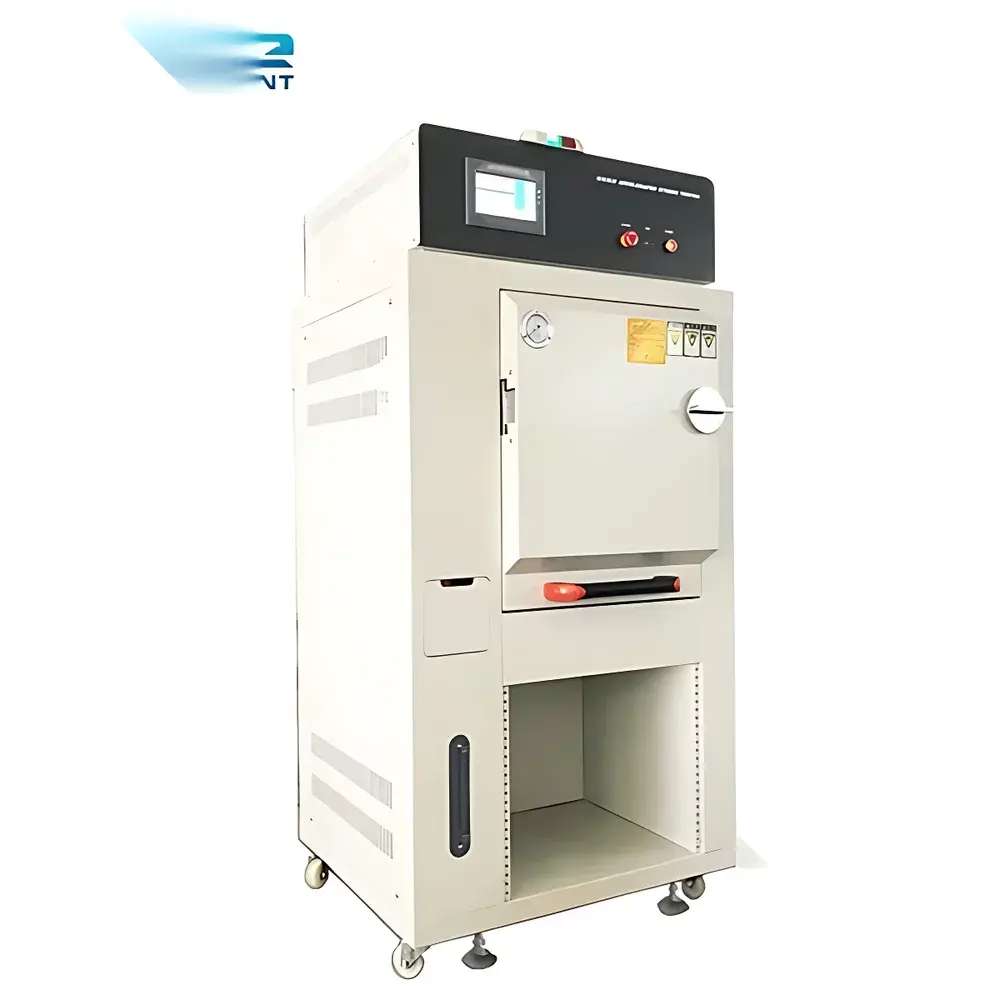
Environmental Stress Screening Chamber – Temperature, Humidity & Pressure (THP) Test System
| Key | Brand: Other Brands |
|---|---|
| Origin | Imported |
| Supplier Type | Authorized Distributor |
| Price | USD 13,800 (FOB) |
| Power Supply | AC 220 V, 1-Phase, 50/60 Hz, 15 A, 4 kW |
| Internal Chamber Geometry | Cylindrical Stainless Steel (AISI 304) |
| Sealing Principle | Reverse-Pressure Dynamic Gasket Engagement |
| Pre-Test Purge | Vacuum-Assisted Air Exchange with Particulate Filter (≤1 µm) |
| Water Consumption | ≤1.2 L per 200 h continuous operation |
| Safety Protection | Dual-Limit Threshold Monitoring (Temperature/Pressure), Auto-Interlock Door Locking, Over-Pressure Relief Valve |
| Compliance | Designed to support ASTM D471, IEC 60068-2-30, MIL-STD-810H Method 507.7, and ISO 16750-4 test protocols |
Overview
The Environmental Stress Screening Chamber – Temperature, Humidity & Pressure (THP) Test System is an integrated tri-stress reliability test platform engineered for accelerated life testing and hermeticity validation of mission-critical components. Unlike conventional environmental chambers, this system employs a monolithic cylindrical stainless steel inner chamber (AISI 304) conforming to ASME BPVC Section VIII Division 1 vessel design principles—ensuring structural integrity under combined thermal, hygroscopic, and overpressure loading up to 200 kPa(g). Its core operational principle combines programmable thermal conditioning (−40 °C to +150 °C), controlled humidity generation (10–98% RH, ±2% RH accuracy), and regulated pressurization (ambient to +200 kPa(g)) within a single sealed volume. The chamber’s unique reverse-pressure gasket engagement mechanism dynamically enhances sealing force as internal pressure rises—eliminating reliance on static compression and extending gasket service life by ≥3× compared to traditional elastomeric seals.
Key Features
- Cylindrical Pressure-Vessel Architecture: Seamless AISI 304 stainless steel inner chamber minimizes condensation accumulation and eliminates corner-induced vapor stagnation—critical for repeatable moisture diffusion profiling in sealed assemblies.
- Reverse-Pressure Dynamic Sealing: Gasket interface is engineered to self-tighten under increasing internal pressure, maintaining leak rates <1 × 10⁻⁶ mbar·L/s (He) across full operating range without manual retorque.
- Vacuum-Assisted Pre-Conditioning Cycle: Integrated vacuum pump evacuates ambient air prior to test initiation; filtered replacement air (HEPA + activated carbon pre-filter, particle retention ≤1 µm) ensures contaminant-free test environment for sensitive optoelectronic or biomedical devices.
- Continuous Operation Support: Dual-mode water replenishment (manual fill port + automated level-sensing reservoir) enables uninterrupted 200-hour test cycles without operator intervention.
- Fail-Safe Interlock System: Real-time monitoring of chamber temperature, relative humidity, absolute pressure, door position, and gasket integrity triggers automatic shutdown and fault-code logging upon deviation from user-defined LIMIT thresholds.
- Post-Test Depressurization Protocol: Programmable pressure decay ramp (0.5–5 kPa/min) prevents mechanical shock to test specimens during cycle termination.
Sample Compatibility & Compliance
This THP chamber accommodates samples up to Ø600 mm × H900 mm (customizable), supporting rigid PCBs, multi-layer ceramic packages, MEMS sensors, LED modules, automotive ECUs, and pharmaceutical blister packaging. Its mechanical and control architecture aligns with the physical test requirements of IEC 60068-2-30 (damp heat cyclic), ASTM D471 (rubber property changes in fluids), MIL-STD-810H Method 507.7 (high-altitude operation simulation), and ISO 16750-4 (road vehicles—electrical loads). While not certified as a Class I Div 1 hazardous location device, its construction meets IP54 ingress protection standards for auxiliary electronics enclosures. All safety-critical functions—including over-pressure relief, thermal cut-off, and door interlock—are independently verified per UL 61010-1 and EN 61010-1.
Software & Data Management
The embedded controller runs a deterministic real-time OS with dual-channel PID regulation for temperature/humidity and closed-loop pressure modulation via mass flow-controlled inert gas injection (N₂ optional). Test profiles are defined using a hierarchical script editor supporting nested loops, conditional branching, and step-triggered event logging. Data acquisition records time-stamped values at 1 Hz resolution for all primary parameters (chamber T/RH/P, door status, gasket temperature, reservoir level) with local SD-card storage (≥16 GB) and optional Ethernet TCP/IP export to external LIMS or MES systems. Audit trail functionality complies with FDA 21 CFR Part 11 requirements when configured with user-role authentication and electronic signature modules.
Applications
- Hermeticity validation of semiconductor packages (QFN, BGA, WLP) via pressure-decay or helium leak correlation methods
- Accelerated aging of conformal-coated PCBs under combined thermal cycling and high-humidity pressurization
- Seal integrity verification of medical device housings (ISO 11607-1) under simulated altitude and moisture ingress conditions
- Material compatibility screening for adhesives, encapsulants, and potting compounds exposed to steam-saturated overpressure
- Reliability qualification of automotive lighting assemblies per SAE J2044 and ZVEI guidelines
- Stability testing of pharmaceutical unit-dose packaging under ICH Q1A(R2) long-term and accelerated conditions
FAQ
What is the maximum allowable internal pressure and corresponding temperature range?
The chamber is rated for continuous operation at up to +200 kPa(g) across −40 °C to +125 °C. At pressures >150 kPa(g), the upper temperature limit is reduced to +100 °C to maintain material safety margins.
Does the system support nitrogen purging for oxygen-sensitive applications?
Yes—optional N₂ inlet manifold with mass flow controller (0–20 L/min) and residual O₂ sensor (0–1000 ppm) is available as a factory-installed configuration.
How is calibration traceability maintained for temperature, humidity, and pressure sensors?
All primary sensors ship with NIST-traceable calibration certificates (valid for 12 months); field recalibration ports allow third-party verification without chamber disassembly.
Can test profiles be exported to comply with GLP audit requirements?
Yes—profile definitions, raw data logs, and system event histories are exportable in CSV and XML formats with embedded digital signatures and timestamped metadata meeting GLP Annex 11 expectations.
Is remote monitoring supported via industry-standard protocols?
Standard Modbus TCP and optional OPC UA server integration enable real-time parameter readout and alarm notification through SCADA or building management systems.



