
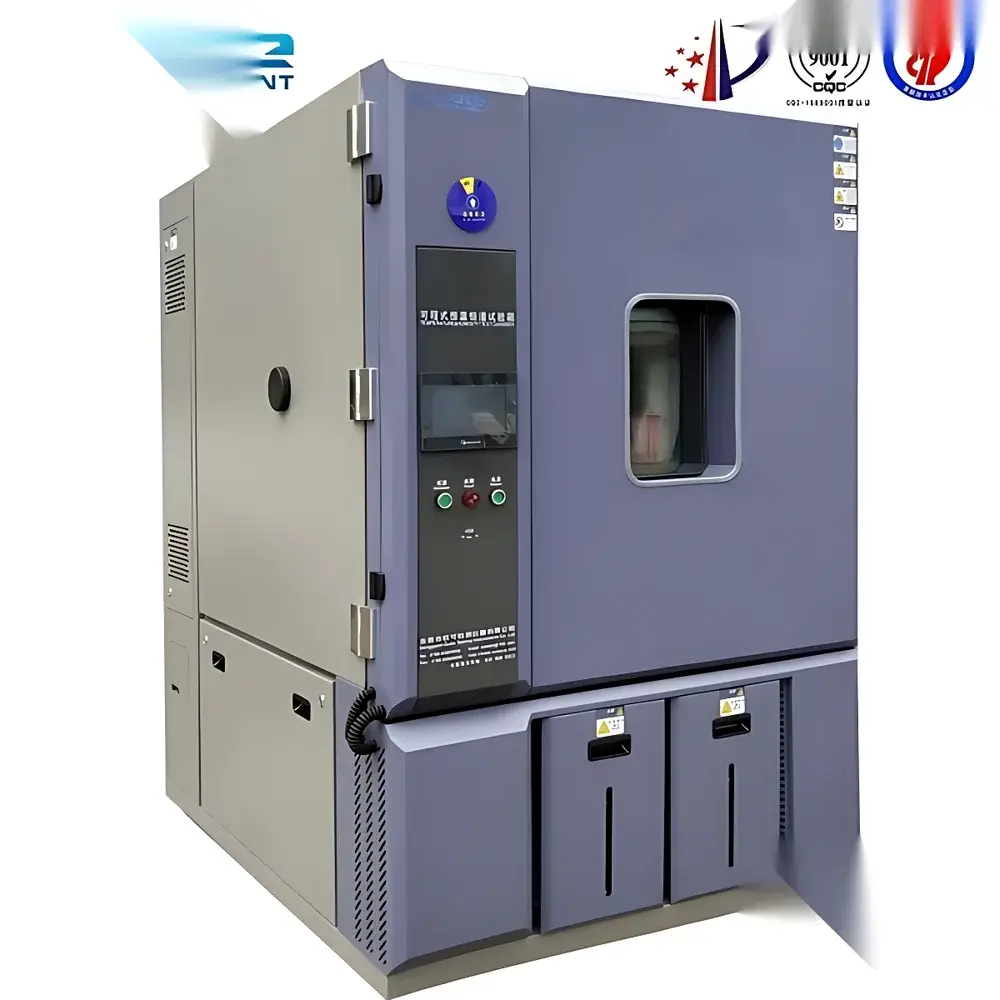
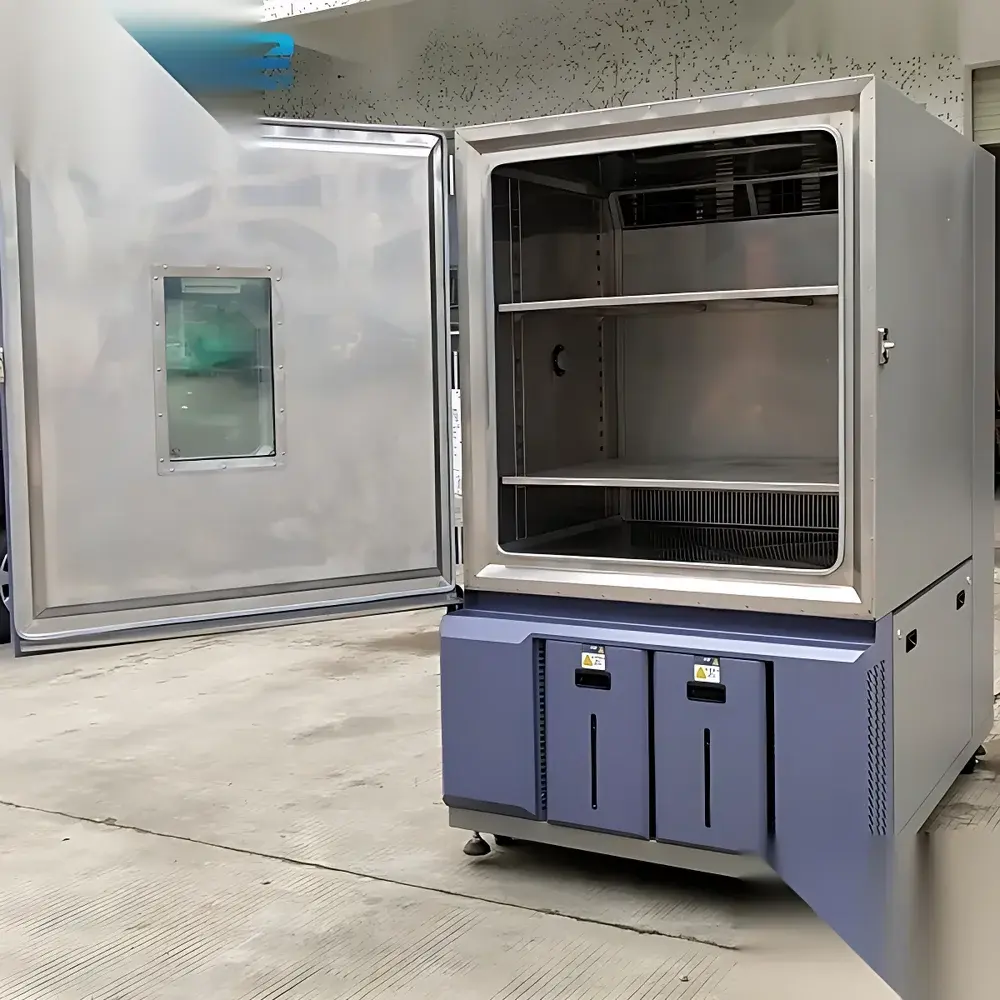
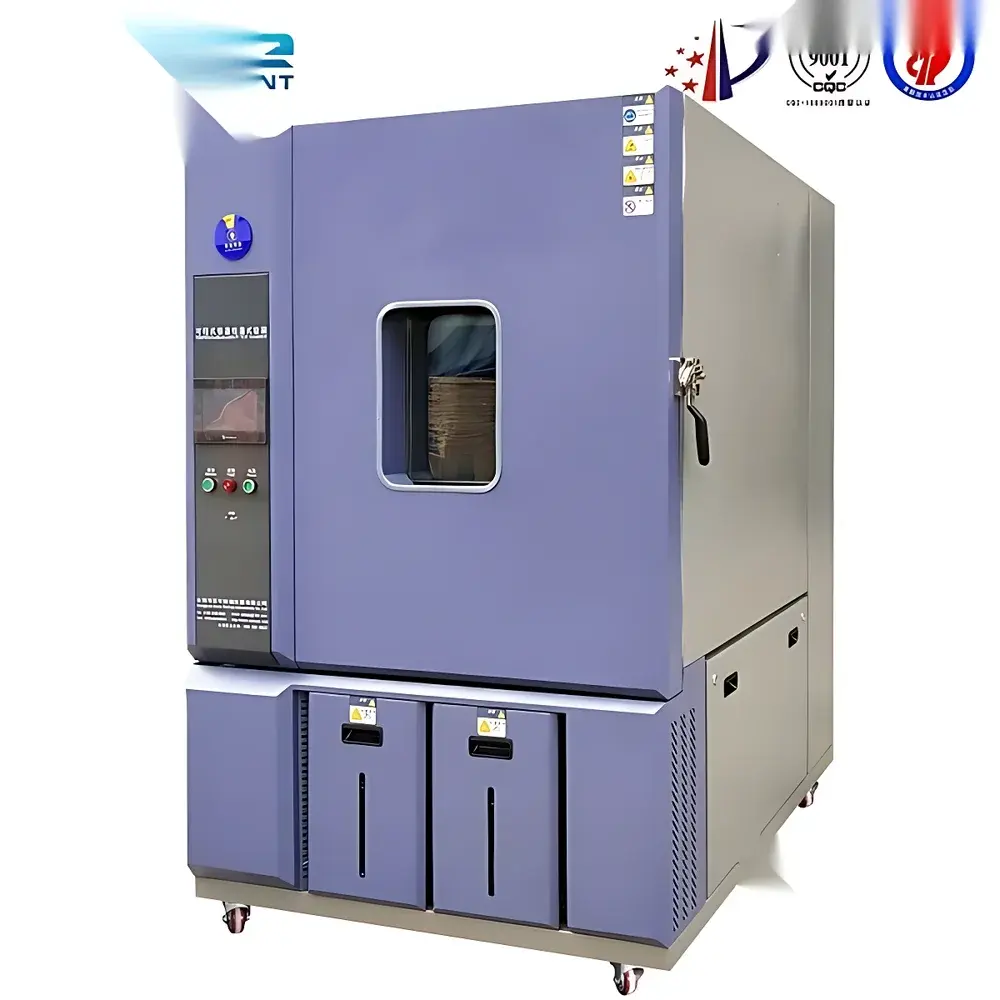
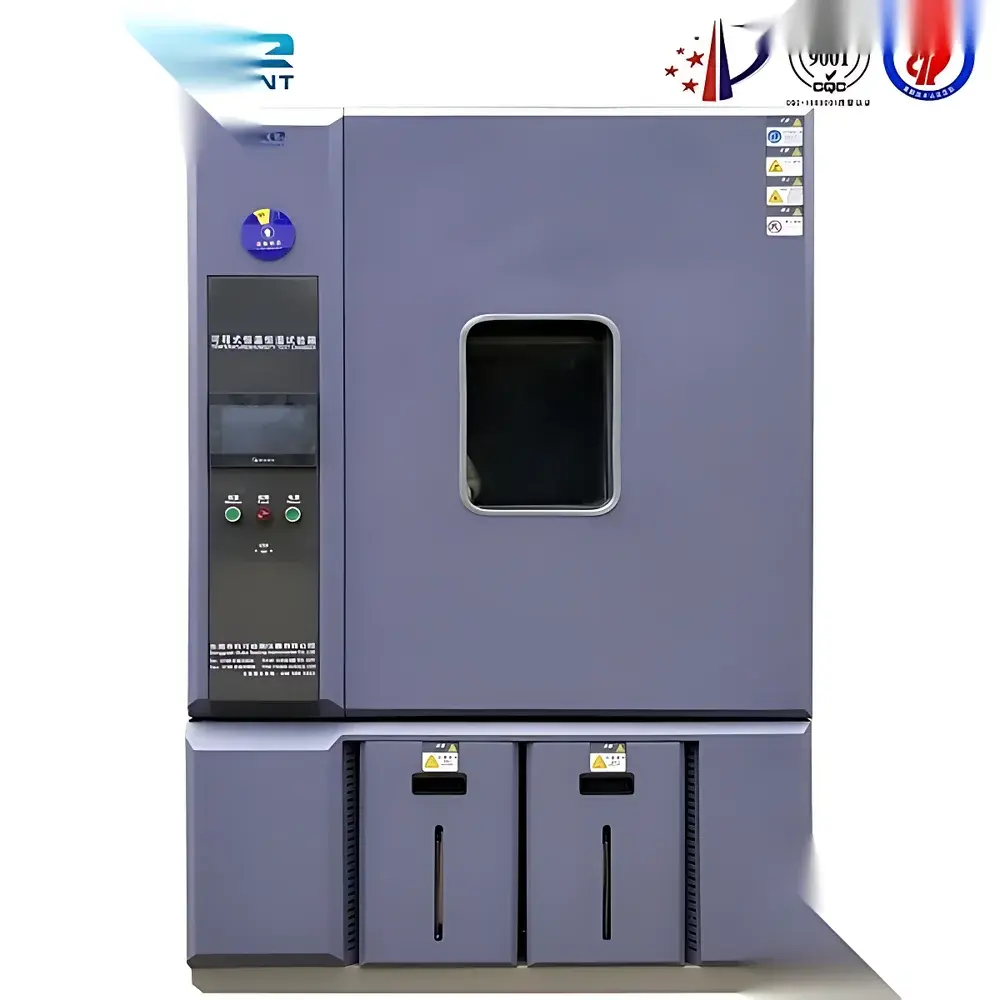
Environmental Test Chamber – High-Temperature & Humidity-Controlled Chamber (General-Purpose, Import-Grade)
| Key Specifications | Temperature Range: Up to +150°C |
|---|---|
| Humidity Range | 20–98% RH |
| Cooling Water Requirement | 10–28°C, 0.1–0.3 MPa |
| Control Method | PID-controlled BTHC (Balanced Temperature and Humidity Control) System |
| Compliance | GB/T 2423.1–1989 (Test A), GB/T 2423.2–1989 (Test B), IEC 60068-2-1, MIL-STD-2164A, GJB 1032–1990, GJB 234–1985 |
| Protection Features | Independent overtemperature cutoff, dry-run protection for humidifier, low-water-level shutdown, compressor overload/overheat/overcurrent protection, high-pressure refrigerant switch, circuit breaker, and earth-leakage protection |
| Operating Conditions | Measured at ambient 25°C ±6°C, no-load state |
| Construction | Fully welded stainless steel inner chamber, insulated double-wall design with high-efficiency polyurethane foam |
| Air Circulation | Adjustable axial fan with balanced airflow distribution |
| Controller | Imported touchscreen PID controller with multi-segment programming, data logging, and real-time trend display |
| Customization | External dimensions and internal volume configurable per user requirements |
Overview
The Environmental Test Chamber – High-Temperature & Humidity-Controlled Chamber is a precision-engineered system designed to replicate and sustain defined thermal and hygrothermal stress conditions for reliability validation, accelerated aging, and environmental qualification testing. It operates on the principle of balanced temperature and humidity control (BTHC), where heating, cooling, humidification, and dehumidification subsystems are dynamically coordinated via proportional-integral-derivative (PID) algorithms to maintain setpoint stability within tight tolerances. Unlike single-stress chambers, this dual-parameter system enables concurrent application of elevated temperature (up to +150°C) and controlled relative humidity (20–98% RH), supporting standardized test profiles required for electronics, automotive components, aerospace hardware, and medical device packaging. Its architecture integrates thermodynamic modeling with robust mechanical design—featuring full stainless-steel construction, high-density polyurethane insulation, and an optimized air circulation path—to ensure uniform chamber-wide distribution of thermal and moisture gradients.
Key Features
- Advanced BTHC control logic ensures long-term stability by continuously matching heat/humidity input to system losses—eliminating overshoot and drift during extended dwell cycles.
- Imported touchscreen PID controller with multi-segment programmability supports complex ramp-soak-hold profiles, real-time parameter monitoring, and built-in alarm history with timestamped event logging.
- Dual-redundant safety architecture includes independent overtemperature cutoff, humidifier dry-run prevention, low-water-level interlock, refrigerant high-pressure switch, and Class B earth-leakage protection per IEC 61000-4-5.
- Full capillary tube expansion system—replacing traditional thermostatic expansion valves—delivers superior refrigerant flow regulation, faster thermal response, and improved repeatability across wide load variations.
- Smooth-radius chamber interior and ergonomic non-slip handle design enhance operator safety and ease of sample loading while minimizing turbulence-induced stratification.
- Modular construction allows customization of internal volume (standard range: 100–1000 L), external footprint, and interface options—including RS-485 Modbus RTU, Ethernet TCP/IP, and optional analog 4–20 mA output for SCADA integration.
Sample Compatibility & Compliance
This chamber accommodates a broad spectrum of physical samples—from printed circuit assemblies (PCBAs) and polymer housings to sealed battery packs and sterile barrier systems—without requiring structural modification or auxiliary fixtures. All performance specifications—including temperature uniformity (±1.5°C), humidity uniformity (±3% RH), and ramp rates—are validated under no-load, ISO 17025-accredited calibration conditions per ASTM E2293 and IEC 60068-3-5. The system fully complies with mandatory environmental stress screening (ESS) standards including MIL-STD-2164A, GJB 1032–1990, and GJB 234–1985, and supports qualification testing aligned with IEC 60068-2-1 (cold), IEC 60068-2-2 (dry heat), and IEC 60068-2-30 (damp heat cyclic). Optional IQ/OQ documentation packages are available to support GLP/GMP-regulated laboratories and FDA 21 CFR Part 11-compliant audit trails.
Software & Data Management
Equipped with embedded firmware supporting local data storage (≥30 days of 1-second interval logs), the chamber interfaces seamlessly with third-party LIMS and MES platforms via standard protocols. Optional PC-based software provides advanced analysis tools—including statistical process control (SPC) charts, deviation mapping, and automated report generation in PDF/CSV formats compliant with ISO/IEC 17025 reporting requirements. All logged parameters—including chamber air temperature, relative humidity, dew point, heater/cooler duty cycle, and alarm status—are time-stamped with NTP-synchronized UTC timestamps. Audit trail functionality records user login/logout events, setpoint modifications, and calibration interventions—ensuring full traceability for regulatory submissions.
Applications
- Accelerated life testing of lithium-ion battery modules under combined thermal-hygric stress.
- Validation of solder joint integrity in automotive ECUs per AEC-Q200 requirements.
- Stability assessment of pharmaceutical blister packaging under ICH Q1A(R3) climatic zones.
- Environmental stress screening (ESS) of avionics subassemblies prior to flight qualification.
- Material compatibility testing of elastomeric seals exposed to high-temperature humid air.
- Reliability verification of conformal-coated PCBs subjected to thermal cycling with humidity bias.
FAQ
What is the maximum achievable temperature and humidity combination?
The chamber achieves up to +150°C at ≤20% RH; maximum humidity (98% RH) is limited to ≤85°C due to saturation constraints and condensation risk mitigation.
Does the chamber support rapid temperature transitions?
Yes—average ramp rates of 3–5°C/min (air) are attainable between 25°C and 100°C under no-load conditions; actual rate depends on thermal mass, insulation integrity, and cooling water inlet temperature.
Is remote monitoring and control supported?
Standard RS-485 Modbus RTU enables integration with building management systems; optional Ethernet module adds web-based interface and SNMP alerting.
How is calibration traceability ensured?
Factory calibration uses NIST-traceable reference sensors; users may perform field verification using calibrated portable probes per ISO/IEC 17025 guidelines.
Can the chamber operate unattended for extended durations?
Yes—the dual-redundant safety system, automatic fault recovery logic, and continuous self-diagnostic routines permit 7×24 operation in supervised laboratory environments.



