
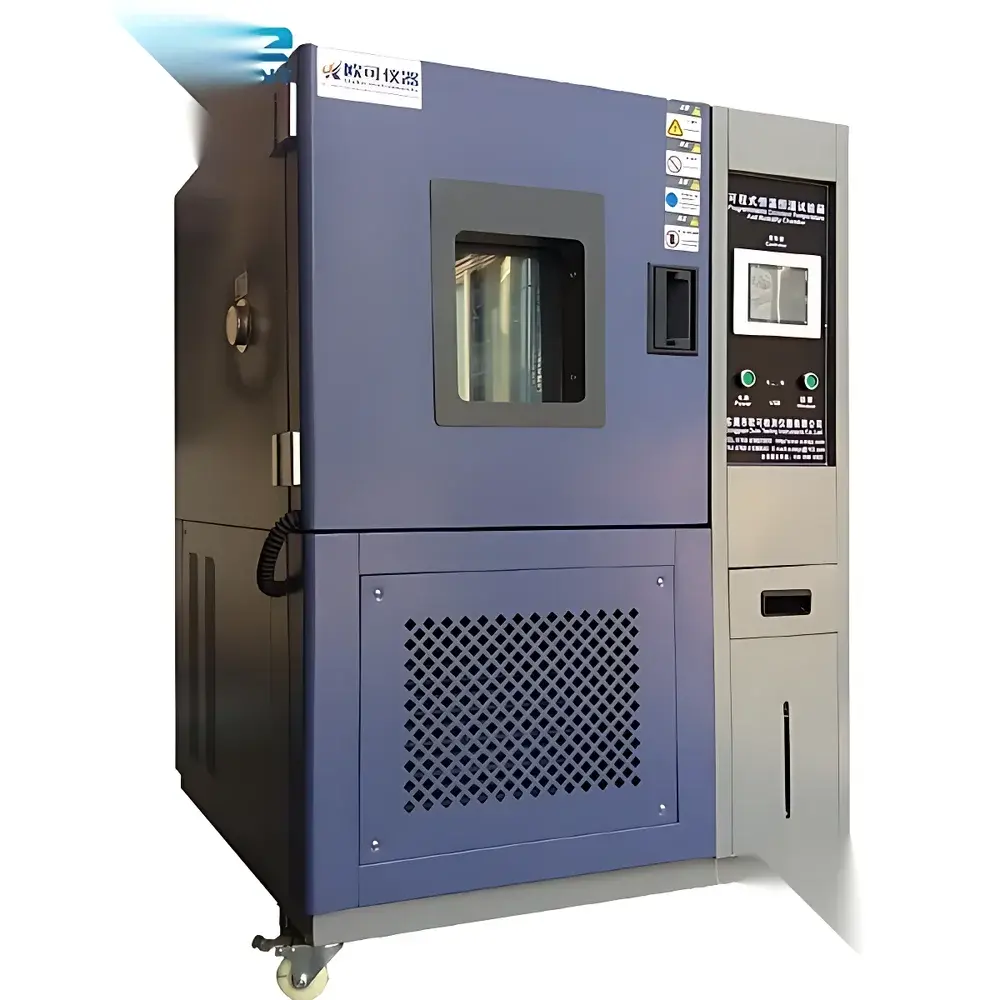
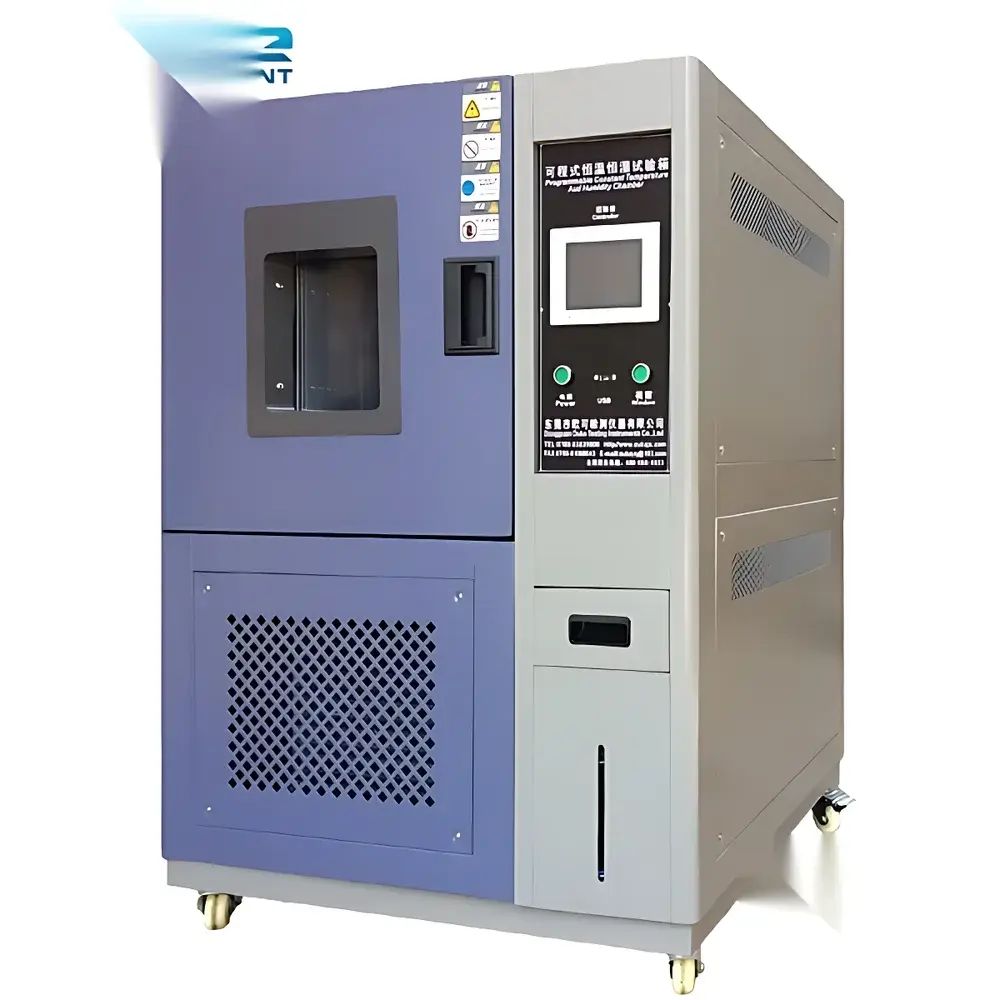
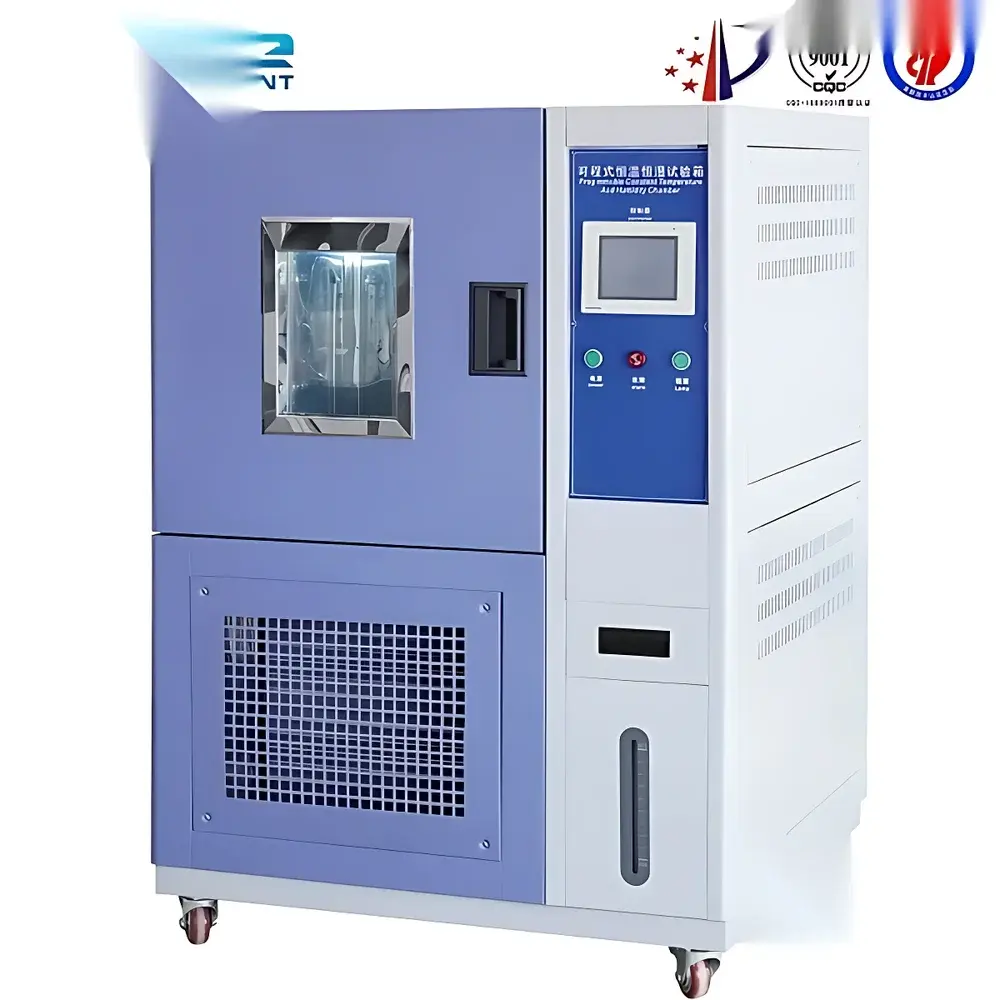
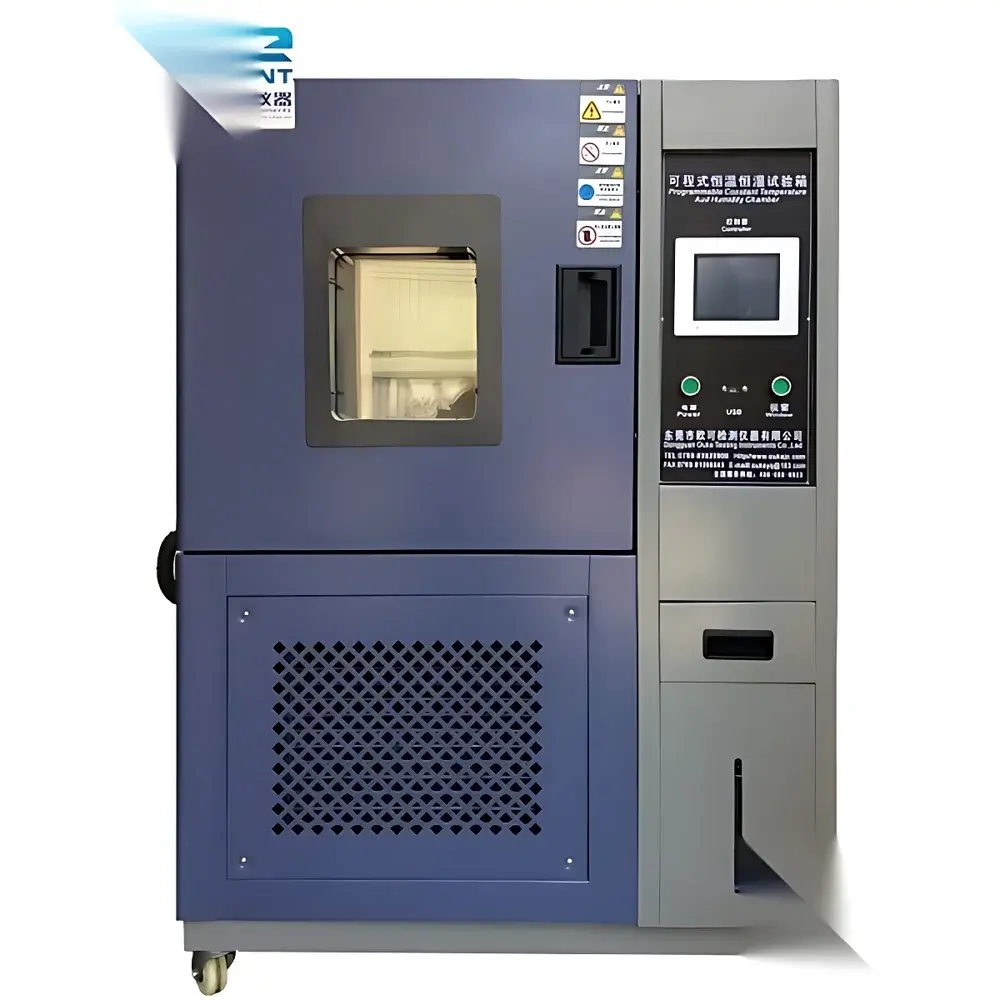
Environmental Test Chamber – Temperature and Humidity Controlled Accelerated Aging Chamber
| Key Specifications | Temperature Range: -40°C to +150°C (typical, model-dependent) |
|---|---|
| Humidity Range | 20%–98% RH |
| Control Accuracy | ±0.5°C / ±2.5% RH |
| Airflow Uniformity | ±1.5°C / ±3% RH (in working zone) |
| Cooling Water Requirement | 10–28°C, 0.1–0.3 MPa |
| Compliance | GB/T 2423.1–2023, GB/T 2423.2–2023, IEC 60068-2-1, IEC 60068-2-2, GJB 1032A–2021, MIL-STD-2164A–2018 |
| Safety Protections | Dry-run protection for humidifier, independent overtemperature cutoff, low-water level alarm, compressor overload/overheat/overcurrent protection, high-pressure refrigerant switch, circuit breaker, earth-leakage circuit interrupter (ELCI) |
| Construction | Seamless stainless steel inner chamber, double-wall insulation, P.I.D.-controlled BTHC (Balanced Temperature & Humidity Control) system with SSR-driven heating/humidification |
| Controller | Touchscreen HMI with programmable ramp-soak profiles, real-time data logging, USB export, optional Ethernet/RS485 interface |
Overview
The Environmental Test Chamber – Temperature and Humidity Controlled Accelerated Aging Chamber is a precision-engineered climatic simulation system designed to replicate and accelerate environmental stress conditions for reliability validation, material aging assessment, and product qualification testing. Operating on the principle of balanced thermal-humidity control (BTHC), the chamber maintains simultaneous, stable, and traceable temperature and relative humidity (RH) profiles across its working volume using proportional-integral-derivative (P.I.D.) algorithms and solid-state relays (SSR) to dynamically match heating/humidification output against thermal and moisture losses. Unlike simple on-off control systems, BTHC ensures long-term stability (<±0.5°C, <±2.5% RH) under variable load conditions—critical for compliance with accelerated aging protocols in electronics, polymers, pharmaceutical packaging, and automotive components. The chamber’s thermodynamic architecture integrates a full-capillary-tube refrigeration system with automatic capacity modulation—eliminating reliance on mechanical expansion valves and delivering faster, smoother, and more reproducible temperature transitions than conventional designs.
Key Features
- Robust safety architecture: Independent dual overtemperature cutouts, humidifier dry-run prevention, real-time water-level monitoring, compressor multi-protection (overload, overheat, overcurrent), refrigerant high-pressure interlock, ELCI, and molded-circuit overcurrent breakers.
- High-fidelity climate control: BTHC logic ensures zero steady-state drift; SSR-driven heating and steam humidification respond within milliseconds to maintain setpoint fidelity during dynamic ramp-soak cycles.
- Optimized thermal-mechanical design: Seamless 304 stainless steel inner chamber, vacuum-insulated double walls, aerodynamically optimized air circulation with adjustable vane diffusers, and uniform airflow distribution (±1.5°C / ±3% RH tolerance across working zone).
- Intuitive human-machine interface: 7-inch capacitive touchscreen controller supporting up to 99 programmable test segments, customizable ramp rates, event-triggered alarms, password-protected parameter locking, and audit-ready operation logs.
- Scalable infrastructure integration: Standard RS485 Modbus RTU and optional Ethernet (TCP/IP) interfaces enable centralized monitoring via SCADA or LIMS platforms; supports GLP/GMP-compliant data archiving with timestamped, tamper-evident records.
Sample Compatibility & Compliance
This chamber accommodates a broad range of physical samples—from PCB assemblies and lithium-ion battery modules to medical device packaging, elastomeric seals, and coated optical substrates—without compromising control integrity. Internal dimensions are customizable per user requirements (standard configurations range from 100 L to 1000 L). All models comply with internationally recognized environmental testing standards, including GB/T 2423.1–2023 (cold), GB/T 2423.2–2023 (dry heat), IEC 60068-2-1 (cold) and -2-2 (dry heat), GJB 1032A–2021 (environmental stress screening), and MIL-STD-2164A–2018 (ESS for electronic equipment). For regulated industries, the system supports 21 CFR Part 11-compliant electronic signatures and audit trails when paired with validated software packages.
Software & Data Management
The embedded controller firmware includes built-in data logging at user-selectable intervals (1 s to 60 min), with onboard storage for ≥30 days of continuous operation. Export formats include CSV and PDF reports compatible with Excel and statistical process control (SPC) tools. Optional PC-based software enables remote supervision, multi-chamber fleet management, automated report generation (including pass/fail status per test segment), and integration with enterprise quality management systems (QMS). All data records include ISO 8601 timestamps, operator ID, chamber serial number, and calibration certificate references—ensuring full traceability for internal audits and regulatory submissions.
Applications
Typical use cases include accelerated life testing of polymer degradation kinetics, thermal cycling validation of solder joint integrity, humidity-induced corrosion evaluation of metallic coatings, shelf-life prediction of barrier-laminated pharmaceutical blisters, and preconditioning of sensors prior to functional testing. In R&D labs, the chamber supports DOE-based environmental stress profiling; in manufacturing QA/QC, it serves as a critical tool for incoming material verification and batch release testing per IATF 16949 and ISO 13485 requirements.
FAQ
What is the typical temperature and humidity recovery time after door opening?
Recovery to ±0.5°C / ±2.5% RH depends on door-open duration, ambient conditions, and load mass—but average recovery is ≤12 minutes for standard 150 L chambers under ISO 16750-4 test conditions.
Can the chamber be calibrated to NIST-traceable standards?
Yes—third-party calibration services are available with certificates traceable to NIST or national metrology institutes (e.g., PTB, NPL), covering temperature, humidity, and uniformity per ISO/IEC 17025.
Is remote monitoring supported out of the box?
The base controller includes RS485 Modbus; Ethernet connectivity and cloud-based telemetry require optional hardware modules and licensed software licenses.
Does the system meet FDA 21 CFR Part 11 requirements?
When deployed with validated software, role-based access controls, electronic signature workflows, and immutable audit logs, the system meets Part 11 technical and procedural criteria for electronic records and signatures.
What maintenance intervals are recommended?
Compressor oil and refrigerant checks every 24 months; humidifier tank cleaning weekly; HEPA filter replacement every 6 months; annual full-system calibration and safety verification by certified service engineers.



