
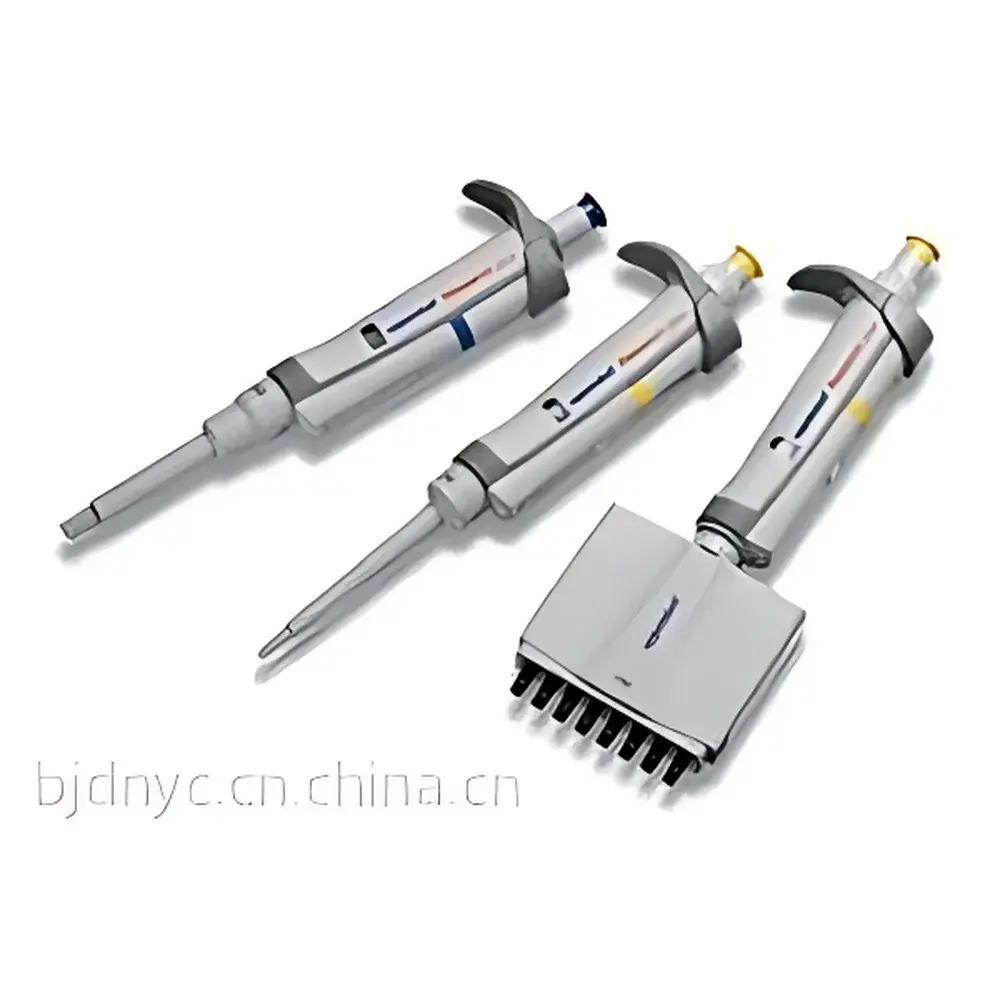
Eppendorf Reference 2 Single-Channel Adjustable Volume Pipette
| Origin | Germany |
|---|---|
| Manufacturer Type | Authorized Distributor |
| Origin Category | Imported |
| Model | Adjustable Volume Single-Channel |
| Instrument Type | Single-Channel Pipette |
| Automation Level | Manual |
| Channels | 1 |
| Volume Range | 0.1–2.5 µL, up to 10 mL (model-dependent) |
| Accuracy Error | ±0.01 % of set volume (typical at nominal volume, per ISO 8655) |
Overview
The Eppendorf Reference 2 Single-Channel Adjustable Volume Pipette is a precision-engineered manual liquid handling instrument designed for high-reproducibility volumetric transfer in life science, clinical diagnostics, pharmaceutical quality control, and academic research laboratories. Based on air displacement principle, it delivers traceable, gravimetrically verified accuracy across its full adjustable range—from ultra-low volumes (0.1 µL) to mid-range capacities (up to 10 mL, depending on model variant). Unlike fixed-volume pipettes, the Reference 2 employs a robust, tool-free calibration mechanism compliant with ISO 8655:2022—enabling end-users to perform routine performance verification and adjustment without external service intervention. Its design integrates metrological traceability, regulatory readiness, and ergonomic durability, making it suitable for GLP-, GMP-, and CLIA-regulated workflows where auditability and operator safety are critical.
Key Features
- Tool-free user calibration system compliant with ISO 8655 Annex C, supporting in-house verification and adjustment without disassembly or specialized tools
- Full lower-body autoclavability at 121 °C / 20 min: the lower sleeve and tip cone can be detached via simple rotational release for sterilization—essential for biosafety Level 2+ applications and aseptic cell culture workflows
- Ergonomic contouring and low actuation force (≤1.5 N for aspiration, ≤2.0 N for dispensing) reduce repetitive strain injury (RSI) risk during extended use
- 360° rotatable pipette shaft allows optimal hand positioning and tip alignment—particularly advantageous when working with narrow tubes or densely packed microplates
- V-shaped sealing ring at the tip cone ensures consistent, leak-free engagement with universal pipette tips—including third-party brands meeting ISO 8655 dimensional tolerances
- Factory-certified performance documentation supplied with each unit, including gravimetric test data across three volume points (10%, 50%, and 100% of nominal capacity), traceable to national standards
Sample Compatibility & Compliance
The Reference 2 accommodates standard conical polypropylene pipette tips ranging from 0.1 µL to 10 mL nominal capacity. Its air-displacement architecture is validated for aqueous solutions, buffers, diluted acids/bases, and low-viscosity organic solvents (e.g., ethanol, acetone). For viscous or volatile liquids, reverse pipetting protocols are recommended and supported by the instrument’s dual-stop plunger mechanism. The device conforms to ISO 9001:2015 quality management requirements and supports compliance with Good Laboratory Practice (GLP) and current Good Manufacturing Practice (cGMP) frameworks. All calibration procedures align with ISO/IEC 17025:2017 metrological competence criteria, and the included certificate satisfies FDA 21 CFR Part 11 electronic record integrity expectations when paired with documented calibration logs.
Software & Data Management
As a fully manual mechanical device, the Reference 2 does not incorporate embedded electronics, firmware, or connectivity interfaces. However, its calibration traceability supports integration into laboratory information management systems (LIMS) and electronic lab notebooks (ELN) through structured documentation workflows. Users may record calibration events—including date, technician ID, reference standard used, deviation values, and pass/fail status—in accordance with internal SOPs and audit requirements. Eppendorf provides downloadable calibration templates and metrological guidance documents compatible with ISO/IEC 17025-accredited quality systems.
Applications
- Precision dispensing in qPCR and digital PCR setup, especially for master mix preparation at sub-microliter volumes
- Serial dilution series in ELISA, Western blotting, and receptor binding assays
- Cell seeding and media exchange in primary and stem cell culture under sterile hood conditions
- Preparation of calibration standards and QC samples in clinical chemistry and toxicology laboratories
- Reagent aliquoting for high-throughput screening (HTS) workflows involving 96- and 384-well microtiter plates
- Method validation studies requiring documented volumetric uncertainty budgets per EURACHEM/CITAC Guide CG4
FAQ
Is the pipette certified for ISO 8655 compliance?
Yes—each unit ships with a factory-issued calibration certificate verifying performance against ISO 8655:2022 requirements, including accuracy, precision, and temperature sensitivity testing.
Can I autoclave the entire pipette?
No—only the lower sleeve and tip cone assembly is autoclavable at 121 °C for 20 minutes. The upper body containing the spring mechanism and volume adjustment gear must remain unsterilized to preserve mechanical integrity.
Does it support electronic data logging?
No—the Reference 2 is a purely mechanical instrument. Data capture requires manual entry into LIMS or ELN platforms using standardized calibration templates.
What tip brands are compatible?
All tips conforming to ISO 8655 dimensional specifications—including Eppendorf PhysioTip, Gilson Pipetman, and Rainin LTS—are reliably sealable due to the V-ring tip cone design.
How often should I recalibrate?
Eppendorf recommends quarterly calibration for routine use; more frequent verification is advised after impact events, exposure to extreme temperatures, or when handling aggressive solvents that may affect internal seals.



