
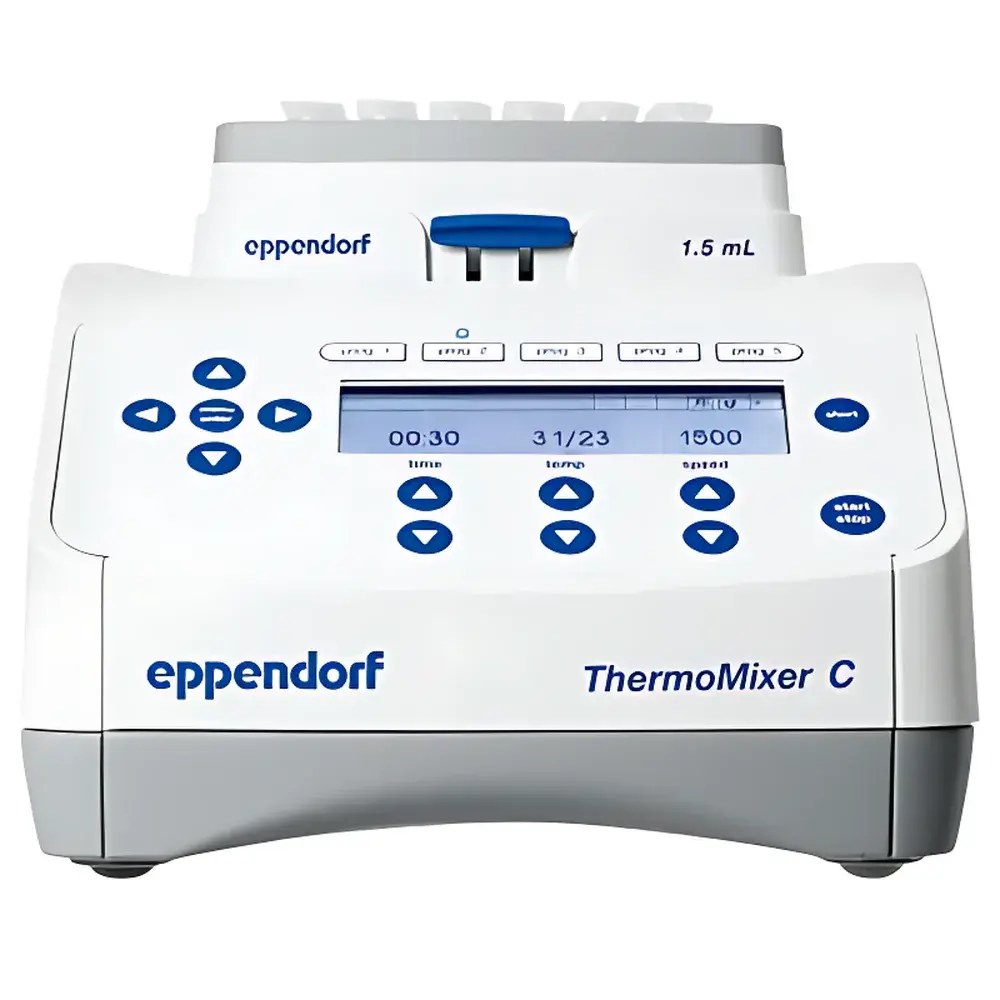
Eppendorf ThermoMixer C Comfort Temperature-Controlled Mixer
| Brand | Eppendorf |
|---|---|
| Country of Origin | Germany |
| Manufacturer Type | Original Equipment Manufacturer (OEM) |
| Import Status | Imported |
| Model | ThermoMixer C |
| Instrument Category | Orbital Shaker / Temperature-Controlled Mixer |
| Timer Range | 15 s – 99 h 30 min |
| Mixing Speed | 300 – 3000 rpm |
| Orbit Diameter | 3 mm |
| Temperature Range | 15 °C below ambient to 100 °C |
| Number of Available SmartBlock Modules | 11 |
Overview
The Eppendorf ThermoMixer C is a precision-engineered temperature-controlled orbital mixer designed for life science laboratories requiring simultaneous, reproducible heating and mixing of low-volume samples in tubes and microplates. Operating on the principle of controlled orbital shaking combined with Peltier-based thermoregulation, the ThermoMixer C delivers uniform thermal energy transfer and consistent kinetic agitation—critical for enzymatic reactions, nucleic acid handling, and cell-based protocols where both temperature stability and mechanical homogeneity directly impact assay fidelity. Unlike conventional incubators or standalone shakers, the ThermoMixer C integrates these two functions within a single compact platform, eliminating inter-device transfer steps and reducing thermal lag and sample disturbance. Its architecture supports ISO/IEC 17025-aligned workflows by enabling traceable temperature logging and programmable parameter locking—key considerations for GLP-compliant environments.
Key Features
- 2D-Mix-Control Technology: A proprietary dual-axis motion algorithm that dynamically adjusts orbital speed and tilt angle to ensure thorough, splash-free mixing across all tube orientations—even at high speeds (up to 3000 rpm) and low volumes (as low as 10 µL).
- Eppendorf SmartBlock Modular System: Eleven interchangeable aluminum heating blocks with integrated Pt1000 sensors provide application-specific geometry (e.g., 0.2 mL PCR strips, 1.5/2.0 mL tubes, 96-well plates) and ±0.5 °C temperature accuracy at setpoint, validated per ASTM E2251-22.
- ThermoTop Hot Lid: An actively heated lid maintains surface temperature above dew point, preventing condensation inside tube caps and minimizing evaporation-related concentration drift during prolonged incubation (e.g., 16-h overnight digestions).
- QuickRelease Mechanism: Tool-free SmartBlock exchange in <3 seconds ensures rapid protocol switching without recalibration or thermal equilibration delay—ideal for multi-step workflows such as plasmid prep followed by restriction digestion.
- PhysioCare Ergonomics: Low-profile footprint (240 × 220 × 180 mm), front-access control panel, and noise emission <45 dB(A) at 1 m comply with EU Directive 2006/42/EC for laboratory equipment safety and operator comfort.
- Programmable Logic Interface: Eight user-definable protocols with independent time, temperature, and speed profiles; real-time display of current setpoints and elapsed time; automatic shutdown after completion.
Sample Compatibility & Compliance
The ThermoMixer C accommodates standard consumables including Eppendorf LoBind® tubes, PCR strips, deep-well plates, and custom-fit SmartBlocks for non-standard vessels (e.g., cryovials, glass capillaries). All SmartBlocks are autoclavable (121 °C, 20 min) and chemically resistant to common solvents (ethanol, isopropanol, dilute acids/bases). The instrument meets IEC 61010-1:2010 for electrical safety and carries CE marking under the EU Medical Device Regulation (MDR) Annex XVI for in vitro diagnostic support use. Temperature calibration reports (traceable to PTB/NIST standards) and audit trails—including parameter changes, start/stop timestamps, and error logs—are exportable via USB for FDA 21 CFR Part 11–compliant data integrity management.
Software & Data Management
While the ThermoMixer C operates as a standalone instrument with intuitive rotary encoder navigation, it supports optional integration with Eppendorf VisioNize Lab Suite software (v3.2+). This platform enables remote monitoring, centralized firmware updates, and secure export of run logs in CSV/PDF formats—including temperature deviation graphs, mixing consistency metrics (coefficient of variation <1.2% across 12 replicates), and electronic signatures for SOP adherence. Audit trail records capture operator ID, timestamp, and parameter modifications—satisfying ALCOA+ principles for regulated QC/QA labs.
Applications
- cDNA synthesis and reverse transcription requiring precise 42–50 °C incubation with gentle agitation
- Restriction enzyme digestion (e.g., EcoRI, HindIII) at 37 °C with continuous mixing to prevent substrate settling
- Protein denaturation and refolding assays across 25–95 °C gradients
- Bacterial transformation protocols involving heat shock (42 °C, 45 s) followed by recovery shaking at 37 °C
- RNA extraction workflows where RNase inhibition demands strict temperature control below 25 °C
- Pre-PCR master mix preparation with homogeneous reagent dispersion prior to thermal cycling
- Lysis of Gram-positive bacteria using lysozyme + mutanolysin at 37 °C with vigorous 2500 rpm mixing
FAQ
Can the ThermoMixer C be used for applications requiring precise temperature ramping?
No—the instrument maintains a fixed setpoint temperature only; it does not support linear or stepwise temperature ramps.
Is the ThermoMixer C compatible with third-party heating blocks?
No—only Eppendorf-certified SmartBlocks with embedded Pt1000 sensors and mechanical keying are recognized and temperature-regulated by the system.
What is the minimum recommended sample volume for reliable mixing at 3000 rpm?
For 1.5 mL tubes, ≥100 µL is advised to ensure vortex formation without splashing; lower volumes require reduced speed or specialized low-volume SmartBlocks.
Does the device support password-protected user access levels?
Yes—administrator and operator modes can be configured via VisioNize Lab Suite to restrict editing of critical parameters.
How often should temperature calibration be performed?
Eppendorf recommends annual calibration against a NIST-traceable reference thermometer, or after any physical impact or extended operation outside specified ambient conditions (15–32 °C).




