
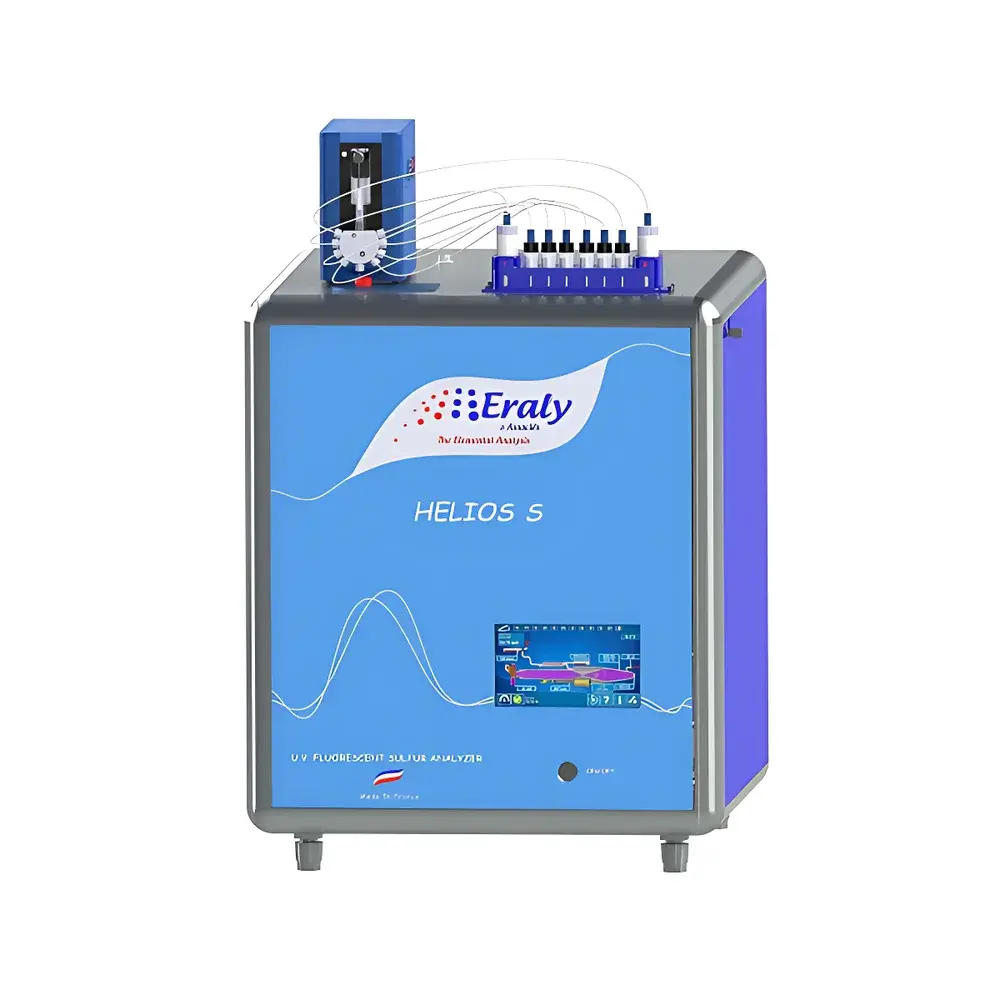
Eraly HELIOS S Total Sulfur Analyzer
| Brand | Eraly & Associés |
|---|---|
| Origin | France |
| Model | HELIOS S |
| Measurement Element | Sulfur |
| Measurement Principle | Ultraviolet Fluorescence (UVF) |
| Detection Limit | 5 ppb |
| Quantitation Limit | 10 ppb |
| Measurement Range | 5 ppb – 10% w/w |
| Combustion Furnace Temperature | Up to 1100 °C |
| Temperature Control Accuracy | ±1 °C |
| Sample Volume | 20–80 µL (liquid), 10 mL (gas), 20 µL (LPG) |
| Gas Requirements | O₂ ≥99.998% at 3 bar, Ar ≥99.995% at 3 bar |
| Power Supply | 110/230 V, 50/60 Hz, 800 W |
| Dimensions (W×H×D) | 51 × 78 × 56 cm |
| Weight | 32 kg |
Overview
The Eraly HELIOS S Total Sulfur Analyzer is a high-performance, benchtop ultraviolet fluorescence (UVF) analyzer engineered for precise, trace-level sulfur quantification in complex hydrocarbon matrices. Designed in close collaboration with refinery laboratories, independent testing facilities, and QC/QA professionals, the HELIOS S implements ASTM- and ISO-compliant combustion-UVF methodology: samples are fully oxidized in a high-temperature quartz furnace (up to 1100 °C), converting all organic and inorganic sulfur species into SO₂; the resulting SO₂ is carried by ultra-pure argon/oxygen gas stream into a reaction chamber where it is excited by pulsed UV light, emitting characteristic fluorescence proportional to sulfur concentration. This physical detection principle ensures matrix-independent response, high specificity, and exceptional reproducibility—critical for regulatory compliance in fuel sulfur monitoring (e.g., Euro 5/6, Tier 3, IMO 2020).
Key Features
- Ultra-low detection capability: 5 ppb limit of detection (LOD) and 10 ppb limit of quantitation (LOQ), validated per ICH Q2(R2) guidelines for analytical method validation.
- Automated range adaptability: No manual method selection or range switching required—the instrument dynamically optimizes PMT gain, integration time, and calibration scaling across the full 5 ppb–10% w/w span.
- Multi-matrix compatibility: Single calibration transferable across liquid fuels (gasoline, diesel, jet fuel), biofuels (FAME, HVO), lubricants, solvents, aqueous solutions, LPG, and permanent gases—enabled by real-time signal normalization and internal reference tracking.
- Integrated 7-inch capacitive touchscreen interface with animated process visualization: live monitoring of UV lamp intensity, PMT signal stability, furnace temperature profile, and carrier gas pressure diagnostics.
- Robust thermal architecture: Dual-zone furnace (F2 configuration) with ±1 °C temperature uniformity and active cooling for rapid cycle-to-cycle thermal recovery (typical analysis time: 3–5 min per sample).
- Comprehensive self-diagnostics and predictive maintenance: Onboard service assistant continuously evaluates optical alignment, detector aging, gas purity drift, and combustion efficiency—flagging early-stage anomalies before performance degradation occurs.
Sample Compatibility & Compliance
The HELIOS S meets stringent international standard requirements for sulfur determination in petroleum products and alternative fuels. It is fully compliant with ASTM D5453 (determination of total sulfur in light hydrocarbons, spark ignition engine fuels, diesel fuels, and engine oils), ASTM D6667 (total volatile sulfur in gaseous samples), ASTM D7183 (sulfur in aromatic hydrocarbons), ASTM D7551 (sulfur in biodiesel), SH/T 0689 (Chinese national standard for gasoline and diesel), and ISO 20846 (petroleum products — determination of sulfur content — UV fluorescence method). Its design supports GLP and GMP environments through audit-trail-enabled software logging, electronic signature support (21 CFR Part 11 ready), and hardware-level calibration traceability to NIST-traceable sulfur standards.
Software & Data Management
HELIOS S operates with Eraly’s proprietary AnalytiCAL™ Suite v4.x, a Windows-based application delivering full method lifecycle control—from sequence definition and calibration curve management (linear, quadratic, or multi-point non-linear fitting) to automated QC check execution (system suitability, blank verification, duplicate precision assessment). All raw spectral data, chromatographic-like UVF decay profiles, and instrument parameter logs are stored in encrypted, timestamped .ACQ files compliant with long-term archival requirements. Data export options include CSV, PDF analytical reports (with embedded metadata), and direct LIMS integration via ASTM E1384-compliant HL7 or ODBC drivers. Software validation packages—including IQ/OQ documentation and risk-based URS—are available upon request for regulated laboratory deployment.
Applications
- Refinery process stream monitoring: Real-time sulfur tracking in hydrotreater feed, product cuts, and reformate blending components.
- Fuel certification labs: Routine testing of ultra-low-sulfur diesel (ULSD), marine distillates, aviation turbine fuel (Jet A-1), and ethanol/gasoline blends (E10, E85).
- Biofuel quality assurance: Quantification of residual catalyst sulfur and process-related contaminants in FAME, HVO, and pyrolysis oil.
- Research & development: Catalyst deactivation studies, sulfur speciation screening (when coupled with GC-S), and formulation optimization for low-sulfur lubricant additives.
- Environmental compliance: Monitoring of sulfur emissions precursors in flue gas condensates and wastewater effluents from petrochemical operations.
FAQ
What combustion gases are required, and what purity specifications must be met?
Oxygen (≥99.998% purity, dew point ≤ –70 °C) and argon (≥99.995% purity, hydrocarbon-free) are required at 3 bar supply pressure. Optional helium carrier gas is supported for specific high-sensitivity applications.
Is the instrument capable of analyzing solid samples?
Yes—solid samples (e.g., catalysts, polymers, particulate filters) can be analyzed using Eraly’s optional solid-sample introduction module (SSIM), which employs controlled pyrolysis followed by oxidative combustion in the main furnace.
How is calibration traceability ensured?
Calibration is performed using certified reference materials (CRMs) traceable to NIST SRM 2721 (sulfur in diesel) or equivalent national metrology institute standards; instrument-specific correction factors are archived with each calibration event in the secure audit trail.
Does the system support remote diagnostics and firmware updates?
Yes—via optional Ethernet-connected maintenance portal with TLS-encrypted communication; remote access requires prior authorization and complies with ISO/IEC 27001-aligned cybersecurity protocols.
What is included in the 5-year hardware warranty?
The comprehensive warranty covers all electro-optical components (UV lamp, PMT detector, optical filters), furnace assembly, gas delivery subsystems, and mainboard electronics—excluding consumables (quartz combustion tubes, filters, septa) and damage resulting from improper gas supply or sample contamination.



