
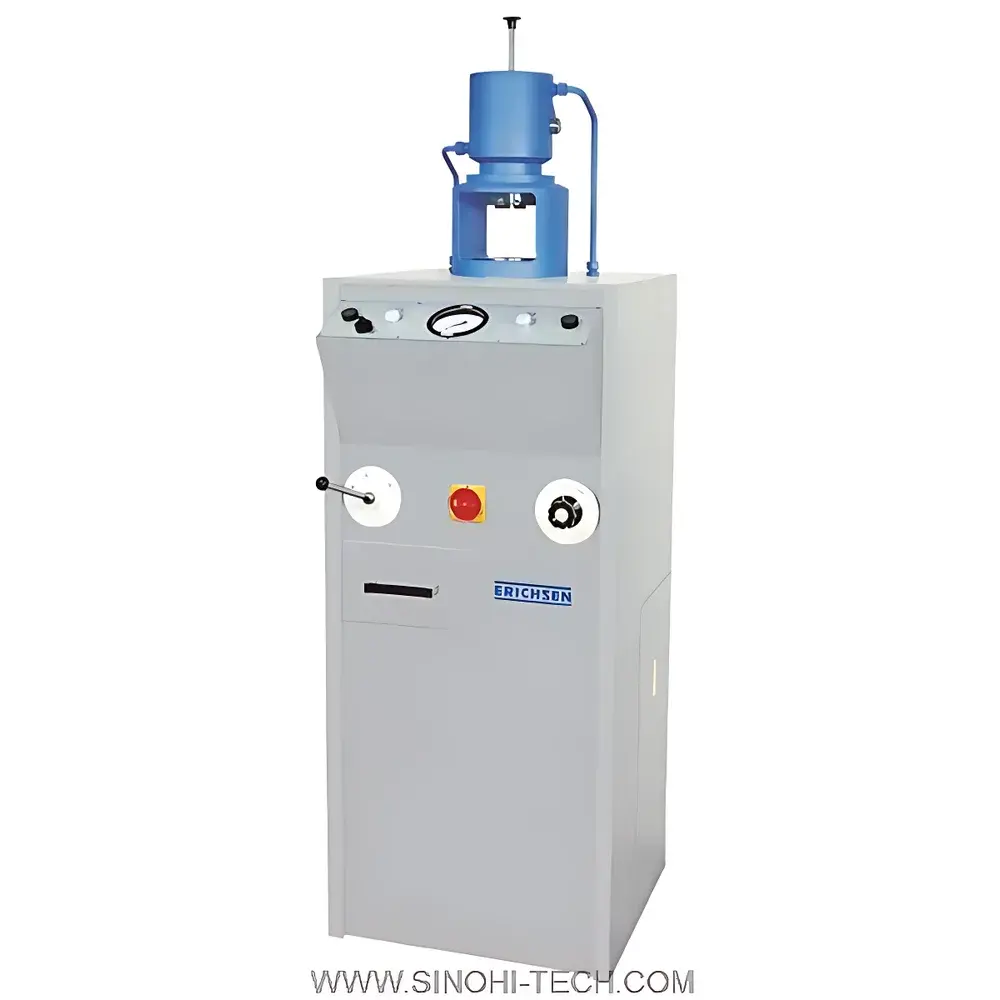
Erichsen #206 Electric-Hydraulic Cupping Tester
| Origin | Germany |
|---|---|
| Manufacturer Type | Authorized Distributor |
| Origin Category | Imported |
| Model | #206 |
| Price | Upon Request |
Overview
The Erichsen #206 Electric-Hydraulic Cupping Tester is a precision-engineered instrument designed for standardized evaluation of coating adhesion, ductility, and deformation resistance on metallic substrates under controlled deep-drawing conditions. Based on the Erichsen cupping principle—defined in ISO 20482, ASTM D4145, and EN 13523-8—the device applies simultaneous compressive and tensile stresses to coated metal sheets via a hemispherical punch, inducing biaxial strain that simulates real-world forming processes such as automotive stamping or appliance manufacturing. Unlike manual or pneumatic testers, the #206 integrates servo-controlled hydraulic actuation with electric drive logic, enabling repeatable force application (up to 80 kN), programmable support force modulation (0–18 kN), and precise stroke control (max. 35 mm). Its mechanical architecture ensures high reproducibility across test sequences, making it suitable for QC laboratories operating under ISO/IEC 17025, IATF 16949, or internal GMP-aligned protocols.
Key Features
- Electric-hydraulic dual-drive system delivering stable, low-noise operation with minimal thermal drift during extended test series
- Adjustable backing force (0–18 kN at up to 25 bar) to simulate varying die support conditions in industrial stamping lines
- Standardized Erichsen cup geometry: 20 mm punch diameter, 10 mm radius, compliant with ISO 20482 Annex A
- Test capacity for coated sheet metal thicknesses from 0.1 mm to 2.8 mm; optimal performance verified for 0.3–1.2 mm substrates per ASTM D4145 Method A
- Integrated stroke limit switch and overload protection safeguarding both operator and sample integrity
- Front-access loading slot (140 mm width × ≥70 mm minimum specimen width) enabling rapid sample insertion without tooling reconfiguration
- Modular die-mounting interface compatible with Erichsen-standard interchangeable punches and dies (e.g., for comparative testing per EN 13523-14)
Sample Compatibility & Compliance
The #206 accommodates flat, rigid specimens including cold-rolled steel, aluminum alloys (e.g., AA1050, AA5182), galvanized steel, and pre-painted coil-coated panels. Surface preparation must conform to ISO 1514 and ISO 2808 prior to testing. The instrument satisfies mechanical requirements for conformance testing under ISO 20482 (coating cupping resistance), ASTM D4145 (paint adhesion on metal substrates), and EN 13523-8 (coil-coated metal—cupping test). All force transducers are calibrated traceable to DAkkS-accredited national standards; routine verification follows ISO 7500-1 Class 1 accuracy criteria. For regulated environments, optional audit-trail logging supports 21 CFR Part 11 compliance when paired with validated Erichsen TestSuite software.
Software & Data Management
While the base #206 operates via front-panel controls, integration with Erichsen TestSuite v4.2 (optional) enables automated test sequencing, real-time force/displacement curve acquisition, and digital archiving of cup depth, crack onset point, and maximum load values. Data export formats include CSV, XML, and PDF reports compliant with GLP documentation standards. The software supports multi-user role-based access control, electronic signatures, and revision-controlled method templates—critical for laboratories undergoing FDA or EMA audits. Raw analog outputs (0–10 V) permit connection to third-party DAQ systems for synchronized environmental monitoring (e.g., temperature/humidity correlation per ISO 20482 Clause 6.2).
Applications
- Qualification of coil-coated steel and aluminum used in HVAC enclosures, roofing, and white goods
- Routine QC of automotive body-in-white (BIW) primer-surfacer-topcoat systems subjected to draw-bend operations
- Development validation of waterborne, UV-curable, and powder coatings for formability retention
- Failure analysis of interfacial delamination in multi-layer polymer/metal laminates
- Correlation studies between cupping depth and subsequent salt-spray (ISO 9227) or cyclic corrosion (VDA 233-102) performance
- Supplier qualification testing per OEM specifications (e.g., Ford WSS-M2P195-A2, GMW14872)
FAQ
What standards does the Erichsen #206 comply with?
It meets ISO 20482, ASTM D4145, EN 13523-8, and DIN 53156 for cupping resistance measurement.
Can the #206 be used for non-metallic substrates?
No—it is engineered specifically for rigid, conductive metallic sheets; plastic or composite substrates require alternative test methods (e.g., ISO 1519-2 mandrel bend).
Is calibration certification included with delivery?
Yes—a DAkkS-traceable factory calibration certificate covering force and displacement axes is supplied; annual recalibration is recommended per ISO/IEC 17025.
What maintenance intervals are required?
Hydraulic fluid replacement every 24 months; seal inspection and torque verification of mounting hardware every 6 months; daily visual checks for leaks and abnormal noise.
How does support force adjustment affect test interpretation?
Varying backing force alters stress distribution across the cup wall; lower support increases localized thinning and crack sensitivity—essential for simulating low-die-contact stamping scenarios.



