
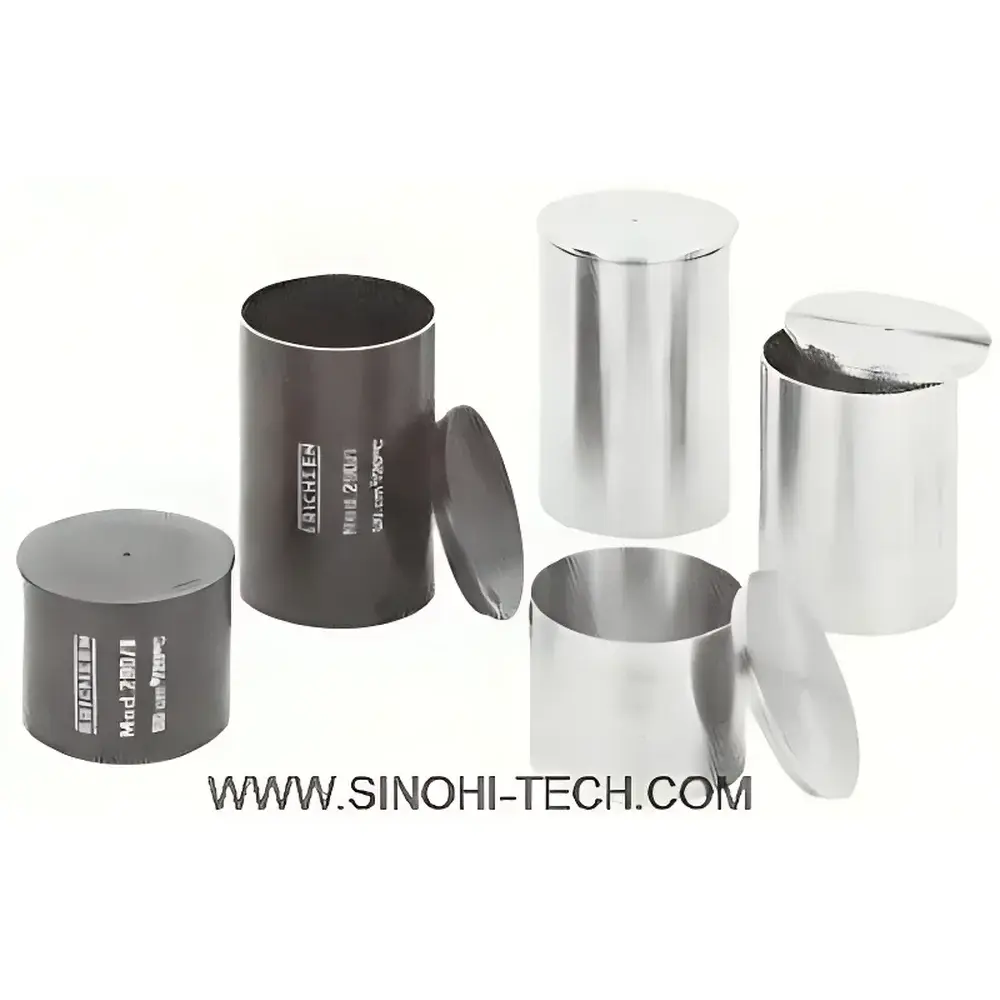
Erichsen #290 Pycnometer
| Origin | Germany |
|---|---|
| Construction Material Options | Aluminum Oxide or Stainless Steel |
| Nominal Volumes | 50 mL, 83.2 mL (ASTM D1475 compliant), or 100 mL |
| Accuracy | ±0.2% standard |
| Temperature Reference | 20 °C |
| Compliance | ASTM D1475, ISO 2811-1, DIN 53217 |
Overview
The Erichsen #290 Pycnometer is a precision volumetric density measurement instrument engineered for laboratory-grade determination of the density (mass per unit volume) of liquid and semi-fluid materials—including paints, coatings, inks, resins, adhesives, and suspensions—under standardized thermal conditions. Density is defined as ρ = m/V, where m is the mass of the sample contained within a fixed, certified internal volume V at a reference temperature of 20 °C (ρ₂₀). Unlike digital electronic densitometers, the #290 operates on the gravimetric pycnometric principle: the difference between the tare mass of the empty pycnometer and the gross mass of the pycnometer filled to its calibrated meniscus level yields the sample mass, which—when divided by the certified volume—yields density with high reproducibility and minimal operator-induced error. Its robust architecture, thermally stable construction, and strict adherence to international volumetric metrology practices make it suitable for quality control laboratories operating under ISO/IEC 17025, GLP, or GMP frameworks.
Key Features
- Three certified nominal volumes: 50 mL (optimized for high-viscosity media), 83.2 mL (fully compliant with ASTM D1475–22 “Standard Test Method for Density of Liquid Coatings, Inks, and Related Products”), and 100 mL (general-purpose configuration)
- Dual-material construction: High-purity aluminum oxide (Al₂O₃) for inert, non-reactive applications; electropolished stainless steel (1.4404 / AISI 316L) for chemical resistance against acidic, alkaline, or solvent-based formulations
- Integrated overflow cap with precision-machined vent hole ensuring repeatable meniscus positioning at the fill line and elimination of entrapped air
- Calibrated accuracy of ±0.2% (k = 2) as standard; optional high-accuracy version with ±0.1% uncertainty and individual NIST-traceable calibration certificate issued per unit
- Thermally equilibrated design supporting stable 20 °C operation in climate-controlled labs; compatible with Class I analytical balances (0.1 mg readability minimum)
- Includes dedicated cap-removal tool (Order No. 0476.01.32) to prevent mechanical deformation of the cap seat or overflow orifice during routine handling
Sample Compatibility & Compliance
The #290 Pycnometer accommodates Newtonian and mildly non-Newtonian liquids across a broad viscosity range (up to ~5,000 mPa·s when using the 50 mL variant). For highly thixotropic or particle-laden systems (e.g., pigment dispersions, ceramic slips), pre-degassing and gentle agitation prior to filling are recommended to ensure complete cavity filling without void formation. Chemical compatibility is material-dependent: aluminum oxide variants are unsuitable for pH 10 solutions; stainless steel versions meet requirements for aggressive solvents (e.g., xylene, MEK, caustic soda) per ASTM D1475 Annex A2. The instrument conforms to ISO 2811-1:2016 (“Paints and varnishes — Determination of density — Part 1: Pycnometer method”) and supports audit-ready documentation under FDA 21 CFR Part 11 when paired with validated balance and LIMS workflows.
Software & Data Management
While the #290 is a manual gravimetric device requiring no embedded electronics or firmware, it integrates seamlessly into digital QC environments via standard analytical balance interfaces (RS-232, USB, or Ethernet). When used with compliant balances supporting GLP/GMP data export (e.g., METTLER TOLEDO XSR, Sartorius Cubis® II), raw mass values—including tare, gross, and net—can be timestamped, user-ID tagged, and exported directly to Excel, LabWare LIMS, or Empower CDS. Calibration certificates include full uncertainty budgets (including temperature coefficient, buoyancy correction, and repeatability components), traceable to national standards (DKD/DAkkS or UKAS-accredited labs). Certificate issuance follows ISO/IEC 17025:2017 Clause 7.7 requirements.
Applications
- Batch release testing of architectural and industrial coatings per ASTM D1475 and ISO 2811-1
- Density verification of ink formulations prior to gravure or flexographic printing
- Raw material acceptance testing for resin suppliers (e.g., epoxy, polyurethane, alkyd)
- Stability assessment of colloidal suspensions via density drift monitoring over time
- Supporting ASTM D2196 (viscosity-density correlation) and ASTM D3648 (pigment volume concentration calculations)
- Reference method validation for inline density sensors (e.g., Coriolis or vibrating-tube meters)
FAQ
What is the temperature specification for density reporting with the #290?
Density results must be reported as ρ₂₀ — i.e., corrected to 20 °C — in accordance with ISO 2811-1 and ASTM D1475. Samples and pycnometers must equilibrate to 20 ±0.5 °C prior to weighing.
Can the #290 be used for volatile solvents?
Yes, provided the fill-and-cap sequence is executed rapidly and the balance enclosure is draft-free. Stainless steel variants minimize evaporation-related mass loss compared to ceramic bodies.
Is cleaning with ultrasonic baths permitted?
Ultrasonic cleaning is acceptable for stainless steel units using neutral aqueous solutions. Aluminum oxide pycnometers must be rinsed manually with low-surface-tension solvents (e.g., isopropanol) and dried with filtered nitrogen; abrasive or acidic cleaners will degrade surface finish and compromise volume integrity.
How often should recalibration be performed?
Annual recalibration is recommended for routine QC use. More frequent verification (e.g., quarterly) using certified reference liquids (e.g., water, toluene) is advised for high-regulation environments or after mechanical impact.
Does Erichsen supply certified reference liquids for verification?
No — Erichsen supplies only the pycnometer and accessories. Users must source traceable density standards (e.g., from AccuStandard or CertiPUR) compliant with ISO 17034 for in-house verification protocols.



