
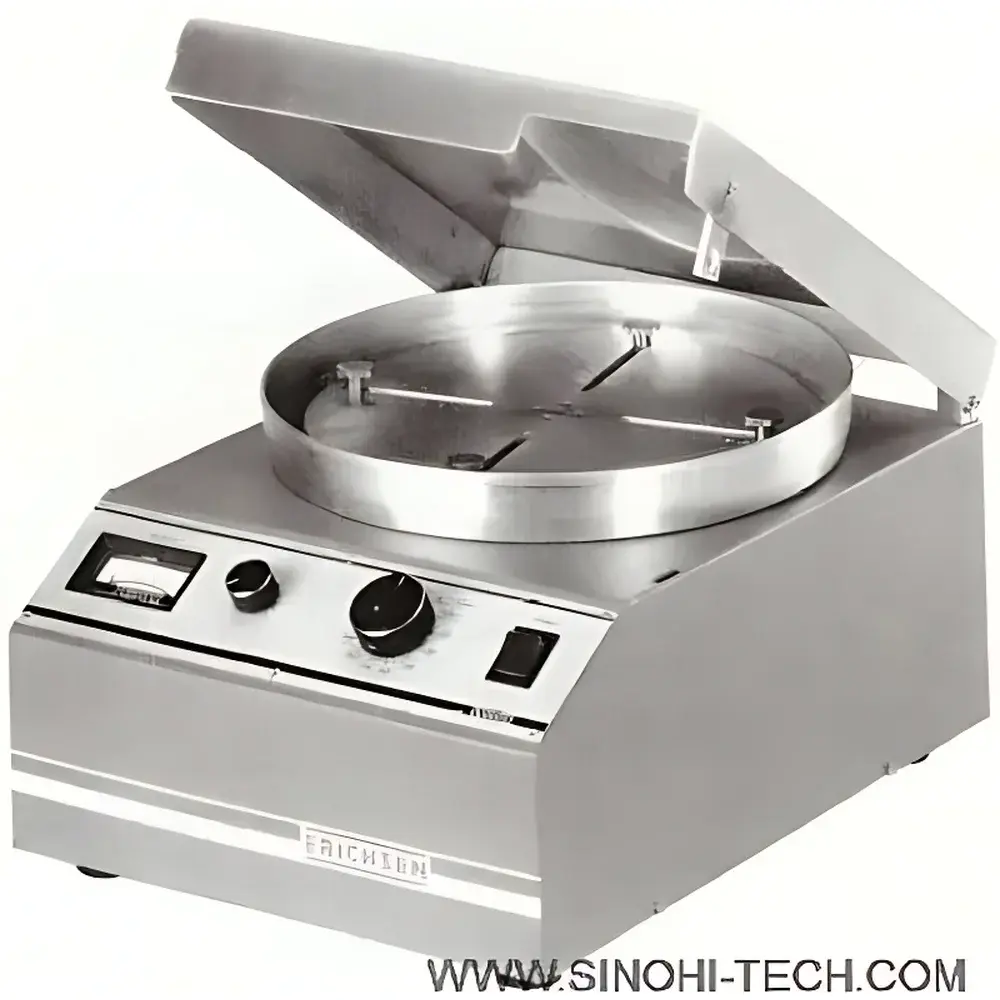
Erichsen #334II Centrifugal Film Applicator
| Origin | Germany |
|---|---|
| Manufacturer Type | Authorized Distributor |
| Origin Category | Imported |
| Model | #334II |
| Pricing | Upon Request |
Overview
The Erichsen #334II Centrifugal Film Applicator is an engineered precision instrument for the reproducible deposition of uniform thin films on flat substrates. Based on controlled centrifugal force application, it operates on the principle that rotational acceleration induces radial outward flow of viscous liquid coatings—enabling consistent film thickness distribution across the substrate surface, independent of radial position under Newtonian or near-Newtonian conditions. This method eliminates manual draw-down variability and avoids edge-beading artifacts common in bar or blade applicators. Designed for laboratories requiring traceable, repeatable coating protocols—particularly in R&D, quality control, and standards compliance testing—the #334II delivers high inter- and intra-batch reproducibility (CV < 3% for identical formulations under fixed parameters), making it suitable for ISO 2808, ASTM D1212, and EN ISO 2360–compliant film thickness validation workflows.
Key Features
- Adjustable rotational speed range: 100–2000 rpm with ±5 rpm stability, digitally controlled via front-panel interface
- Precise timer resolution: 1-second increments over 5–300 second range, with automatic motor shutdown upon completion
- Robust aluminum alloy chassis with integrated safety shield and removable stainless-steel collection trough
- Modular sample stage accommodates rigid planar substrates up to 200 × 200 mm, secured via four M4 threaded clamping points
- Wide viscosity compatibility: validated for Newtonian and mildly shear-thinning systems from 10 to 20,000 mPa·s
- Low-maintenance brushless DC motor drive ensuring long-term torque consistency and minimal thermal drift
- Compliance-ready design: CE-marked, IEC 61000-6-2/6-4 compliant for electromagnetic immunity and emissions
Sample Compatibility & Compliance
The #334II supports rigid, non-flexible substrates including metal sheets (≤1.25 mm thickness), float glass (≤3.00 mm), and solid wood panels (≤4.00 mm). Substrate flatness tolerance must not exceed 0.1 mm deviation over 100 mm to ensure uniform gap formation during spin. Coating materials must be free of particulates >50 µm to prevent nozzle clogging or uneven dispersion. The instrument meets requirements for GLP-compliant coating preparation per OECD Test Guideline 117 (Partition Coefficient) and ASTM D7248 (Standard Practice for Preparation of Paint Films for Testing). It is routinely employed in automotive OEM labs for primer and clear-coat evaluation, and in packaging R&D for barrier layer deposition verification.
Software & Data Management
While the #334II operates as a standalone analog-digital hybrid unit without embedded software, its parameter set (rpm, time) is fully documentable within laboratory information management systems (LIMS) or electronic lab notebooks (ELN). All operational settings are manually recorded and traceable; for regulated environments, users may integrate external digital loggers (e.g., USB-connected data acquisition modules) to capture real-time rotational profile data. The device supports audit trail readiness when paired with SOP-controlled documentation practices aligned with FDA 21 CFR Part 11 requirements—specifically through controlled access to parameter entry, timestamped run logs, and version-controlled procedure files.
Applications
- Preparation of standardized test films for gloss, adhesion, hardness, and corrosion resistance evaluation (ISO 2808, ASTM D3359)
- Controlled deposition of conductive inks, anti-reflective coatings, and functional polymer layers in optoelectronics prototyping
- Calibration substrate generation for FTIR, ellipsometry, and profilometry thickness measurement validation
- Viscoelastic behavior screening via comparative film uniformity analysis across shear rate regimes
- Accelerated weathering and UV stability test panel preparation with minimized batch-to-batch thickness variance
FAQ
What substrate dimensions are supported?
The maximum usable area is 200 × 200 mm; minimum recommended size is 80 × 80 mm to ensure full coverage and mechanical stability during rotation.
Can the #334II handle thixotropic paints?
Yes—but users must account for center-thickening behavior. Protocol optimization (e.g., pre-shear conditioning, reduced spin time) is required to minimize radial gradient; results should be validated via cross-sectional SEM or stylus profilometry.
Is cleaning the collection trough and sample stage straightforward?
Both components are tool-free detachable and compatible with common organic solvents (e.g., acetone, xylene) and aqueous detergent solutions. Residue inspection under 10× magnification is recommended between runs.
Does the unit require calibration certification?
No periodic factory calibration is mandated; however, users should verify rotational speed accuracy annually using a traceable optical tachometer (e.g., NIST-traceable Class 1 device) and document deviations exceeding ±10 rpm.
How does ambient temperature affect film thickness repeatability?
Temperature fluctuations >±2°C during operation may alter viscosity-driven spreading dynamics. For critical applications, maintain ambient conditions at 23 ± 1°C per ISO 291 and precondition samples to equilibrium prior to loading.
Related Products



