
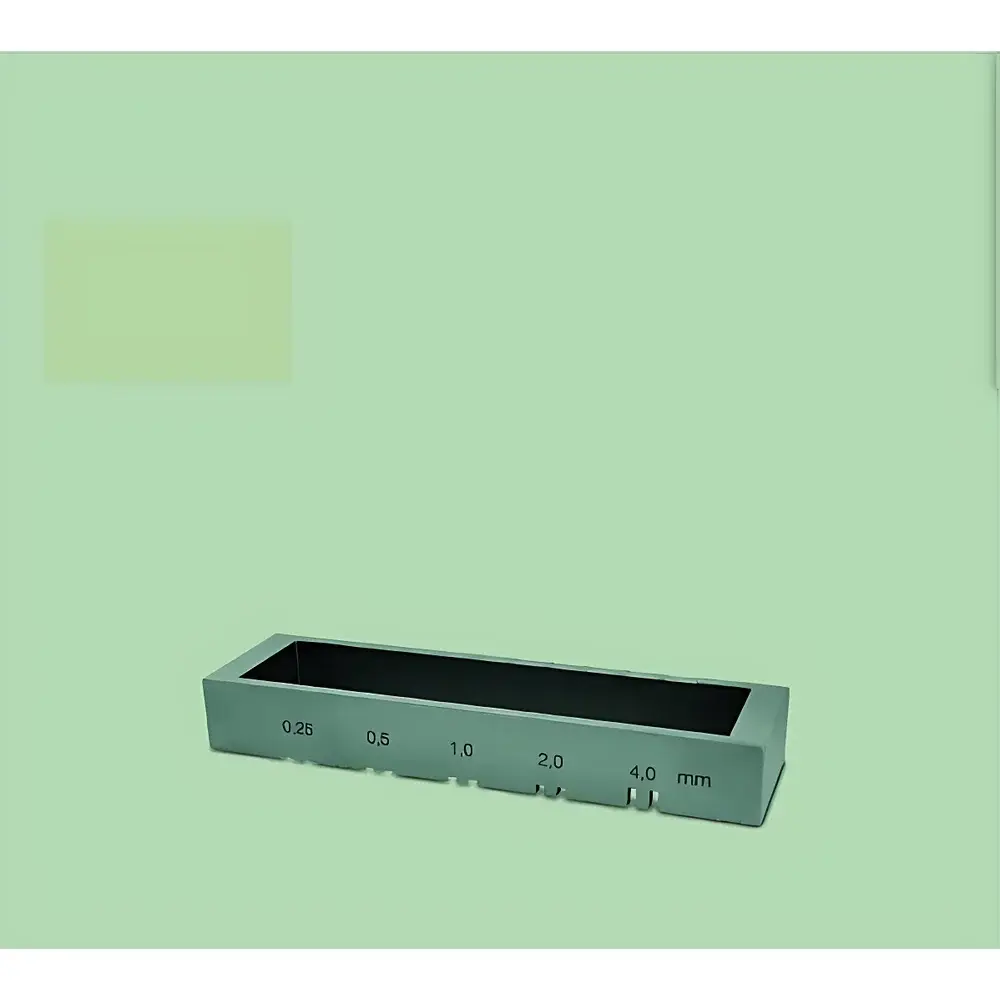
Erichsen 419 Leveling and Sag Resistance Tester
| Brand | ERICHSEN (Germany) |
|---|---|
| Origin | Germany |
| Model | Erichsen 419 |
| Standards | ASTM D 2801 / ASTM D 4400 (419-ASTM) |
| Dimensions (419-ASTM) | 155 × 30 × 15 mm (L×H×W) |
| Dimensions (419-DIN) | 115 × 30 × 15 mm (L×H×W) |
| Net Weight (419-ASTM) | ~0.1 kg |
| Net Weight (419-DIN) | ~0.12 kg |
| Slot Heights (419-ASTM) | Leveling: 75–300 µm |
| Sag | 250, 500 µm, 1, 2, 4 mm |
| Slot Heights (419-DIN) | 75–1300 µm (25/50/100 µm increments) |
| Slot Width (419-ASTM) | Leveling: 6.4 mm |
| Sag | 1.6 mm |
| Slot Width (419-DIN) | 10 mm |
| Slot Spacing (419-ASTM) | Leveling: 1.6 mm |
| Sag | 2.5 mm (between dual bars), 12 mm (between adjacent height rows) |
| Slot Spacing (419-DIN) | 2 mm |
| Side Thickness (419-ASTM) | 3 mm |
| Side Thickness (419-DIN) | 5 mm |
Overview
The Erichsen 419 Leveling and Sag Resistance Tester is a precision-manufactured, manual drawdown instrument engineered for standardized evaluation of leveling behavior and sag resistance in liquid coatings and paints. It operates on the principle of controlled wet-film deposition using calibrated stainless-steel applicators with precisely machined parallel slots. Leveling performance is assessed by applying multiple parallel wet films of incrementally varying thickness onto a horizontal substrate—after drying or curing, the degree of coalescence between adjacent film strips indicates the material’s ability to flow and eliminate surface irregularities under capillary and surface tension forces. Sag resistance is evaluated by immediately reorienting the coated substrate to a vertical position post-application, allowing gravitational flow to manifest; the maximum film thickness at which no visible downward movement (e.g., teardrop formation, wave distortion, or localized thickening at the bottom edge) occurs defines the sag limit. This dual-function capability—available only in the 419-ASTM configuration—enables laboratories to perform both ASTM D 2801 (leveling) and ASTM D 4400 (sag resistance) tests within a single, traceable workflow. The 419-DIN variant complies strictly with DIN 55677 for sag testing across an extended, finely graded thickness range.
Key Features
- Two dedicated configurations: 419-ASTM (dual-mode leveling + sag) and 419-DIN (sag-only, DIN-compliant)
- Stainless-steel construction ensures dimensional stability, corrosion resistance, and long-term repeatability
- Micro-machined slot geometry adheres to strict tolerances per ASTM and DIN specifications
- No moving parts or electronics—designed for operator-controlled, low-variability manual application
- Compact, handheld form factor enables integration into QC benches, R&D labs, and production line sampling stations
- Calibrated slot heights traceable to national metrology standards via ERICHSEN’s manufacturing QA documentation
Sample Compatibility & Compliance
The Erichsen 419 is validated for Newtonian and near-Newtonian liquids within typical industrial coating viscosity ranges (approximately 10–500 mPa·s at application shear rates). It is suitable for solvent-borne, water-borne, and UV-curable liquid paints, enamels, varnishes, and clearcoats—but not recommended for non-Newtonian pastes, gels, or high-viscosity mastics (>1,000 mPa·s), where rheological complexity compromises uniform drawdown. All test procedures align with internationally recognized quality frameworks: ASTM D 2801 and D 4400 are widely referenced in automotive OEM specifications (e.g., Ford WSS-M2P195-A, GMW 14872) and aerospace paint qualification protocols (e.g., Boeing BAC 5741). DIN 55677 remains the benchmark standard for European architectural and industrial coating manufacturers subject to CE marking and EN ISO 9001 internal audit requirements. While the instrument itself does not generate electronic records, its use supports GLP-compliant test reporting when integrated with documented SOPs, calibrated substrates (e.g., Leneta charts, ISO 1514 steel panels), and controlled environmental conditions (ISO 2812-1:2019).
Software & Data Management
The Erichsen 419 is a purely mechanical test device with no embedded firmware, connectivity, or software interface. Data acquisition and interpretation remain manual: operators record observed film continuity (for leveling) or sag onset thresholds (for sag resistance) directly onto standardized test forms or LIMS-integrated worksheets. To ensure regulatory traceability—particularly in GMP or FDA-regulated environments (e.g., pharmaceutical coating development)—users are advised to pair the 419 with auditable documentation practices: timestamped photographic evidence of dried films, substrate lot traceability, ambient temperature/humidity logs (per ASTM D 3924), and operator identification per 21 CFR Part 11–aligned procedural controls. ERICHSEN provides calibration certificates upon request, and third-party verification against NIST-traceable step gauges is supported for laboratory accreditation (e.g., ISO/IEC 17025).
Applications
- Formulation optimization of acrylic, alkyd, epoxy, and polyurethane coatings for balanced leveling/sag performance
- Batch release testing in paint manufacturing to verify conformance with internal specifications and customer technical data sheets
- Technical service support for field failure analysis—e.g., diagnosing orange peel, cratering, or curtain effect in spray-applied systems
- Raw material screening (e.g., rheology modifiers, surfactants, solvents) for their impact on wet-film mobility
- Training and method validation in ISO 17025-accredited testing laboratories performing ASTM- or DIN-based certification
FAQ
Can the Erichsen 419 be used for non-Newtonian or thixotropic coatings?
No—the instrument assumes uniform shear thinning during drawdown. Strongly structured or time-dependent fluids may yield inconsistent film thicknesses and unreliable leveling/sag readings.
Is substrate preparation standardized for Erichsen 419 testing?
Yes: ASTM D 3924 mandates conditioning substrates at 23 ± 2 °C and 50 ± 5% RH for ≥4 h prior to application. Recommended substrates include ISO 1514 cold-rolled steel panels or Leneta PCC-2000 charts, cleaned per ASTM D 4285.
How often should the 419 applicator be recalibrated?
ERICHSEN recommends annual verification using certified step-height reference standards. Visual inspection for slot deformation or surface pitting should occur before each use.
Does the 419-DIN model support leveling assessment?
No—its slot geometry (10 mm width, 2 mm spacing, continuous 75–1300 µm gradation) is optimized exclusively for sag evaluation per DIN 55677.
Can results from the 419-ASTM be directly correlated to rheological parameters like yield stress or viscosity?
Not quantitatively. The 419 provides functional pass/fail or comparative ranking data—not absolute rheological values. Complementary rotational rheometry (e.g., Brookfield or TA Instruments) is required for fundamental property derivation.






