
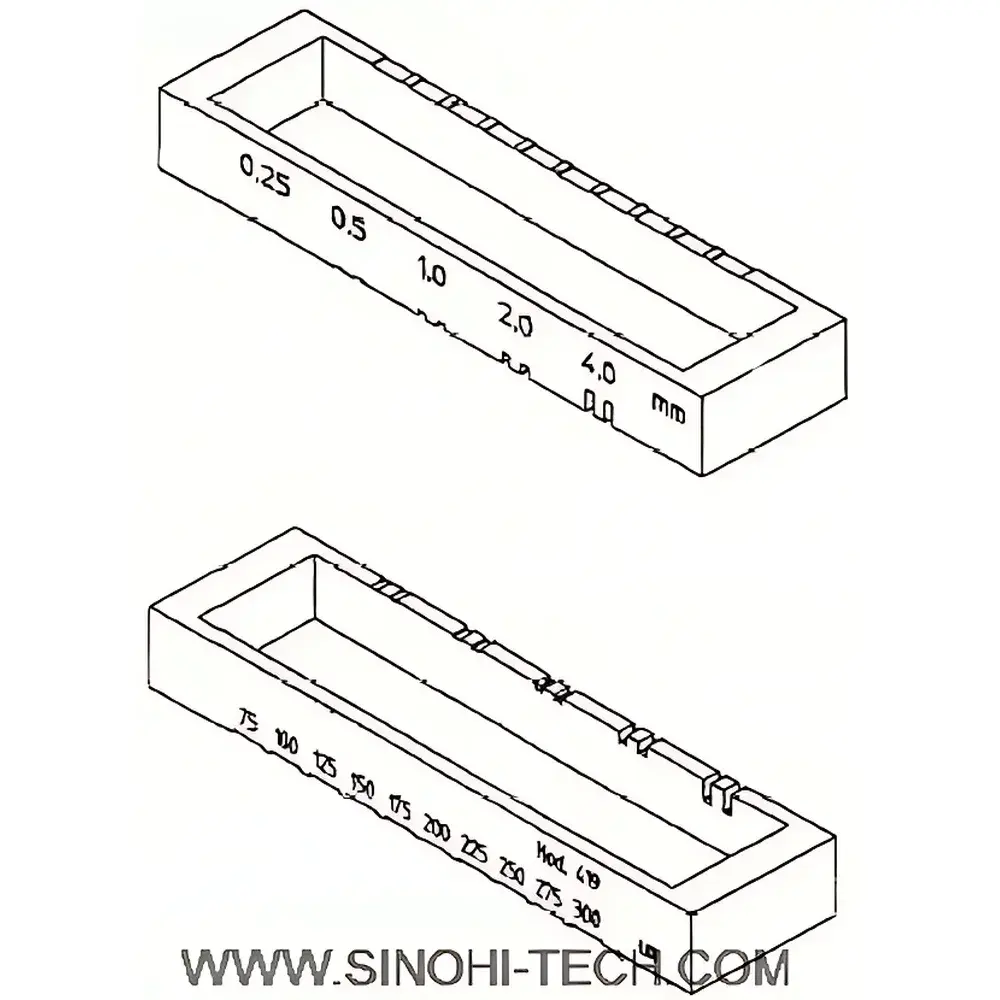
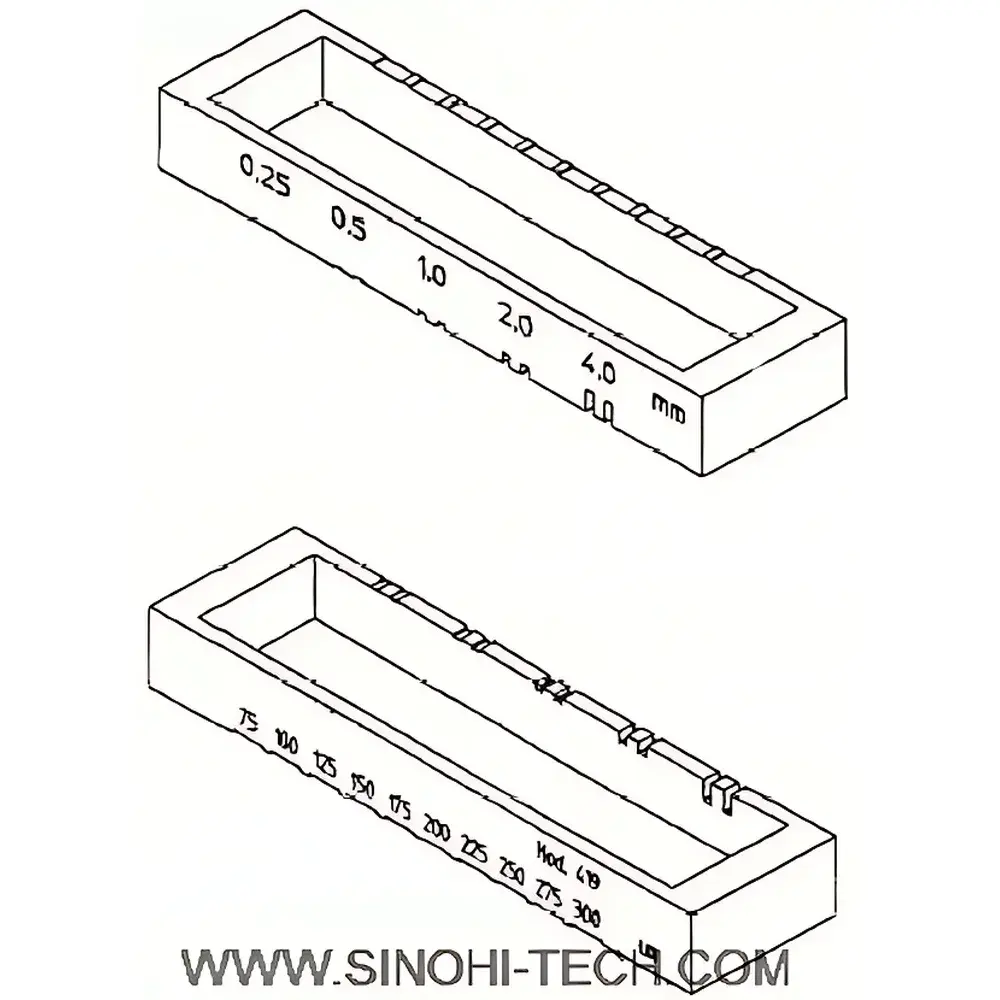
Erichsen #419 Leveling and Sag Resistance Tester
| Origin | Germany |
|---|---|
| Manufacturer Type | Authorized Distributor |
| Origin Category | Imported |
| Model | #419 |
| Pricing | Upon Request |
| Standard Compliance | DIN 53210, ASTM D4400 |
| Slot Thickness | 5 mm |
| Slot Height Range | 75–300 µm (25 µm increments), 350–700 µm (50 µm increments), 800–1300 µm (100 µm increments) |
| Slot Width | 10 mm |
| Inter-Slot Spacing | 2 mm |
| Accessories Included | Protective storage case |
Overview
The Erichsen #419 Leveling and Sag Resistance Tester is a precision-engineered manual drawdown instrument designed for standardized evaluation of leveling performance and sag resistance in liquid coatings, inks, and related viscoelastic formulations. Based on the fundamental principle of controlled film formation via fixed-gap drawdown, the device enables reproducible application of test films across a defined gradient of wet film thicknesses—critical for assessing how a material flows under gravity after application and whether it retains uniform thickness without undesirable downward movement (sag) or surface defects (e.g., orange peel, streaking). The instrument complies with internationally recognized test methods including DIN 53210 (Part 2 for leveling, Part 3 for sag resistance) and ASTM D4400 (Standard Test Method for Sag Resistance of Paints Using a Multigroove Applicator), making it suitable for QC laboratories operating under ISO/IEC 17025, automotive OEM specifications, and regulatory-compliant R&D environments.
Key Features
- Multi-step precision-ground stainless steel applicator bar with 21 calibrated slots per height range, enabling systematic variation of wet film thickness in strict accordance with DIN and ASTM tolerances.
- Three distinct slot height ranges: 75–300 µm (25 µm increments), 350–700 µm (50 µm increments), and 800–1300 µm (100 µm increments), covering the full spectrum of industrial coating viscosities—from low-solids architectural paints to high-build industrial primers.
- Rigid 5 mm-thick aluminum alloy body with integrated alignment guides ensures consistent drawdown angle, minimal operator-induced variability, and long-term dimensional stability.
- Uniform 10 mm slot width and precisely maintained 2 mm inter-slot spacing guarantee optical clarity and unambiguous visual assessment of leveling behavior and sag onset across adjacent film thicknesses.
- Supplied with protective storage case (model-specific): Part No. 0053.01.31 includes full DIN/ASTM dual-standard configuration; Part No. 0029.01.31 is optimized for DIN-only sag testing protocols.
Sample Compatibility & Compliance
The #419 tester is compatible with solvent-borne, water-borne, and high-solids coatings, as well as UV-curable systems and functional dispersions where rheological response to gravitational stress must be quantified. It supports substrate types including glass plates (DIN 53160), Leneta charts, and cold-rolled steel panels (ASTM D2243). All measurements are traceable to national metrology institutes via certified calibration certificates available upon request. The device meets requirements for use in GLP-compliant laboratories and supports audit-ready documentation when paired with standardized observation templates aligned with ISO 28891 (Coating inspection—Visual assessment procedures).
Software & Data Management
As a purely mechanical, non-electronic instrument, the #419 requires no firmware, drivers, or software installation. However, its output—visual film profiles—is fully integrable into digital lab workflows. Users routinely document results using calibrated imaging systems (e.g., 10× macro lens + controlled LED illumination), followed by analysis in validated image-processing platforms compliant with FDA 21 CFR Part 11 (e.g., Adobe Photoshop CC with audit trail enabled or dedicated QC software such as QI Macros). Raw observations—including onset film thickness of sag, leveling rating per ISO 15184, and comparative grading against reference standards—are recorded in structured electronic lab notebooks (ELN) supporting version control and reviewer sign-off.
Applications
- Formulation development of architectural and industrial coatings to optimize resin-pigment-dispersant balance for improved flow and anti-sag performance.
- Batch release testing in manufacturing QA labs verifying conformance to internal specifications and customer technical data sheets (TDS).
- Competitive benchmarking against reference products using side-by-side drawdowns on identical substrates and environmental conditions (23 ± 2°C, 50 ± 5% RH per ISO 3270).
- Root cause analysis of field failures linked to poor leveling (e.g., cratering, mottling) or sag-related defects in vertical applications (e.g., railcar exteriors, façade elements).
- Training and proficiency testing for new technicians in accredited coating testing laboratories.
FAQ
What standards does the #419 comply with?
It is designed and verified for compliance with DIN 53210 Parts 2 and 3, ASTM D4400, and ISO 28891 Annex B for visual assessment methodology.
Can the same applicator be used for both leveling and sag testing?
Yes—the #419 bar supports both tests; however, test interpretation differs: leveling is assessed after flash-off (typically 10–30 min), while sag evaluation occurs immediately post-application or at specified time intervals per standard.
Is calibration required before each use?
No routine recalibration is needed due to its passive, dimensionally stable construction; however, periodic verification of slot heights using certified optical profilometry or laser micrometry is recommended annually or per internal quality protocol.
Are replacement bars available for individual height ranges?
Erichsen offers full-bar replacements only—not segmented or partial-height variants—to ensure geometric integrity and inter-lot consistency.
Does the instrument require special environmental conditioning?
While the device itself is insensitive to ambient conditions, test validity depends on controlling substrate temperature, humidity, and airflow per ISO 3270; therefore, operation within a climate-controlled laboratory is mandatory for accredited use.



