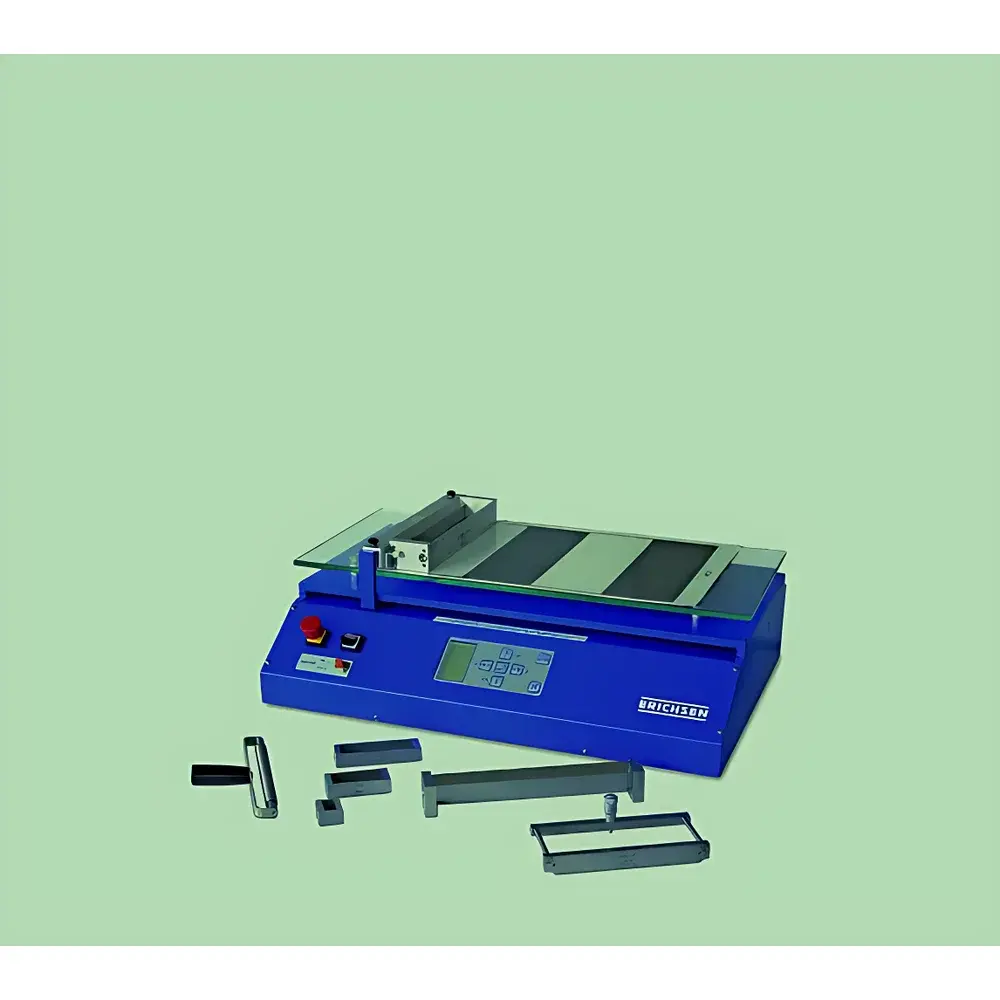
ERICHSEN 510 Automated Film Applicator
| Brand | ERICHSEN (Germany) |
|---|---|
| Origin | Germany |
| Model | ERICHSEN 510 |
| Dimensions | 610 × 425 × 210 mm (L×W×H) |
| Net Weight | 23 kg |
| Power Supply | 100–240 VAC, 50/60 Hz |
| Coating Speed Range | 0.1–19.9 mm/s and 20–100 mm/s |
| Drying Time Measurement Range | 0.1–19.9 min/cm and 20–108 min/cm |
Overview
The ERICHSEN 510 Automated Film Applicator is a precision-engineered, microprocessor-controlled platform designed for reproducible wet-film deposition and standardized drying time assessment in coating R&D and quality control laboratories. Unlike manual applicators, the 510 employs a high-resolution stepper motor drive system to deliver linear motion with exceptional positional repeatability and speed stability—critical for generating uniform films across diverse substrates. Its core operational principle relies on controlled translational movement of interchangeable applicator bars or test tools along a rigid, low-vibration carriage guided by precision linear rails. This architecture enables strict compliance with international coating standards including ISO 2808 (paints and varnishes — determination of film thickness), ASTM D823 (standard practice for producing films of uniform thickness of organic coatings on laboratory panels), and DIN 53150 (determination of surface drying time of paints and varnishes). The instrument serves as both a film-forming station and a dynamic test stage—capable of executing sequential, multi-sample coating runs or synchronized drying evaluations under identical environmental conditions.
Key Features
- Microprocessor-controlled stepper motor drive ensures precise, repeatable travel speed (0.1–100 mm/s in two calibrated ranges) and stroke length, eliminating operator-induced variability.
- Modular design supports rapid interchange of applicator bars (e.g., ERICHSEN 288, 358, 360, 411, 421) and drying test tools (DIN 53150-compliant ballotini, wool thread, roller, ball, coil, and notched wheel accessories).
- Dual-function capability: simultaneous operation as an automated film applicator and a standardized drying time measurement platform with traceable time–distance correlation.
- Integrated liquid collection trough minimizes solvent exposure and simplifies cleanup during high-throughput coating cycles.
- Robust aluminum alloy frame with vibration-damped base ensures mechanical stability during extended operation and across variable ambient conditions.
- Universal power input (100–240 VAC, 50/60 Hz) with included international adapter enables global deployment without voltage conversion hardware.
Sample Compatibility & Compliance
The ERICHSEN 510 accommodates a wide range of substrate geometries and material classes via optional vacuum chucks and heated platforms—including glass slides (0571.01.32), perforated vacuum plates (0046.01.32, 0521.01.32, 0598.01.32, 0599.01.32), slot-type vacuum holders (0047.01.32, 0522.01.32), and LEVETA-certified plastic foils and opacity cards (e.g., 451-series contrast charts). All vacuum systems operate at regulated negative pressure to secure flexible or low-rigidity substrates without deformation. Heated vacuum options support thermal curing studies up to 140 °C, enabling evaluation of thermoset resins, UV-curable formulations, and battery electrode slurries. The system meets requirements for GLP-compliant environments when paired with audit-trail-capable software (see Software & Data Management), and its mechanical calibration traceability aligns with ISO/IEC 17025 accreditation criteria for testing laboratories.
Software & Data Management
While the ERICHSEN 510 operates via front-panel keypad control, it is fully compatible with ERICHSEN’s optional PC-based control and data logging software suite (sold separately). This software provides real-time monitoring of carriage position, speed profile, and elapsed time; stores parameter sets for SOP-driven workflows; and exports timestamped CSV files containing stroke duration, distance traveled, and user-defined annotations. When configured with validated software modules, the system supports 21 CFR Part 11 compliance—including electronic signatures, role-based access control, and immutable audit trails—making it suitable for regulated pharmaceutical, medical device, and aerospace coating validation protocols. Raw motion data can be imported into third-party statistical analysis packages (e.g., JMP, Minitab) for DOE-based optimization of film thickness uniformity or drying kinetics modeling.
Applications
- R&D laboratories evaluating film formation behavior of waterborne, solvent-based, and high-solids coatings under controlled shear and dwell conditions.
- QC departments performing routine wet-film thickness verification per ASTM D1212 and correlating wet-to-dry thickness ratios for batch release.
- Academic research groups studying thin-film morphology in photovoltaic absorber layers, solid-state electrolytes, and functional nanocomposite coatings.
- Inkjet and flexographic ink developers quantifying set-off resistance and through-dry performance using standardized drying tool arrays.
- Automotive OEM suppliers validating primer-surfacer topcoat compatibility via parallel drying rate comparison across formulation variants.
- Battery materials labs preparing uniform cathode/anode slurry films on current collectors for electrochemical performance benchmarking.
FAQ
Is the ERICHSEN 510 supplied with applicator bars or drying test tools?
No—the base unit includes only the main frame, motorized carriage, liquid collection trough, universal power adapter, and operating manual. All applicator bars, drying tools, vacuum chucks, and mounting brackets are ordered separately based on application requirements.
Can the 510 be used for scratch hardness testing?
Yes—when fitted with the ERICHSEN 318 or 435 scratch hardness tester mounted on the carriage, the 510 delivers constant-velocity linear motion essential for ASTM D3363 and ISO 1518-1 compliant scratch assessments.
What is the minimum and maximum film thickness achievable with the 510?
Film thickness is determined solely by the geometry of the selected applicator bar (e.g., gap height, edge profile) and substrate absorption—not by the 510 itself. Common bars yield wet films from 15 µm to 500 µm; dry film thickness depends on solids content and substrate porosity.
Does the 510 require annual recalibration?
The stepper motor drive system is factory-calibrated and does not drift under normal use. However, users should verify carriage speed accuracy annually using a certified optical tachometer or laser displacement sensor per ISO 17025 internal verification procedures.
Is technical support available outside Germany?
Yes—ERICHSEN maintains authorized service partners in over 40 countries, offering remote diagnostics, on-site calibration, and application engineering support in English, French, Spanish, and Chinese.
Related Products