
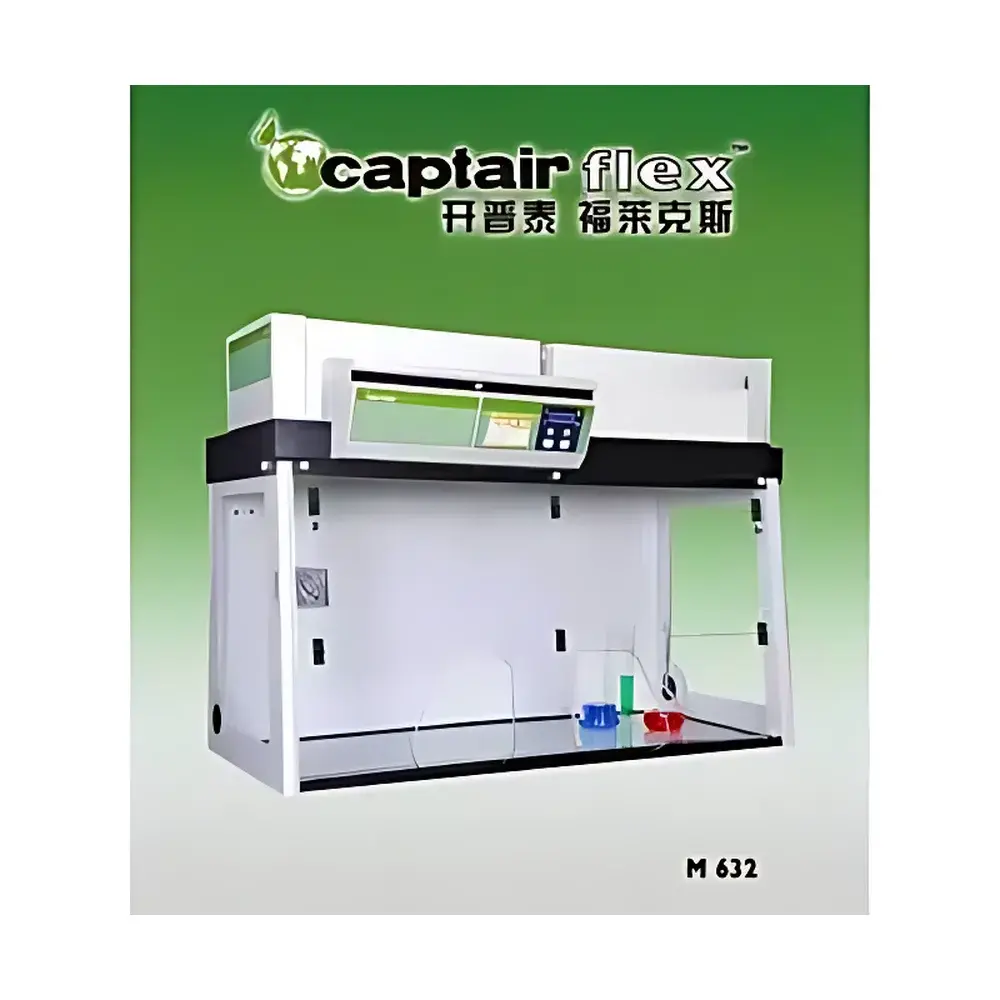
Erlab Captair M632 Ductless Fume Hood
| Brand | Erlab |
|---|---|
| Origin | France |
| Model | M632 |
| Airflow Capacity | 460 m³/h |
| Face Velocity Range | 0.4–0.6 m/s (per AFNOR NF X 15-211:2009) |
| Filter Configuration | Dual-layer molecular filtration system (Class 1 per NFX 15-211) |
| Power Consumption | 125 W |
| Input Voltage | 100–240 V AC, 50–60 Hz |
| Internal DC Voltage | 24 V DC |
| Sound Pressure Level | 55 dB(A) |
| Dimensions (L × W × H, external) | 1600 × 620 × 1161–1345 mm |
| Operating Aperture | Elliptical |
| Lighting | 18 W fluorescent lamp(s), 500 lux, IP67 rated |
| Compliance | AFNOR NF X 15-211:2009, SGS-certified per NFX 15-211 filtration standard |
Overview
The Erlab Captair M632 is a CE-marked, Class 1 ductless fume hood engineered for precision chemical containment in modern laboratories where infrastructure constraints, energy efficiency, and flexible installation are critical operational requirements. Unlike conventional ducted hoods that exhaust conditioned air outdoors—requiring make-up air systems and significant HVAC load—the Captair M632 employs a closed-loop recirculation principle based on active airflow management and certified molecular filtration. Ambient laboratory air is drawn across the work surface at a controlled face velocity (0.4–0.6 m/s), passes through a dual-stage, high-efficiency molecular filter assembly, and is returned as purified air directly into the room. This design eliminates reliance on external ductwork, reduces thermal load on HVAC systems by up to 85%, and maintains stable indoor air quality without compromising operator safety or regulatory compliance.
Key Features
- Dual-layer molecular filtration architecture: Two identical, independently replaceable molecular filter modules—one upstream and one downstream of the centrifugal blower—provide redundant chemical capture. Should the primary (lower) filter reach saturation, the secondary (upper) filter remains fully active, ensuring uninterrupted containment integrity and zero breakthrough risk during routine operation.
- Captair Flex™ digital control panel: A centralized, microprocessor-based interface manages real-time airflow monitoring, alarm thresholds, maintenance scheduling, and user-configurable safety protocols. Integrated sensors continuously validate face velocity; deviation beyond ±5% triggers both audible and visual alerts per EN 61000-6-3 EMC standards.
- Filter saturation verification port: Equipped with a standardized sampling port compatible with colorimetric detection tubes (e.g., Dräger, Gastec), enabling rapid, non-invasive assessment of breakthrough performance without filter disassembly or downtime.
- Ergonomic workstation design: Tilted front sash (15° angle), elliptical access aperture, and curved work surface edge reduce operator fatigue and improve dexterity. The central splash guard and reinforced acrylic sash meet EN 14175-3 impact resistance requirements for chemical splash protection.
- Energy-optimized operation: Low-power 125 W brushless DC motor, 24 V internal circuitry, and acoustic damping materials deliver quiet (≤55 dB[A]) yet robust airflow (460 m³/h) while minimizing electromagnetic interference and heat generation.
Sample Compatibility & Compliance
The Captair M632 is validated for use with volatile organic compounds (VOCs), low-to-moderate concentration inorganic acids (e.g., HCl, HNO₃), bases, and particulate-generating procedures including weighing, dilution, and solvent transfer. It is not intended for perchloric acid, hydrofluoric acid, radioactive isotopes, or pyrophoric substances. All filtration media comply with AFNOR NF X 15-211:2009 Class 1 performance criteria for adsorption capacity, breakthrough time, and pressure drop stability. Independent third-party testing by SGS confirms ≥99.9% removal efficiency for representative challenge agents (acetone, methanol, formaldehyde, ammonia) under defined test conditions. The unit carries CE marking under Directive 2006/42/EC (Machinery) and 2014/30/EU (EMC), and meets ISO 15195:2018 recommendations for laboratory ventilation equipment validation.
Software & Data Management
While the Captair M632 operates as a standalone device without cloud connectivity, its embedded firmware supports full audit trail functionality required under GLP and ISO/IEC 17025 frameworks. The control panel logs all critical events—including airflow excursions, filter runtime (0–250 h intervals), alarm activations, and manual override actions—with timestamping and user ID assignment (via optional RFID badge integration). Maintenance records, calibration certificates, and SGS test reports are stored locally in non-volatile memory and exportable via USB for inclusion in laboratory quality documentation systems. Optional Melecode™ S sensor module provides automated VOC-specific saturation alerts calibrated for common organic solvents, enhancing traceability in regulated QC/QA environments.
Applications
This ductless hood serves laboratories requiring frequent reconfiguration, limited ceiling space, or strict energy budgets—such as academic teaching labs, pharmaceutical R&D facilities, analytical chemistry suites, and cleanroom-adjacent preparation areas. Typical applications include: preparative chromatography solvent handling; pH adjustment and titration workflows; small-scale synthesis under inert atmosphere (when used with glovebox-compatible accessories); powder weighing in ISO Class 5–7 environments; and routine reagent dispensing in GLP-compliant stability studies. Its mobility (optional castor kit) supports shared-resource models across multi-user facilities without structural modification.
FAQ
What types of chemicals can be safely handled in the Captair M632?
It is certified for VOCs, alcohols, ketones, esters, low-concentration mineral acids, and basic aqueous solutions. Consult Erlab’s Chemical Compatibility Database before use with halogenated solvents, strong oxidizers, or reactive metals.
How often must the filters be replaced?
Replacement frequency depends on usage intensity and chemical profile. The built-in timer alerts every 250 operating hours; actual service life ranges from 6–24 months. Saturation verification via colorimetric tube testing is recommended prior to each scheduled change.
Does the unit require external ducting or make-up air?
No. The Captair M632 is fully self-contained and recirculates filtered air within the laboratory space, eliminating ductwork, wall penetrations, and HVAC compensation requirements.
Is the Captair M632 compliant with U.S. OSHA or ANSI standards?
While designed to AFNOR NF X 15-211:2009, its performance metrics (face velocity, containment, filtration efficiency) align with ANSI/AIHA Z9.5–2022 Class I criteria for ductless hoods when operated per manufacturer instructions and validated for specific chemical tasks.
Can it be integrated into a lab-wide safety monitoring system?
Yes—via dry-contact relay outputs and Modbus RTU (optional), the unit interfaces with building management systems (BMS) or centralized safety dashboards for real-time status reporting and alarm aggregation.



