
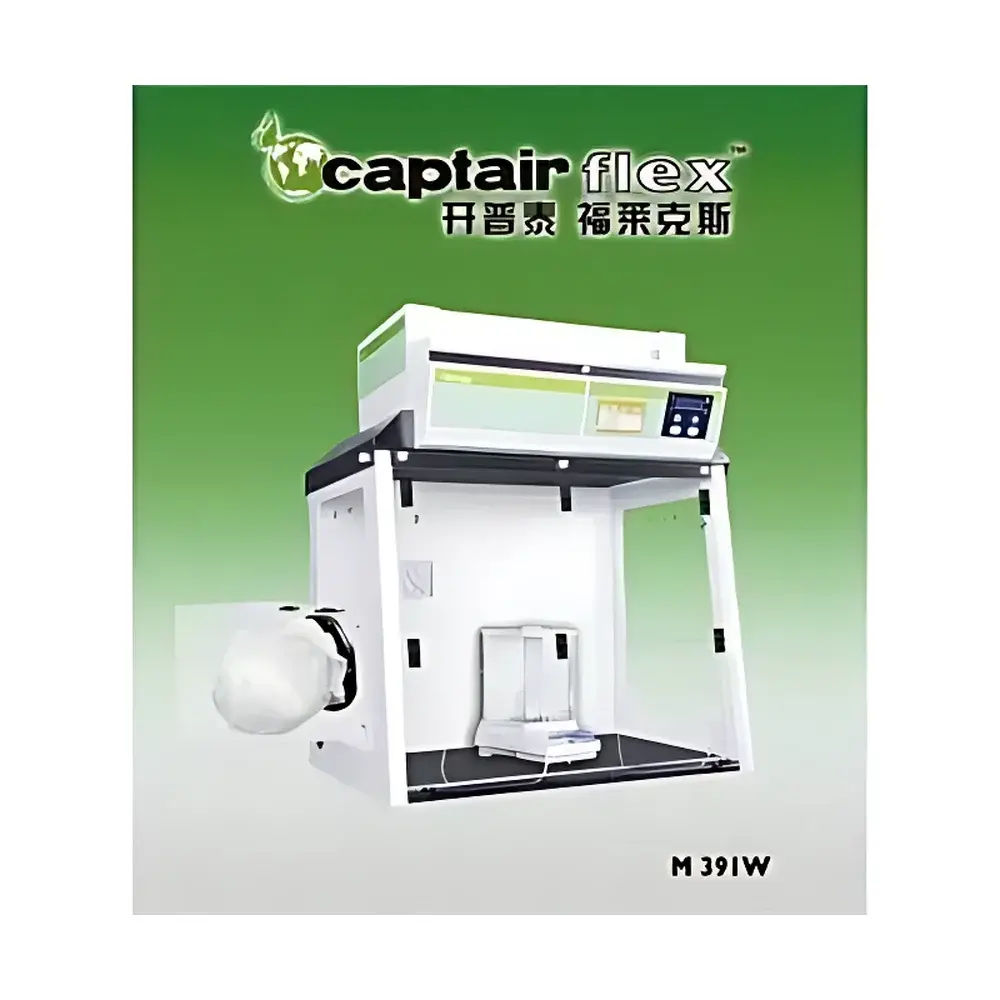
Erlab Captair Smart M391W Filtered Balance Workstation
| Brand | Erlab |
|---|---|
| Origin | France |
| Model | M391W |
| Construction | Fully Steel, Double-Sided Operation |
| Airflow Capacity | 230 m³/h |
| Face Velocity Range | 0.4–0.6 m/s (compliant with AFNOR NF X 15-211:2009) |
| Filtration System | Dual-layer molecular filter array (Class 1 per NF X 15-211) |
| Power Consumption | 58 W |
| Input Voltage | 100–240 V AC / 24 V DC internal |
| Sound Pressure Level | 52 dB(A) |
| Dimensions (L×W×H, mm) | External 1000 × 620 × 1161–1345 |
| Lighting | 18 W fluorescent lamp(s), 500 lux, IP67 rated |
| Certifications | Compliant with NF X 15-211:2009, SGS & Intertek validated performance report |
Overview
The Erlab Captair Smart M391W is a high-performance, recirculating filtered balance workstation engineered for precision weighing and low-to-moderate volatility chemical handling in laboratory environments where ductless operation, energy efficiency, and operator safety are critical. Unlike conventional ducted fume hoods that exhaust conditioned air from the facility, the M391W employs an integrated, dynamically balanced airflow system coupled with dual-stage molecular filtration to capture volatile organic compounds (VOCs), acids, bases, and solvents at source. Its core principle relies on laminar, inward-directed face velocity (0.4–0.6 m/s, per AFNOR NF X 15-211:2009) to ensure containment during weighing, dispensing, or powder transfer operations. The unit draws ambient air through the work surface, passes it across the operator’s hands and sample zone, then directs it vertically upward into a fan-driven filtration module housing two identical, vertically stacked molecular filter cartridges. This dual-filter architecture provides redundancy: when the lower cartridge approaches saturation—as monitored via timed alerts and optional Melecode™ S sensor—the upper cartridge maintains full containment integrity without interruption to workflow or risk of breakthrough.
Key Features
- Dual-layer molecular filtration system (Class 1 configuration per NF X 15-211), enabling continuous operation with fail-safe redundancy during filter replacement cycles.
- Captair Smart™ Flex control panel: centralized digital interface managing real-time airflow monitoring, audible/visual alarms for flow deviation, programmable maintenance timers (0–250 operating hours), and configurable service protocols.
- Integrated face velocity sensor with on-screen digital readout—calibrated to meet AFNOR NF X 15-211:2009 requirements for consistent containment performance.
- Ergonomic front panel with optimized 15° tilt angle, elliptical access opening, central splash guard, and curved work surface edge for forearm support and reduced musculoskeletal fatigue.
- IP67-rated 18 W fluorescent lighting (500 lux at work surface), scalable to 1–3 lamps depending on internal depth; designed for glare-free illumination under GxP-compliant visual inspection conditions.
- Low-power consumption (58 W total, 24 V DC internal circuitry) and ultra-quiet operation (52 dB(A)) suitable for open-plan labs and shared instrumentation spaces.
- Modular mobility option: compatible with certified castor trolleys (optional accessory) for flexible repositioning without structural modification.
Sample Compatibility & Compliance
The M391W is validated for use with liquid reagents, low-dust powders, solvent-based solutions, and controlled weighing of hygroscopic or light-sensitive compounds. It is not intended for high-volatility, pyrophoric, or radioactive materials requiring Class I or II biosafety-level containment. Its filtration matrix targets common laboratory chemicals including acetone, methanol, chloroform, hydrochloric acid vapors, ammonia, and formaldehyde—verified per SGS and Intertek test reports aligned with NF X 15-211 methodology. The unit complies with European occupational exposure limit (OEL) guidelines and supports GLP/GMP-aligned documentation workflows through its audit-trail-capable control system. While not FDA 21 CFR Part 11–certified out-of-the-box, its logging functions (time-stamped alarm events, filter runtime, airflow deviations) are structured to facilitate internal validation for regulated QC/QA laboratories.
Software & Data Management
The Captair Smart™ Flex interface does not require external software installation. All operational data—including cumulative runtime, filter usage duration, airflow deviation logs, and alarm history—are stored locally in non-volatile memory and accessible via the front-panel menu. Optional Melecode™ S saturation detection adds real-time VOC-specific endpoint signaling for organic-heavy workflows. For integration into lab-wide asset management systems, the unit supports RS-232 serial output (configuration-dependent) to relay status codes to building management or CMMS platforms. No cloud connectivity or proprietary drivers are employed; data export is limited to manual screen capture or periodic USB log dump (via optional adapter). This architecture prioritizes cybersecurity resilience and regulatory acceptability in validated environments.
Applications
- High-accuracy analytical weighing of reference standards and pharmaceutical intermediates under ISO/IEC 17025-controlled conditions.
- Preparation of calibration standards and QC samples in environmental, food, and clinical testing labs.
- Safe handling of cytotoxic agents during formulation development where ducted exhaust is unavailable or cost-prohibitive.
- Material characterization workflows involving moisture-sensitive or oxidation-prone compounds (e.g., lithium battery cathode precursors).
- Teaching laboratories requiring reliable, plug-and-play containment without HVAC retrofitting or permitting delays.
- ISO Class 5–7 cleanroom-adjacent applications where particle ingress must be minimized while maintaining chemical vapor control.
FAQ
What types of chemicals can be safely handled in the M391W?
The unit is validated for low-to-moderate volatility organic solvents, aqueous acids/bases, and particulates generated during weighing or dispensing. High-boiling-point solvents (e.g., DMSO, glycerol) and compounds with vapor pressures exceeding 10 mmHg at 20°C require prior compatibility assessment using Erlab’s chemical resistance database.
How often must the molecular filters be replaced?
Filter service intervals depend on chemical load, concentration, and daily usage duration. Under typical academic lab conditions (4–6 hrs/day, mixed solvents), replacement is recommended every 6–12 months. The built-in timer and optional Melecode™ S sensor provide objective saturation indicators.
Does the M391W require external ductwork or make-up air systems?
No. As a fully recirculating system, it operates independently of building HVAC infrastructure. It consumes no conditioned air, eliminating the need for dedicated make-up air units or exhaust shafts.
Can the unit be validated for GxP compliance?
Yes. While the base configuration lacks out-of-the-box 21 CFR Part 11 features, its deterministic alarm logic, time-stamped event logging, and mechanical interlocks support IQ/OQ/PQ execution per ASTM E2500 and EU Annex 11 guidance.
Is the lighting suitable for photostable compound handling?
The IP67 fluorescent lamps emit negligible UV output (<0.1 µW/cm² at 365 nm) and are compatible with light-sensitive APIs when used with amber or opaque shielding accessories (available separately).



