
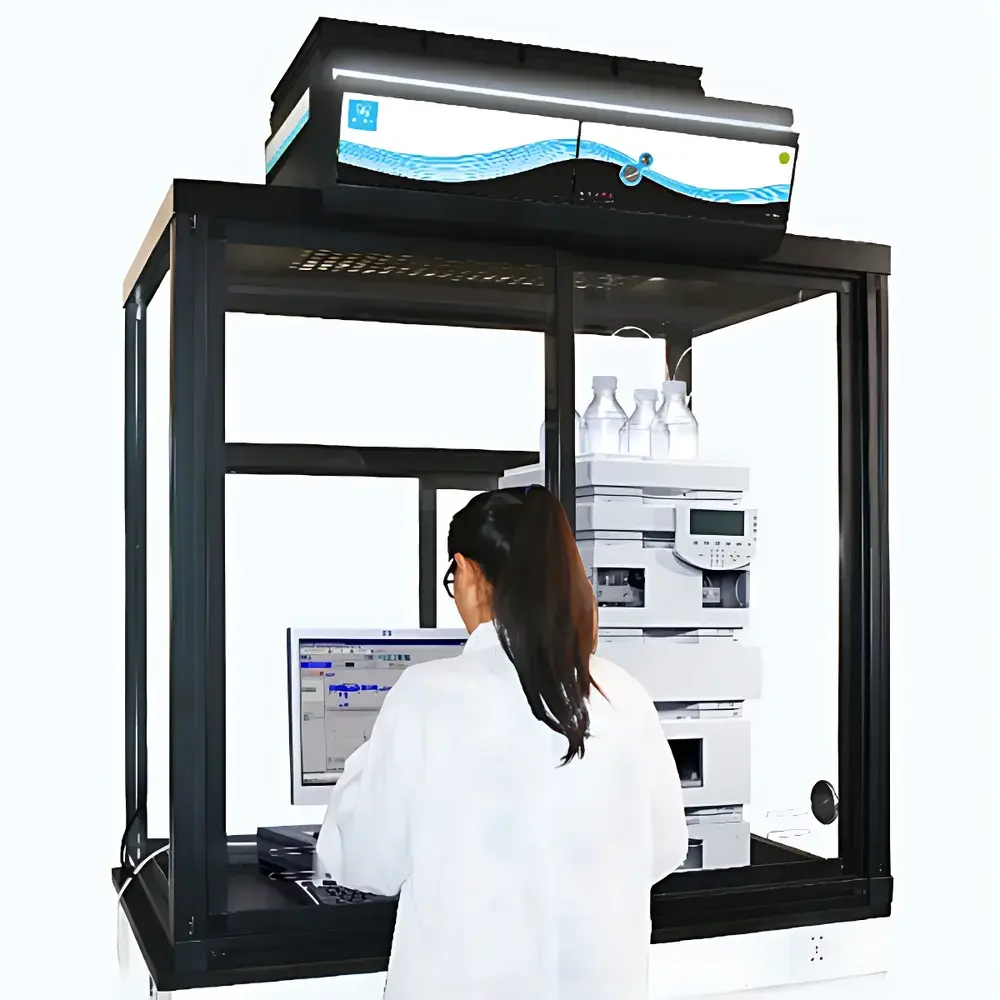
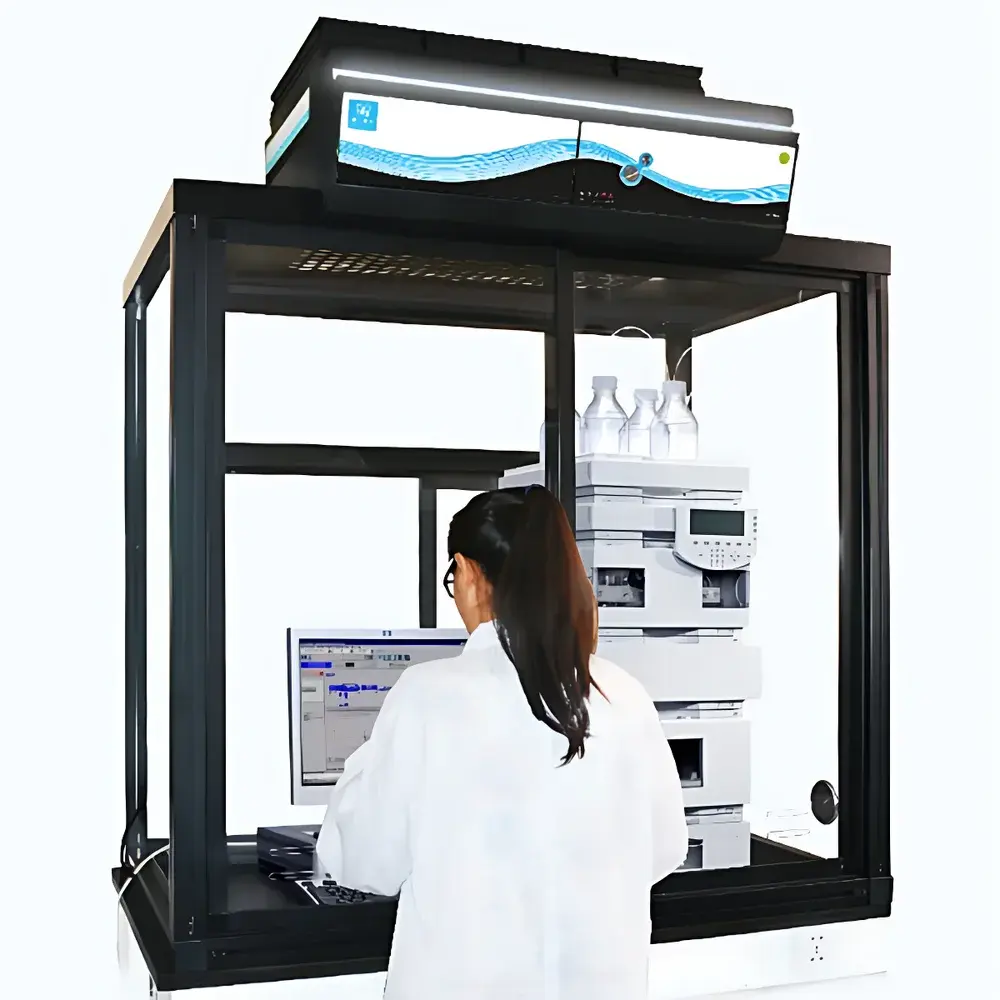
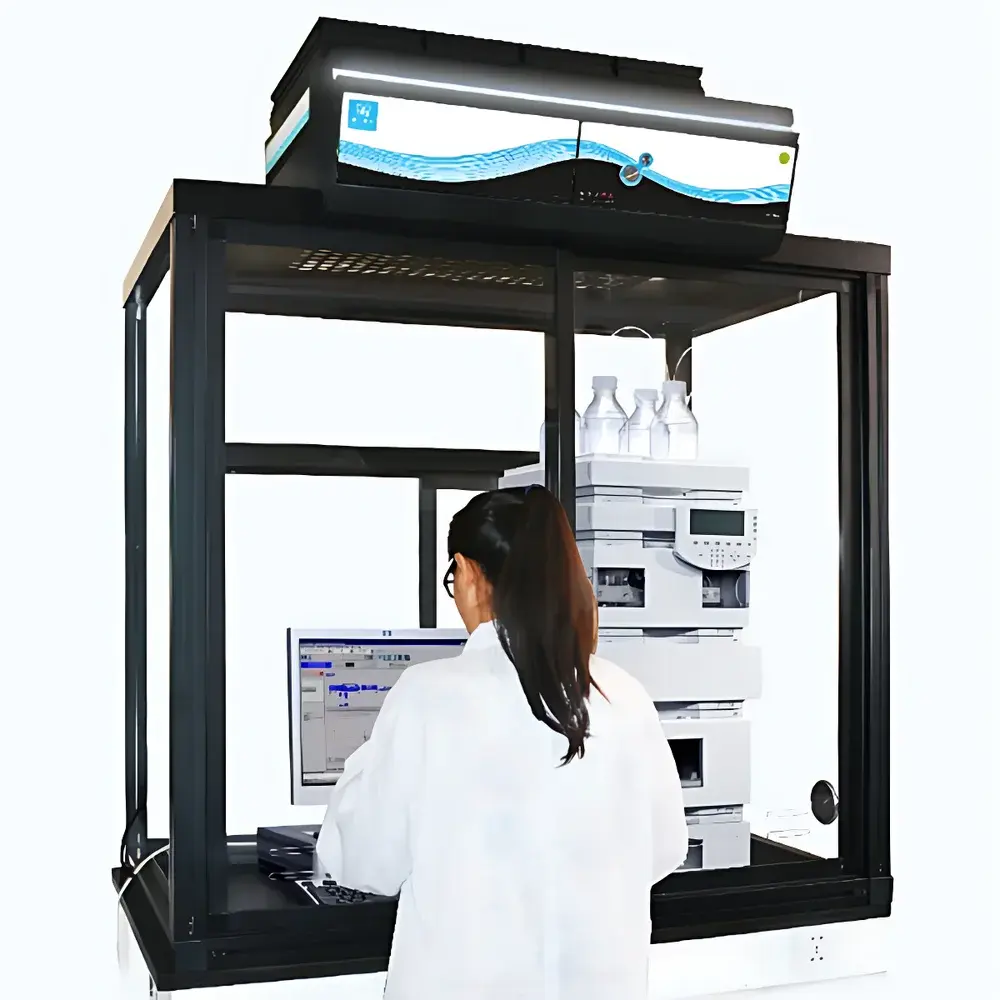
Erlab Instrument Enclosure 001 Custom-Built Safety Enclosure for Laboratory Analytical Instruments
| Brand | Erlab |
|---|---|
| Origin | Shanghai, China |
| Manufacturer Type | Authorized Distributor |
| Country of Origin | China |
| Model | Instrument Enclosure 001 |
| Pricing | Available Upon Request |
Overview
The Erlab Instrument Enclosure 001 is a custom-engineered, ductless laboratory safety enclosure designed specifically to protect sensitive analytical and physical testing instruments from environmental contamination while safeguarding personnel from hazardous chemical vapors and particulates. Built upon Erlab’s 50+ years of expertise in airflow dynamics, molecular filtration, and containment engineering—originating from its foundational work in recirculating fume hood technology—the Instrument Enclosure 001 employs a closed-loop, fan-driven air management system with dual-stage molecular filtration. It operates on the principle of active air purification: ambient air is drawn through precision-engineered intake grilles, passed sequentially through a pre-filter (capturing dust, lint, and coarse particulates) and a high-capacity carbon-based molecular filter (targeting volatile organic compounds, acids, bases, aldehydes, and other lab-grade chemical vapors), then recirculated into the laboratory space. This design eliminates the need for external ductwork, reduces HVAC load, and maintains stable thermal and particulate conditions around enclosed instrumentation—critical for metrology-grade balances, optical spectrometers, surface analyzers, and microfluidic platforms.
Key Features
- Customizable internal dimensions and footprint—engineered to accommodate instruments ranging from benchtop HPLC systems to floor-standing XRD units, with modular side panels, removable roof sections, and configurable access ports.
- Dual-stage filtration architecture: MERV-8 pre-filter + Erlab’s proprietary NanoPure™ activated carbon matrix with >95% adsorption efficiency for common solvents (e.g., acetone, methanol, chloroform, hexane) at typical lab concentrations (1–50 ppm).
- Integrated variable-speed centrifugal blower with real-time airflow monitoring; maintains consistent face velocity (0.4–0.5 m/s) across the front sash aperture and uniform laminar flow inside the chamber.
- Pre-fitted sliding sash (tempered glass, 12 mm thickness) with counterbalanced mechanism and ergonomic handle; rear service panel with gasketed cable/port pass-throughs for uninterrupted instrument connectivity.
- Filter saturation indicator linked to integrated pressure differential sensors—provides visual and optional relay-output alerts when replacement is required (typical service life: 6–12 months depending on VOC load).
- Structural frame fabricated from powder-coated steel; interior surfaces finished with epoxy-polyester hybrid coating for chemical resistance and electrostatic dissipation (ESD-safe option available).
Sample Compatibility & Compliance
The Instrument Enclosure 001 is compatible with non-explosive, low-heat-emission laboratory instrumentation—including but not limited to FTIR spectrometers, UV-Vis-NIR photometers, viscometers, particle size analyzers, and automated titrators. It is not rated for Class I Division 1 hazardous locations or continuous operation with high-boiling-point solvents (>150 °C boiling point) or strong oxidizers (e.g., concentrated nitric acid, perchloric acid). The enclosure conforms to EN 14175-3:2018 (fume hood performance requirements), meets ISO 15195:2018 recommendations for laboratory ventilation safety, and supports GLP/GMP-aligned workflows via optional audit-trail-capable filter lifecycle logging. While not certified as a full fume hood under ANSI Z9.5, it complies with OSHA 1910.1450 (Laboratory Standard) provisions for “local exhaust ventilation alternatives” when deployed per Erlab’s validated application guidelines.
Software & Data Management
The enclosure includes an embedded microcontroller-based control panel with LED status indicators for airflow, filter life, and sash position. Optional integration with Erlab’s AirControl™ 3.0 software (via RS-485 or Ethernet) enables remote monitoring of real-time airflow rate (m³/h), cumulative filter usage hours, pressure drop trends, and event logs—including sash open/close timestamps and alarm history. All data are timestamped and exportable in CSV format. For regulated environments, the system supports 21 CFR Part 11-compliant user authentication, electronic signatures, and immutable audit trails when paired with validated IT infrastructure.
Applications
- Shielding hygroscopic or static-sensitive instrumentation (e.g., quartz crystal microbalances, AFM stages) from ambient humidity and airborne particulates.
- Containing solvent vapors emitted during automated sample preparation (e.g., SPE, LC fraction collection) without exhausting conditioned lab air.
- Providing localized containment for aging GC detectors or mass spectrometer ion sources undergoing routine maintenance or calibration.
- Enabling safe deployment of open-beam optical instruments (e.g., Raman spectrometers) in shared lab spaces where volatile cleaning agents are routinely used.
- Supporting ISO/IEC 17025-accredited testing labs seeking documented, repeatable environmental controls for method validation studies.
FAQ
Can the Instrument Enclosure 001 be used with heat-generating equipment such as ovens or plasma cleaners?
No. The enclosure is not designed for sustained thermal loads exceeding 100 W per cubic meter of internal volume. Equipment with significant convective or radiant heat output requires supplemental cooling or dedicated ducted ventilation.
Is third-party filter certification available for specific chemical challenges?
Yes. Erlab provides application-specific filter validation reports per ASTM D5208 and ISO 10121-1 protocols upon request, including breakthrough curve data for target compounds.
Does the enclosure require annual third-party performance verification?
While not mandated by regulation, Erlab recommends biannual airflow and containment verification per EN 14175-6 using tracer gas (SF₆) and smoke visualization—performed by Erlab-certified field engineers.
Can multiple enclosures be networked for centralized monitoring?
Yes. Up to 32 units can be daisy-chained via Modbus RTU or integrated into a BMS using BACnet/IP gateway modules.
What is the lead time for fully customized configurations?
Standard configurations ship within 4–6 weeks; fully bespoke designs (e.g., integrated gas purge, vibration isolation mounts, ESD flooring) require 10–14 weeks from final mechanical drawing approval.



