
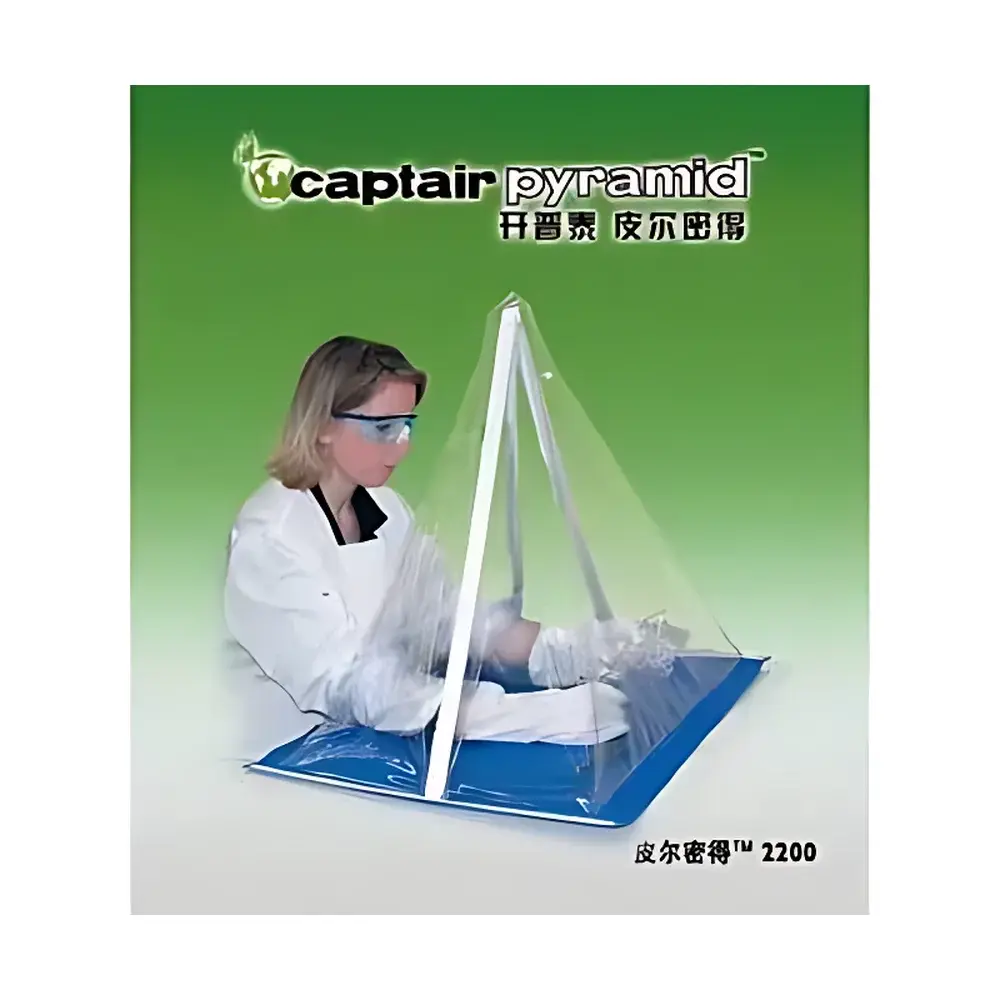
Erlab Pyramid 2200 Portable Airtight Isolation Enclosure
| Brand | Erlab |
|---|---|
| Origin | France |
| Model | Pyramid 2200 |
| Type | Research-Grade Glove Enclosure |
| Body Material | Reinforced PVC (High-Frequency Welded) |
| Sealing Test | Positive-pressure integrity verified at 2.5 mmHg (333 Pa) |
| Portability | Foldable, Lightweight, Single-Use Design |
| Glove Integration | Integrated welded sleeve with standard 8" diameter gloves |
| Structural Support | Dual telescopic support rods |
| Gas Inlet | Dedicated inert gas inlet valve (N₂ or Ar compatible) |
| Serial Numbering | Individually serialized for traceability |
| Compliance | Designed per ISO 14644-1 Class 5 cleanroom handling principles and ASTM E2915-21 guidelines for temporary containment integrity |
Overview
The Erlab Pyramid 2200 is a lightweight, single-use, portable airtight isolation enclosure engineered for transient containment applications in field and laboratory environments. Unlike traditional rigid glove boxes, the Pyramid 2200 employs a pneumatically inflated architecture based on positive-pressure differential containment — a principle aligned with ISO 14644-1 Class 5 particulate control thresholds and ASTM E2915-21 standards for evaluating the structural integrity of temporary barrier systems. Its core function is to establish a physically isolated, chemically inert, and particle-controlled workspace without requiring permanent installation, external vacuum pumps, or complex utility hookups. The enclosure operates under low-differential overpressure (2.5 mmHg / ~333 Pa), sufficient to prevent inward leakage while maintaining operator dexterity and visual clarity. This design makes it particularly suitable for time-sensitive, mobile, or low-infrastructure scenarios where conventional glove box infrastructure is impractical — including forensic evidence handling, hazardous material triage, inert-atmosphere sample preparation, and controlled surface sampling.
Key Features
- Reinforced transparent PVC body fabricated via high-frequency welding to ensure hermetic seam integrity and consistent leak-tight performance across units.
- Integrated glove sleeves thermally bonded to the enclosure wall — eliminating gasket interfaces and minimizing potential ingress pathways at the arm entry point.
- Front-mounted dual-zipper access system with overlapping flap design to preserve internal atmosphere during glove insertion and removal.
- Telescoping aluminum support rods provide vertical rigidity and adjustable height (75–110 cm range), enabling stable deployment on uneven or non-dedicated surfaces.
- Low-pressure inflation port compatible with standard inert gas manifolds (N₂, Ar); inflation to 2.5 mmHg achieves full volumetric expansion within <60 seconds.
- Foldable and transport-ready: weighs <4.2 kg; packs into a compact carry case (45 × 30 × 12 cm) without disassembly.
- Individually serialized unit labeling supports audit trails required under GLP-compliant field protocols and chain-of-custody documentation.
Sample Compatibility & Compliance
The Pyramid 2200 is validated for use with solid, dry, and low-volatility samples under inert or ambient atmospheres. It is not rated for solvent vapors, high-humidity conditions (>60% RH), or exothermic reactions exceeding 40 °C. Its single-use designation ensures cross-contamination avoidance between discrete operations — critical in forensic fingerprint development, explosive residue screening, and pharmaceutical raw material inspection. While not certified as a biosafety cabinet (BSC) or ISO Class 3/4 cleanroom enclosure, its tested pressure-hold performance meets ASTM E2915-21 criteria for “temporary containment enclosures” used in preliminary hazard assessment. Documentation includes factory-applied pressure decay test reports and material safety data (PVC formulation compliant with EU REACH Annex XIV exemptions).
Software & Data Management
The Pyramid 2200 is a fully mechanical, analog containment system with no embedded electronics, firmware, or software components. All operational parameters — inflation pressure, dwell time, and environmental exposure duration — are recorded manually in lab notebooks or digital ELN entries. Serial number traceability enables integration into LIMS workflows for sample-specific containment metadata (e.g., “Pyramid-2200-SN#88421 used during NIST SRM 2976 analysis, 2024-05-12”). No FDA 21 CFR Part 11 compliance is applicable due to absence of electronic records generation; however, procedural SOPs may reference unit serial numbers to satisfy GLP audit requirements for equipment accountability.
Applications
- Controlled opening and visual inspection of suspicious packages or uncharacterized materials in law enforcement and customs settings.
- Inert-atmosphere manipulation of air-sensitive compounds (e.g., organometallic catalysts, alkali metal derivatives) during pre-characterization steps.
- On-site forensic sampling — including latent fingerprint lifting, trace evidence collection, and controlled swabbing under dust- and moisture-restricted conditions.
- Field-deployable containment for geological or archaeological specimen stabilization prior to transport to central labs.
- Secondary containment during high-risk liquid transfer operations where splash mitigation and vapor suppression are required but full fume hood access is unavailable.
FAQ
Is the Pyramid 2200 reusable?
No — it is designed and validated for single-use operation only. Re-inflation or cleaning compromises weld integrity and pressure-hold performance.
Can it be used with volatile organic solvents?
Not recommended. PVC has limited chemical resistance to ketones, chlorinated hydrocarbons, and strong esters; consult the material compatibility chart before exposure.
What inert gases are compatible with the inflation system?
Nitrogen (N₂) and argon (Ar) are fully compatible; helium is not advised due to higher permeation rates through PVC.
Does it meet any regulatory certification for biological containment?
No — it is not classified as a biosafety cabinet (BSC) or certified to NSF/ANSI 49; its use is restricted to physical and particulate containment, not bioaerosol filtration.
How is pressure integrity verified prior to use?
Each unit ships with a certificate of conformance documenting successful 2.5 mmHg pressure hold for ≥5 minutes; users should perform a visual inflation stability check before first deployment.



