
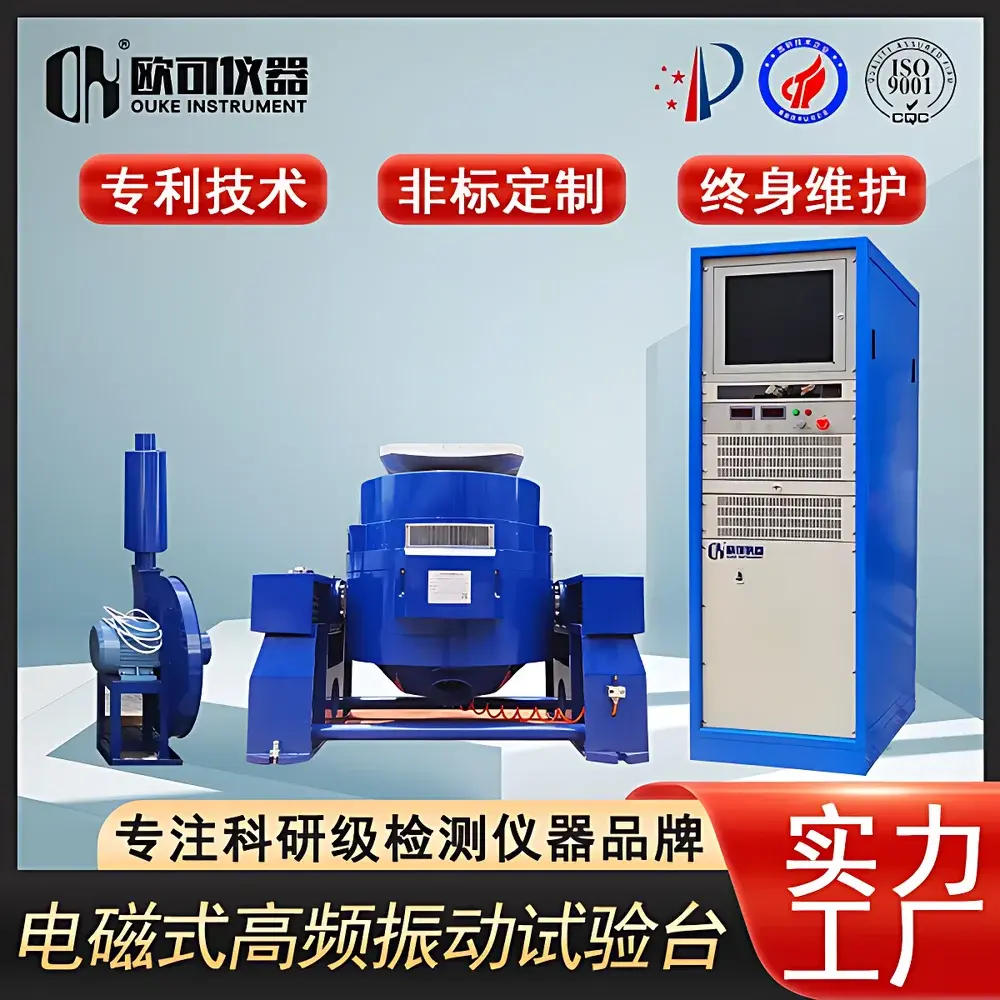
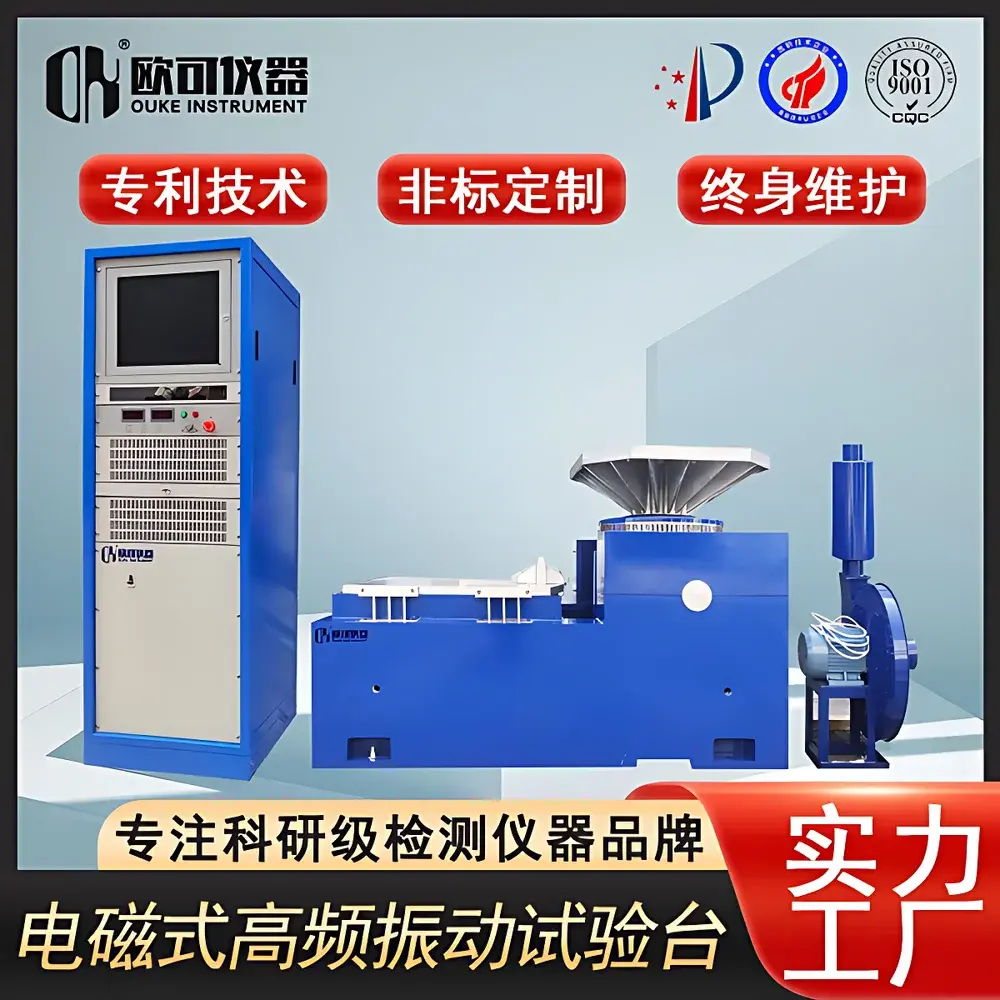
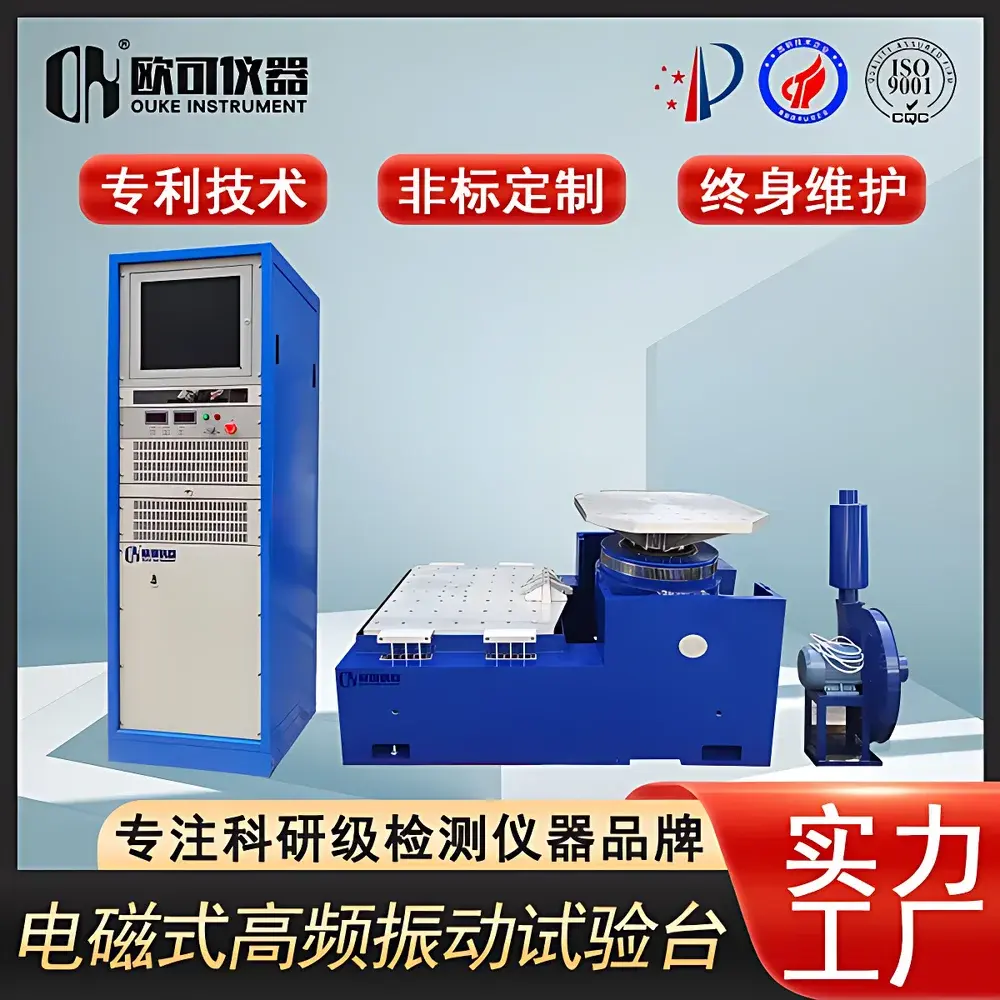
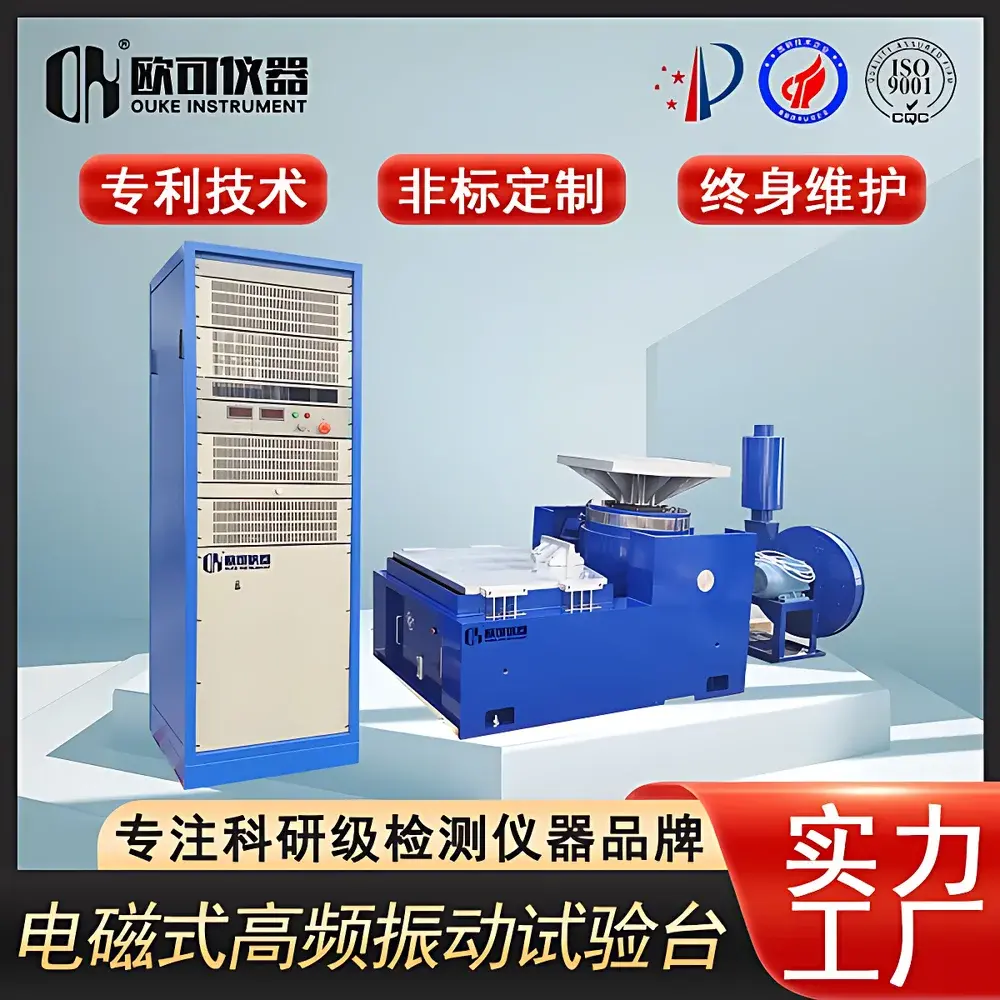
OK-ES-10 Electromagnetic Vertical-Horizontal Vibration Shaker System
| Brand | OK Instruments |
|---|---|
| Origin | Guangdong, China |
| Manufacturer Type | OEM/ODM Manufacturer |
| Country of Origin | China |
| Model | OK-ES-10 |
| Instrument Type | Electromagnetic Vibration Shaker |
| Rated Force | 1.98 kN |
| Frequency Range | 5–5000 Hz |
| Max. Payload Capacity | 70 kg |
| Table Dimensions | 400 × 400 × 30 mm |
| Peak Acceleration | 10 g |
Overview
The OK-ES-10 Electromagnetic Vertical-Horizontal Vibration Shaker System is a high-fidelity, digitally controlled electromagnetic shaker engineered for precision mechanical vibration testing across research laboratories, quality assurance departments, and product development centers. It operates on the principle of Lorentz force generation—applying alternating current to a voice-coil assembly suspended within a static magnetic field—to convert electrical input signals into highly repeatable, broadband mechanical motion. Unlike hydraulic shakers, this system delivers clean, oil-free actuation with superior waveform fidelity and rapid dynamic response, making it ideal for sine, random, shock, and transient vibration profiles defined by international standards including ISO 10816, ISO 20283, MIL-STD-810H, and IEC 60068-2-64. Its dual-axis capability (vertical + horizontal via optional slip table) enables full six-degree-of-freedom simulation when integrated with auxiliary fixtures and environmental chambers.
Key Features
- Electromagnetic drive architecture with permanent magnet or electromagnet flux path options—optimized for energy efficiency or high-force output.
- Digital closed-loop servo control: Real-time feedback from integrated accelerometers ensures amplitude and phase accuracy within ±1.5 dB across the full 5–5000 Hz operating bandwidth.
- Rated peak force of 1.98 kN supports rigorous reliability screening of medium-to-large assemblies—including automotive ECUs, avionics enclosures, and industrial control units—up to 70 kg total mass (including fixture and moving parts).
- Robust aluminum alloy table (400 × 400 × 30 mm) featuring standardized M8 threaded mounting holes spaced at 50 mm intervals for universal fixture compatibility.
- Integrated suspension system with low-friction flexure guidance ensures minimal parasitic motion and high axial stiffness (>2.5 × 10⁶ N/m), critical for maintaining test integrity at resonance frequencies.
- Scalable power amplifier design with forced-air or optional water-cooling support—enabling continuous operation under high-duty-cycle random vibration spectra.
Sample Compatibility & Compliance
The OK-ES-10 accommodates samples ranging from miniature PCB modules (<0.5 kg) to full-size consumer electronics enclosures, automotive instrument clusters, and aerospace subassemblies. Fixture design adheres to ASTM D999 and ISO 13373-2 guidelines for modal decoupling and load-path integrity. All controller firmware and data acquisition modules comply with GLP/GMP documentation requirements, supporting audit-ready test reports with timestamped metadata, calibration traceability, and electronic signatures. The system meets CE marking directives (EMC Directive 2014/30/EU, Machinery Directive 2006/42/EC) and is compatible with FDA 21 CFR Part 11–compliant software environments when deployed in regulated pharmaceutical or medical device validation workflows.
Software & Data Management
The OK-ES-10 is operated via OK-VibControl™—a modular PC-based software suite supporting real-time spectrum analysis, Sine Sweep, Resonance Search, Random Vibration (PSD synthesis per MIL-STD-810H Annex G), Classical Shock (half-sine, trapezoidal, sawtooth), and Time Waveform Replication (TWR). All test configurations are stored as XML-based project files with version-controlled revision history. Raw acceleration data is acquired at up to 102.4 kHz sampling rate (16-bit resolution) and exported in universal formats (.tdms, .uff, .csv) for post-processing in MATLAB, Python (SciPy), or commercial FEA tools. Built-in data logging includes full audit trail functionality: user login events, parameter changes, calibration status, and hardware fault logs—all compliant with ISO/IEC 17025 documentation standards.
Applications
- Structural dynamics characterization: Modal analysis, transmissibility mapping, and damping ratio estimation for mechanical assemblies.
- Environmental stress screening (ESS): High-acceleration random vibration to accelerate latent defect manifestation in electronics manufacturing.
- Transportation simulation: Replication of road-induced vibrations (SAE J1211), rail freight profiles (EN 12299), and airborne equipment spectra (DO-160 Section 8).
- Shock qualification: Drop-test emulation using synthesized shock response spectra (SRS) per MIL-STD-810H Method 516.8.
- Multi-stress integration: Seamless coupling with temperature-humidity chambers for combined environmental testing (e.g., MIL-STD-810H Method 520.5).
- Educational use: Hands-on instruction in vibration theory, control systems engineering, and experimental modal analysis at university labs.
FAQ
What is the difference between electromagnetic and electro-hydraulic shakers?
Electromagnetic shakers like the OK-ES-10 offer superior high-frequency fidelity (up to 5 kHz), faster transient response, and zero hydraulic fluid maintenance. Electro-hydraulic systems excel in ultra-low-frequency displacement (±100 mm) and extreme force delivery (>100 kN), but suffer from higher nonlinearity and complex infrastructure requirements.
Can the OK-ES-10 perform simultaneous vertical and horizontal vibration?
Yes—when equipped with an optional horizontal slip table and dual-channel controller configuration, the system supports orthogonal two-axis excitation. Full 6-DOF simulation requires external motion platform integration.
Is third-party calibration support available?
OK Instruments provides NIST-traceable calibration certificates (per ISO 17025) and maintains partnerships with accredited metrology labs in North America, EU, and APAC regions for on-site verification and periodic recalibration.
How is payload inertia accounted for during force calculation?
System-level force margining follows the industry standard: Frequired ≥ (mpayload + mfixture + mmoving parts) × apeak × 1.5, ensuring adequate headroom for resonant amplification and controller saturation margins.
Does the system support remote monitoring and unattended operation?
Yes—the OK-VibControl™ software includes TCP/IP API access, OPC UA server integration, and scheduled test execution with email/SMS alerting for abnormal termination or thermal shutdown events.



