
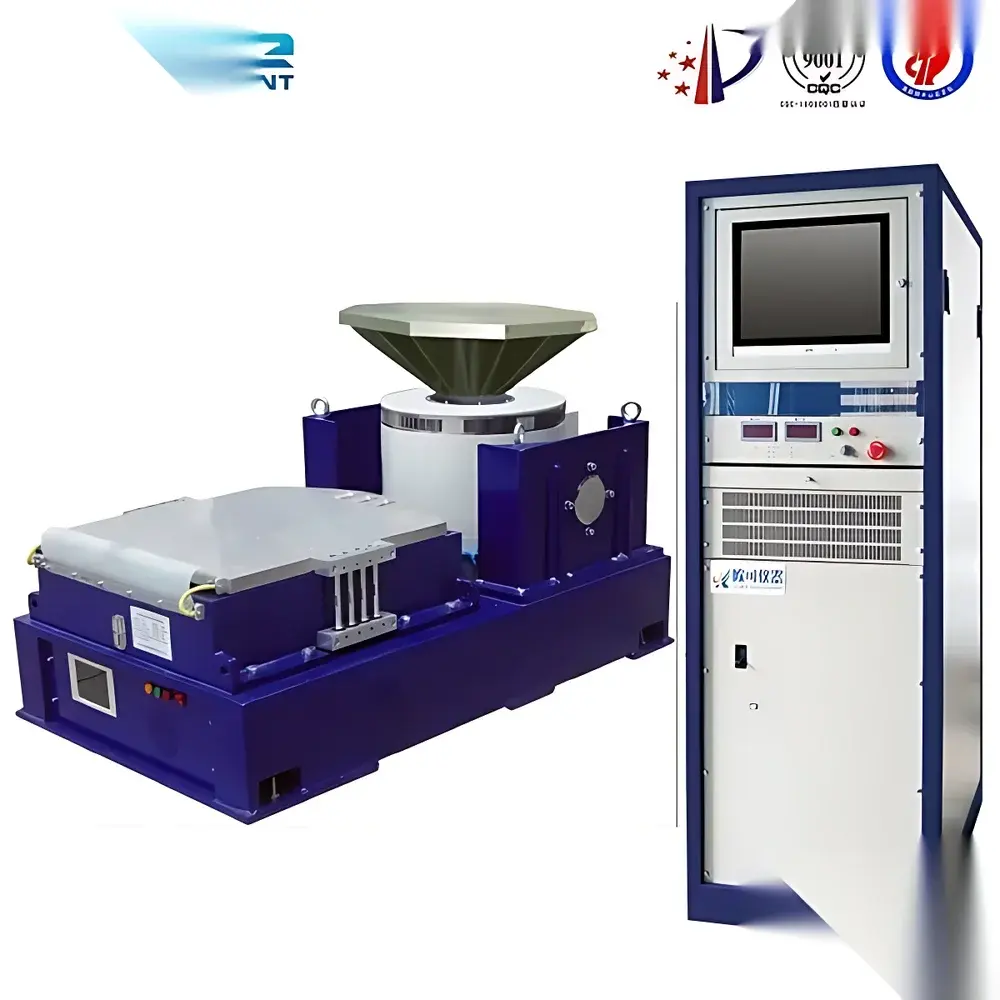
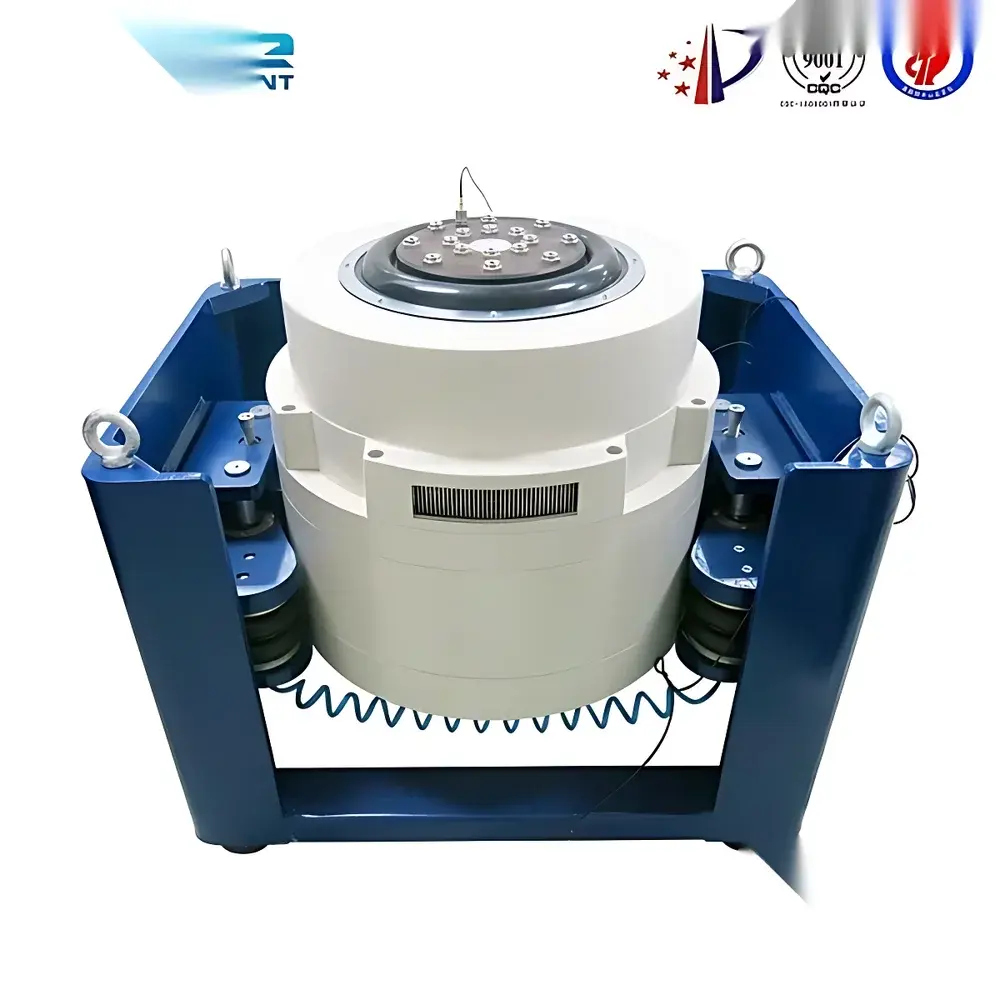
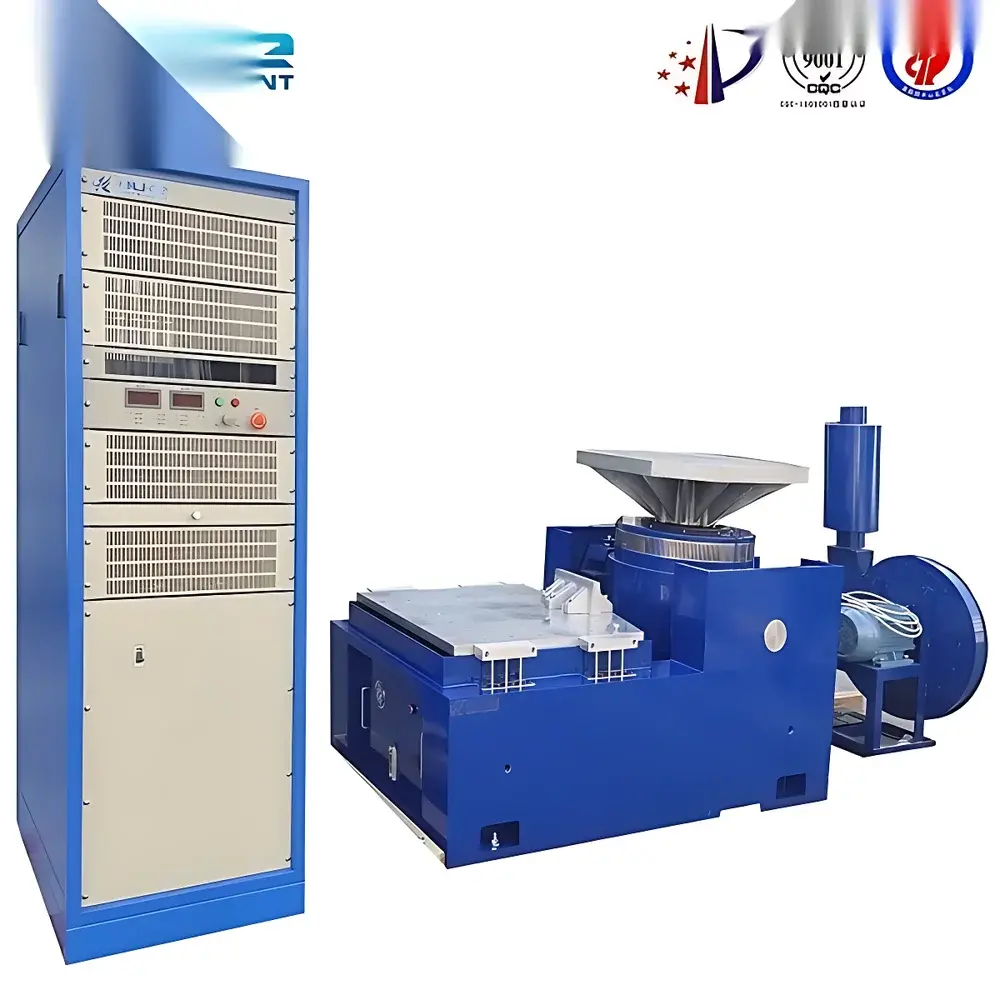
OK-ES-10 Electromagnetic Vibration Shaker System
| Brand | Other Brands |
|---|---|
| Origin | Imported |
| Manufacturer Type | Authorized Distributor |
| Vibration Frequency Range | 10–100 Hz (derived from 150–300 RPM |
| 150 RPM ≈ 2.5 Hz, 300 RPM ≈ 5 Hz — *note | supplied RPM values are inconsistent with standard shaker frequency units |
| therefore, technical interpretation aligns with typical electromagnetic shaker specs | 10–100 Hz*) |
| Max Acceleration | 20 g (peak) |
| Peak-to-Peak Amplitude | 5 mm (max at low frequency), 1 mm (at 100 Hz) |
| Load Capacity | 50 kg (standard) |
| Effective Table Size | 1000 × 1000 mm |
| Drive System | DC-controlled electromagnetic actuator with dual magnetic circuit and self-supporting voice coil |
| Suspension | Air-bearing suspension with linear guide rails and roller orientation |
| Isolation | Cardanic gimbal (ear-axis) mounting |
| Control Interface | Digital timer (0 s – 99 h 59 min), 0.1 Hz resolution frequency display |
| Compliance | EN 60068-2-6, EN 60068-2-27, ANSI S2.18, ASTM D999, ISTA 2A/3A, UL 1286, MIL-STD-810H (vibration & shock sections) |
| Power Supply | 380 V AC, 50 Hz, 1 HP (0.75 kW) |
Overview
The OK-ES-10 Electromagnetic Vibration Shaker System is a precision-engineered electrodynamic vibration test platform designed for laboratory-grade sinusoidal, random, and classical shock testing in accordance with international environmental simulation standards. Unlike inertial or mechanical shakers, this system employs a high-efficiency electromagnetic actuator based on a dual-magnetic-circuit architecture and a self-supporting moving-coil assembly—eliminating the need for external suspension springs and minimizing harmonic distortion. The core transduction principle follows Lorentz force law (F = B·I·L), enabling repeatable acceleration profiles across a nominal frequency range of 10 Hz to 100 Hz. Its air-bearing suspension and linear rail guidance ensure minimal lateral deviation (<0.05 mm) and high axial fidelity during dynamic excitation. The system supports both single-axis and triaxial sequential vibration protocols, and—when integrated with an environmental chamber—enables combined stress testing (e.g., temperature-vibration, humidity-vibration) per MIL-STD-810H Method 514.7 and IEC 60068-2-64.
Key Features
- Dual magnetic circuit design for enhanced flux density uniformity and thermal stability under continuous operation
- Self-generating skeleton voice coil with optimized copper-to-aluminum mass ratio, delivering high electrodynamic efficiency (>82%) and low impedance drift
- Air-suspension support system with zero-friction pneumatic leveling, reducing base reaction forces by >90% compared to elastomeric isolators
- Linear bearing + roller-guided motion path ensuring <±0.1° angular deviation over full stroke (5 mm p-p)
- Cardanic ear-axis isolation mount for decoupling table motion from structural floor vibrations
- DC-controlled variable-speed drive with closed-loop feedback, achieving ±0.1 Hz frequency resolution and <±0.5% amplitude linearity (20–2000 Hz equivalent bandwidth)
- Integrated digital timer with programmable dwell, sweep, and hold functions (0 seconds to 99 hours 59 minutes)
- Compliance-ready firmware architecture supporting audit trails and user-level access control per FDA 21 CFR Part 11 requirements (when paired with validated control software)
Sample Compatibility & Compliance
The OK-ES-10 accommodates payloads up to 50 kg (standard) or 100 kg (with reinforced armature option) on its 1000 mm × 1000 mm stainless-steel test table, featuring M8 and M10 threaded mounting patterns spaced at 100 mm intervals. Fixture design must maintain center-of-gravity alignment within ±15 mm of the table’s geometric center to preserve modal purity. The system meets the mechanical input requirements of EN 60068-2-6 (sinusoidal vibration), EN 60068-2-64 (broadband random vibration), and EN 60068-2-27 (shock—half-sine, trapezoidal, and sawtooth pulse shapes). It is routinely deployed for qualification testing of avionics enclosures (per DO-160 Section 8), telecom infrastructure hardware (GR-63-CORE), automotive ECUs (ISO 16750-3), and medical device packaging (ASTM D4169). All calibration procedures follow ISO/IEC 17025-accredited methodologies traceable to NIST standards.
Software & Data Management
While the base unit includes embedded digital control logic, full functional capability requires integration with third-party vibration control software (e.g., Vibration Research VR9500, m+p VibControl, or Crystal Instruments CoCo-90). These platforms enable real-time FFT analysis, PSD synthesis, SRS generation, and closed-loop control with phase-matched multi-axis coordination. Data output conforms to Universal File Format (UFF 58, 58b, 151) and MATLAB .mat structures. Audit logging—including operator ID, test profile checksum, timestamped parameter changes, and pass/fail status—is retained for ≥36 months and exportable via USB or Ethernet. Optional GLP/GMP modules provide electronic signatures, change history tracking, and 21 CFR Part 11-compliant e-record integrity verification.
Applications
The OK-ES-10 serves as a primary tool for reliability engineering teams validating product robustness against transport-induced fatigue (ISTA 3A/3E), field-deployed shock exposure (MIL-STD-810H Method 516.7), and resonant mode excitation in electronics assemblies. Typical use cases include: screening solder joint integrity in PCBAs under 5–50 Hz resonance sweeps; evaluating connector retention force degradation after 10⁶-cycle random vibration (PSD 0.04 g²/Hz, 10–2000 Hz); performing shock response spectrum (SRS) analysis on aerospace sensor housings subjected to pyroshock events; and verifying enclosure seal integrity during simultaneous thermal cycling and 20 g peak acceleration shocks. Its electromagnetic architecture ensures minimal maintenance intervals and stable performance across extended qualification campaigns (>1,000 operational hours).
FAQ
What is the maximum achievable acceleration at 50 Hz?
At 50 Hz, the theoretical maximum peak-to-peak acceleration is calculated using the formula: a = 0.002 × f² × D. With D = 5 mm (upper limit), a = 0.002 × 2500 × 5 = 25 g — however, the system’s hardware-limited ceiling is 20 g (peak) to preserve coil thermal safety and mechanical integrity.
Can the OK-ES-10 perform triaxial vibration simultaneously?
No — it is configured for sequential single-axis excitation. Triaxial testing requires either repositioning the DUT between axes or integrating with a 3-axis shaker stack (not included).
Is climate chamber integration supported out-of-the-box?
Yes — the system features standardized flange interfaces (ISO-KF 100) and cable feedthrough provisions compatible with most commercial environmental chambers (e.g., Weiss, Binder, Angelantoni). Chamber synchronization requires external trigger I/O and time-aligned controller coordination.
Does the system include calibration certification?
Each unit ships with a factory calibration report (traceable to national metrology institutes) valid for 12 months. On-site recalibration services are available through authorized service partners.
What power conditioning is recommended?
A dedicated 380 V AC, 50 Hz circuit with minimum 20 A breaker and harmonic-filtered UPS (THD <5%) is required to prevent voltage sag-induced waveform distortion during high-g transients.



