
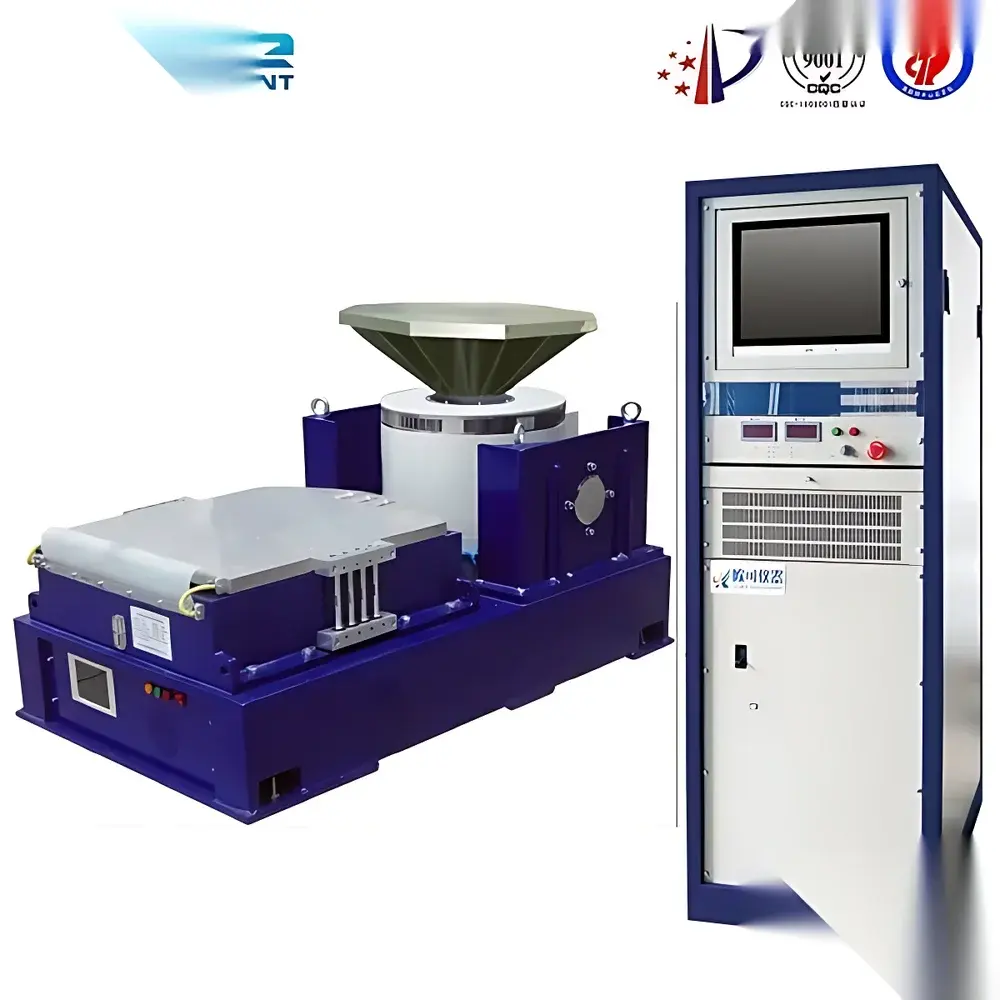
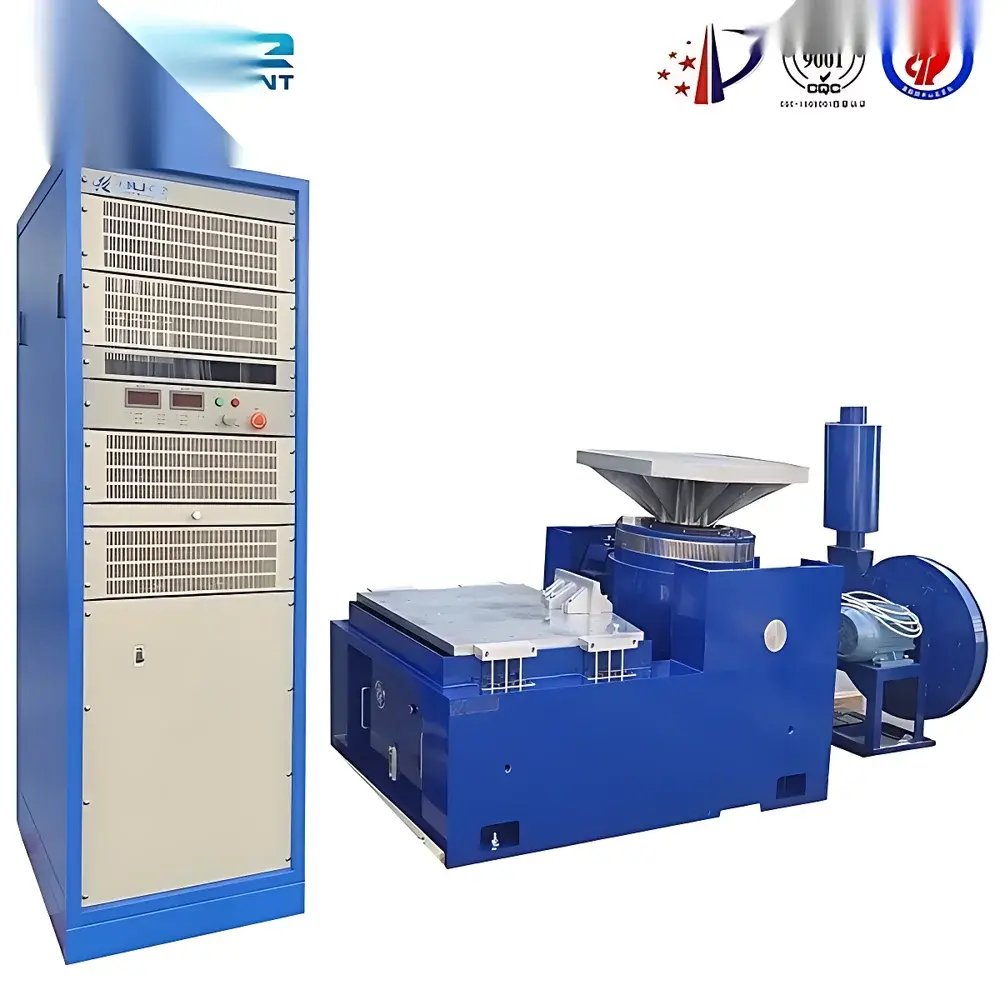
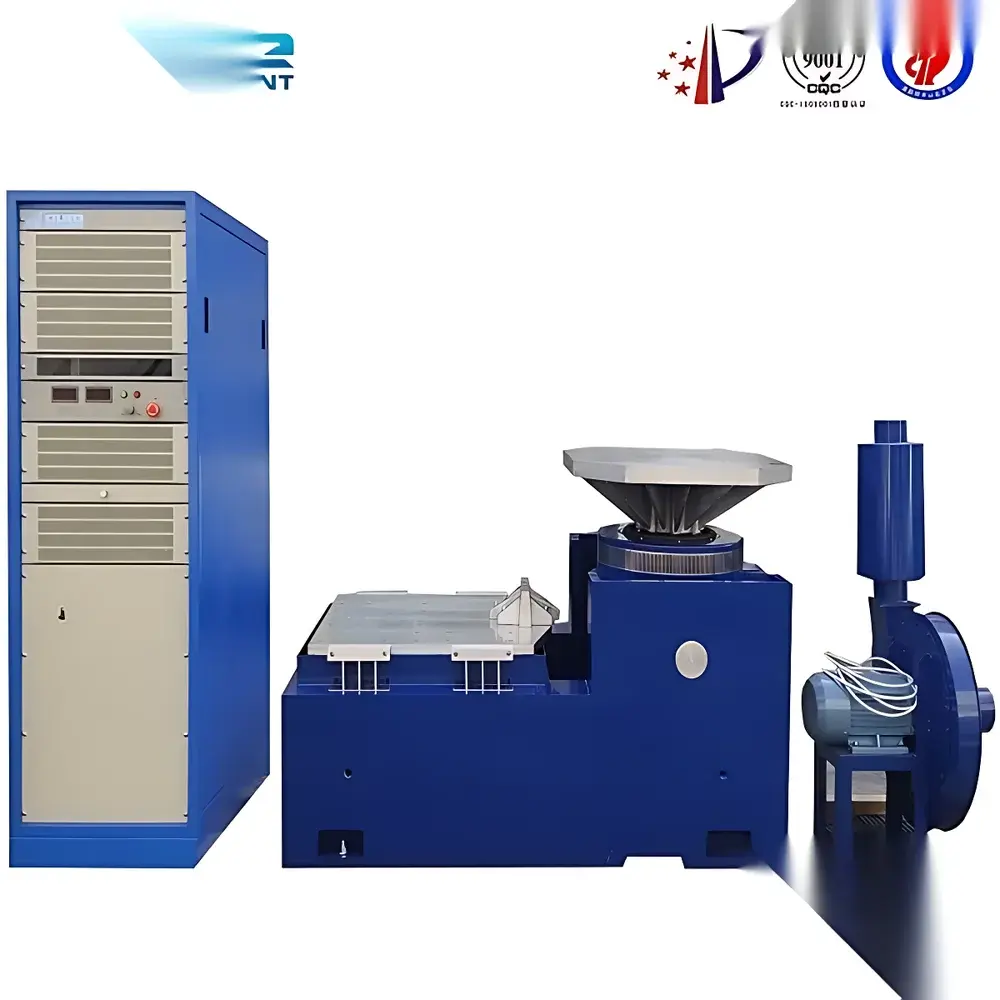
OK-ES-10 Electromagnetic Vibration Shaker System
| Brand | Other Brands |
|---|---|
| Origin | Imported |
| Manufacturer Type | Authorized Distributor |
| Price | USD 21,000 (FOB) |
| Max Acceleration | 20 g (peak) |
| Frequency Range | 5–3,000 Hz |
| Displacement (p-p) | Up to 25.4 mm |
| Velocity Range | 150–300 rpm equivalent (mechanical drive mode) |
| Payload Capacity | 50 kg |
| Effective Table Area | 1.0 × 1.0 m |
| Control Mode | DC Speed Regulation |
| Power Supply | 380 V, 50 Hz, 1 HP |
| Compliance | EN 60068-2-6, EN 60068-2-64, ANSI S2.18, ASTM D999, ISTA 3A/3E/3H, UL 746C |
Overview
The OK-ES-10 Electromagnetic Vibration Shaker System is a high-fidelity, three-axis capable mechanical vibration test platform engineered for precision simulation of sinusoidal, random, and classical shock environments. Unlike purely electrodynamic shakers optimized for high-frequency fidelity, the OK-ES-10 integrates a hybrid electromagnetic–mechanical actuation architecture—featuring dual-magnetic-circuit excitation, self-supporting voice coil assembly, pneumatic suspension support, linear bearing and roller guidance, and elastomeric pivot isolation—to deliver robust low-to-mid frequency performance with exceptional force transmission linearity and thermal stability. It operates on the principle of controlled inertial excitation: displacement is generated via electromagnetic Lorentz force acting on a moving coil within a static magnetic field, while mechanical resonance management ensures minimal harmonic distortion across its operational bandwidth (5–3,000 Hz). This system is designed for laboratory-grade qualification testing in accordance with international environmental stress screening (ESS) and transportation simulation protocols.
Key Features
- Dual-magnetic-circuit design enhances flux density uniformity and improves force factor linearity over extended stroke ranges.
- Self-generating skeleton-type moving coil eliminates traditional adhesive bonding, reducing thermal drift and improving long-term repeatability under cyclic loading.
- Pneumatic suspension support system decouples base motion from reaction forces, minimizing floor-transmitted vibrations and enabling stable operation at high g-levels.
- Linear bearing and precision roller guidance ensure axial alignment integrity during prolonged broadband random tests (per ISO 10816-3 and MIL-STD-810H Method 514.8).
- Three-axis sequential or synchronized excitation capability supports orthogonal sine sweep, PSD-controlled random, and transient shock profiles including half-sine, trapezoidal, and terminal-peak sawtooth pulses.
- Integrated digital controller with real-time FFT analysis enables closed-loop acceleration, velocity, and displacement control with ≤±0.5 dB amplitude tolerance across defined spectra.
- Optional climatic chamber coupling allows concurrent thermal–vibrational stress application (e.g., temperature range −40°C to +150°C), compliant with MIL-STD-810H Method 501.7/502.7.
Sample Compatibility & Compliance
The OK-ES-10 accommodates payloads up to 50 kg on its 1.0 × 1.0 m stainless steel table surface, supporting fixtures for automotive ECUs, avionics enclosures, PCB assemblies, consumer electronics housings, and military-grade connectors. Its mechanical architecture meets structural rigidity requirements for modal testing up to the third bending mode of typical mid-size test articles. The system conforms to multiple internationally recognized test standards: EN 60068-2-6 (sinusoidal vibration), EN 60068-2-64 (broadband random vibration), ANSI S2.18 (vibration data acquisition), ASTM D999 (shipping container vibration simulation), ISTA 3-series transport protocols, and UL 746C (polymeric material endurance under dynamic stress). All calibration procedures follow ISO/IEC 17025-accredited traceability paths, with annual verification reports available upon request.
Software & Data Management
Control and analysis are executed via a Windows-based real-time operating system running proprietary vibration test software compliant with FDA 21 CFR Part 11 requirements—including electronic signatures, audit trail logging, user role-based access control, and immutable raw data archiving. The software supports import/export of standard formats (SDF, UFF58, MATLAB .mat), automated test sequencing with conditional branching, and post-test response spectrum (RS) and fatigue damage spectrum (FDS) generation. All measurement channels (acceleration, velocity, displacement, drive voltage) are sampled at ≥51.2 kHz with 24-bit resolution. Data files include embedded metadata: timestamp, operator ID, calibration certificate number, ambient temperature/humidity, and compliance reference clause. Exported reports adhere to GLP/GMP documentation templates for regulated industries.
Applications
This shaker system serves as a core qualification tool across defense, aerospace, telecommunications, and industrial electronics sectors. Typical use cases include: structural integrity validation of satellite payload mounts under launch vibration profiles; durability assessment of automotive infotainment modules per GMW3172 and Ford CETP; EMI/EMC pre-compliance screening of medical devices under IEC 60601-1-11; life-cycle reliability testing of smart home appliances per UL 60730; and packaging performance evaluation for e-commerce logistics (ISTA 3E, Amazon SQP). Its ability to replicate field-relevant shock spectra—including pyroshock surrogates and road-profile synthesized waveforms—makes it suitable for failure mode identification and HALT/HASS protocol development.
FAQ
What is the maximum achievable acceleration and how is it related to frequency and displacement?
Acceleration (gpeak) is governed by the empirical relation: a = 0.002 × f² × D, where f is frequency (Hz) and D is peak-to-peak displacement (mm). At 100 Hz, the theoretical limit is 1 mm p-p to maintain ≤20 g. Full-scale displacement (25.4 mm p-p) is only permissible below ~14 Hz.
Does the system support real-time closed-loop control?
Yes—accelerometer feedback is processed in hardware with <100 µs latency; control algorithms implement PID + notch filtering to suppress resonant peaks and maintain spectral fidelity per ISO 5347-13.
Can the shaker be integrated into an existing environmental test chamber?
Yes—standardized flange interfaces (ISO-KF 100) and vacuum-compatible feedthroughs enable seamless coupling with climatic chambers meeting IEC 60068-3-5 and MIL-STD-810H thermal–vibration test matrices.
Is calibration certification included with shipment?
Each unit ships with NIST-traceable factory calibration report covering force, acceleration, and displacement transfer functions across full operational range, valid for 12 months.
What safety interlocks are implemented?
Hardware-enforced safety chain includes emergency stop (EN 60204-1), over-temperature cutoff, over-acceleration limiter, table position monitoring, and door interlock for optional chamber integration.



