
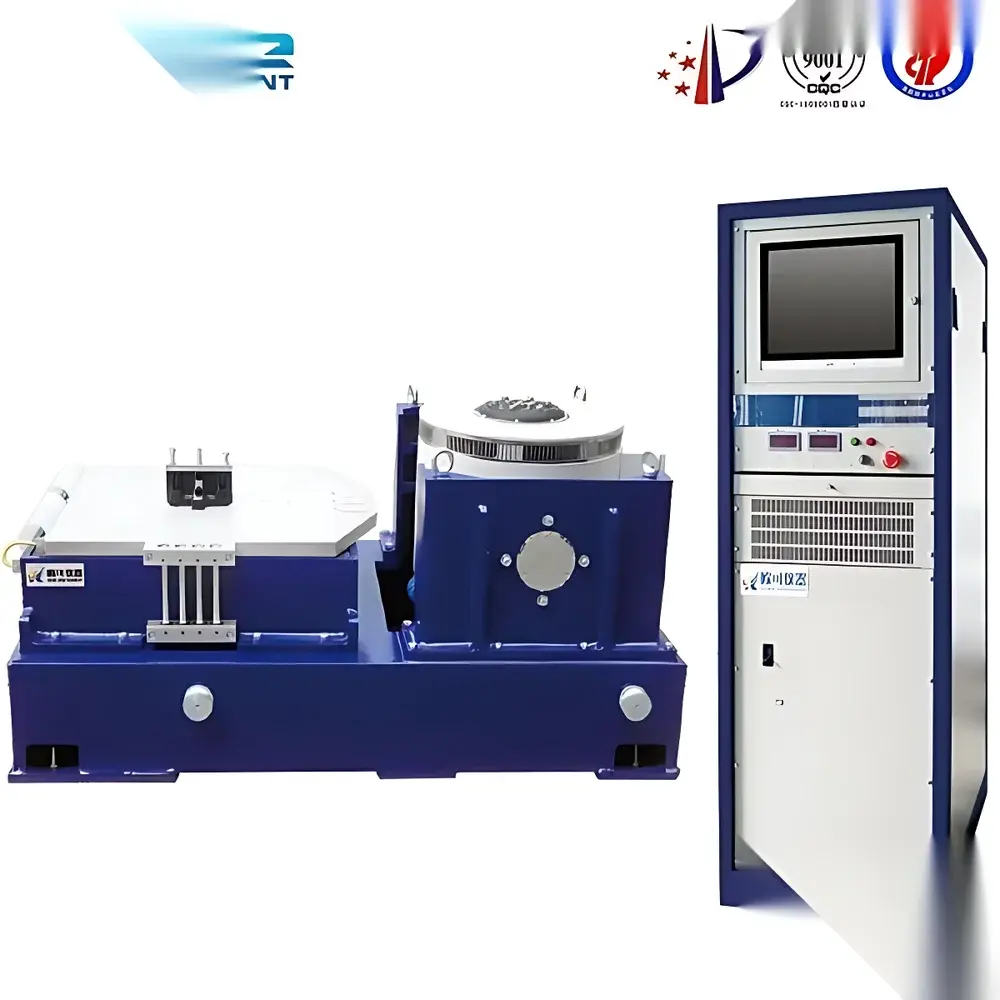
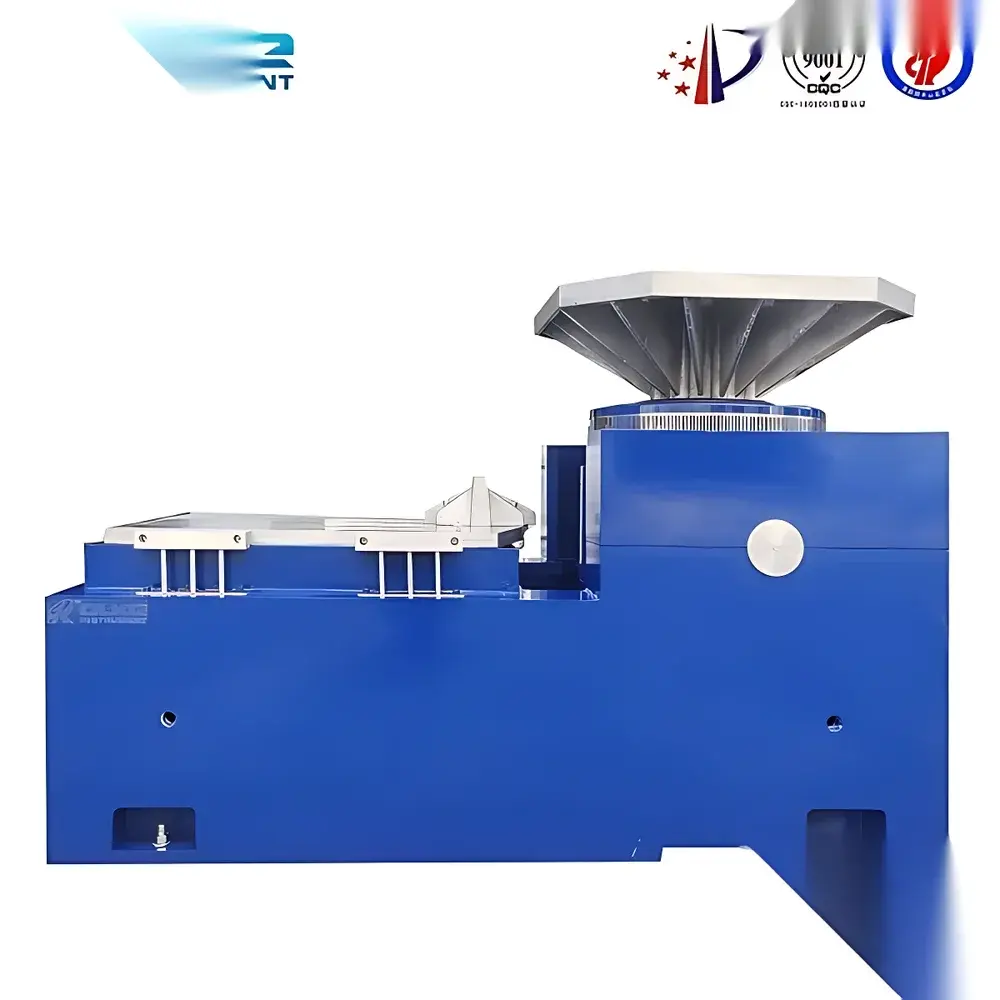
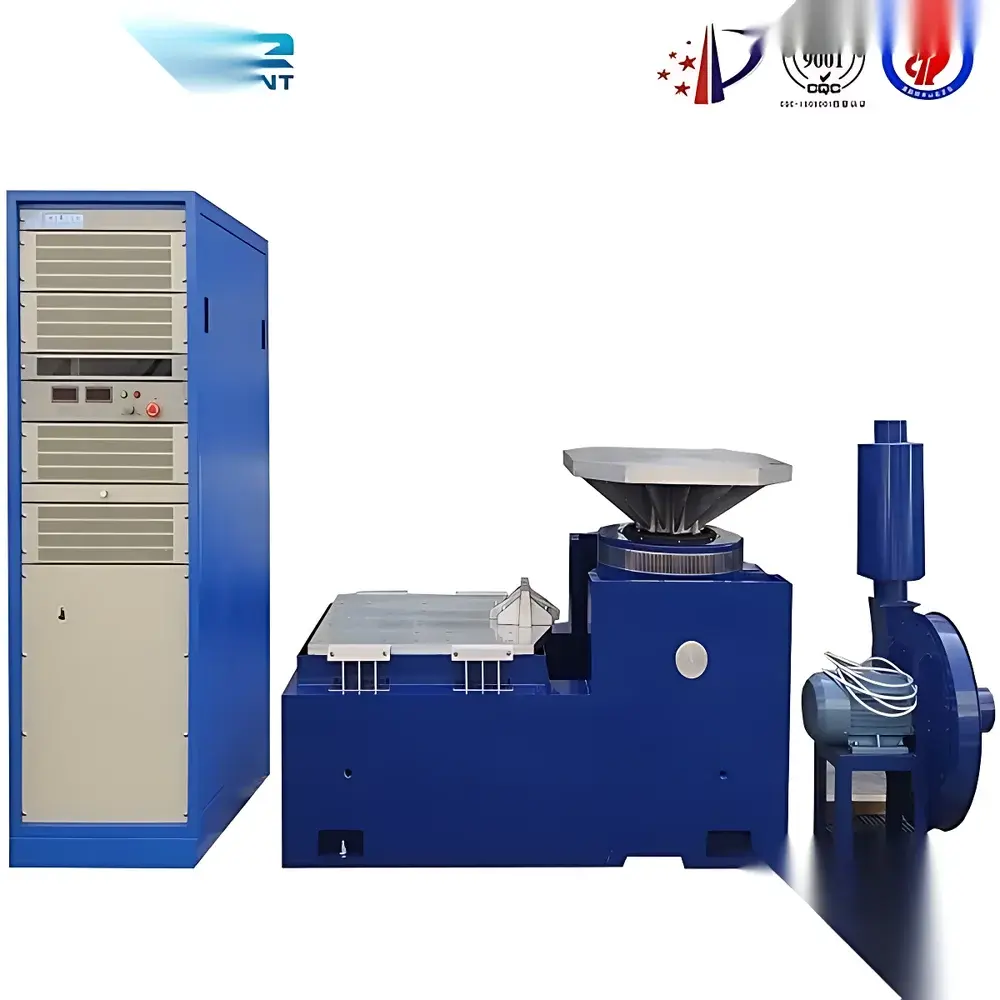
OK-ES-10 High-Frequency Electrodynamic Vibration Shaker System
| Brand | Other Brands |
|---|---|
| Origin | Imported |
| Manufacturer Type | Authorized Distributor |
| Frequency Range | 10–300 Hz (equivalent to 600–18,000 rpm) |
| Max Acceleration | 20 g (peak) |
| Peak-to-Peak Amplitude | 5 mm (standard), up to 25.4 mm at low frequencies |
| Load Capacity | 50 kg (standard), 100 kg (reinforced configuration) |
| Effective Table Size | 1000 × 1000 mm |
| Drive Power | 1 HP (0.75 kW) |
| Control Accuracy | ±0.1 Hz (frequency), ±0.1 mm (amplitude) |
| Timing Range | 0 s – 99 h 59 min |
| Compliance Standards | ASTM D999, ISTA 3A/3E/3H, EN 60068-2-6, EN 60068-2-27, ANSI S2.18, UL 1604 |
| Power Supply | 380 V, 50 Hz, 3-phase |
Overview
The OK-ES-10 High-Frequency Electrodynamic Vibration Shaker System is an engineered solution for rigorous mechanical stress screening and environmental simulation in product development, quality assurance, and regulatory validation workflows. Designed around a dual-magnetic-circuit actuator architecture with self-supporting voice coil assembly and pneumatic suspension support, the system delivers high-fidelity sinusoidal, random, and transient vibration profiles across a broad frequency spectrum (10–300 Hz). Unlike basic rotary shakers, this electrodynamic platform operates on Lorentz-force principles—ensuring linear force generation, minimal harmonic distortion, and repeatable acceleration profiles essential for compliance-driven testing. Its structural integration of linear bearings and roller guides minimizes lateral drift and cross-axis coupling, while the gimbal-mounted isolation base suppresses reaction forces transmitted to facility floors. The system supports both single-axis and triaxial sequential testing configurations and is compatible with climatic chambers for combined environmental stress screening (CES)—enabling synchronized thermal-vibrational conditioning per MIL-STD-810H Method 514.7 and IEC 60068-2-64.
Key Features
- Dual magnetic circuit design ensures high force-to-power ratio and thermal stability during extended duty cycles.
- Self-generating armature coil eliminates need for external cooling ducts or forced-air systems—reducing maintenance overhead and acoustic noise.
- Pneumatic suspension bearing system provides near-frictionless vertical motion and inherent damping for improved waveform fidelity.
- Linear bearing + roller guide assembly guarantees sub-micron positional repeatability and <0.5% transverse motion deviation over full stroke.
- Gimbal-mounted isolator base decouples inertial reaction forces from supporting structures—critical for lab installations without reinforced foundations.
- DC speed-controlled drive enables precise ramping, dwell, and sweep functions with programmable acceleration/deceleration profiles.
- Integrated digital controller with real-time FFT analysis, closed-loop amplitude regulation, and automatic safety cutoff at 20 g peak or 5 mm p-p limit.
Sample Compatibility & Compliance
The OK-ES-10 accommodates test specimens up to 100 kg (with optional reinforcement kit) on its 1000 × 1000 mm aluminum honeycomb table surface, which features standardized M8 threaded mounting holes spaced at 50 mm intervals. It supports rigid fixtures, slip plates, and custom interface adapters per ISO 5344 mechanical interface specifications. All vibration profiles adhere strictly to internationally recognized test standards—including ASTM D999 (shipping container durability), ISTA Series 3 protocols (e-commerce logistics validation), EN 60068-2-6 (sinusoidal vibration), EN 60068-2-64 (broadband random), and ANSI S2.18 (shock response spectrum synthesis). Data traceability meets GLP/GMP requirements through timestamped audit logs, user-access controls, and optional 21 CFR Part 11-compliant software modules.
Software & Data Management
The system operates via embedded firmware with USB/Ethernet connectivity and is fully compatible with industry-standard control platforms including VibrationVIEW (VibSoft), m+p Analyzer, and Dewesoft X. Real-time acquisition supports simultaneous measurement of acceleration (IEPE), displacement (LVDT), and temperature (RTD inputs). All test sequences are stored in .tdms or .uff format with embedded metadata (operator ID, calibration certificate ID, environmental conditions). Built-in pass/fail logic engine compares measured PSDs, SRS envelopes, or sine dwell spectra against user-defined tolerances—generating PDF reports compliant with ISO/IEC 17025 documentation requirements. Optional cloud sync enables centralized fleet monitoring and remote diagnostics via TLS-encrypted API endpoints.
Applications
- Qualification testing of avionics modules, satellite subsystems, and UAV components under launch vibration spectra (per ECSS-Q-ST-70-08C).
- Reliability screening of automotive ECUs, infotainment units, and ADAS sensors per ISO 16750-3 and LV-124.
- Package integrity validation for medical devices shipped under FDA-regulated cold chain logistics (ISTA 7E).
- Failure mode identification in consumer electronics—especially solder joint fatigue in PCB assemblies subjected to resonant excitation.
- Material fatigue characterization of polymer composites and additive-manufactured lattice structures using controlled random vibration exposure.
- Calibration verification of accelerometers and inertial measurement units (IMUs) per ISO 16063-21.
FAQ
What is the maximum achievable acceleration at 100 Hz?
At 100 Hz, the system maintains a peak-to-peak amplitude limit of 1.0 mm to comply with the 20 g ceiling, calculated via the standard electrodynamic shaker equation: a = 0.002 × f² × D.
Can this shaker perform shock testing using classical pulse waveforms?
Yes—it supports half-sine, trapezoidal, and terminal-peak sawtooth pulses per ISO 10326-1 and MIL-STD-810H Method 516.6, with programmable rise time, duration, and repetition rate.
Is climatic chamber integration supported out-of-the-box?
The OK-ES-10 includes mechanical and electrical interfaces for seamless integration with walk-in or reach-in environmental chambers—enabling concurrent thermal-vibrational stress application per JEDEC JESD22-B103.
Does the system include calibration certification?
Each unit ships with NIST-traceable factory calibration data (acceleration sensitivity, frequency response flatness, linearity error), valid for 12 months; field recalibration services are available through authorized service centers.
What safety interlocks are implemented?
Hardware-enforced limits include over-acceleration cutoff (20 g), over-amplitude shutdown (5 mm p-p), thermal overload protection on amplifier stage, and emergency stop with mechanical brake engagement.



