
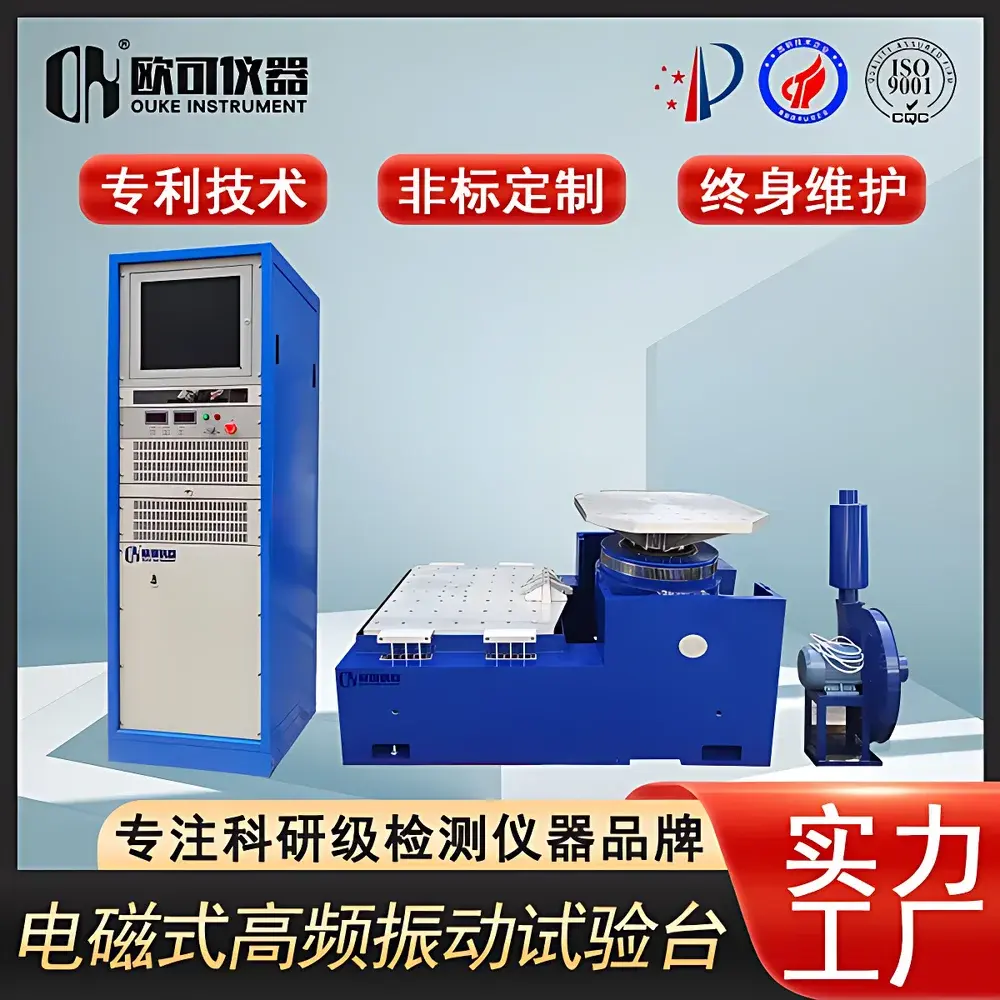
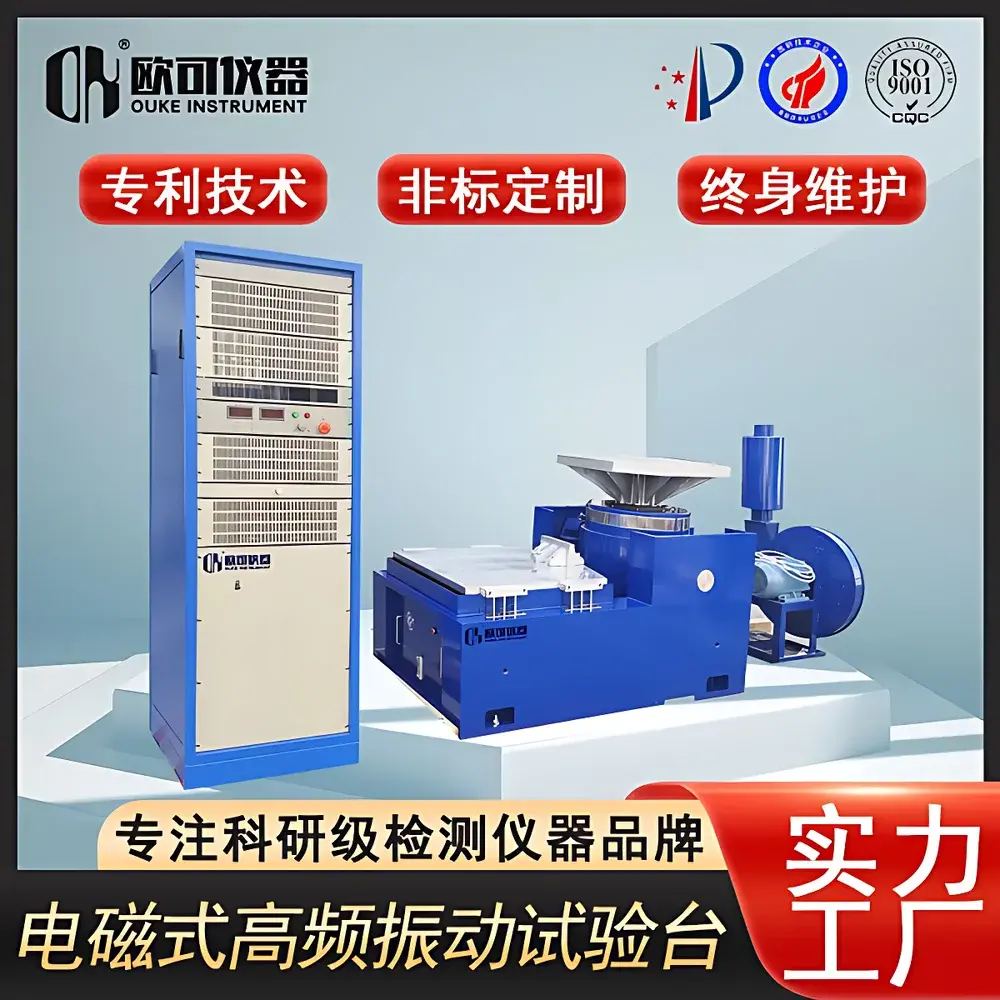
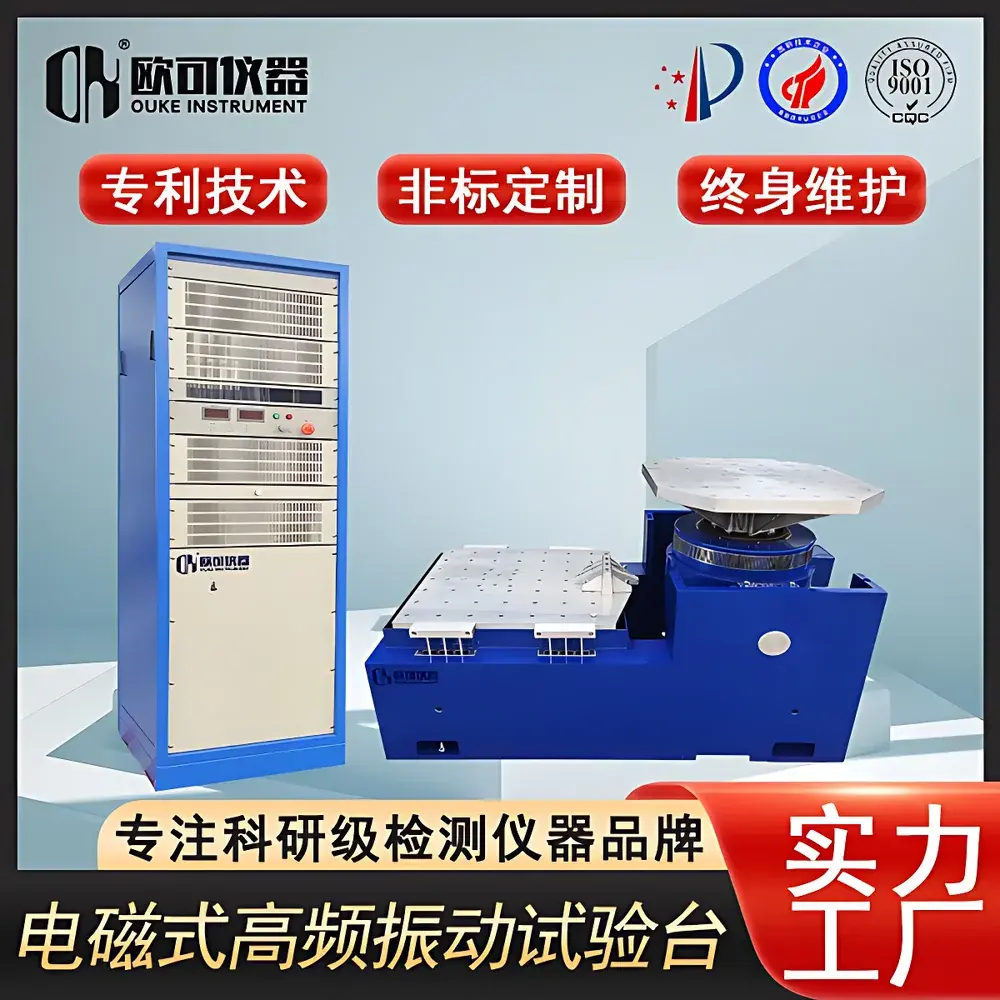
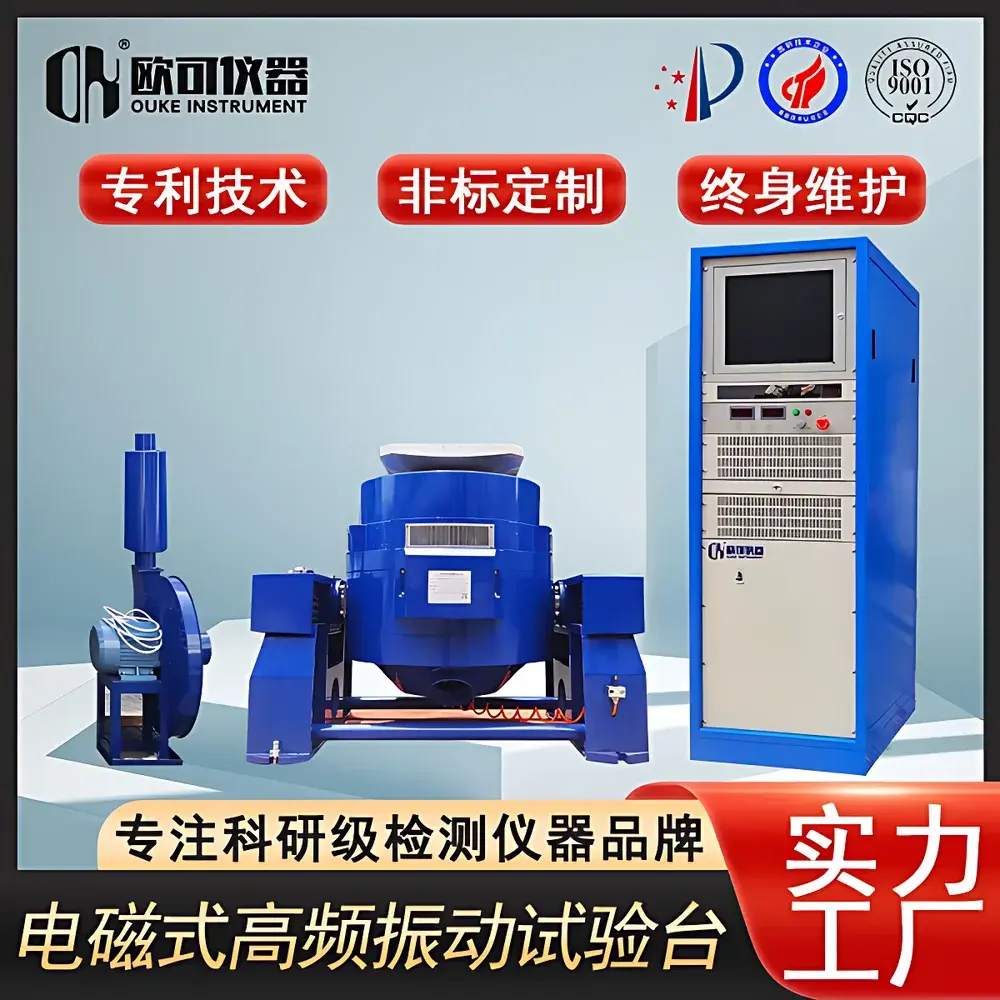
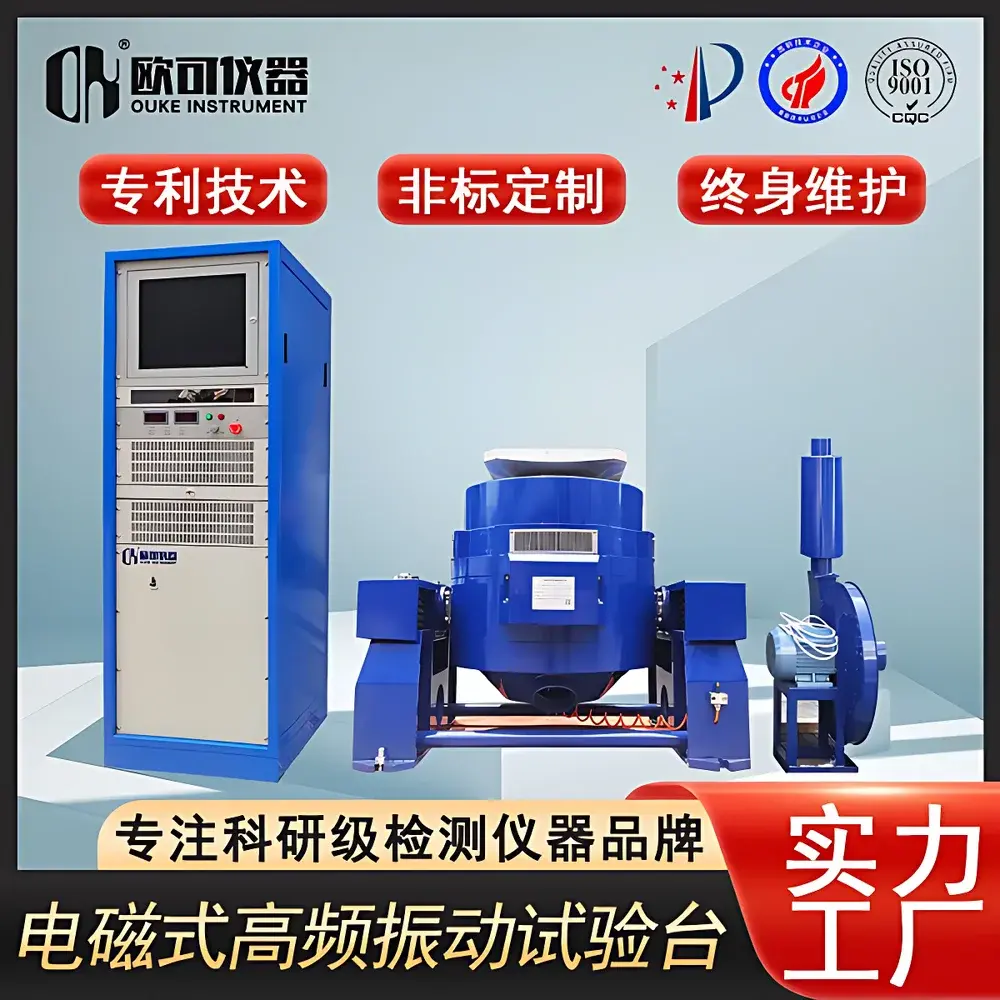
OK-ES-2.2 Electromagnetic Vibration Shaker System
| Brand | OK Instruments |
|---|---|
| Origin | Guangdong, China |
| Manufacturer Type | Direct Manufacturer |
| Product Category | Domestic |
| Model | OK-ES-2.2 |
| Instrument Type | Electromagnetic Vibration Shaker |
| Rated Thrust | 1.98 kN |
| Rated Frequency Range | 5–5000 Hz |
| Maximum Test Load | 70 kg |
| Table Dimensions | 400 × 400 × 30 mm |
| Maximum Acceleration | 10 g |
Overview
The OK-ES-2.2 Electromagnetic Vibration Shaker System is a high-fidelity, digitally controlled electrodynamic shaker engineered for precision environmental simulation and mechanical reliability testing. It operates on the principle of electromagnetic force generation governed by the Lorentz law—where a time-varying current in a voice coil, suspended within a static magnetic field, produces a proportional linear mechanical force. This force drives the rigidly coupled shaker table to reproduce target waveforms—including sinusoidal, random, shock, and transient profiles—with high fidelity across a broad frequency spectrum. Designed for laboratory and industrial qualification environments, the OK-ES-2.2 delivers deterministic control over acceleration, velocity, and displacement profiles under closed-loop feedback, making it suitable for compliance testing per ISO 10816, ASTM D999, IEC 60068-2-6, and MIL-STD-810H vibration clauses.
Key Features
- Wide operational bandwidth: 5 Hz to 5000 Hz—enabling resonance search, high-frequency fatigue assessment, and broadband random vibration simulation.
- Digital closed-loop control architecture with real-time error correction using integrated accelerometers and adaptive control algorithms (e.g., feedforward + PID compensation).
- Rated thrust of 1.98 kN ensures stable performance up to 70 kg payload at full acceleration capability (10 g peak), with sufficient headroom for fixture mass and dynamic loading margins.
- Robust 400 × 400 × 30 mm aluminum alloy table featuring standardized M8 threaded mounting arrays for universal fixture compatibility and modal decoupling.
- Integrated thermal management system with forced-air cooling—optimized for continuous operation at rated power without derating in ambient temperatures ≤35 °C.
- Low harmonic distortion (<3% THD at 1 kHz, full-scale sine) and excellent phase linearity ensure accurate waveform replication essential for spectral integrity in random and transient tests.
Sample Compatibility & Compliance
The OK-ES-2.2 accommodates test specimens ranging from printed circuit assemblies (PCBAs) and MEMS sensors to automotive ECUs and aerospace avionics modules. Its mechanical interface supports standard triaxial mounting configurations and optional horizontal slip tables for orthogonal axis testing. All system-level calibration procedures follow traceable metrology protocols aligned with ISO/IEC 17025 requirements. The shaker’s control software supports audit-ready data logging compliant with FDA 21 CFR Part 11 (when deployed with validated PC configuration), and test reports include timestamped raw acceleration data, control spectra, and pass/fail annotations against user-defined tolerance bands per ISO 5344 or SAE J1211.
Software & Data Management
The system is operated via OK-VCS (Vibration Control Suite), a Windows-based application built on a real-time deterministic kernel. It provides intuitive workflow templates for sine sweep/standby, narrowband random, wideband PSD synthesis, classical shock (half-sine, sawtooth, trapezoidal), and resonant dwell testing. Data acquisition supports up to 8 analog input channels (including dual-control accelerometer inputs) with 24-bit resolution and 102.4 kHz sampling. All test sessions are archived with metadata including controller firmware version, calibration certificate ID, operator login, and environmental monitoring logs. Export formats include UFF58, MATLAB .mat, CSV, and PDF-certified reports with digital signature support.
Applications
- Product qualification: Structural durability validation of consumer electronics, medical devices, and industrial controllers per IPC-9592 or JEDEC JESD22-B103.
- Reliability screening: Environmental Stress Screening (ESS) and HALT/HASS protocols requiring rapid spectrum iteration and failure mode identification.
- Transport simulation: Reproduction of road vehicle vibration spectra (e.g., ISO 20653, SAE J2380) and airborne equipment profiles (DO-160 Section 8).
- Dynamic characterization: Modal analysis via impact hammer correlation or swept-sine excitation, supporting FRF computation and damping estimation.
- Multi-axis integration: Compatible with auxiliary slip tables and hydraulic actuators for multi-degree-of-freedom (MDOF) test setups when synchronized via IEEE 1588 PTP timing.
FAQ
What standards does the OK-ES-2.2 support for vibration testing?
It supports test execution and reporting per ISO 10816 (machine vibration), IEC 60068-2-6 (sinusoidal vibration), IEC 60068-2-64 (random vibration), and MIL-STD-810H Method 514.7.
Is the system compatible with third-party control software such as Vibration Research’s VR9500 or m+p VibControl?
Yes—the shaker amplifier features analog voltage command inputs and IEEE-488 (GPIB) and Ethernet/IP interfaces for external controller integration.
What maintenance is required for long-term reliability?
Routine inspection includes air filter cleaning every 200 operating hours, annual verification of accelerometer sensitivity, and biannual torque check of table mounting hardware.
Can the OK-ES-2.2 perform low-frequency displacement-limited tests?
While optimized for acceleration-dominated regimes above 20 Hz, its peak-to-peak displacement capability (~25 mm) permits limited low-frequency sine testing down to 5 Hz under reduced load conditions.
Does OK Instruments provide factory calibration and traceable certification?
Yes—each unit ships with NIST-traceable calibration certificates for thrust output, table acceleration response, and frequency flatness, valid for 12 months from shipment date.



