
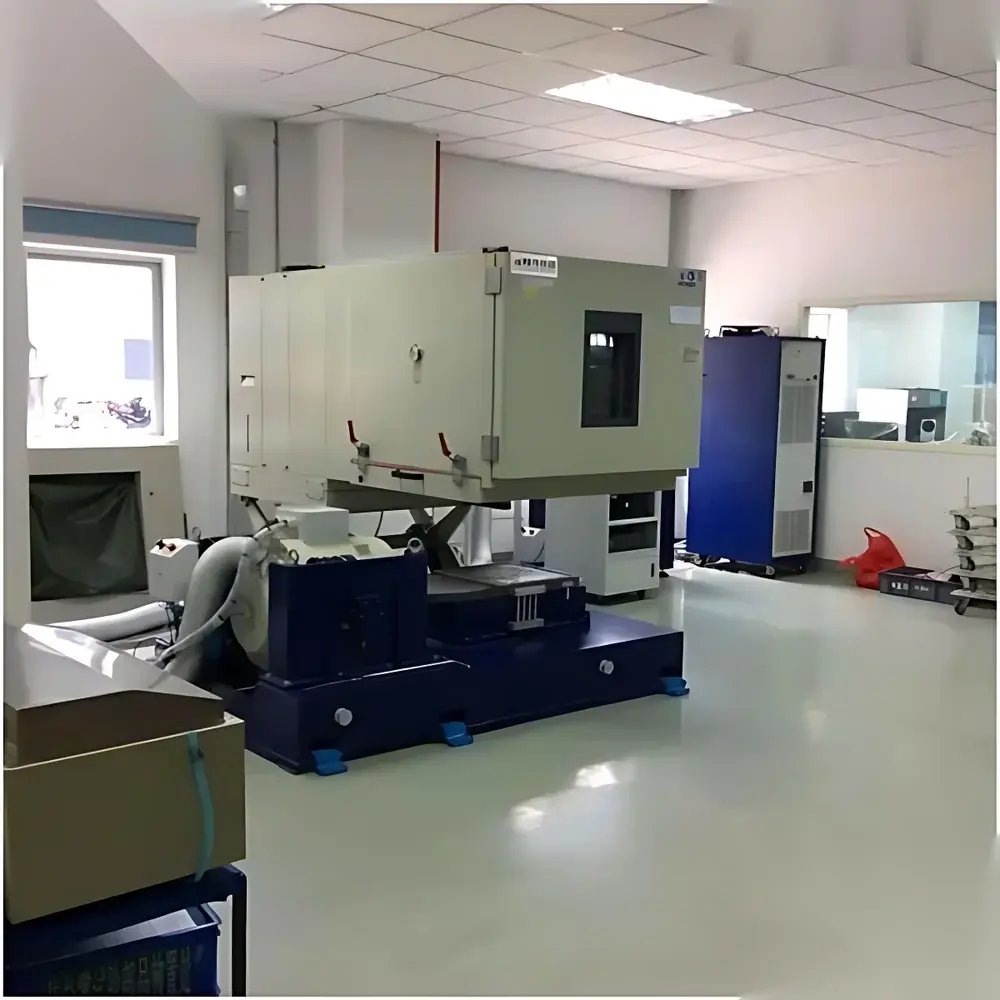
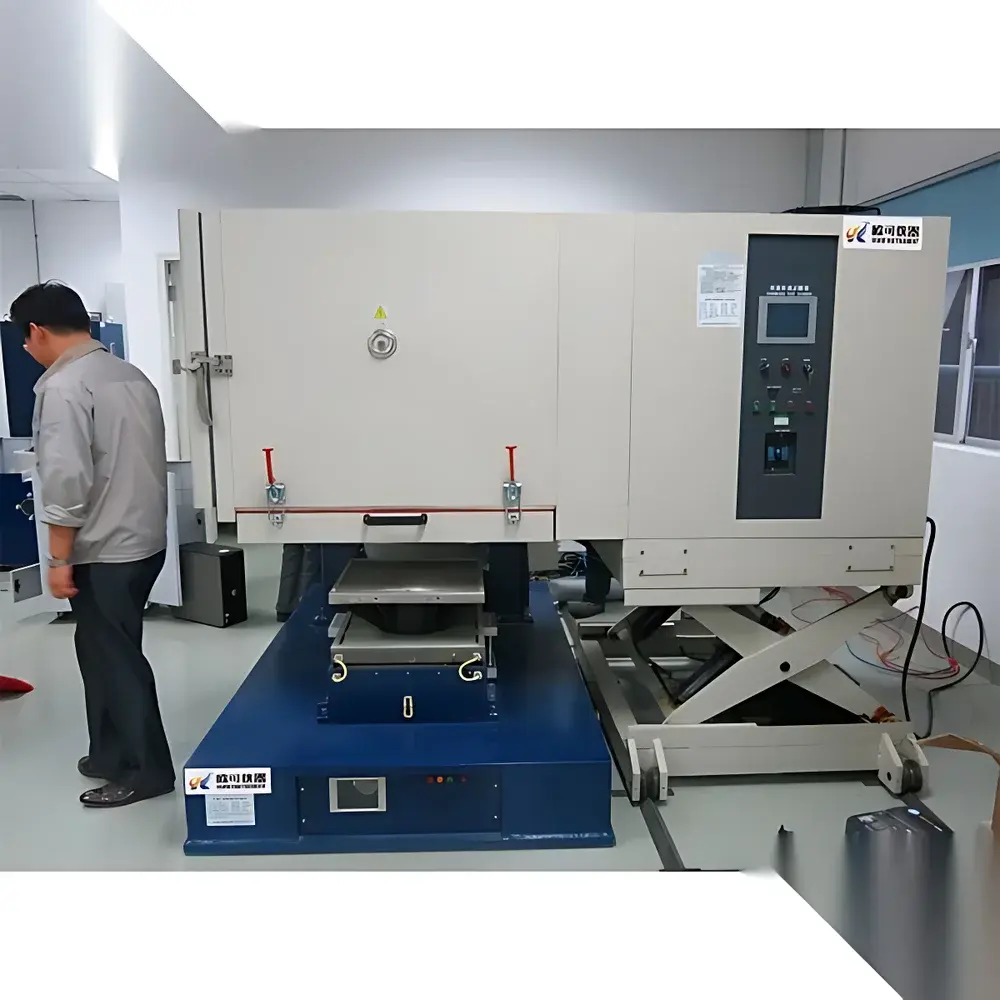
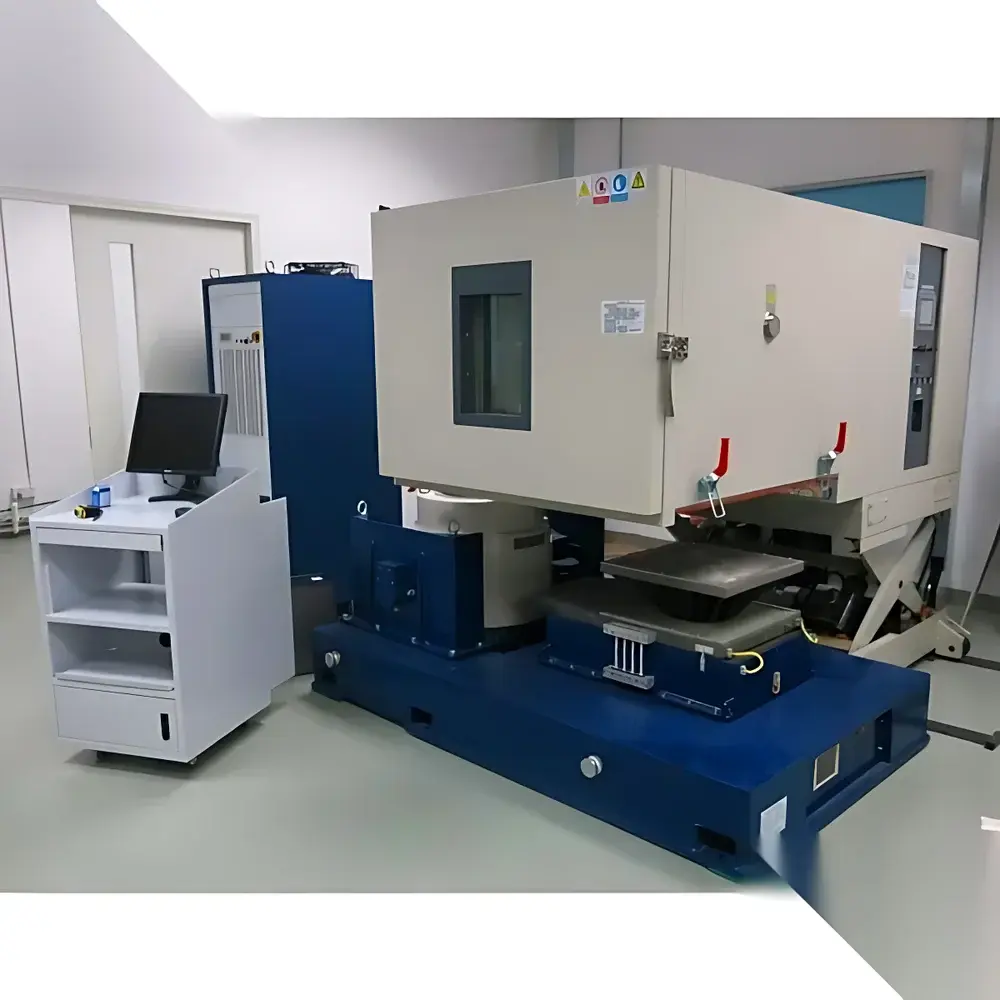
OK-ES-2 Combined Temperature-Humidity-Vibration Test Chamber
| Key Features | Model OK-ES-2 |
|---|---|
| Vibration Type | Reciprocating |
| Max. Load Capacity | 120 kg |
| Effective Table Size | 1.0 × 1.0 m |
| Peak Sinusoidal Force | 300 kgf |
| Random & Shock Force | 600 kgf |
| Frequency Range | 2–3000 Hz |
| Displacement (p-p) | 25 mm |
| Max. Acceleration | 981 m/s² |
| Max. Velocity | 2 m/s |
| Drive System | DC Speed Control |
| Motor Power | 1 HP |
| Input Power | 220 V, 50 Hz |
| Table Bolt Pattern | 6× M8 on Ø60 mm circle |
| Dynamic Moving Mass | 2 kg |
| First Resonance Frequency | 2400 Hz |
| Allowable Eccentric Moment | >196 N·m |
| Magnetic Leakage | <1 mT |
| Axial Isolation Frequency | <3 Hz |
| Dimensions (L×W×H) | 780 × 537 × 662 mm |
| Net Weight | 320 kg |
| Timer Range | 0 s – 99 h |
| Compliance Standards | EN, ANSI, UL, ASTM, ISTA |
Overview
The OK-ES-2 Combined Temperature-Humidity-Vibration Test Chamber is an integrated environmental simulation system engineered for rigorous reliability validation of packaged products and electronic assemblies under real-world transport conditions. It simultaneously applies controlled thermal cycling, humidity exposure, and multi-axis mechanical vibration—enabling accelerated life testing that replicates cumulative stresses encountered during global logistics. The chamber’s core vibration subsystem operates on electromagnetic excitation principles, utilizing a high-stiffness moving coil actuator (Φ110 mm) with active force feedback control to deliver precise sinusoidal, random, and shock profiles across a broad frequency spectrum (2–3000 Hz). Its robust architecture supports both vertical and horizontal vibration modes—including sequential, simultaneous, and four-degree-of-freedom (4DOF) configurations—ensuring alignment with international transport simulation protocols.
Key Features
- Triple-stress integration: Independent yet synchronized control of temperature (−70°C to +180°C), relative humidity (10–98% RH), and broadband mechanical vibration
- High-performance shaker system: 300 kgf sinusoidal thrust and 600 kgf random/shock capability, compliant with MIL-STD-810G, IEC 60068-2-64, and ISO 10326-1
- Precision motion control: Digital servo amplifier with closed-loop acceleration/velocity/displacement monitoring; frequency accuracy ±0.1% over 1–600 Hz range
- Modular table interface: 1.0 × 1.0 m stainless steel platform with six standardized M8 mounting points on a Ø60 mm bolt circle, supporting payloads up to 120 kg
- Thermal-humidity chamber: Dual-stage refrigeration, steam-based humidification, and PID-controlled air circulation ensuring uniformity ≤±0.5°C and ≤±2% RH
- DC motor drive with 0.1 RPM resolution and programmable dwell/timer functions (0 seconds to 99 hours)
- Low magnetic leakage design (<1 mT at 100 mm distance) suitable for EMI-sensitive device testing
Sample Compatibility & Compliance
The OK-ES-2 accommodates full-package units—including palletized shipments, consumer electronics enclosures, medical device cartons, and automotive subassemblies—within its climate-controlled workspace. Its vibration table meets ISO 5344 mechanical interface requirements and supports standard fixture mounting per ASTM D4169 Annex A3. All operational profiles adhere to internationally recognized transport simulation standards: ISTA Series 2 and 3 protocols (e.g., ISTA 3A, 3E, 3H), ASTM D999 (vibration resistance of shipping containers), EN 60068-2-6 (sinusoidal vibration), EN 60068-2-64 (random vibration), and ANSI/UL 60950-1 clause 4.5.2 for structural integrity verification. The system is fully compatible with GLP-compliant test documentation workflows and supports audit-ready data logging aligned with FDA 21 CFR Part 11 requirements when paired with validated software.
Software & Data Management
The chamber integrates with industry-standard test control software supporting real-time waveform generation, spectral analysis (PSD, SRS), and time-history recording at ≥20 kHz sampling rate. Users can define multi-segment test profiles combining temperature ramps, humidity holds, and vibration spectra—including swept-sine, narrowband random, and transient shock events. All raw sensor data (acceleration, temperature, RH, displacement) are timestamped and stored in IEEE-compliant binary format (.tdms or .uff), enabling traceability and post-processing in MATLAB, Python (SciPy), or commercial CAE tools. Built-in reporting modules generate PDF test certificates with pass/fail annotations against user-defined acceptance criteria and regulatory thresholds.
Applications
This system serves as a critical validation tool across supply chain quality assurance and product development labs. Typical use cases include: evaluating packaging system performance under combined climatic and mechanical stress (e.g., e-commerce fulfillment centers); verifying structural durability of PCB assemblies subjected to thermal expansion mismatch and resonant excitation; qualifying medical device sterilization packaging for cold-chain distribution; validating automotive infotainment modules per LV-124 vibration specifications; and supporting Design for Six Sigma (DFSS) initiatives by quantifying failure modes under realistic field-representative loading. It is widely deployed in Tier-1 supplier QA labs, third-party certification bodies (e.g., SGS, TÜV, UL), and corporate R&D centers pursuing IATF 16949 or ISO 13485 compliance.
FAQ
What standards does the OK-ES-2 support for transport simulation testing?
It natively supports ISTA 3-series protocols, ASTM D4169, EN 60068-2-6/-64, and ANSI/UL 60950-1 structural evaluation requirements.
Can the system perform independent humidity-only or vibration-only tests?
Yes—each environmental subsystem (temperature, humidity, vibration) operates independently or in any combination via programmable sequence logic.
Is remote monitoring and data export supported?
Yes, Ethernet-based SCADA integration enables real-time status visualization, alarm notification, and secure export of calibrated measurement data in CSV, UFF, or TDMS formats.
What is the maximum payload for simultaneous temperature-humidity-vibration operation?
The rated simultaneous load is 50 kg for full triple-stress operation; up to 120 kg is permitted for vibration-only mode within specified displacement limits.
Does the system include calibration documentation traceable to NIST or PTB?
Factory calibration certificates with uncertainty budgets and traceability statements are provided; optional on-site calibration services are available through accredited metrology partners.



