
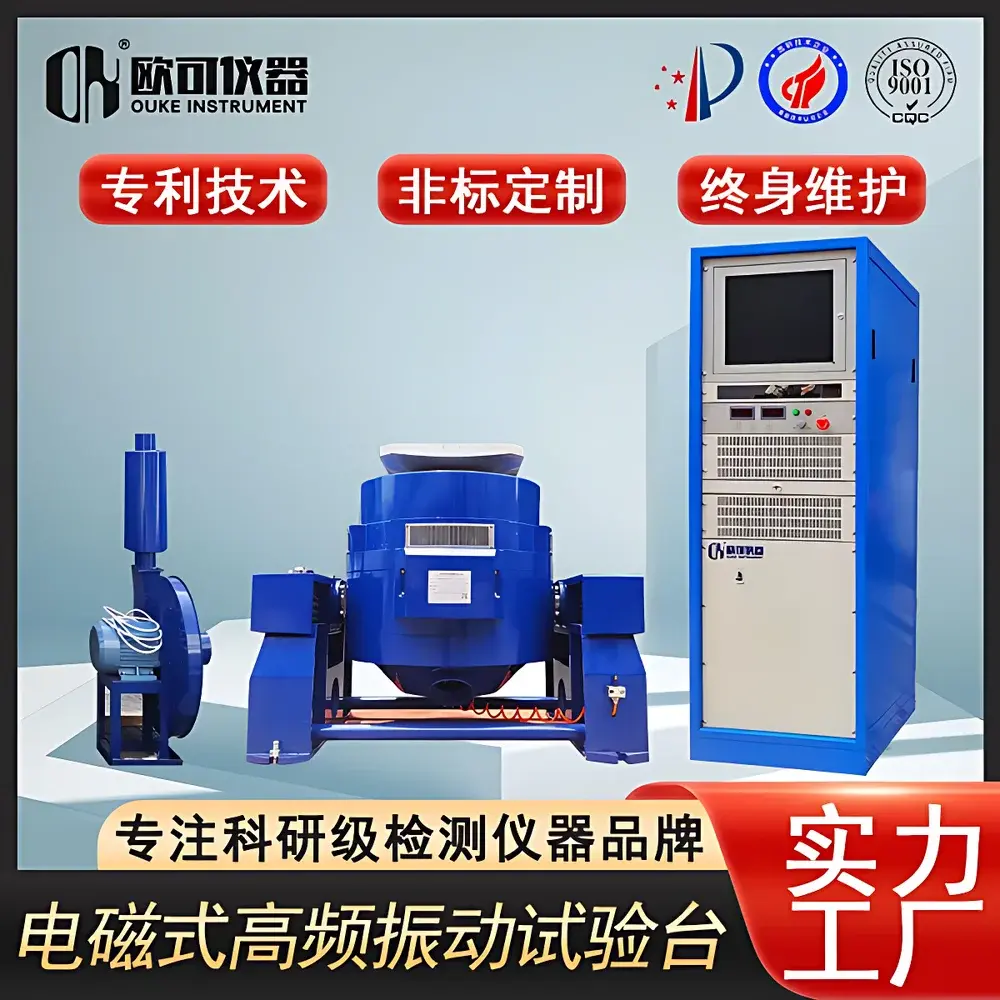
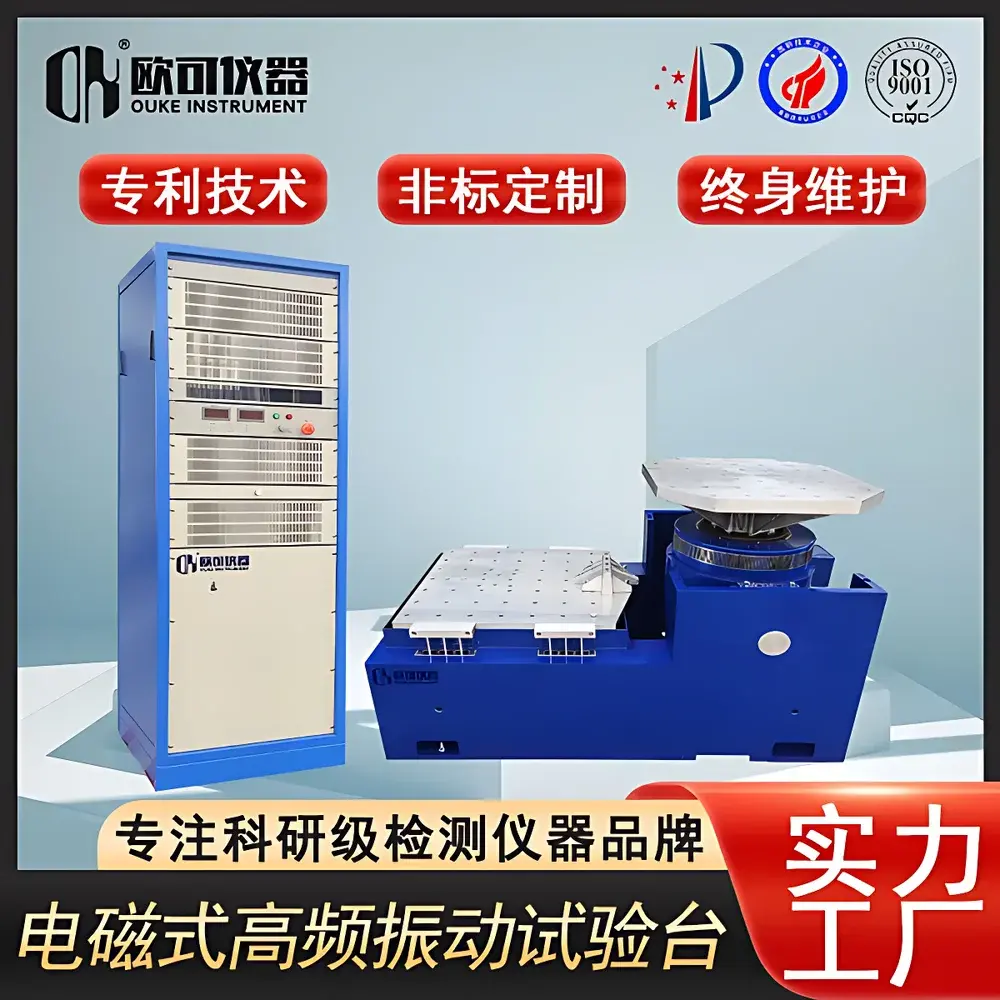
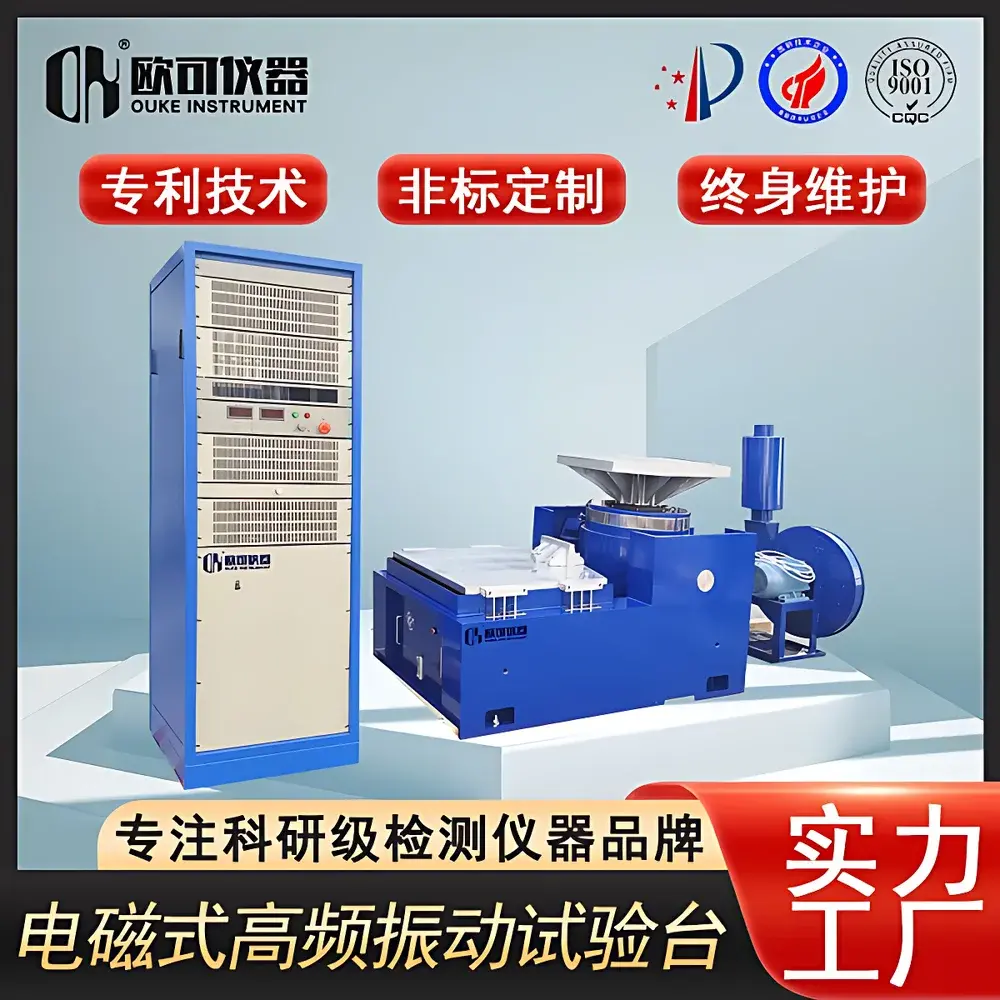
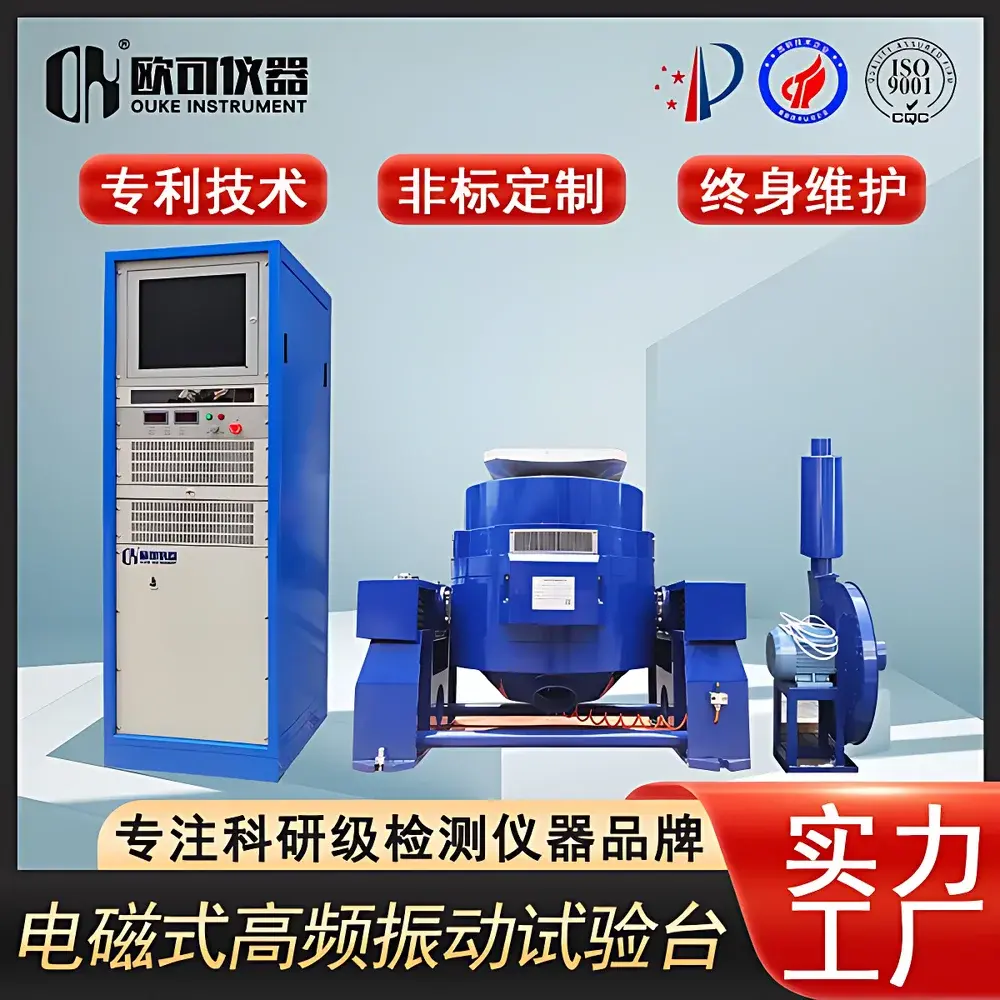
OK-ES-2 Electromagnetic Vertical Vibration Shaker
| Brand | OK Instruments |
|---|---|
| Origin | Guangdong, China |
| Manufacturer Type | Direct Manufacturer |
| Product Category | Domestic |
| Model | OK-ES-2.00000 |
| Instrument Type | Electromagnetic Vibration Shaker |
| Rated Thrust | 1.98 kN |
| Rated Frequency Range | 5–5000 Hz |
| Maximum Test Load | 70 kg |
| Table Dimensions (L×W×H) | 300 × 300 × 30 mm |
| Maximum Acceleration | 10 g |
| Drive Power | 4.2 kW |
| Adjustable Peak-to-Peak Amplitude | 0–4 mm |
| Acceleration Range | 10–750 m/s² |
| Vibration Waveform | Sine |
| Control Resolution | 0.01 Hz (display), ±0.1 Hz (accuracy) |
| Operating Voltage | 380 V ±10% |
| Magnetic Shielding | Magnesium Alloy Table Surface |
| Control Mode | Programmable (30-segment), Sweep (up/down frequency + dwell time), Fixed-Frequency, Amplitude Modulation, Time-Based Termination |
Overview
The OK-ES-2 Electromagnetic Vertical Vibration Shaker is a precision-engineered electrodynamic shaker system designed for laboratory and industrial vibration testing in accordance with international mechanical shock and sinusoidal vibration standards. Based on electromagnetic force generation (Lorentz principle), the shaker delivers controlled, repeatable acceleration profiles across a broad frequency spectrum—from low-frequency structural resonance evaluation to high-frequency component fatigue analysis. Its core architecture features a rigid, low-inertia moving coil assembly coupled with a high-stiffness suspension system, enabling high-fidelity signal reproduction and minimal phase distortion up to 5 kHz. The system is optimized for vertical-axis excitation but supports optional horizontal configuration via reorientation or auxiliary fixtures—making it suitable for both single-axis qualification per ISO 10816, IEC 60068-2-6, and MIL-STD-810H, as well as multi-axis test sequencing when integrated into larger environmental test suites.
Key Features
- Electromagnetic actuation with 1.98 kN rated thrust and peak acceleration capability of 10 g (98.1 m/s²) at full load (70 kg)
- Wide operational bandwidth: 5 Hz to 5000 Hz, with programmable sweep, fixed-frequency, and amplitude-modulated modes
- 30-segment programmable controller supporting nested loops, dwell times, and real-time parameter monitoring
- Magnesium alloy table surface (300 × 300 × 30 mm) providing inherent magnetic shielding—critical for testing magnetically sensitive components (e.g., MEMS sensors, Hall-effect devices, or magnetic encoders)
- Digital PID-regulated frequency control with 0.01 Hz display resolution and ±0.1 Hz frequency stability under thermal load
- Adjustable peak-to-peak displacement from 0 to 4 mm; continuous amplitude tuning without mechanical gear changes
- Integrated low-noise cooling system and vibration-isolated base structure eliminating need for anchor bolts or reinforced flooring
- EMI-hardened control electronics with active interference suppression circuitry—validated for operation in electromagnetically noisy environments (e.g., near power converters or RF transmitters)
Sample Compatibility & Compliance
The OK-ES-2 accommodates test specimens up to 70 kg mass, with standard mounting via M8 threaded holes distributed across the magnesium table surface. Its modular design allows rapid integration with custom fixtures—including slip tables for horizontal testing, thermal chambers for combined temperature-vibration profiles, and accelerometer calibration rigs. The system complies with essential mechanical test standards including ISO 5344 (electrodynamic shaker performance verification), ASTM D999 (vibration testing of packaged products), and IEC 60068-2-64 (broadband random vibration). While not inherently FDA 21 CFR Part 11 compliant, its digital controller supports audit-trail-ready data logging when paired with validated third-party software—enabling GLP/GMP-aligned validation protocols for regulated industries such as medical device manufacturing and aerospace component certification.
Software & Data Management
The embedded controller provides real-time visualization of acceleration, velocity, displacement, and drive current waveforms via a high-resolution LCD interface. All test parameters—including sweep profiles, dwell durations, amplitude setpoints, and termination conditions—are stored in non-volatile memory with timestamped logs. Raw analog outputs (±10 V) are available for external DAQ systems, supporting synchronization with high-speed cameras, strain gauges, or acoustic emission sensors. Optional PC-based software enables waveform synthesis (sine, swept-sine, shock response spectrum), automated report generation (PDF/CSV), and post-test FFT analysis. Data export conforms to IEEE 1159-compliant formats, facilitating traceability during regulatory audits or inter-laboratory comparison studies.
Applications
- Structural modal analysis of printed circuit boards (PCBs), automotive ECUs, and avionics enclosures
- Reliability screening of solder joints, connectors, and microelectromechanical systems (MEMS)
- Qualification testing of consumer electronics per JEDEC JESD22-B103 (mechanical shock) and JESD22-B104 (vibration)
- Vibration fatigue life prediction using Miner’s rule and Wöhler curve derivation
- Calibration of accelerometers and seismometers per ISO 16063-21
- Material damping characterization via resonant frequency decay measurement
- Package integrity validation for logistics simulation (ASTM D4728, ISTA 3A)
FAQ
What is the maximum payload capacity at 5000 Hz?
At upper-frequency limits, payload must be reduced to maintain mechanical integrity and thermal safety. For sustained operation above 2 kHz, recommended maximum load is 25 kg; consult the derating curve in Section 4.2 of the technical manual.
Does the system support random vibration testing?
The base OK-ES-2 model is configured for deterministic waveforms (sine, swept-sine, programmable step). Random vibration capability requires optional spectral controller firmware and dedicated power amplifier upgrades—available as part of the OK-ES-2-RV configuration package.
Is magnetic shielding effective across the entire frequency range?
Yes. The magnesium alloy table attenuates static and low-frequency (40 dB. Above 1 kHz, eddy-current shielding dominates, delivering >25 dB attenuation up to 5 kHz—verified via Helmholtz coil calibration per IEC 61000-4-8.
Can the controller log test data to external storage?
Internal logging retains up to 128 hours of timestamped parameter history. USB host port supports FAT32-formatted drives for direct CSV export; Ethernet interface enables remote SCPI command access and TCP/IP-based data streaming.
What maintenance intervals are recommended?
Annual inspection of voice coil alignment, suspension compliance, and cooling fan performance is advised. No routine lubrication is required—the system employs dry-film bearing technology and sealed linear guides per ISO 15243.



