
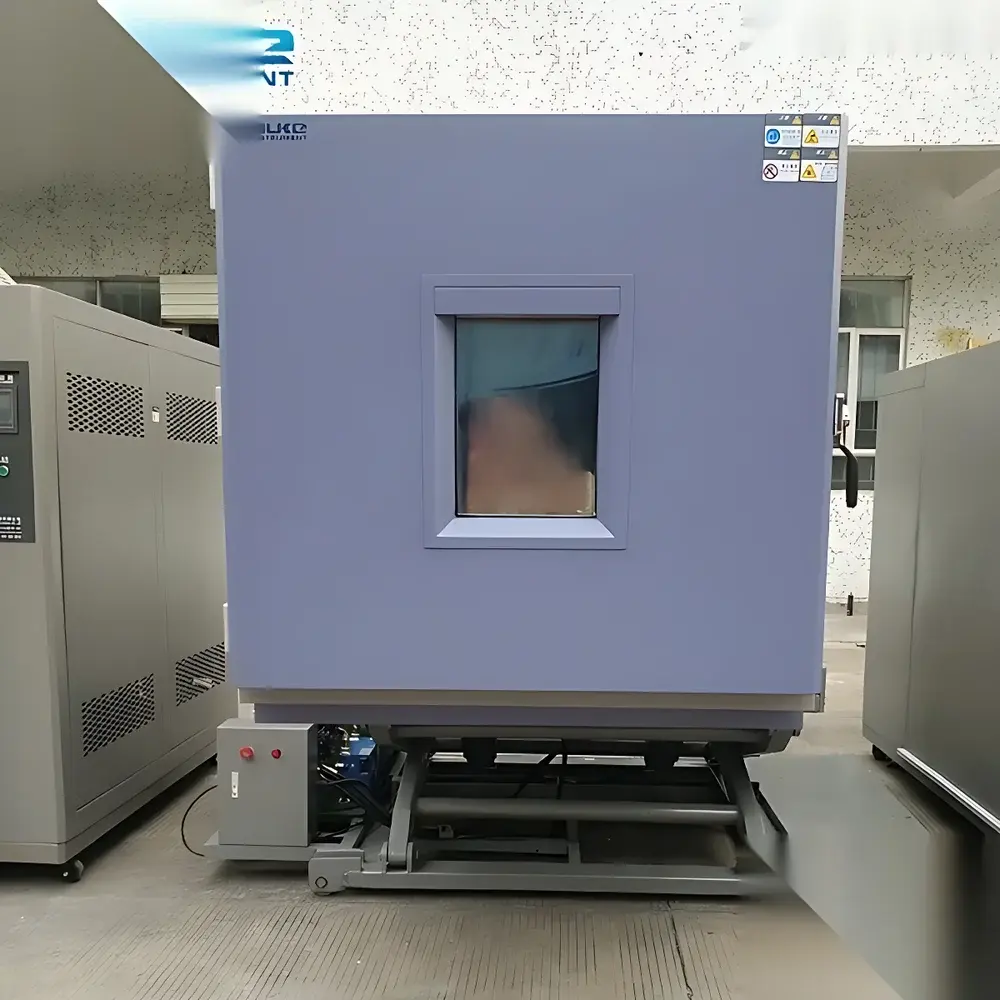
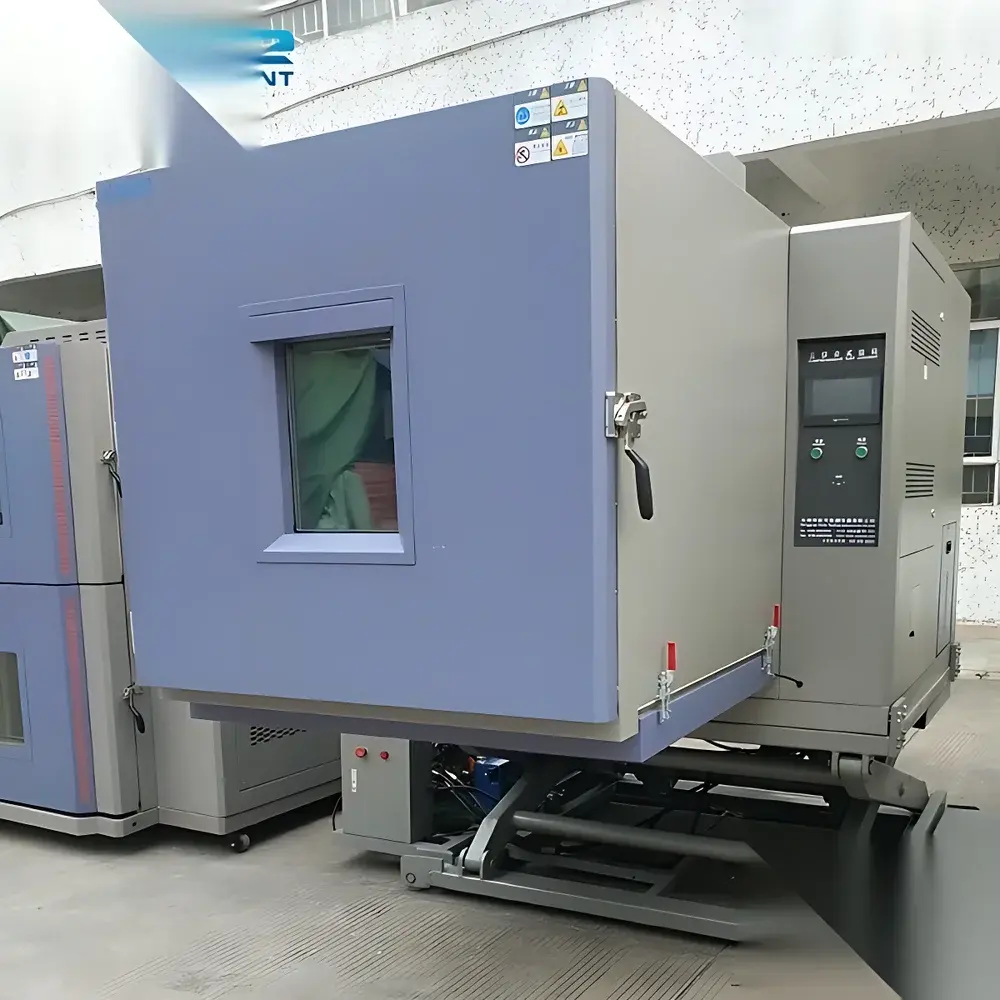
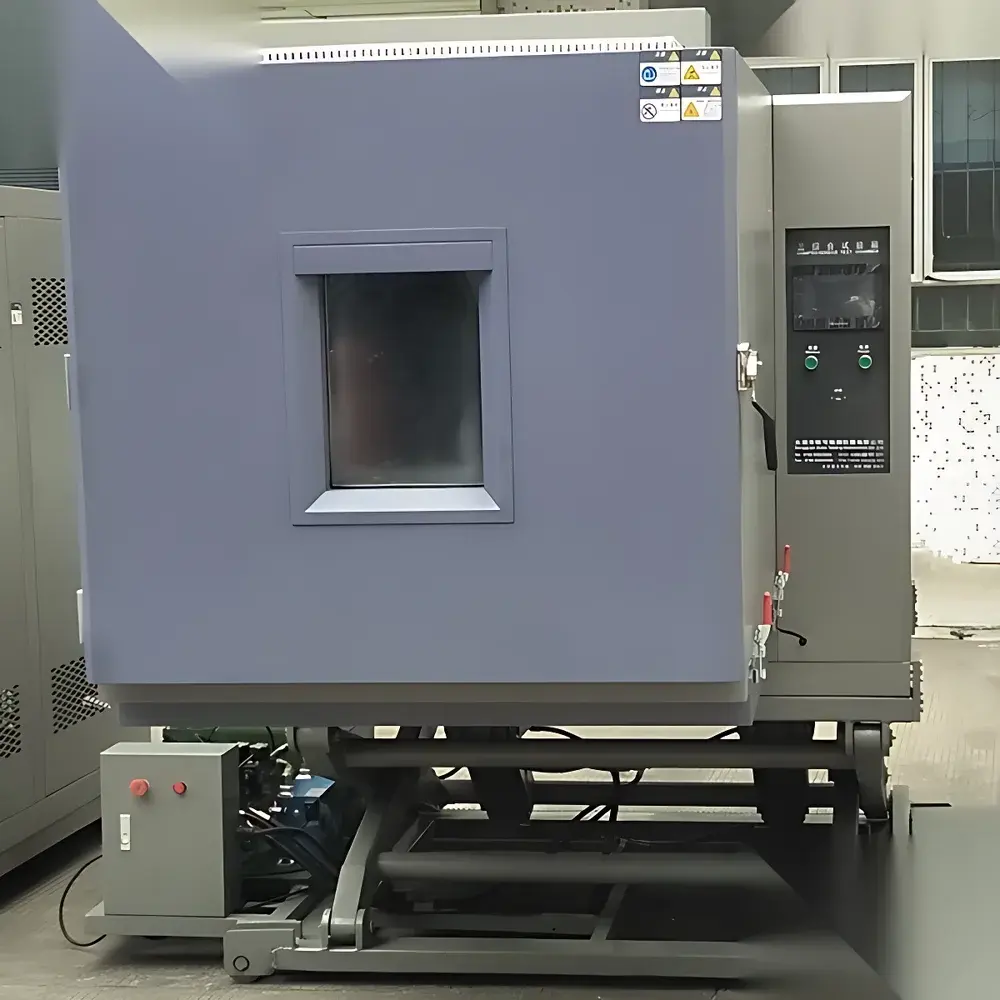
OK-ES-20 Combined Temperature-Humidity-Vibration Test Chamber
| Brand | OK Instruments |
|---|---|
| Model | OK-ES-20 |
| Type | Tri-Environmental Test System (Temperature + Humidity + Vibration) |
| Frequency Range | 5–60 Hz |
| Frequency Resolution | 0.01 Hz |
| Frequency Accuracy | ±0.1 Hz |
| Peak-to-Peak Amplitude Range | 0–5 mm |
| Maximum Acceleration | 20 g |
| Table Surface Dimensions | 1100 × 800 mm |
| Load Capacity | 100 kg |
| Vibration Axes | Vertical + Horizontal (Dual-Axis) |
| Waveform | Sinusoidal |
| Sweep Mode | Programmable Up/Down Sweep (0.01 Hz resolution) |
| Programmable Test Profiles | 30 Segments (Frequency/Time), Loopable |
| Octave & Logarithmic Sweep Modes | Supported (3-directional, loopable) |
| Vibration Drive Power | 7.5 kW |
| Time Control Resolution | 1 s |
| Input Voltage | 380 V ±10% |
| Approx. Chamber Footprint | 1100 × 800 × 60 mm (L×W×H) |
| Compliance | IEC 60068-2, MIL-STD-810H, JIS C 0040, ASTM D4728, ISO 16750-3 |
Overview
The OK-ES-20 Combined Temperature-Humidity-Vibration Test Chamber is an integrated tri-environmental test system engineered for rigorous reliability validation across aerospace, defense, automotive electronics, telecommunications, and consumer appliance sectors. It synchronously applies controlled thermal stress (temperature and humidity), mechanical excitation (sinusoidal vibration), and environmental conditioning within a single test envelope—enabling accelerated life testing, HALT/HASS pre-screening, and qualification per international standards. The system operates on Couette-type electrodynamic actuation with dual-axis (vertical + horizontal) shaker integration, coupled to a high-stability climatic chamber featuring precision PID-controlled refrigeration, steam-based humidification, and rapid thermal ramping. Its architecture supports real-time phase synchronization between environmental profiles and vibration waveforms—critical for evaluating thermo-mechanical coupling effects in PCB assemblies, connectors, solder joints, and structural housings.
Key Features
- Dual-axis electrodynamic vibration system with independent vertical and horizontal exciters, rated for 20 g peak acceleration and 100 kg payload at full amplitude (0–5 mm p-p)
- High-resolution frequency control (0.01 Hz resolution, ±0.1 Hz accuracy) across 5–60 Hz range, supporting precise resonance tracking and dwell testing
- Multi-mode excitation capability: programmable sinusoidal sweep (linear/logarithmic), octave stepping, and 30-segment time-frequency profiles with infinite looping
- Integrated climate chamber with temperature range –70°C to +180°C and humidity range 10–98% RH, compliant with IEC 60068-2-1, -2, -14, and -78
- Self-diagnostic hardware architecture with real-time fault logging, interlock monitoring (over-temperature, over-acceleration, over-displacement), and emergency stop redundancy
- Passive air-spring isolation system eliminates need for reinforced concrete foundation while maintaining waveform fidelity and minimizing floor-borne transmission
- Modular platform design accommodates optional horizontal extension tables or vertical lift mechanisms for non-standard DUT geometries
Sample Compatibility & Compliance
The OK-ES-20 accommodates samples up to 100 kg mass and 1100 × 800 mm footprint, including full ECUs, radar modules, battery packs, avionics enclosures, and automotive infotainment units. Its unified control architecture ensures synchronized execution of multi-stress profiles required by MIL-STD-810H Method 514.7 (vibration), Method 502.7 (temperature), and Method 507.6 (humidity); IEC 60068-2-6 / -14 / -78; JIS C 0040; and ASTM D4728 (shipping vibration simulation). All test sequences are timestamped and logged with audit-trail metadata, supporting GLP/GMP documentation requirements and FDA 21 CFR Part 11-compliant electronic records when paired with validated software.
Software & Data Management
Control and data acquisition are managed via OK-VTS v4.2 software—a Windows-based application supporting real-time waveform visualization, spectral analysis (FFT), profile scripting, and automated report generation (PDF/CSV). The software implements role-based access control, digital signature workflows, and immutable log files with SHA-256 hash verification. Raw sensor data (accelerometer, thermocouple, RH probe) is streamed at ≥10 kHz sampling rate and stored in HDF5 format for post-processing in MATLAB, Python, or NI DIAdem. Optional integration with LabVIEW APIs and OPC UA servers enables enterprise-level MES/SCADA connectivity.
Applications
- Qualification of electronic assemblies under combined thermal cycling and resonant vibration exposure
- Structural fatigue assessment of EV battery enclosures during thermal soak + road-simulation spectra
- Validation of connector retention force degradation under humidity-induced corrosion and cyclic loading
- HALT screening of 5G base station RF modules using rapid temperature transitions overlaid with broadband sine sweeps
- Package integrity testing via synthesized half-sine shock pulses (configurable duration/amplitude) simulating drop events
- Reliability benchmarking of medical imaging subsystems per ISO 13485 and IEC 62304 design verification protocols
FAQ
Does the OK-ES-20 support simultaneous temperature, humidity, and vibration operation?
Yes—the system executes fully synchronized tri-environmental profiles with phase-aligned control loops and shared timebase synchronization.
Can custom vibration spectra (e.g., random, transient) be imported?
The base configuration supports sinusoidal modes only; random vibration capability requires optional OK-RV add-on module with dedicated controller and power amplifier.
What safety certifications does the chamber hold?
CE marking per Machinery Directive 2006/42/EC and Low Voltage Directive 2014/35/EU; UL/cUL recognition pending upon regional configuration.
Is remote monitoring and alarm notification available?
Standard Ethernet interface supports SNMP traps, email alerts, and Modbus TCP readout of operational status, error codes, and setpoint deviations.
How is calibration traceability maintained?
Factory calibration includes NIST-traceable accelerometer sensitivity verification, PT100 sensor calibration, and humidity sensor gravimetric validation—certificates issued per ISO/IEC 17025.



