
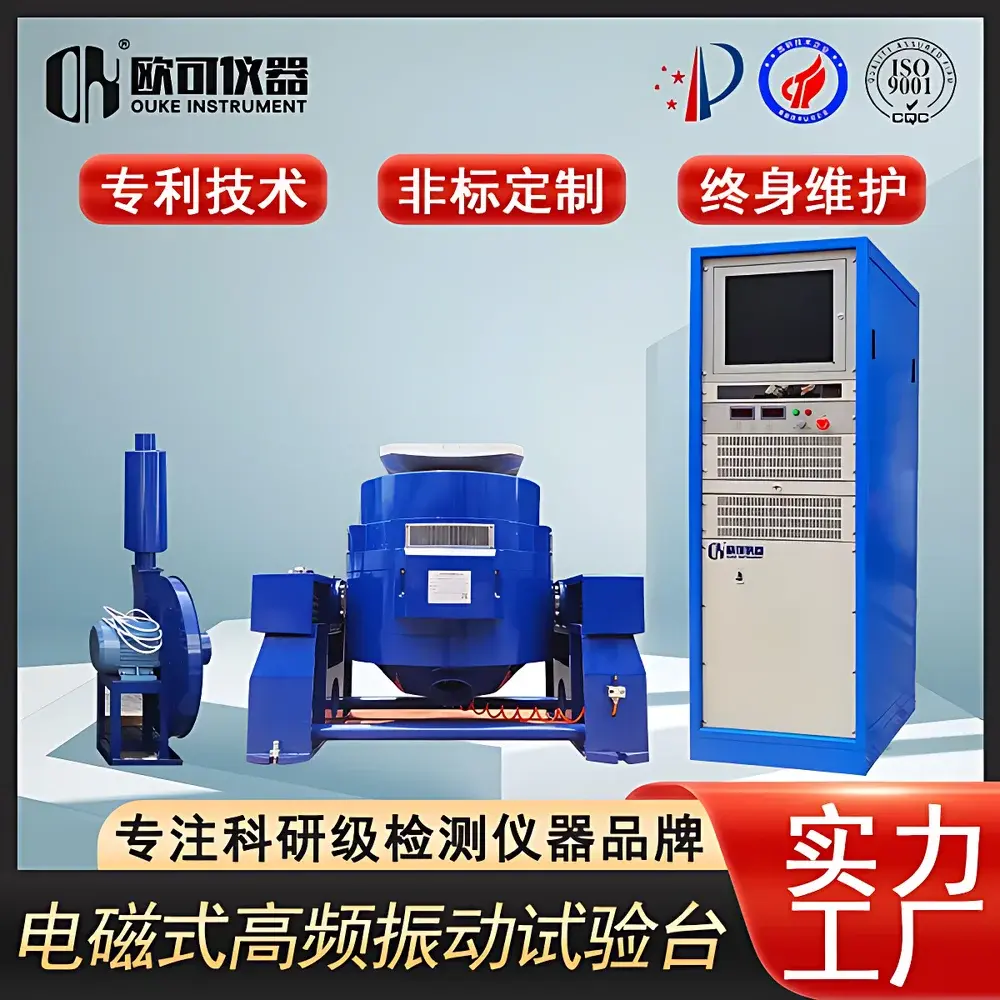
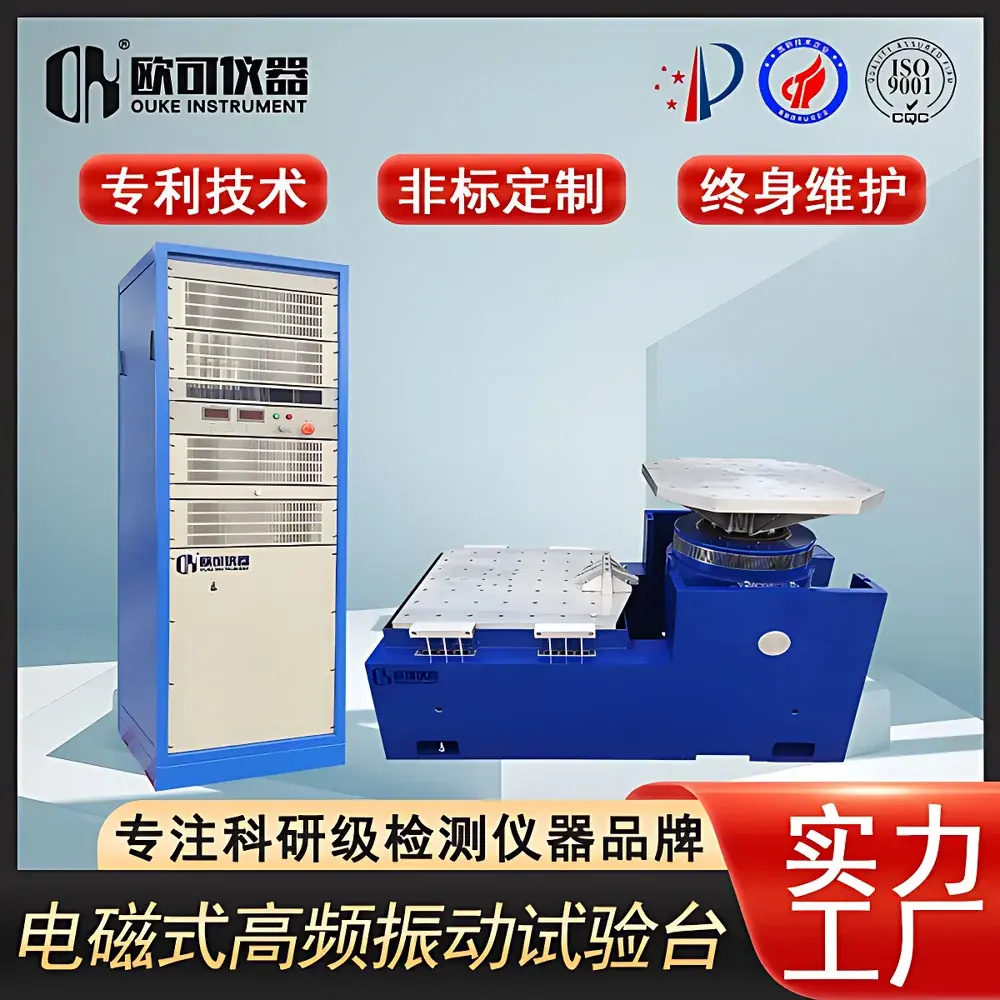
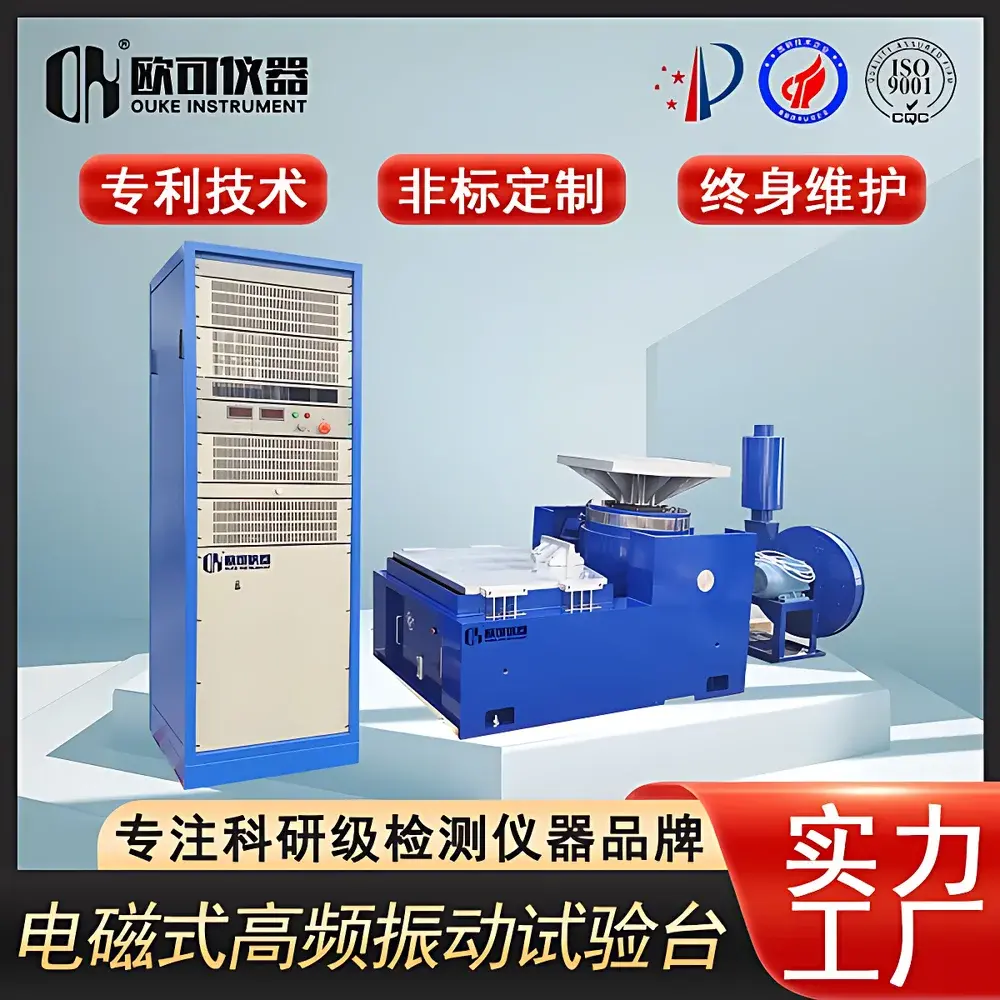
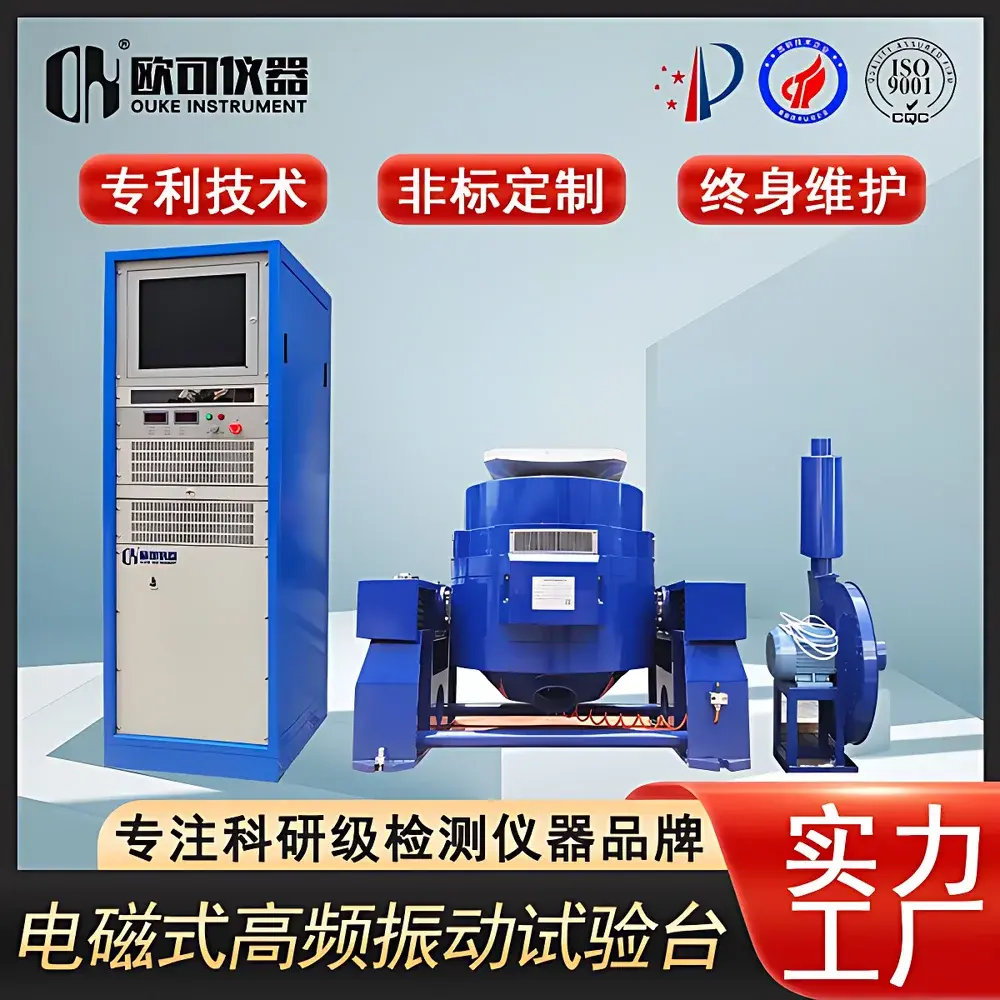
OK-ES-3.1 XYZ Triaxial Electrodynamic Vibration Shaker System
| Brand | OK Instruments |
|---|---|
| Origin | Guangdong, China |
| Manufacturer Type | Direct Manufacturer |
| Instrument Type | Electrodynamic Vibration Shaker |
| Rated Thrust | 1.98 kN |
| Frequency Range | 5–5000 Hz |
| Maximum Payload Capacity | 70 kg |
| Tabletop Dimensions | 300 × 300 × 30 mm |
| Peak Acceleration | 10 g |
Overview
The OK-ES-3.1 XYZ Triaxial Electrodynamic Vibration Shaker System is an engineered solution for high-fidelity, multi-axis mechanical stress simulation in laboratory and industrial reliability testing environments. Unlike conventional uniaxial or sequential triaxial shakers, the OK-ES-3.1 delivers true simultaneous excitation along orthogonal X, Y, and Z axes—enabling physically representative reproduction of real-world dynamic loading conditions. Its core operating principle leverages electrodynamic actuation combined with a precision-engineered three-axis sliding platform (also referred to as a triaxial motion converter), which transforms vertical (Z-axis) electromagnetic vibration into coupled horizontal (X/Y) motions through kinematically constrained mechanical transmission. This architecture achieves broadband triaxial coherence without requiring three independent shaker units—offering a technically balanced compromise between performance fidelity, system rigidity, and operational cost. Designed specifically for mid-size test articles subjected to transportation, automotive, and aerospace qualification standards, the system supports both random and deterministic vibration profiles per ISO 10326, ASTM D4728, MIL-STD-810H Method 514.8, and IEC 60068-2-64.
Key Features
- Integrated electrodynamic shaker base with 1.98 kN rated thrust and extended 5–5000 Hz operational bandwidth—optimized for broad-spectrum random and swept-sine excitations.
- Triaxial sliding platform with low cross-axis coupling (< ±3% amplitude transfer between axes at 1 kHz), ensuring minimal unintended modal interference during synchronized excitation.
- Rigid 300 × 300 × 30 mm aluminum tabletop with T-slot pattern (M6) and surface flatness ≤ ±5 µm over full area—compatible with standard fixture mounting and inertial mass anchoring.
- Real-time MIMO-capable controller interface supporting closed-loop acceleration feedback from up to six channels (three control + three monitor points), enabling spectral convergence within ±1.5 dB tolerance across all axes.
- Thermal management system with forced-air cooling and integrated temperature monitoring to sustain continuous operation at peak acceleration (10 g RMS) without derating.
- Compliance-ready architecture: firmware and data logging modules support audit trails, electronic signatures, and export formats compatible with FDA 21 CFR Part 11 and GLP/GMP documentation workflows.
Sample Compatibility & Compliance
The OK-ES-3.1 accommodates test specimens up to 70 kg with center-of-gravity height ≤ 150 mm above the tabletop surface. Its mechanical design prioritizes modal decoupling—ensuring that structural resonances introduced by fixtures or adapters do not significantly distort control spectrum fidelity below 2 kHz. The system meets mechanical safety requirements per EN 61000-6-2 (immunity) and EN 61000-6-4 (emissions), and has undergone third-party verification for vibration profile repeatability (±0.2 dB inter-run deviation under identical control settings). It is routinely deployed in laboratories accredited to ISO/IEC 17025 for environmental testing, with documented traceability to NIST-traceable accelerometers and calibration certificates issued annually per ISO 17025 Annex A.5.
Software & Data Management
Control and analysis are executed via OK-VibraSuite™ v4.2—a Windows-based application compliant with IEC 62443-3-3 cybersecurity guidelines. The software provides dual-mode operation: standalone local control or networked integration with enterprise LIMS and PLM systems via OPC UA 1.04. All test sessions generate time-synchronized .tdms files containing raw accelerometer waveforms, control spectra (PSD), error signals, and thermal telemetry. Audit logs record operator ID, timestamp, parameter changes, and pass/fail status with SHA-256 hashing for integrity verification. Export modules support CSV, MATLAB (.mat), and HDF5 formats; automated report generation includes compliance annotations for USP , ISO 16750-3, and GB/T 2423.10–2019.
Applications
- Automotive component validation: battery module vibration fatigue under combined road-induced excitations (ISO 16750-3, LV-124).
- Aerospace avionics screening: ECU and sensor housing durability assessment per MIL-STD-810H Method 514.8, Category 24 (multi-axis random).
- Industrial packaging certification: evaluation of protective packaging systems for medical imaging equipment and semiconductor fabrication tools during simulated multimodal freight transport.
- Research-grade modal interaction studies: investigation of nonlinear coupling effects in layered composite structures under phase-controlled triaxial inputs.
- Quality assurance in electronics manufacturing: accelerated life testing of solder joint integrity in high-density PCB assemblies under realistic shock-vibration superposition.
FAQ
What distinguishes the OK-ES-3.1 from a stacked single-axis shaker configuration?
It employs a monolithic electrodynamic driver with a kinematic three-axis converter—eliminating mechanical synchronization delays, phase drift, and independent amplifier mismatches inherent in multi-shaker setups.
Is the system capable of performing classical shock testing (e.g., half-sine, trapezoidal)?
Yes—via optional ShockWave™ add-on module, supporting pulse durations from 2 ms to 50 ms and peak accelerations up to 100 g (limited by payload inertia and table resonance constraints).
How is cross-axis coupling quantified and minimized?
Coupling is measured per ISO 10816-4 using orthogonal reference accelerometers; mechanical tuning of slider preload and damping reduces off-axis response to < 2.8% at 1 kHz and < 5.1% at 3 kHz.
Does the controller support real-time waveform replication (RWR) from field-collected data?
Yes—OK-VibraSuite™ includes time-domain synthesis engine with anti-aliasing filtering and resampling resolution down to 100 kHz, compliant with SAE J2570 Class C requirements.
What maintenance intervals are recommended for long-term calibration stability?
Biannual verification of shaker force factor (Bl) and accelerometer sensitivity is advised; annual full-system metrological recalibration against primary standards is required for ISO/IEC 17025-compliant labs.



