
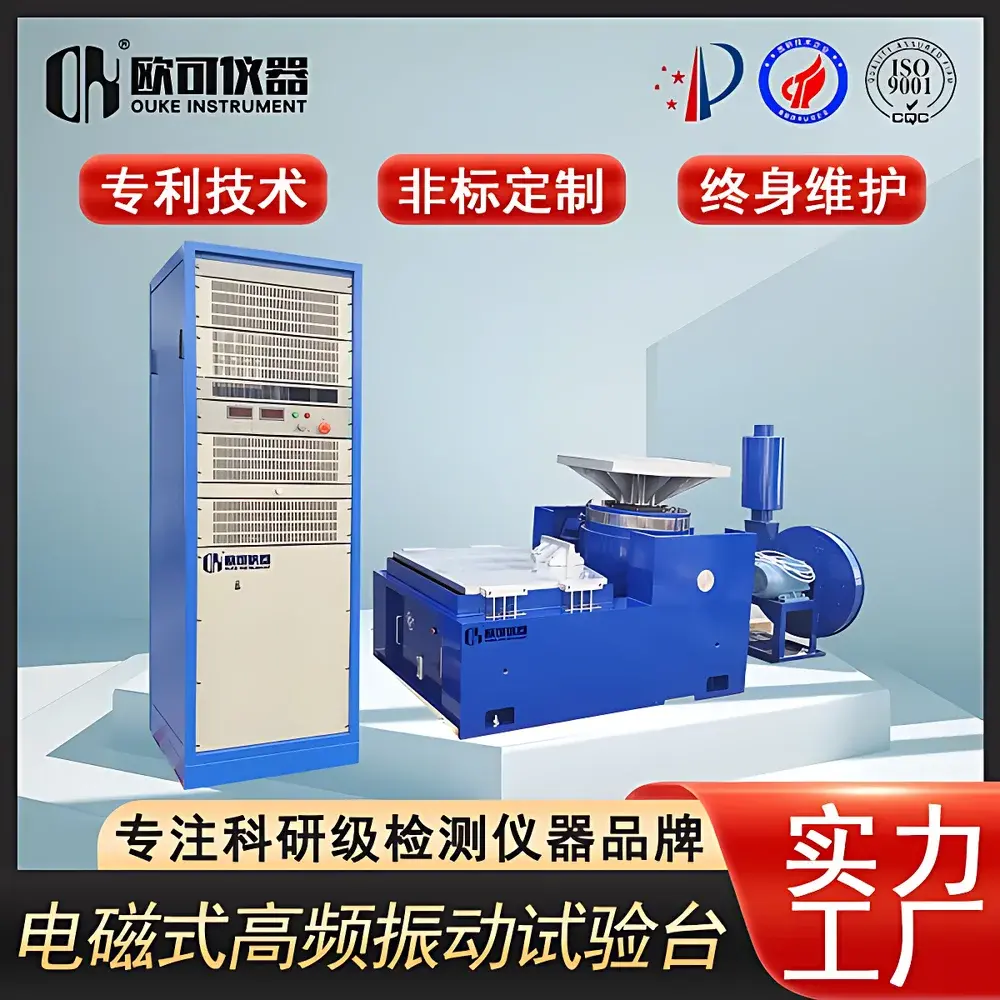
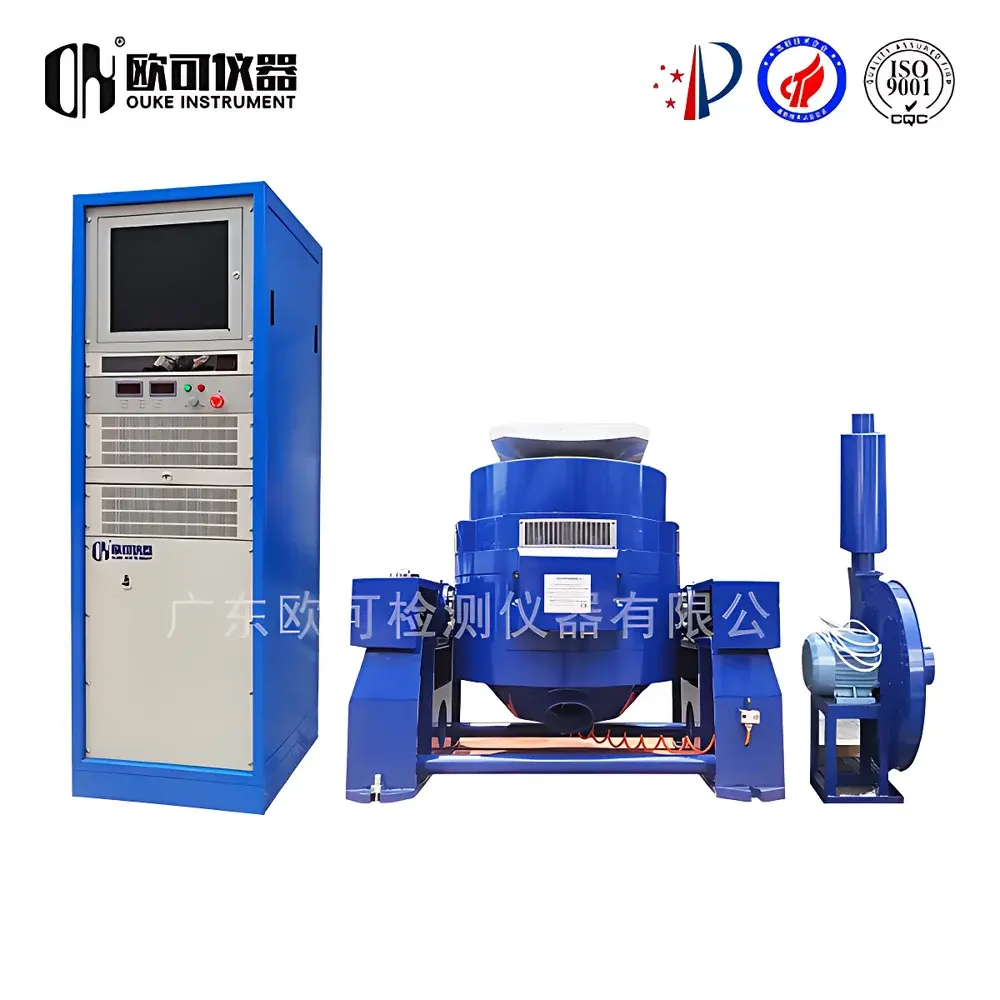
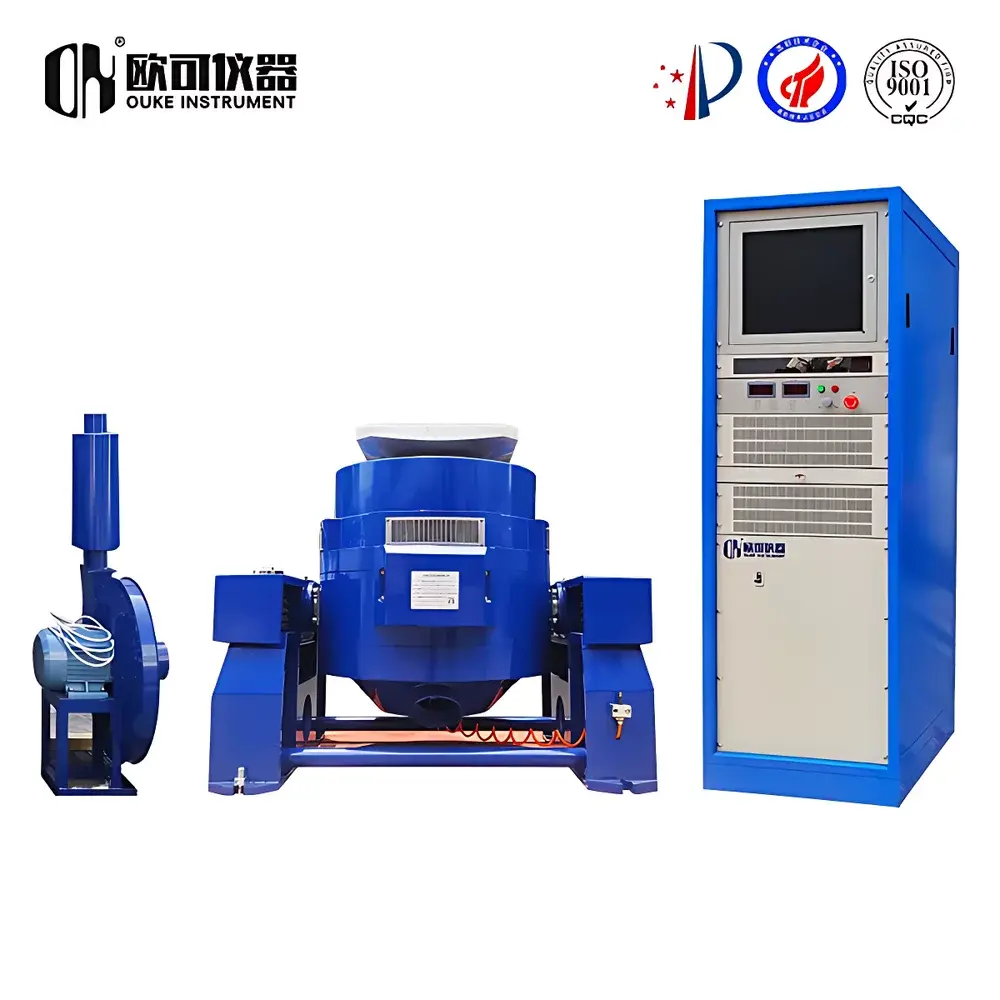
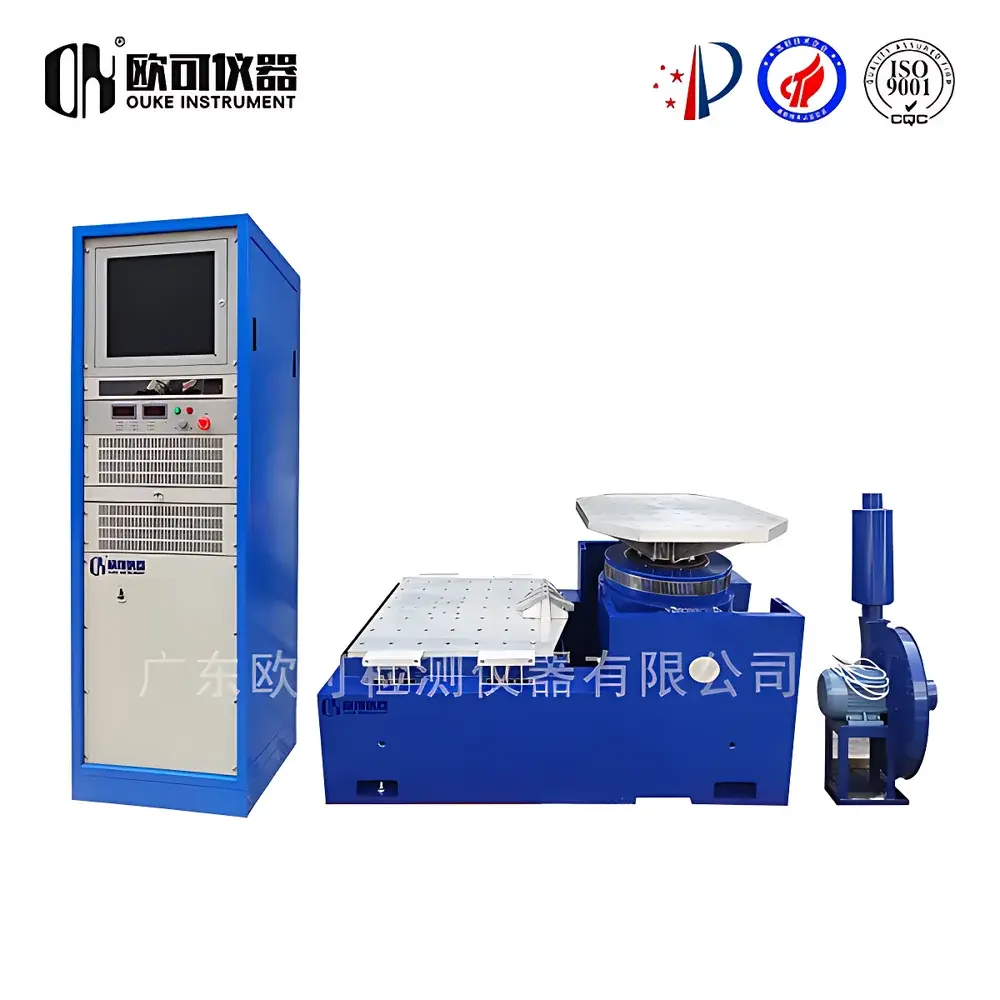
OK-ES-3.33 High-Frequency Electromagnetic Vibration Shaker
| Brand | OK Instruments |
|---|---|
| Origin | Guangdong, China |
| Manufacturer Type | Direct Manufacturer |
| Instrument Type | Electromagnetic Vibration Shaker |
| Model | OK-ES-3.33 |
| Rated Thrust | 1.98 kN |
| Frequency Range | 5–5000 Hz |
| Maximum Payload | 70 kg |
| Table Dimensions | 400 × 400 × 30 mm |
| Peak Acceleration | 10 g |
| Table Material & Construction | Solid aluminum alloy with reinforced stiffening ribs |
| Drive Coil | Lightweight beryllium-copper composite coil |
| Amplifier Bandwidth | DC–6 kHz (min.) |
| Control Interface | Ethernet-based real-time controller with IEEE 1588 precision time synchronization |
| Compliance | Designed per ISO 5344, ASTM D999, and MIL-STD-810H Method 514.8 Annex G (High-Frequency Vibration) requirements |
Overview
The OK-ES-3.33 High-Frequency Electromagnetic Vibration Shaker is an engineered solution for controlled mechanical excitation in the 5–5000 Hz range, optimized for applications demanding high acceleration fidelity, minimal displacement, and structural modal integrity at elevated frequencies. Unlike conventional electromagnetic shakers—typically limited to 2000–3000 Hz—the OK-ES-3.33 employs a purpose-built dynamic architecture: a low-mass, high-stiffness moving coil; a solid, vibration-damped aluminum table; and a wide-bandwidth linear power amplifier. Its design adheres to the fundamental vibration physics principle that acceleration (a) relates to displacement (d) and frequency (f) via a ∝ d·f², enabling peak accelerations up to 10 g with sub-millimeter peak-to-peak displacement (< 0.8 mm). This makes it suitable for testing components where inertial loading dominates over displacement-driven fatigue—such as turbine blades, MEMS sensors, quartz resonators, and high-speed bearing assemblies.
Key Features
- Electromagnetic drive system with beryllium-copper composite voice coil for minimized moving mass and extended first-mode resonance beyond 7 kHz
- Rigid 400 × 400 × 30 mm solid aluminum table, CNC-machined with integral mounting threads and T-slots for repeatable fixture integration
- Real-time digital controller supporting closed-loop acceleration control with phase margin > 45° across full 5–5000 Hz bandwidth
- Integrated thermal monitoring of coil and amplifier stages with automatic derating logic to maintain measurement stability during prolonged high-g sweeps
- Compliant with IEEE 1588-2008 (PTP) for synchronized multi-channel test setups, enabling correlation with external laser Doppler vibrometers or strain acquisition systems
- Front-panel and remote Ethernet interface supporting SCPI command set for integration into automated test sequences (e.g., LabVIEW, Python-based PyVISA environments)
Sample Compatibility & Compliance
The OK-ES-3.33 is intended for specimens with mass ≤ 70 kg and base dimensions compatible with the 400 mm square table. Fixture design is critical: fixtures must exhibit a first bending mode ≥ 15 kHz (i.e., ≥3× upper test frequency) to avoid modal contamination. Typical fixtures are monolithic magnesium or 7075-T6 aluminum, stress-relieved and modal-tuned via FEA prior to machining. The system complies with mechanical safety requirements per IEC 61000-4-29 (vibration test equipment) and supports audit-ready documentation for GLP/GMP-regulated environments. While not intrinsically rated for hazardous locations, optional ATEX-compliant enclosures are available upon request. Calibration certificates traceable to NIM (China National Institute of Metrology) are provided with each unit.
Software & Data Management
The shaker is supplied with OK-VibControl v4.x—a deterministic real-time application running on a dedicated Linux RTOS platform. It supports sine, random, shock, and transient synthesis modes, including resonant dwell tracking and force-limited control. All control parameters, waveform logs, and spectral data are stored in HDF5 format with embedded metadata (test ID, operator, timestamp, calibration ID). Audit trails comply with FDA 21 CFR Part 11 requirements: electronic signatures, immutable event logging, and role-based access control (RBAC) are implemented. Raw time-history data export supports ASCII, MATLAB (.mat), and UFF58 formats. API support enables integration with enterprise LIMS or PLM platforms via RESTful webhooks.
Applications
- Aerospace component validation: High-cycle fatigue testing of compressor/turbine blades under simulated aerodynamic flutter conditions (1–5 kHz)
- MEMS device qualification: Functional screening of silicon micro-accelerometers, gyroscopes, and RF filters under broadband random vibration per MIL-PRF-38534 Class K
- Crystal oscillator aging studies: Accelerated life testing of quartz tuning forks and SAW devices at resonant harmonics
- Material science research: High-frequency ultrasonic fatigue characterization of Ti-6Al-4V and carbon fiber laminates using resonant loading techniques
- Vibration sensor calibration: Primary reference source for laboratory-grade accelerometer calibration up to 5 kHz per ISO 16063-21
- Automotive electronics: ECU and ADAS sensor robustness verification against engine-induced high-frequency structure-borne noise (e.g., 2–4 kHz combustion harmonics)
FAQ
What is the maximum usable frequency when testing a 50 kg payload?
The rated 5000 Hz upper limit assumes optimal fixture rigidity and proper mass distribution. With a 50 kg mass centered on the table and a fixture exhibiting >15 kHz first mode, full specification performance is maintained.
Can the OK-ES-3.33 perform closed-loop force control?
No—it is acceleration-controlled only. Force-limited operation requires external load cell feedback integrated via analog input and custom control loop configuration.
Is third-party calibration included with delivery?
Yes: NIM-traceable acceleration sensitivity calibration (at 160 Hz, 1000 Hz, and 3000 Hz) and thrust verification are performed pre-shipment and documented in the Certificate of Conformance.
Does the system support triaxial testing?
Not natively. Triaxial capability requires three synchronized OK-ES-3.33 units with master-slave timing alignment and coordinated control firmware—available as a turnkey option.
What environmental conditions are required for stable operation?
Ambient temperature: 15–30 °C; relative humidity: ≤70% non-condensing; floor vibration isolation: ≤2.5 µm RMS below 10 Hz recommended; dedicated 3-phase 400 V ±10%, 63 A supply with harmonic filtering.



