
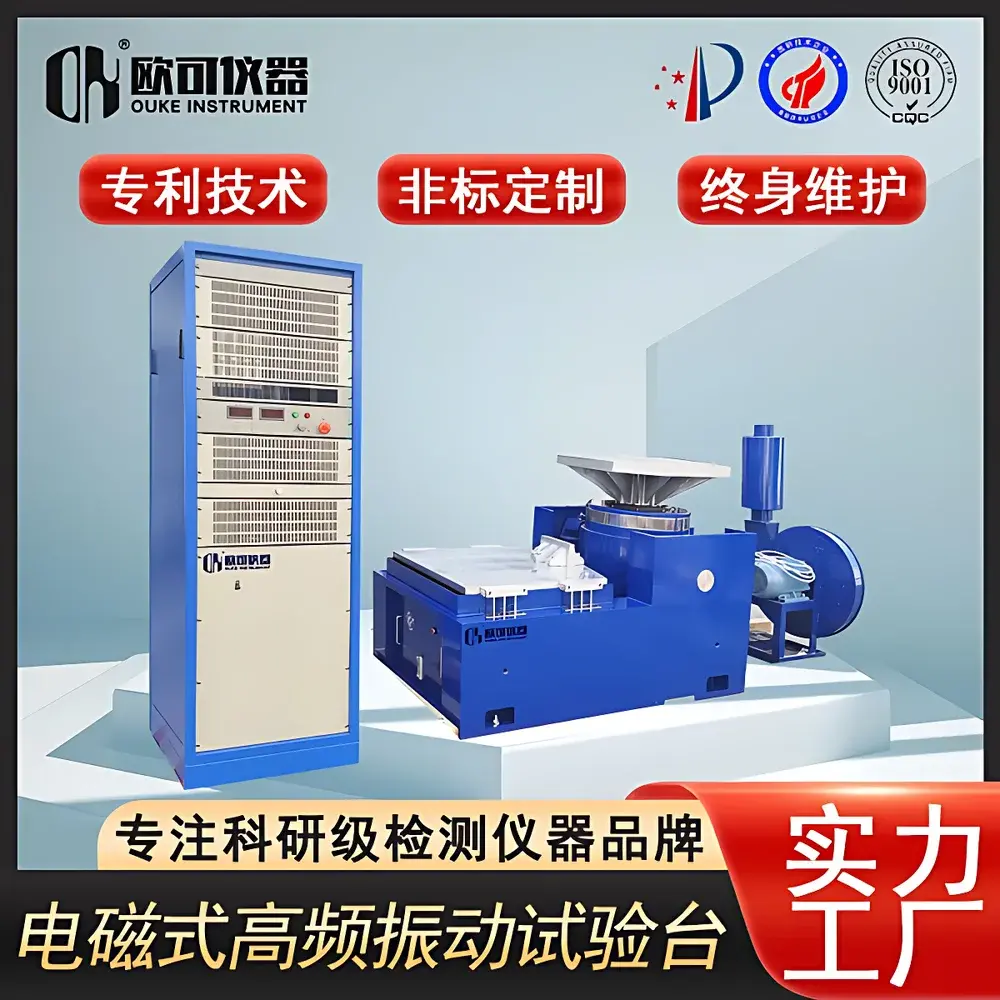
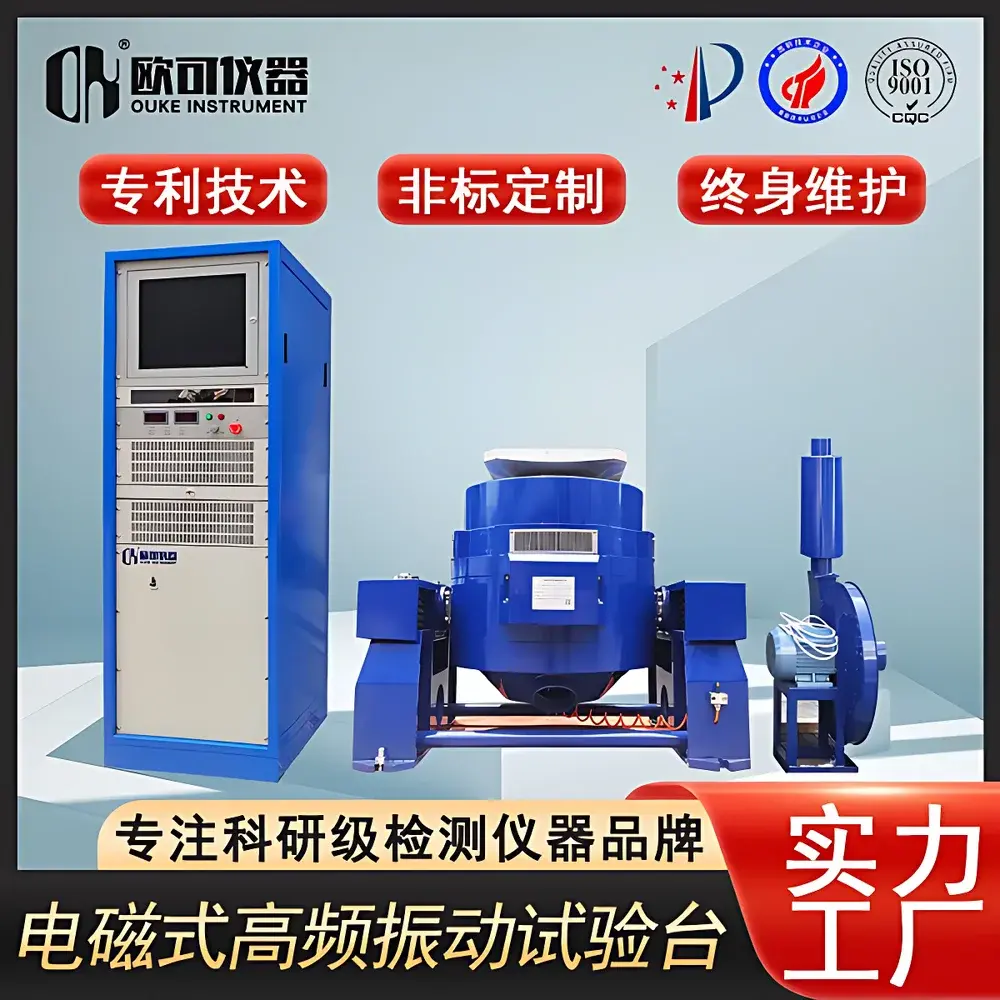
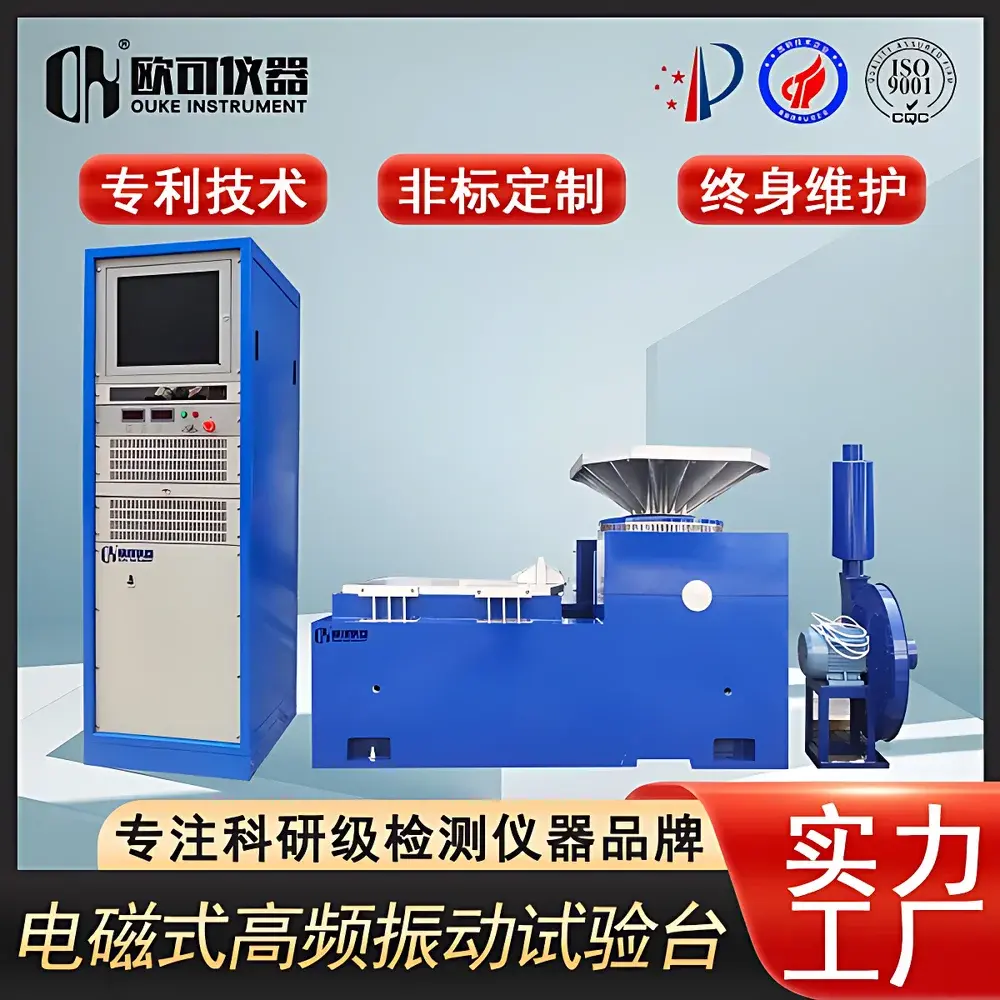
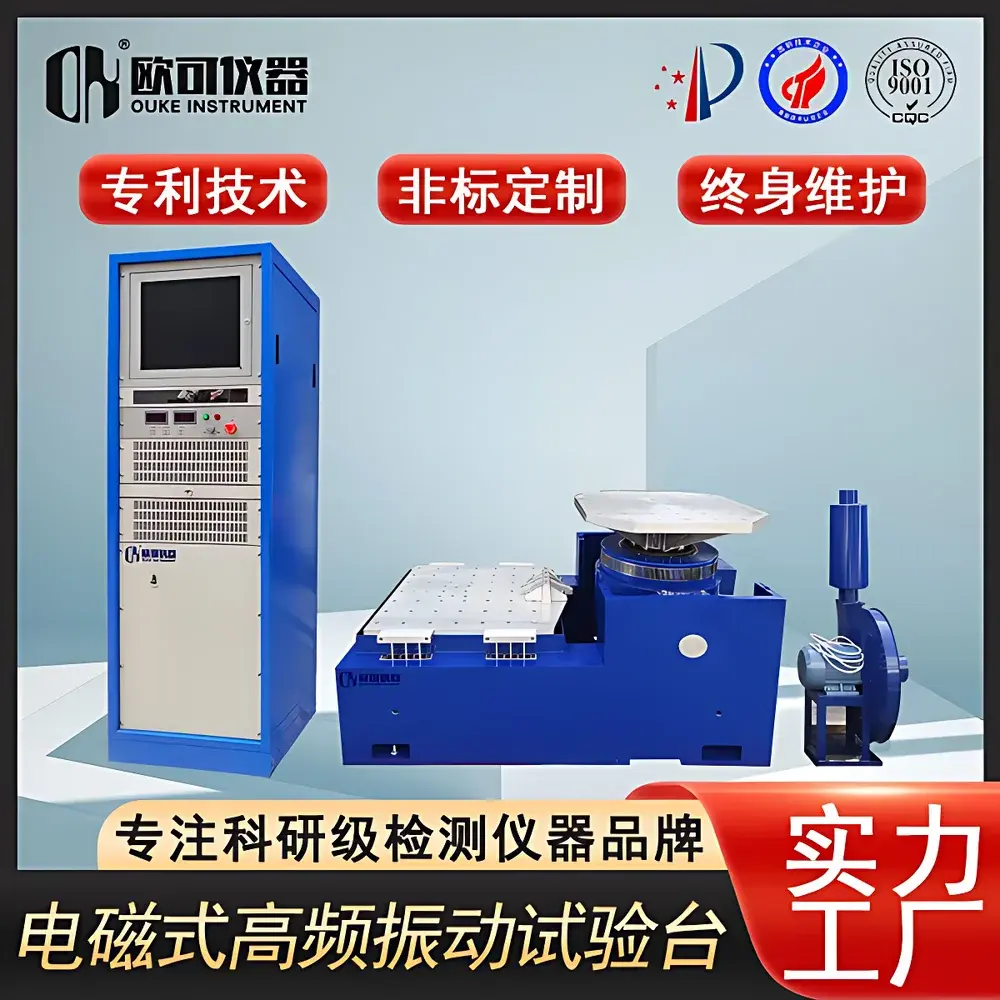
OK-ES-3.333 Electromagnetic High-Frequency Vibration Shaker
| Brand | OK Instruments |
|---|---|
| Origin | Guangdong, China |
| Manufacturer Type | Direct Manufacturer |
| Instrument Type | Electrodynamic Vibration Shaker |
| Rated Force | 1.98 kN |
| Frequency Range | 5–5000 Hz |
| Maximum Test Load | 70 kg |
| Tabletop Dimensions | 300 × 300 × 100 mm |
| Peak Acceleration | 10 g |
Overview
The OK-ES-3.333 Electromagnetic High-Frequency Vibration Shaker is a precision-engineered electrodynamic shaker system designed for rigorous environmental reliability testing across aerospace, automotive, electronics, and defense sectors. It operates on the fundamental principle of Lorentz force generation: an alternating current supplied to a voice-coil assembly—suspended within a high-intensity magnetic field—produces a proportional axial force that drives the rigidly coupled tabletop in precise harmonic or broadband motion. This electromagnetic actuation mechanism eliminates mechanical linkages and hydraulic fluid dependencies, enabling superior frequency response linearity, rapid transient fidelity, and exceptional waveform reproduction from 5 Hz to 5 kHz. Unlike servo-hydraulic or mechanical shakers, the OK-ES-3.333 delivers high acceleration capability (up to 10 g peak) with minimal phase distortion in the mid-to-high frequency domain—making it especially suited for resonance detection, modal survey, random vibration qualification per MIL-STD-810H and ISO 16750-3, and high-cycle fatigue screening.
Key Features
- Electrodynamic actuation architecture with permanent magnet flux circuit, ensuring stable magnetic field density and thermal robustness during extended duty cycles.
- Rated sinusoidal force output of 1.98 kN (202 kgf), engineered to accommodate test articles up to 70 kg—including fixture mass—with adequate safety margin for closed-loop control stability.
- Wide operational bandwidth spanning 5 Hz to 5000 Hz, validated per IEC 60068-2-6 and ASTM D999 standards for sinusoidal and random vibration profiles.
- Rigid 300 × 300 × 100 mm aluminum tabletop with standardized 10-mm threaded mounting holes (M6/M8 pattern), optimized for modal rigidity and low transmissibility above 1 kHz.
- Integrated displacement-limiting mechanism and real-time over-acceleration cut-off, compliant with Category II safety requirements under IEC 61000-4-28.
- Thermally managed design incorporating forced-air cooling for both power amplifier and shaker armature, supporting continuous operation at rated force up to 40°C ambient.
Sample Compatibility & Compliance
The OK-ES-3.333 accommodates a broad spectrum of physical specimens—from printed circuit assemblies (PCBAs) and MEMS sensors to structural subassemblies such as avionics enclosures and automotive ECUs. Fixture interface compatibility follows ISO 5344 mechanical mounting conventions; custom fixtures may be qualified per ASTM E1856 for dynamic mass loading effects. The system meets essential electromagnetic compatibility (EMC) requirements per EN 61326-1 and supports traceable calibration in accordance with ISO/IEC 17025-accredited laboratories. When operated with a compliant controller and data acquisition unit, it satisfies audit-ready documentation requirements for GLP and GMP environments—including full test log archiving, user access control, and electronic signature support aligned with FDA 21 CFR Part 11 Annex 11 principles.
Software & Data Management
The shaker integrates seamlessly with industry-standard vibration control platforms (e.g., Vibration Research VR9500, Crystal Instruments Spider-80Xi, or m+p VibControl), enabling full-spectrum test configuration: sine sweep, resonant dwell, random PSD synthesis, shock response spectrum (SRS), and mixed-mode excitation. All controllers provide real-time FFT analysis, coherence monitoring, and automatic limit enforcement. Raw time-history data is recorded in IEEE 1159-compliant binary format (.tdms or .uff), supporting post-processing in MATLAB, Python (SciPy), or commercial FEA tools for correlation with finite element models. Audit trails include operator ID, timestamped parameter changes, calibration certificate references, and system health diagnostics—ensuring full traceability for internal QA reviews or third-party certification audits.
Applications
- Aerospace: Qualification testing of satellite payload mounts, UAV airframe components, and inertial measurement units (IMUs) per ECSS-Q-ST-70-08C.
- Automotive: Durability validation of ADAS radar housings, battery management systems (BMS), and infotainment modules per ISO 16750-3 and GMW3172.
- Electronics Manufacturing: High-volume vibration screening of solder joints and connector retention strength per IPC-J-STD-002 and JEDEC JESD22-B103.
- Defense Systems: Environmental stress screening (ESS) of tactical radios and EO/IR sensor assemblies under MIL-STD-810H Method 514.8.
- Academic Research: Experimental modal analysis (EMA) of composite laminates, damping characterization of viscoelastic materials, and active vibration control algorithm development.
FAQ
What is the maximum allowable payload mass when operating at peak acceleration?
The 70 kg load rating assumes combined mass of test article + fixture + accelerometer. For sustained 10 g operation, total mass must remain ≤ 70 kg; dynamic amplification factors near resonance require additional derating per ISO 10816-3 guidance.
Does the system support real-time closed-loop control for random vibration testing?
Yes—when paired with a certified vibration controller, the OK-ES-3.333 maintains PSD error tolerance within ±1.5 dB (RMS) across its full 5–5000 Hz range, meeting Class 1 performance criteria per ISO 10816-3 Annex B.
Is water cooling required for continuous operation?
No—forced-air cooling suffices for standard duty cycles. Water cooling is optional and recommended only for extended high-force random tests (>4 hours at >1.5 kN RMS).



