
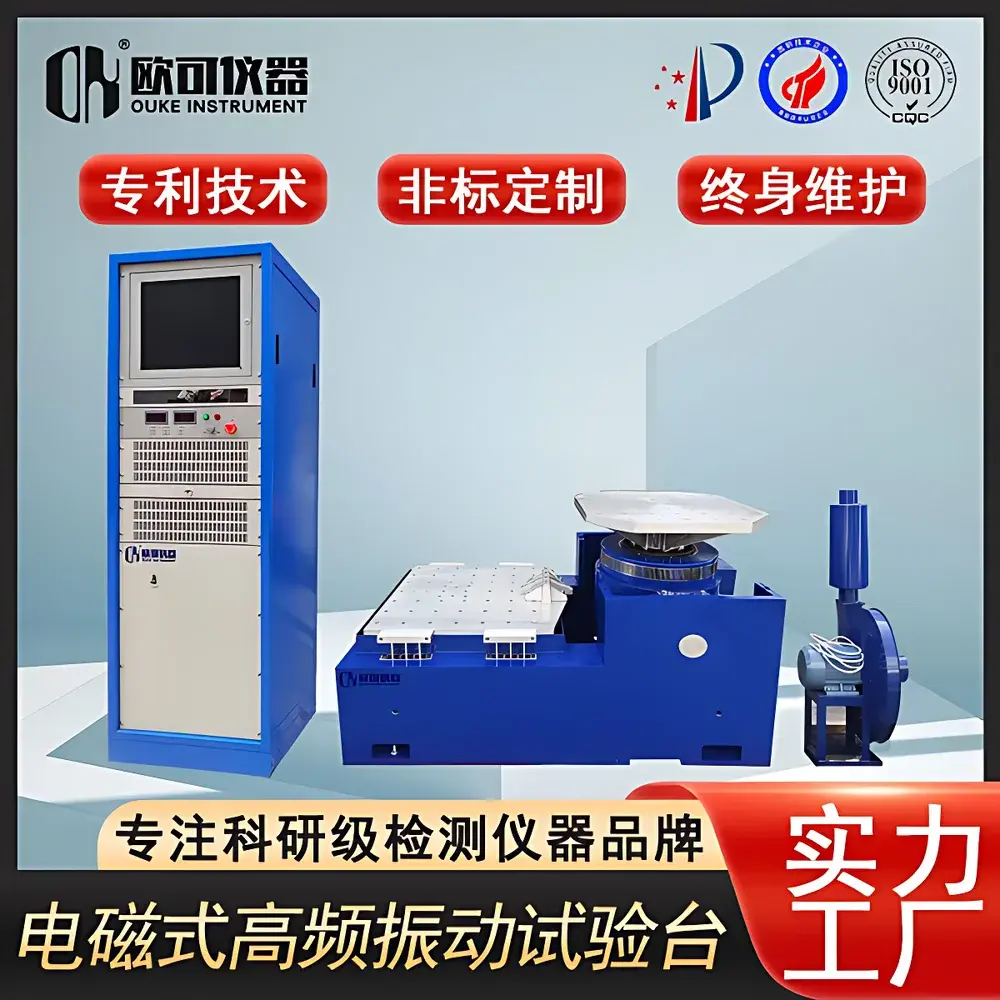
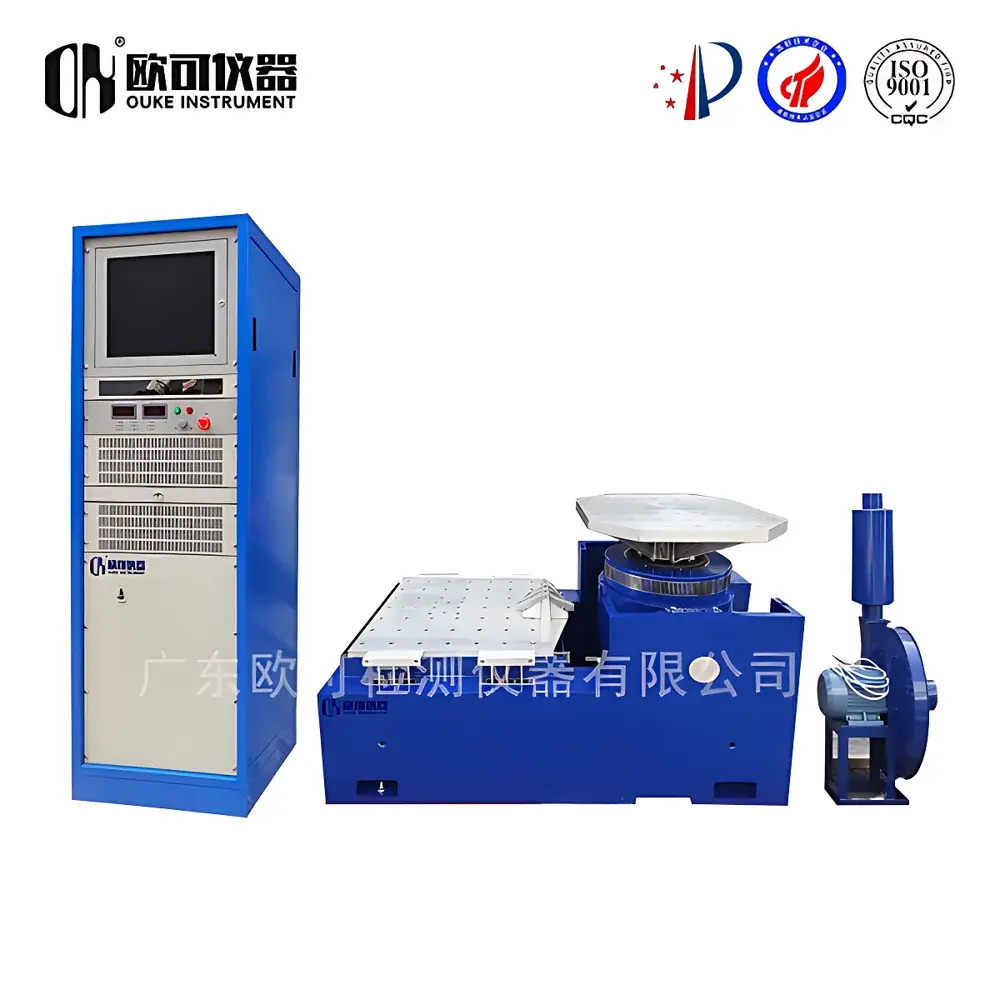
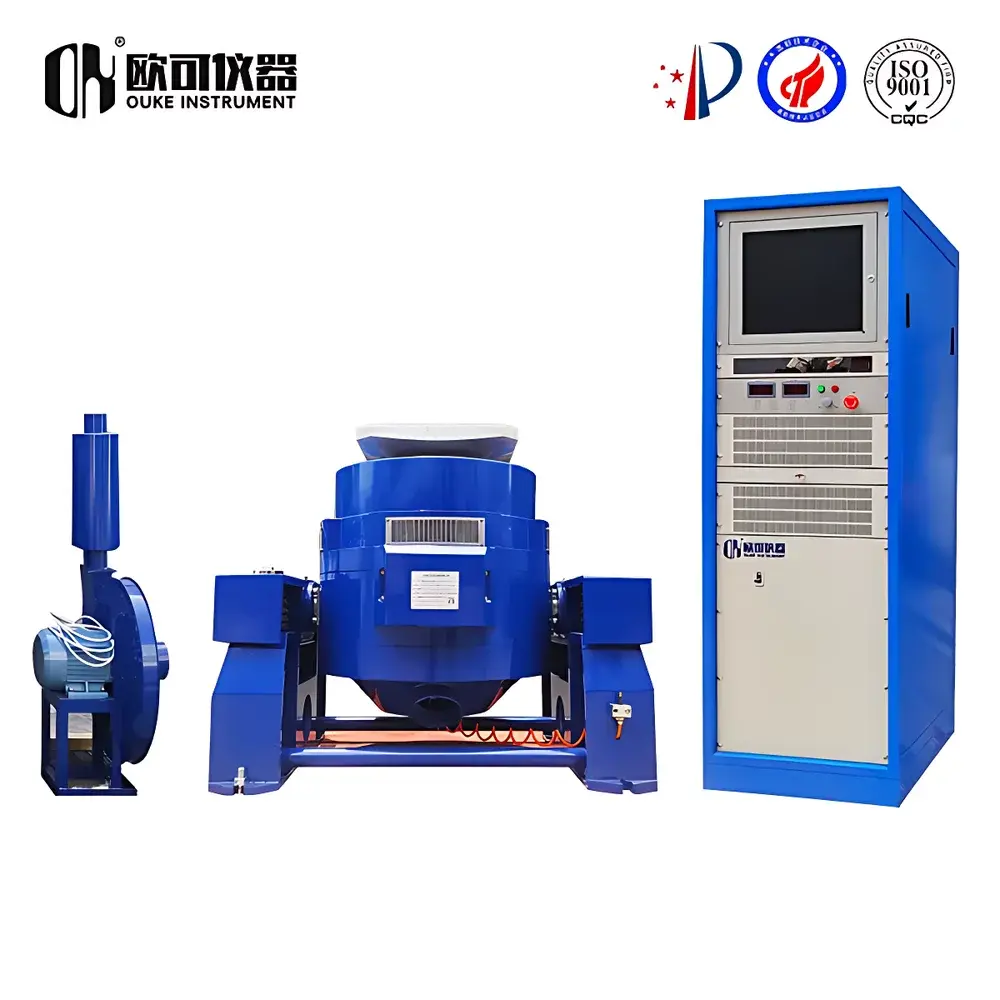
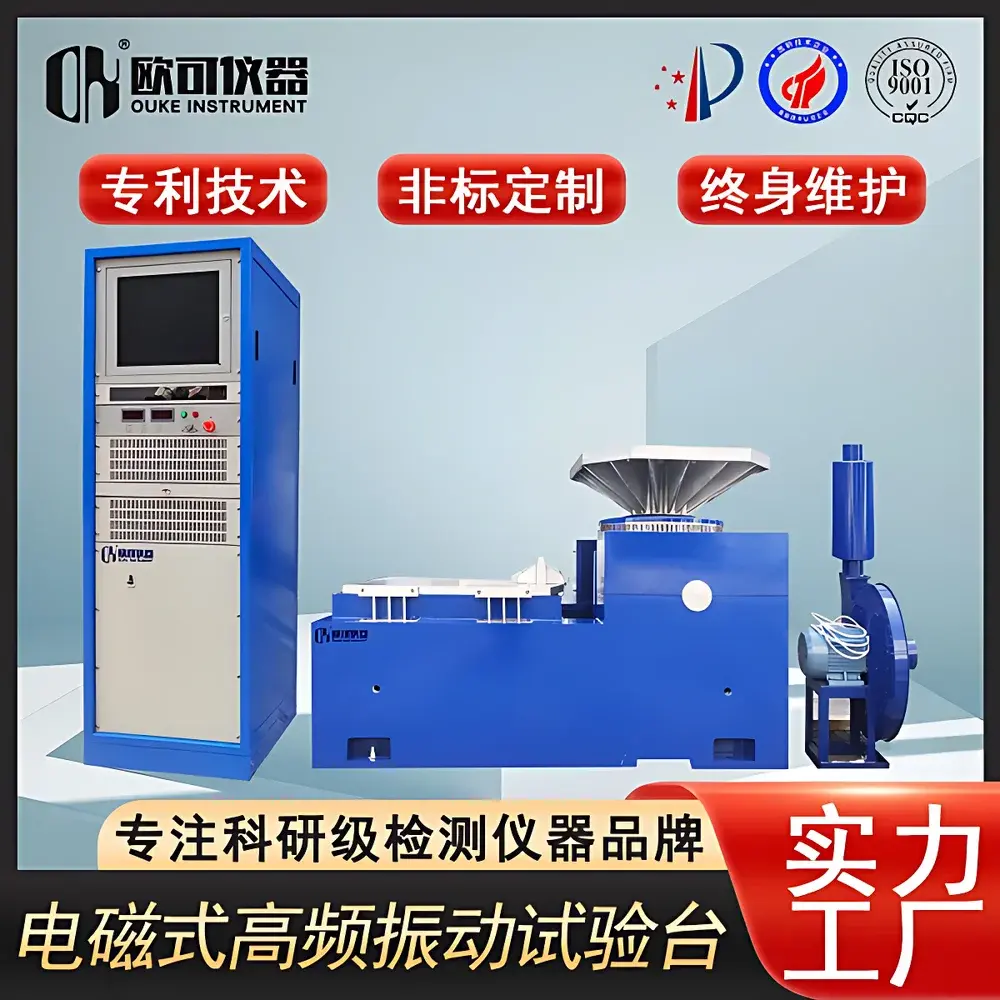
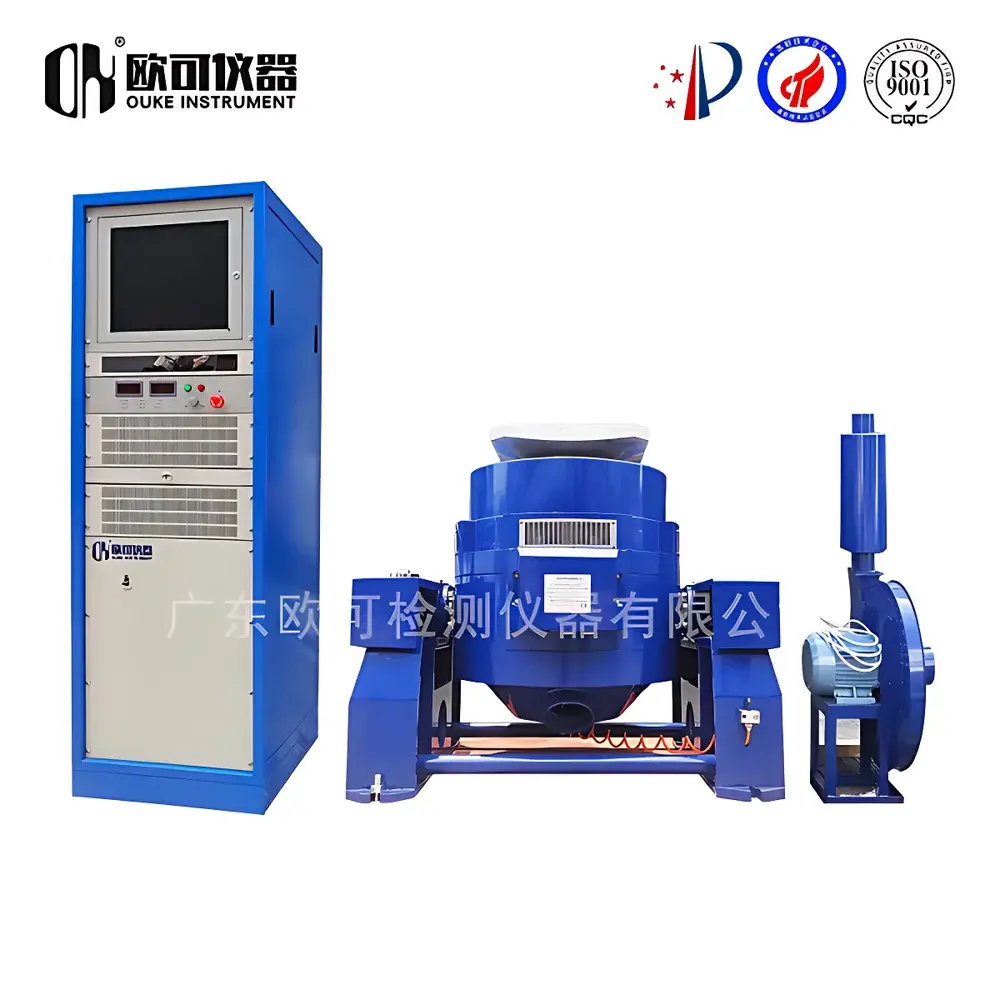
OK-ES-3.66 Electromagnetic Random Vibration Shaker System
| Brand | OK Instruments |
|---|---|
| Origin | Guangdong, China |
| Manufacturer Type | OEM Manufacturer |
| Instrument Type | Electromagnetic Vibration Shaker |
| Rated Thrust | 1.98 kN |
| Frequency Range | 5–5000 Hz |
| Max. Test Load | 70 kg |
| Tabletop Dimensions | 400 × 400 × 30 mm |
| Max. Acceleration | 10 g |
Overview
The OK-ES-3.66 is a high-performance electromagnetic random vibration shaker system engineered for precision environmental simulation and reliability validation in industrial R&D, quality assurance, and certification laboratories. It operates on the principle of electrodynamic force generation—where a voice-coil actuator interacts with a static magnetic field to produce controlled mechanical motion—enabling faithful reproduction of statistically defined random vibration profiles across a broad frequency spectrum (5–5000 Hz). Unlike deterministic sine sweep testing, this system excels at simulating real-world dynamic environments such as road transport, airborne cargo handling, and aerospace launch conditions. Its core functionality relies on closed-loop power spectral density (PSD) control, where real-time acceleration feedback from triaxial or uniaxial accelerometers is continuously processed via fast Fourier transform (FFT), compared against user-defined target PSD curves (e.g., ISO 16750-3, MIL-STD-810H Method 514.8), and used to iteratively adjust drive signals until measured and target spectra converge within specified tolerance bands (typically ±1.5 dB). This ensures metrologically traceable, repeatable, and statistically robust test execution compliant with GLP and GMP-aligned laboratory practices.
Key Features
- Electromagnetic shaker architecture optimized for wideband random vibration synthesis, featuring high-force-to-mass ratio and low moving mass for superior high-frequency response.
- Rated thrust of 1.98 kN enables stable operation under demanding PSD profiles up to 10 g2/Hz, supporting test loads up to 70 kg—including fixture mass—without thermal derating.
- Integrated digital random vibration controller with dual-channel capability (1 control + 1 monitor), supporting real-time PSD equalization, kurtosis monitoring, and automatic over-test protection.
- Robust 400 × 400 × 30 mm aluminum tabletop with standardized T-slots (M8) for secure, repeatable fixture mounting; surface flatness ≤ ±5 µm over full area.
- High-efficiency forced-air cooling system maintains coil temperature below 120°C during extended random dwell tests, ensuring long-term amplitude stability and repeatability.
- Compliant with IEC 60068-2-64 for random vibration testing and compatible with common industry-standard PSD templates including automotive (ISO 16750-3), defense (MIL-STD-810H), and rail (EN 61373).
Sample Compatibility & Compliance
The OK-ES-3.66 accommodates a wide range of sample geometries and mounting configurations through its modular fixture interface. Typical applications include printed circuit board assemblies (PCBAs), electronic enclosures, automotive ECUs, avionics modules, medical devices, and consumer electronics subassemblies. All test fixtures must be designed to minimize resonance coupling and maintain rigid transmission of vibratory energy—fixture transmissibility is validated prior to qualification testing per ASTM E1492. The system meets electromagnetic compatibility requirements per EN 61326-1 and is CE-marked for use within the European Economic Area. For regulated industries, the controller firmware supports audit-trail logging, user access control, and electronic signature compliance aligned with FDA 21 CFR Part 11 Annex 11 principles when integrated with validated LIMS or ELN platforms.
Software & Data Management
The system is operated via OK-VibControl™—a Windows-based application built on deterministic real-time kernel architecture. It provides intuitive graphical PSD editor with drag-and-drop spectrum building, multi-segment breakpoint definition, and auto-scaling based on total RMS acceleration calculation. All test sessions generate timestamped binary data files (.vib) containing raw accelerometer waveforms, computed PSDs, control error histories, and thermal telemetry. Export options include CSV, MATLAB .mat, and universal UFF58 formats. Built-in report generator produces PDF outputs conforming to ISO/IEC 17025 documentation requirements, including uncertainty estimates derived from system calibration certificates (traceable to NIM or NIST-equivalent standards). Remote monitoring and diagnostic access are supported via secure TLS-encrypted Ethernet connection, enabling integration into centralized test facility management systems.
Applications
- Environmental stress screening (ESS) of production-line electronics to precipitate latent defects including solder joint fatigue, micro-cracks, and loose interconnects.
- Reliability qualification per IPC-9592, JEDEC JESD22-B104, and AEC-Q200 for automotive-grade components subjected to road-induced broadband excitation.
- Vibration fatigue analysis of structural assemblies using time-domain waveform replication (TWR) or kurtosis-enhanced random profiles to accelerate life-cycle assessment.
- Transport simulation testing per ISTA 3A, ASTM D4728, and ISO 13355 for packaged goods, evaluating integrity of packaging systems and internal product mounting.
- Pre-compliance screening for regulatory certifications including CE, FCC, and UL, reducing risk of failure during formal third-party testing.
FAQ
What is the difference between sine and random vibration testing?
Sine testing applies a single-frequency oscillation to identify resonant modes and verify structural integrity at specific frequencies. Random testing applies a broadband, statistically defined signal that simultaneously excites multiple resonances—better replicating real-world environments and accelerating defect detection.
Does the OK-ES-3.66 support multi-axis testing?
The base configuration is single-axis (vertical). For triaxial testing, three OK-ES-3.66 units can be synchronized via master-slave digital trigger interface with phase coherence maintained to ±2° across all axes.
How is system calibration performed and how often is it required?
Calibration follows ISO 16063-21 using reference-grade laser interferometry and primary-standard accelerometers. Annual calibration is recommended; full system verification (shaker + controller + sensor chain) should be conducted before each qualification test series.
Can the system generate non-Gaussian random profiles?
Yes—via optional kurtosis control module, the controller supports adjustable kurtosis values (3–7) to emulate transient shock content present in field data without compromising PSD fidelity.
Is technical support available outside mainland China?
OK Instruments provides remote diagnostics, application engineering consultation, and on-site service coordination through authorized partners in North America, EU, and APAC regions, with English-language documentation and firmware updates included in standard warranty.



