
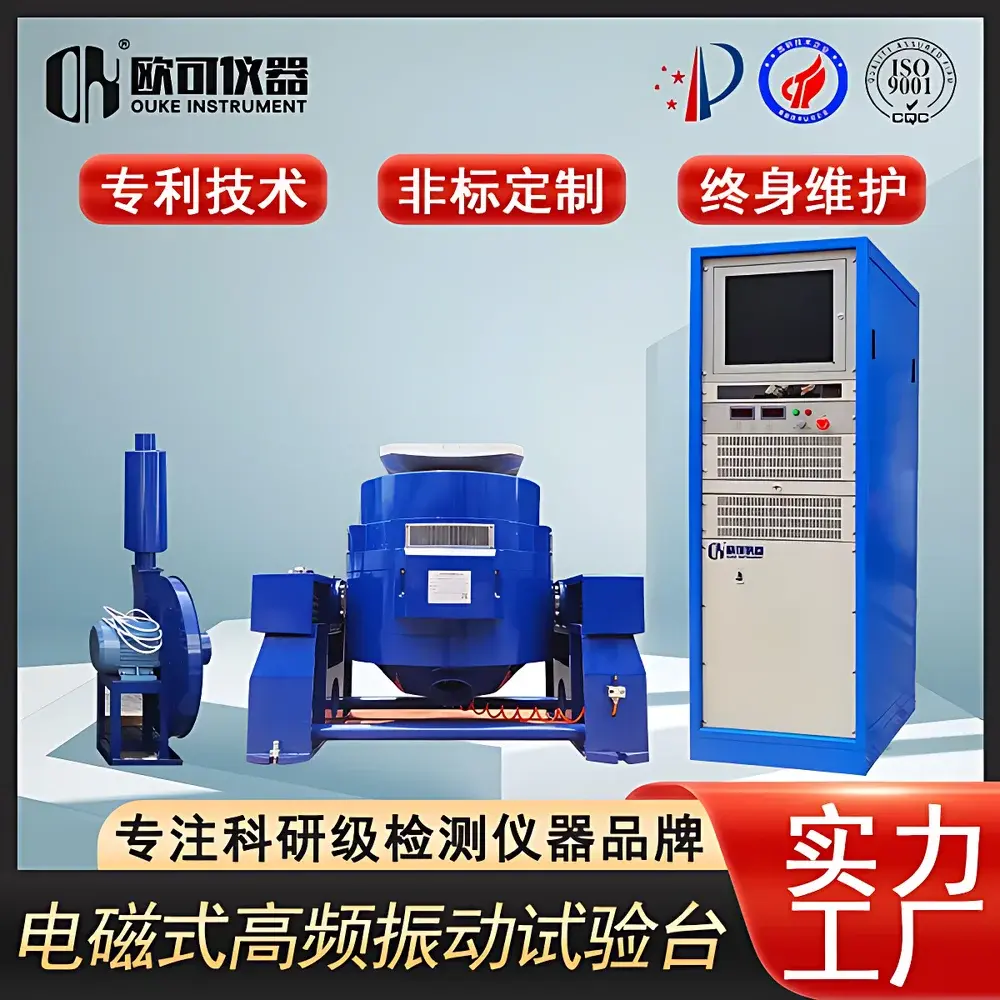
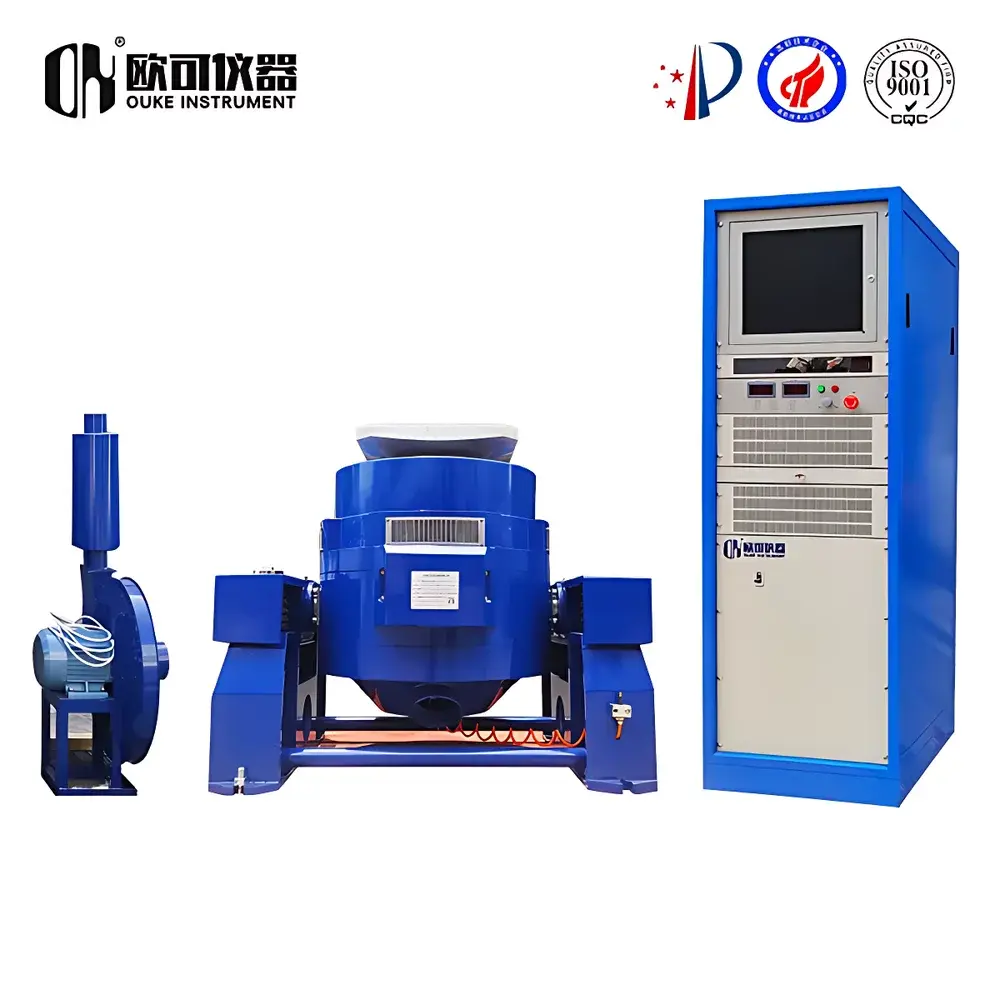
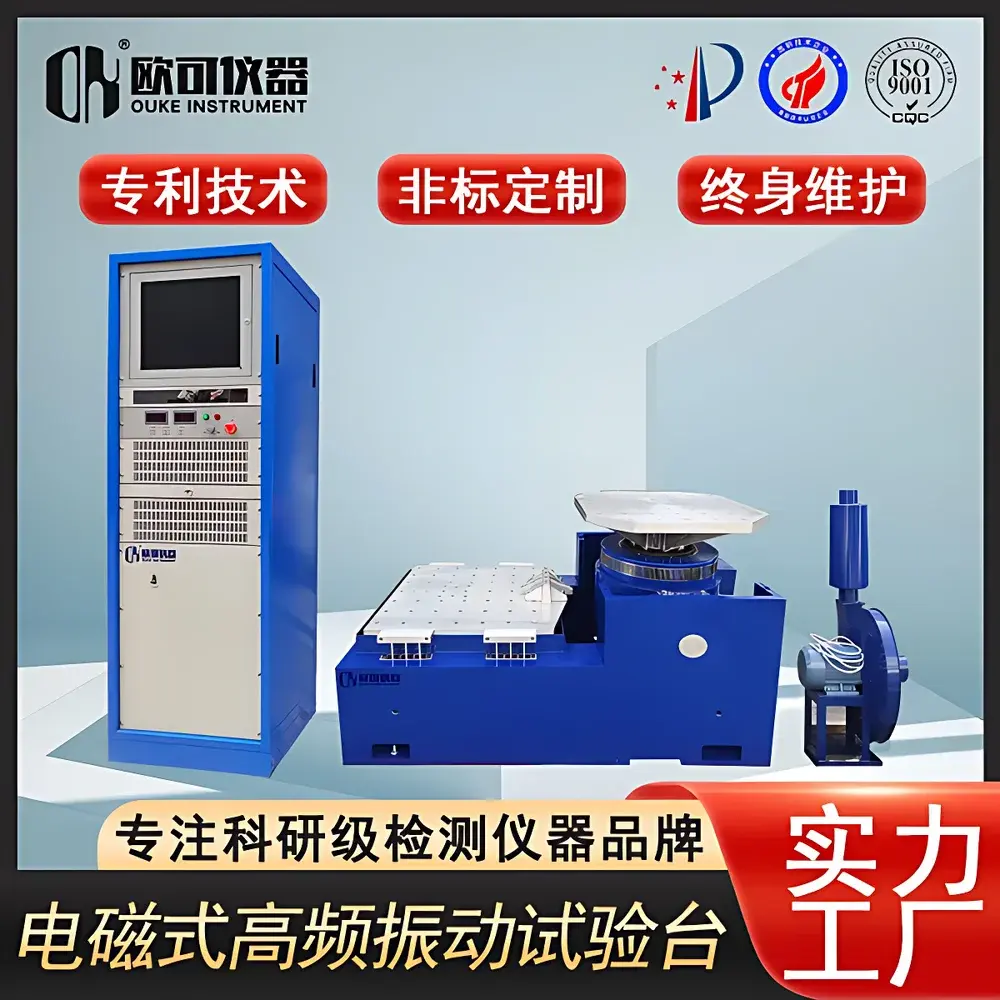
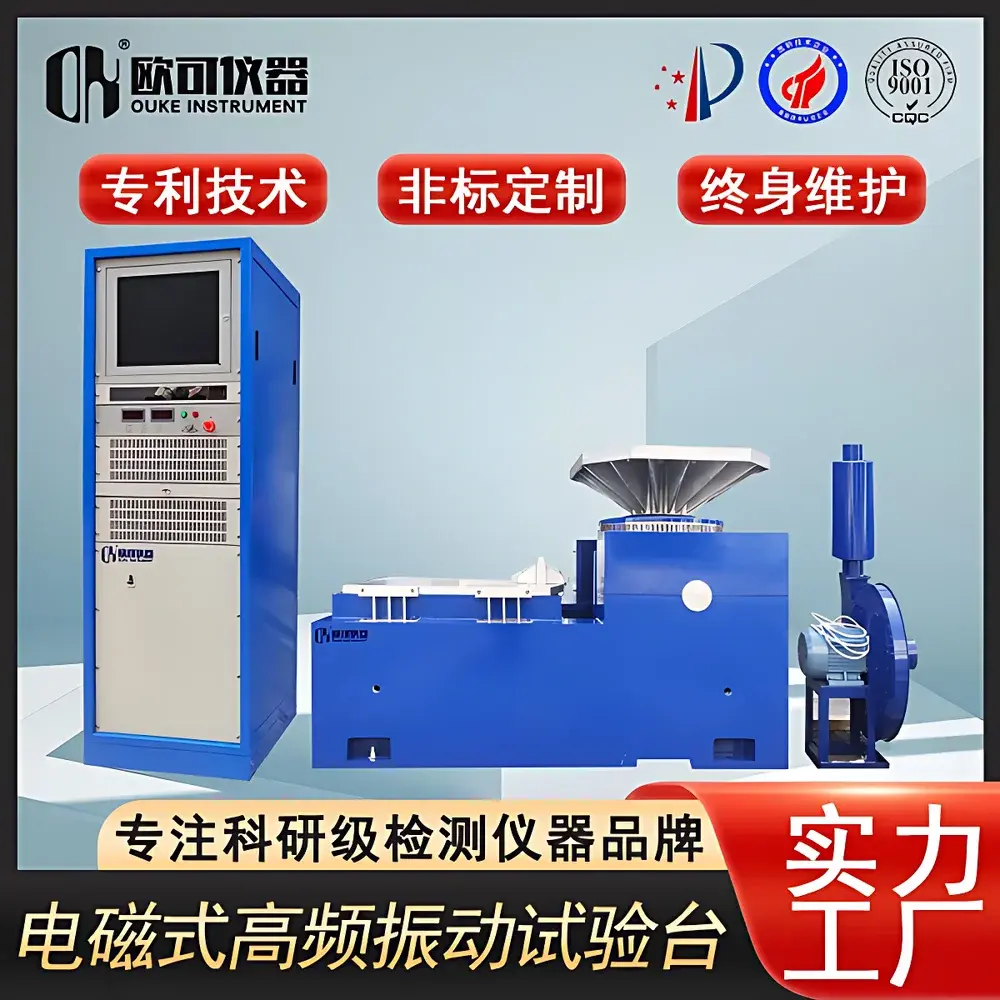
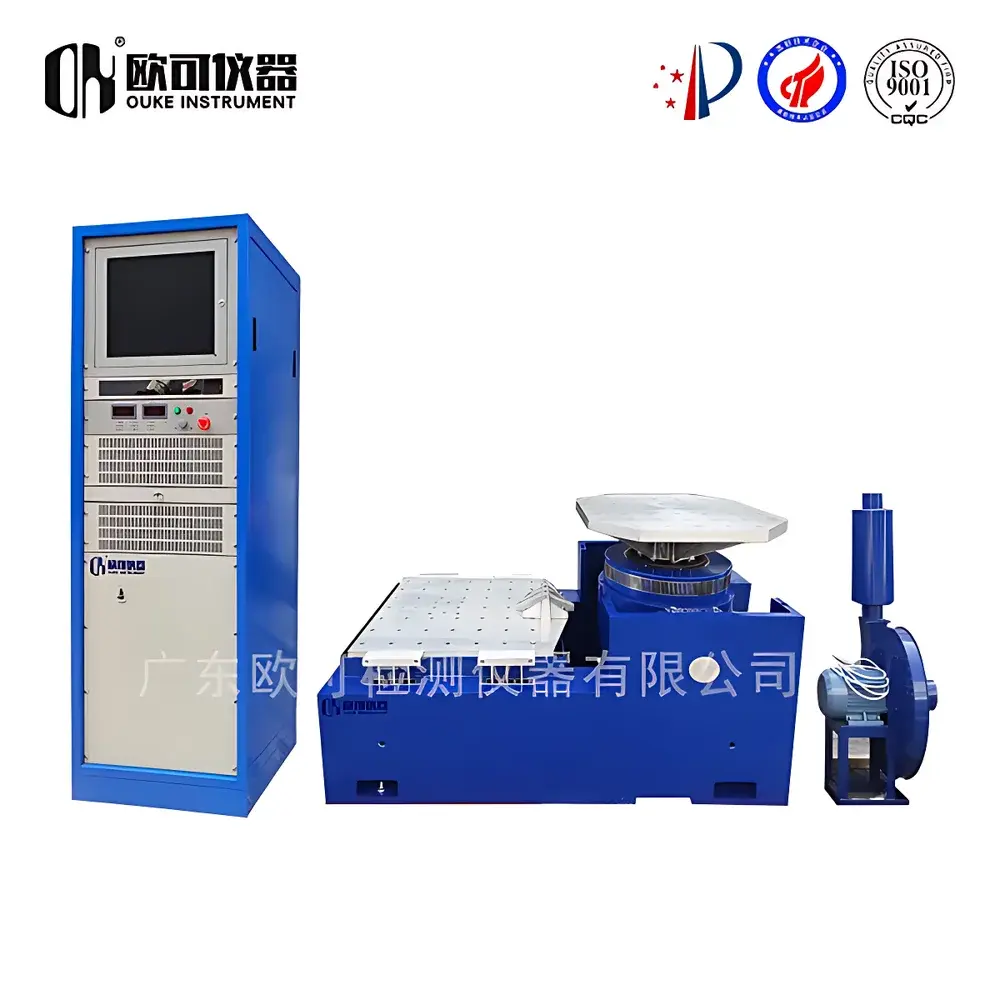
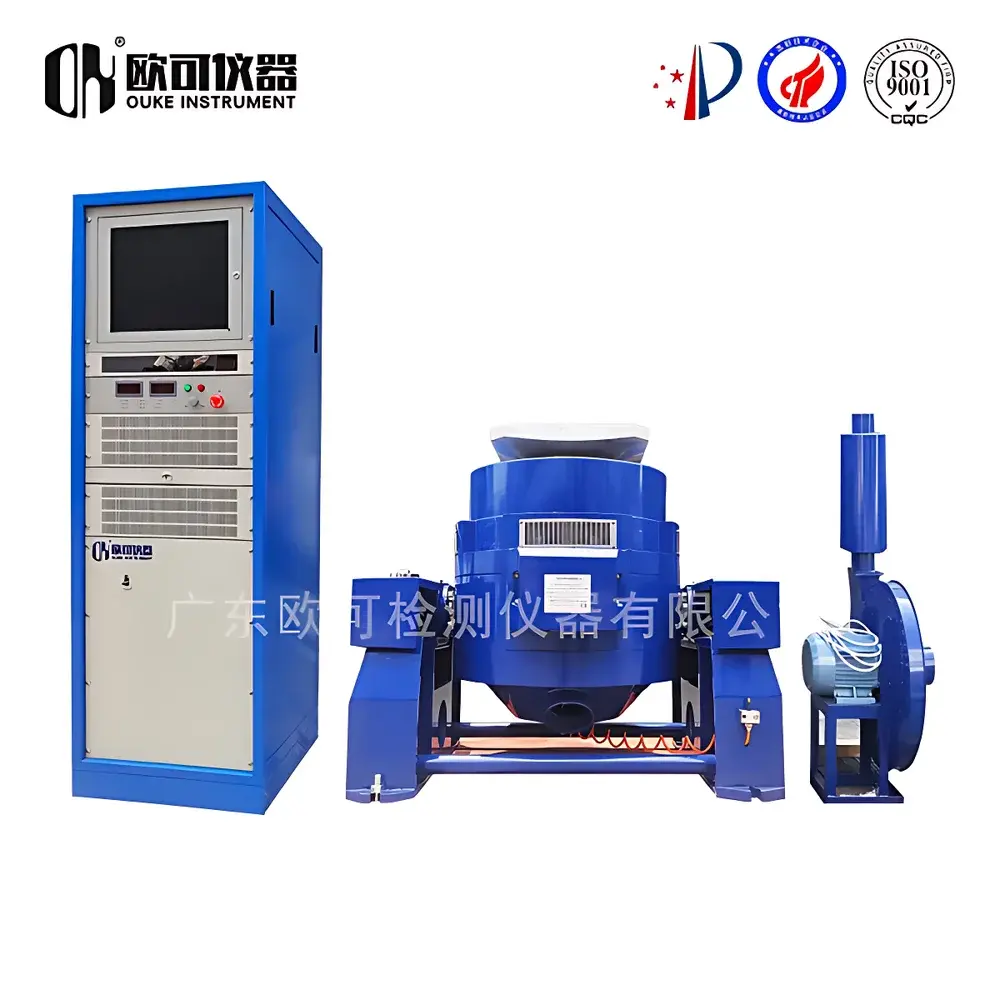
OK-ES-3 Triaxial Electromagnetic Vibration Shaker System
| Brand | OK Instruments |
|---|---|
| Origin | Guangdong, China |
| Manufacturer Type | OEM/ODM Manufacturer |
| Instrument Type | Electromagnetic Sinusoidal Vibration Shaker |
| Rated Thrust | 1.98 kN |
| Frequency Range | 5–5000 Hz |
| Maximum Test Load | 70 kg |
| Tabletop Dimensions | 300 × 300 × 30 mm (L×W×H) |
| Peak Acceleration | 10 g (unloaded) |
| Cooling Method | Forced Air Cooling |
| Control Mode | Closed-loop Sinusoidal Sweep & Fixed-Frequency Excitation |
| Compliance | Designed for ASTM D999, ISO 10326-1, IEC 60068-2-6, MIL-STD-810H (Vibration Sections), GB/T 2423.10 |
Overview
The OK-ES-3 Triaxial Electromagnetic Vibration Shaker System is a precision-engineered, digitally controlled electromagnetic shaker platform designed for high-fidelity sinusoidal vibration testing in research laboratories, quality assurance departments, and product development centers. Unlike broadband random or shock exciters, the OK-ES-3 operates on the principle of electromagnetic Lorentz-force actuation—where a precisely regulated sinusoidal current passes through a voice-coil armature suspended within a high-intensity permanent magnetic field. This generates a deterministic, repeatable harmonic force that drives the rigidly coupled 300 × 300 mm tabletop in controlled uniaxial or sequential triaxial motion (X/Y/Z axes via repositioning or optional horizontal slip table). Its core function is structural dynamic characterization: identifying natural frequencies, modal damping ratios, and resonant amplification factors through frequency-sweep excitation, while maintaining strict amplitude fidelity across its full 5–5000 Hz operational bandwidth. The system is not intended for environmental simulation per se; rather, it serves as an analytical instrument for modal analysis, resonance avoidance validation, and fatigue endurance assessment under controlled harmonic loading.
Key Features
- Electromagnetic drive architecture with high-efficiency neodymium magnet circuit and low-inductance moving coil—ensuring minimal phase lag and high linearity up to 5 kHz.
- Closed-loop acceleration control using integrated IEPE-compatible accelerometer feedback (sensor not included; compatible with industry-standard 100 mV/g or 10 mV/g units).
- Dual-mode excitation: Linear and logarithmic frequency sweep (0.1–10 oct/min), plus fixed-frequency dwell (duration programmable from 1 second to 999 hours).
- Rigid aluminum alloy tabletop (300 × 300 × 30 mm) with standardized 10-mm threaded mounting holes (M6 pattern, 50 mm pitch) for secure fixture integration.
- Integrated forced-air cooling system for continuous operation at rated thrust without thermal derating.
- Modular mechanical design supporting optional horizontal slip table (sold separately) for lateral-axis testing per ISO 10326-1 orientation requirements.
- Compliance-ready architecture: supports audit-trail logging, user-level access control, and calibration certificate traceability to national metrology institutes.
Sample Compatibility & Compliance
The OK-ES-3 accommodates test specimens up to 70 kg—including automotive ECUs, aerospace avionics enclosures, PCB assemblies, medical device housings, and industrial sensors—provided mass distribution remains within ±15% of tabletop center and moment of inertia limits are observed. Fixture design must ensure rigid coupling without resonant coupling artifacts below 500 Hz. The system meets functional requirements of key international standards: ASTM D999 (shipping vibration simulation), ISO 10326-1 (laboratory vibration testing of packaged products), IEC 60068-2-6 (sinusoidal vibration testing of electrotechnical devices), and MIL-STD-810H Method 514.8 (vibration response and endurance). While not certified for GLP/GMP production release, its deterministic output and repeatability support IQ/OQ documentation per FDA 21 CFR Part 11 when paired with validated controller software and calibrated transducers.
Software & Data Management
The OK-ES-3 integrates with OK-VCS v3.2 Vibration Control Software (Windows 10/11, 64-bit), a deterministic real-time control application compliant with IEEE 1003.1 POSIX standards. It supports dual-channel input (control + reference), real-time FFT-based spectrum monitoring, auto-spectrum normalization, and post-test coherence analysis. All test parameters—including sweep rate, dwell time, acceleration setpoint, and limit thresholds—are stored in encrypted XML project files with SHA-256 checksums. Audit logs record operator ID, timestamp, parameter changes, and hardware status (temperature, amplifier current, coil impedance) at 100 ms intervals. Export formats include CSV (time-history), UFF58 (universal file format), and PDF reports with embedded calibration certificates and pass/fail annotations aligned to ISO 10326-1 acceptance criteria.
Applications
- Resonance Survey & Modal Parameter Extraction: Identification of structural eigenfrequencies and mode shapes in aerospace subassemblies, turbine blades, and composite panels via swept-sine excitation with simultaneous multi-point response measurement.
- Design Verification Testing: Validation of mechanical robustness at known critical frequencies—e.g., verifying headlamp housing integrity at 28 Hz (engine idle RPM harmonic) or satellite payload bracket stiffness at 120 Hz (reaction wheel spin frequency).
- Manufacturing Process Screening: Detection of latent defects including solder joint cracks, loose fasteners, or trapped particulates through anomaly detection in acceleration transmissibility curves during low-amplitude, high-frequency sweeps (1–5 kHz).
- Transport Simulation: Replication of dominant spectral components from road, rail, or marine transport environments using discrete-tone synthesis—particularly effective for evaluating packaging integrity per ISTA 3A protocols.
- Academic Dynamics Research: Teaching and experimental investigation of single/multi-degree-of-freedom systems, damping estimation techniques (half-power bandwidth), and active vibration cancellation algorithm development.
FAQ
What distinguishes the OK-ES-3 from random vibration shakers?
The OK-ES-3 is optimized for deterministic, single-frequency harmonic excitation—ideal for resonance identification and fatigue life assessment at specific frequencies. Random shakers distribute energy continuously across a broad band; they simulate real-world environments but lack the diagnostic resolution required for modal analysis.
Can the OK-ES-3 perform simultaneous three-axis vibration?
No. It is a uniaxial shaker by default. Triaxial testing requires sequential reorientation (vertical → horizontal X → horizontal Y) using the optional slip table and manual fixture re-mounting. True simultaneous triaxial capability necessitates a dedicated MIMO shaker system.
Is water cooling available as an upgrade?
Not standard. The forced-air cooling system is rated for continuous 100% thrust operation at ambient temperatures ≤35°C. For extended high-load testing above 40°C ambient, custom liquid-cooled variants (OK-ES-3-LC) can be commissioned under OEM agreement.
Does the system include calibration certification?
Yes—each unit ships with NIST-traceable factory calibration data for thrust output, acceleration linearity, and frequency response (5–5000 Hz), valid for 12 months. Field recalibration services are available through OK Instruments’ accredited metrology lab.
What safety interlocks are implemented?
Hardware-enforced over-acceleration cutoff (12 g limit), thermal shutdown (<85°C coil temperature), amplifier current limiting, and emergency stop circuitry compliant with IEC 60204-1. All interlocks generate non-resettable fault logs in the controller software.



